
The story of Aegina Synagogue
Aegina, an island in the Saronic Gulf about an hour by ferry from Piraeus, had a Greek-speaking Jewish community in late Roman times. Its synagogue stood east of the ancient 'hidden harbour' (Kryptos Limen), in an important quarter of the ancient town below the hill of Kolona. Its mosaic floor is dated to about 300-350 CE on the style of its geometric patterns. Two Greek inscriptions set in the floor near the western entrance record that Theodoros, head of the synagogue (archisynagogos) for four years, built it from its foundations with community revenues and members' gifts, and that the mosaic was completed under his son of the same name.
The building was a hall about 13.5 by 7.6 metres with an entrance and antechamber on the west and a raised apse on the east, facing Jerusalem, for the Torah shrine. It was used, according to the island's present-day Jewish heritage campaigners, until about the seventh century, when the community moved inland to Paleochora. Christian graves were later dug into its foundation walls. The German archaeologist Ludwig Ross found the floor in 1829; Eleazar Lipa Sukenik studied it in 1928, and Belle Mazur, working with Franz Gabriel Welter, uncovered the apse in 1932. In the 1960s the mosaic was taken up and relaid at Kolona so that a hotel could be built on the site.
Where it stood for roughly 250 to 400 years
Historic: east of the Kryptos Limen (ancient hidden harbour), Aegina town; exact plot not documented. Today: original site said to be under the Aura hotel (Afroditis 2, Aegina, approximate); the relaid mosaic lies at the Kolona archaeological site, Nikou Kazantzaki, 180 10 Aegina.
Open larger map →The Jewish community
Almost nothing is known of the Aegina community apart from the synagogue itself. The 2019 conservation campaign and the material published with it describe the Jews of Aegina as Romaniotes, Greek-speaking Jews long settled in Greece, who probably arrived as refugees from the barbarian invasions and pirate raids of the late second and third centuries CE. The same sources say the community earned its living by dyeing textiles, including purple-dyeing, and by tanning, and that it was prosperous enough to pay for a high-quality mosaic floor. Those claims about trades are not supported by any ancient text read in this run and should be treated as the campaigners' interpretation. The two inscriptions show a community organised around a synagogue treasury, with an elected or appointed head, the archisynagogos, holding office for a fixed term, and with members contributing money for the building. Levine's translation, summarised by the Posen Library, gives the sums as 85 gold pieces from contributed revenues and 105 gold pieces from the synagogue's own funds.
Architecture and design
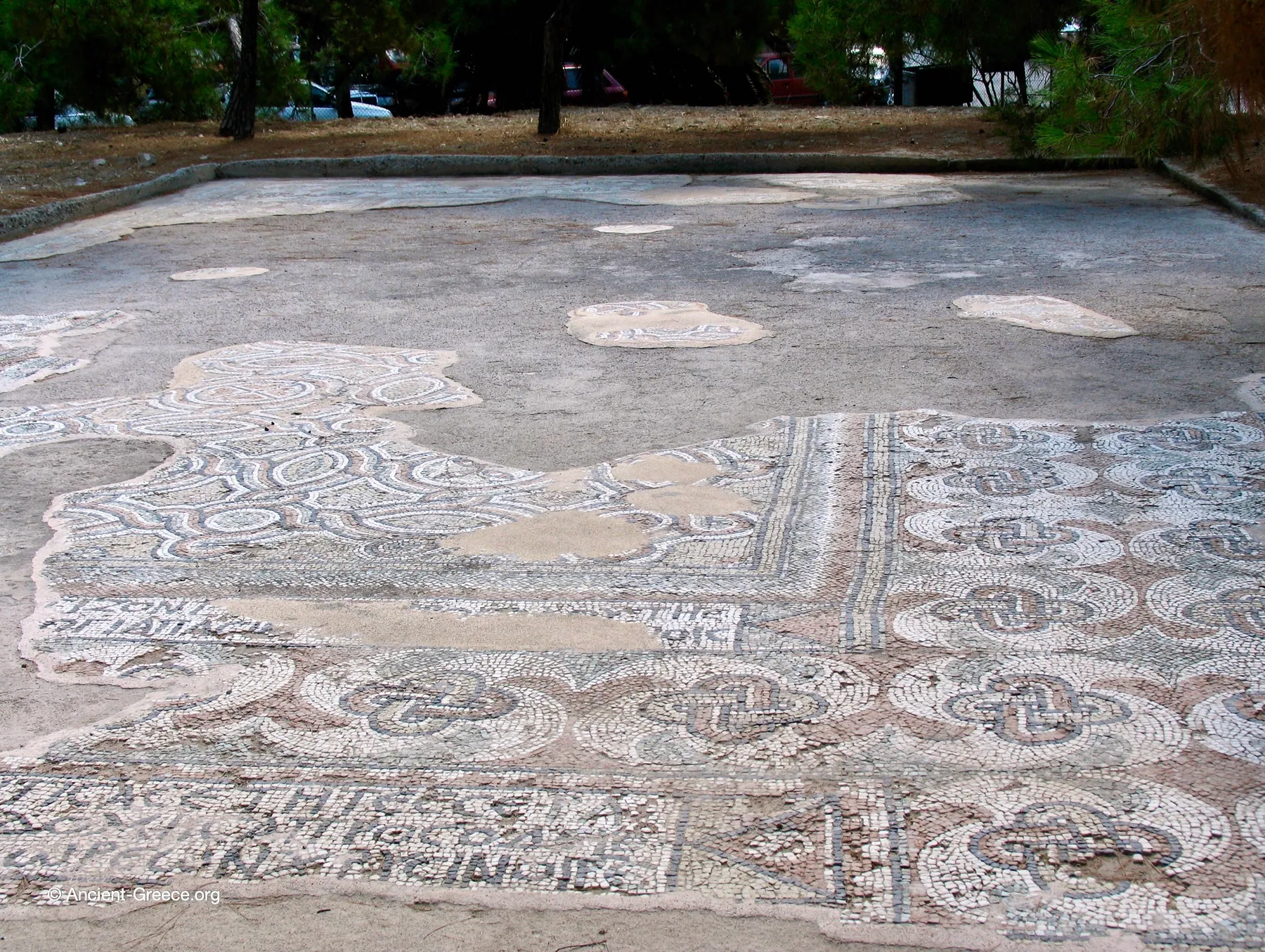
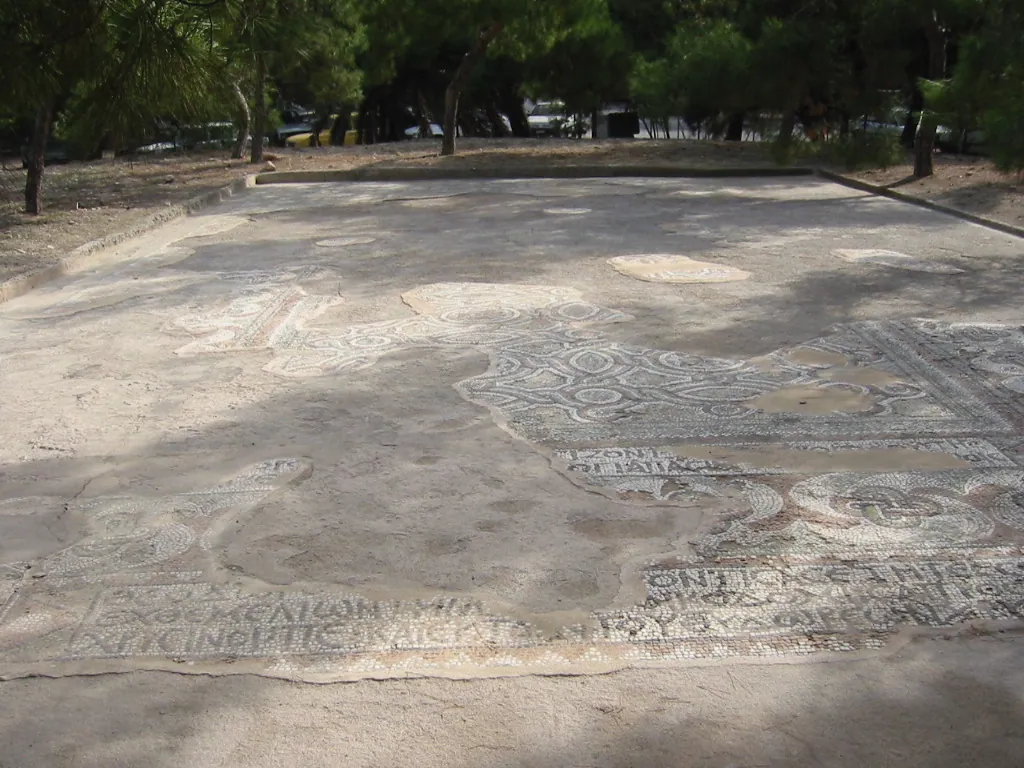
The excavated building was a single rectangular hall measuring about 13.5 by 7.6 metres internally, the dimensions Rachel Hachlili gives for the mosaic. The entrance and an antechamber lay on the west side. On the east, facing Jerusalem, a raised apse held the Torah shrine; a reading desk stood between the apse and the main hall. The apse was not found by Ross in 1829 but was uncovered by Belle Mazur and Franz Gabriel Welter in 1932. The whole floor was covered with a polychrome mosaic of geometric panels, with four-petalled rosettes, interlaced circles and flowers and a climbing ivy border, typical of fourth-century floors in the Greek world. Photographs of the relaid floor show large areas of loss, filled with plain mortar, around surviving panels of interlaced circles and a long band of quatrefoil knots. The two Greek inscriptions are set in panels near the western entrance. Nothing is recorded about the walls, roof, windows or seating, and the architect and builders are unknown.
Life inside the synagogue
No literary source describes worship in this synagogue, so its inner life can only be read from the floor. The inscriptions call the building a synagogue and use the same word for the congregation that met in it, a usage Hachlili notes. They name Theodoros as archisynagogos, the officer who managed the building and the services, and record that he held the post for four years while the hall was built; his son Theodoros the younger then held office when the mosaic was laid. Funds came both from members' offerings and from the synagogue treasury. The inscription closes, in Levine's translation as summarised by the Posen Library, with a blessing on all who enter, and Hachlili reads the word used for blessing (eulogia) as a sign of Greek influence. The apse on the east wall held the Torah scrolls, and tradition cited by the campaigners has the elders seated there during services. A reading platform stood in front of it. Nothing is known about the rabbis, readers or liturgy.
Destruction
The synagogue was not destroyed in any recorded act of violence. The sources read say only that it went out of use, around the seventh century CE according to the 2019 campaign, when the island's population, Jews included, withdrew from the exposed harbour town to Paleochora inland to escape pirate raids. The ancient-greece.org description of the site adds that Christian graves were cut into the foundation walls, which shows that the building was already abandoned and its site reused as a burial ground. No source read names anyone who demolished it, and when its walls fell or were taken down is unknown. What survived was the mosaic floor, which Ludwig Ross found almost intact in 1829. It was then covered and re-excavated several times. In the 1960s, during the rebuilding of the town, the mosaic was lifted and relaid at the Kolona archaeological site because a hotel, named in the Central Board of Jewish Communities' press release as the Aura, was to be built on the original plot. By 2019 the relaid floor had eroded and lost many tesserae.
The community’s fate
The Jewish presence on Aegina did not end with the abandonment of the harbour synagogue. According to the 2019 campaign, the community moved with the rest of the population to Paleochora in the seventh century and probably built a second synagogue there; its site is unknown, and an inscription from it, once recorded at Paleochora, has since been lost. How long Jews lived at Paleochora, and when the community disappeared from the island, is not recorded in any source read in this run. No continuous Jewish community connects the ancient congregation with the present day. The Romaniote Jews of Greece as a whole, of whom the Aegina congregation is counted an early example, were, as the Times of Israel report on the mosaic recalls, nearly wiped out during the Second World War in the Nazi Holocaust. Today the mosaic is cared for by the Ephorate of Antiquities of Piraeus and the Islands, and the Central Board of Jewish Communities of Greece and the Athens rabbinate took part in the 2019 conservation launch.
The site today
Nothing of the building stands. The original plot, east of the ancient harbour near the Kolona promontory, was built over in the 1960s by a hotel that the Central Board of Jewish Communities of Greece names as the Aura. The mosaic floor itself survives but was moved: it lies in the open on the grounds of the Kolona archaeological site, beside the Archaeological Museum of Aegina, under pine trees. In 2019 it was badly eroded, with loose tesserae and damage from rain, sea air and pine resin. That year the NGO ECOWEEK and the Ephorate of Antiquities of Piraeus and the Islands launched a conservation programme, with an exhibition at the museum and plans for a protective shelter, signage and lighting. A 2025 article by the architect Elias Messinas still locates the mosaic at the Archaeological Museum of Aegina; whether the shelter has been built was not confirmed.
Notable names
Theodoros (the elder)
4th century CEArchisynagogos (head of the synagogue) for four years; builder of the synagogueTheodoros is named in the first of the two Greek mosaic inscriptions as archisynagogos, head of the synagogue, for four years, during which he built the synagogue from its foundations. The building was financed from contributed revenues and from the synagogue treasury, with sums of 85 and 105 gold pieces given in Levine's translation. He is known only from this inscription; his son of the same name completed the work.
Biography or source →Theodoros the younger
4th century CEArchisynagogos; son of Theodoros, under whom the mosaic floor was laidThe second inscription states that the mosaic work was carried out, and paid for from the synagogue's revenues, under Theodoros the younger, son of the builder Theodoros, who held the same office of archisynagogos. The ancient-greece.org site description reads the inscription the same way, as recording completion and the laying of the mosaic under the namesake son. Nothing else is known about him.
Biography or source →Do you have something to contribute?
Photographs, documents, family stories or memories of this synagogue and its community help keep its history alive.
- Το ψηφιδωτό της Συναγωγής της Αίγινας (announcement, July 2019)
- Press release on the opening of the Aegina synagogue mosaic exhibition (August 2019)
- Kolona Archaeological Site - 14 (synagogue mosaic)
- Greek Inscriptions from Aegina, Greece
- Race to preserve rare mosaic of ancient Greek synagogue
- Campaigners bid to save rare 1,700-year-old Greek island synagogue mosaic (Amanda Borschel-Dan, Times of Israel, reproduced)
- Ancient synagogue mosaic floor in need of conservation
- File:Mosaic Floor of a Jewish Synagogue in Greece - 300 CE.JPG
- Preservation of Synagogues in Greece: Using Digital Tools to Represent Lost Heritage
- Αύρα hotel, Afroditis 2, Aegina (OpenStreetMap node 2869331844)
- Αρχαιολογικός χώρος Κολώνας (OpenStreetMap way 378823406)
Share a memory or thought
No comments yet. Be the first to add one.