
The story of Apamea Synagogue
Apamea, on the middle Orontes in western Syria, was one of the great cities of Roman Syria. Its Jewish synagogue was found in 1934, during the fourth season of the Belgian archaeological mission led by Fernand Mayence, beneath a later church known as the Atrium Church. It stood off the colonnaded main street, the Cardo, on a side street running down from the theatre.
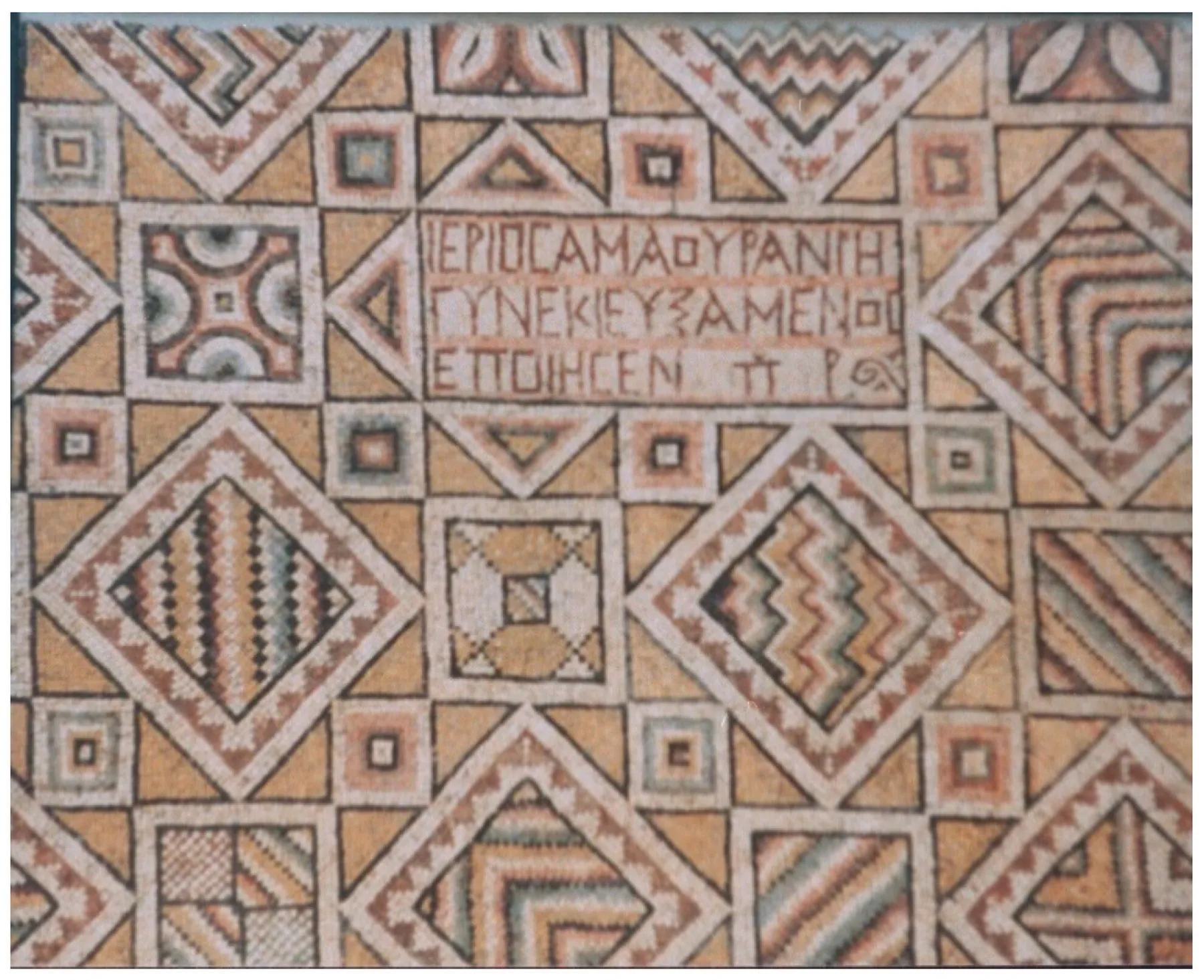
The building is known almost entirely from its floor. The prayer hall ran north to south, with a square niche for the Torah shrine in the southern wall facing Jerusalem. Its mosaic pavement, about 120 square metres of geometric carpets, contains twenty Greek dedicatory inscriptions naming thirteen women and seven men. Two inscriptions date the work to the Seleucid year 703, which editors equate with 392 CE; one gives the day as 9 Dystros, that is 9 March 392.
The synagogue did not last long. Scholars date the first phase of the Atrium Church above it to about 415-420 CE, so the synagogue was in use for perhaps twenty to thirty years. The floor survived because the church builders covered it rather than tearing it up. Many excavation records were lost when fires struck the Brussels museum in 1944 and 1946. Panels of the floor are now in Brussels and Damascus.
Where it stood for roughly 25 to 30 years
Historic: lower city of Apamea on the Orontes, off the Cardo on the street descending from the theatre, beneath the Atrium Church. Today: archaeological site of Apamea near Qal'at al-Mudiq, Hama governorate, Syria (approximate, pin at the Atrium Church).
Open larger map →The Jewish community
Little is known of the Jews of Apamea beyond what the synagogue floor records. The inscriptions name the officers in office when the pavement was laid in 392 CE: the archisynagogoi Eusebius, Nemias (Nehemiah) and Phineas, the gerusiarch Theodorus, and elders including Isaac (Eisakios) and Saul (Saoulos). A second inscription names Nemias as hazzan and deacon. The congregation had ties to Antioch: Ilasios, archisynagogos of the Antiochenes, paid for the mosaic of the entrance. Another donor, Euthalis, is called scholastikos, a man trained in law. Of the twenty donors named in the floor, thirteen were women, who together paid for about half of the design At least one donor gave together with a spouse and children in fulfilment of a vow. The size of the community, its origins and its later history after the synagogue went out of use are unknown from the sources read.
Architecture and design
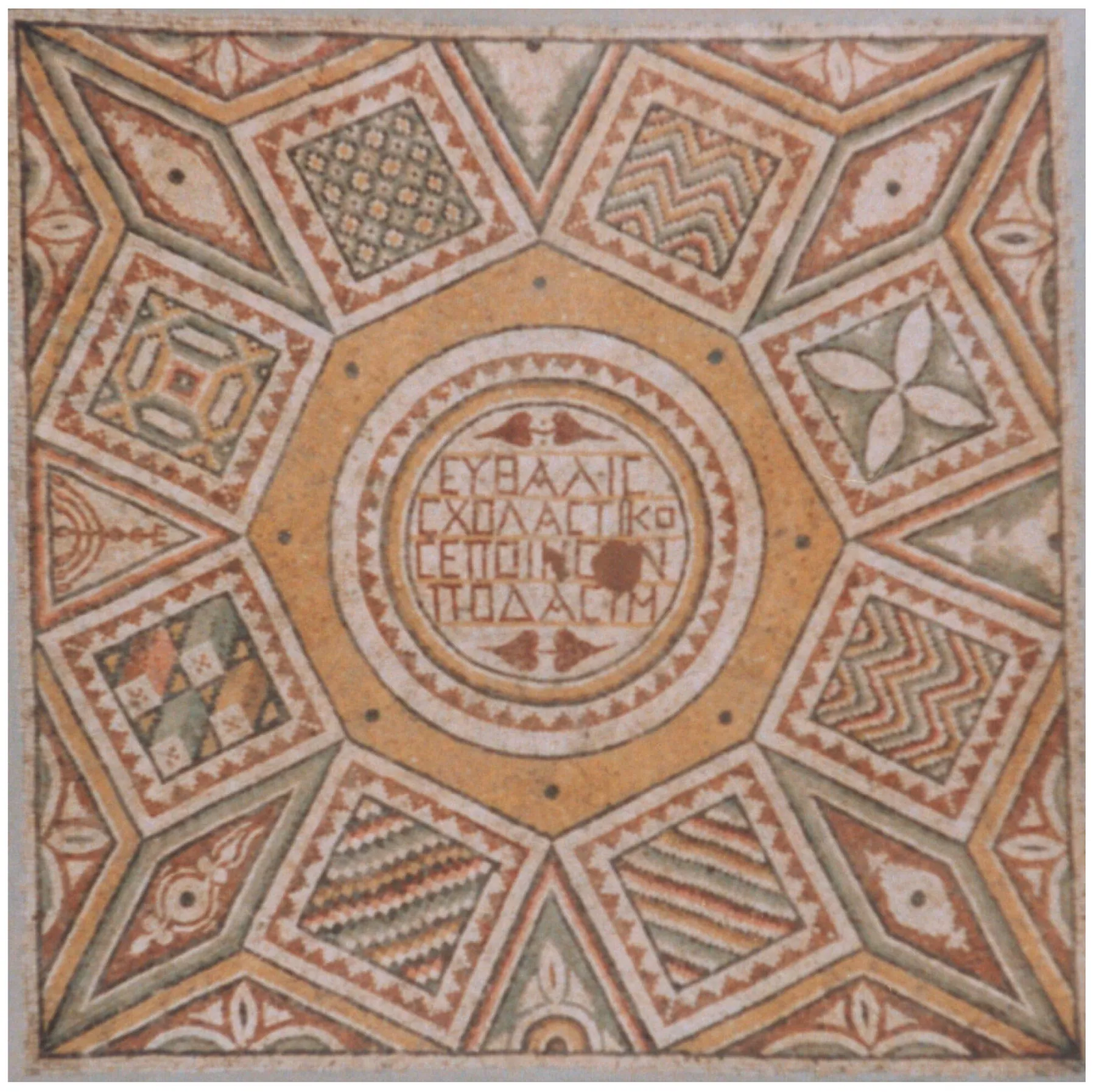
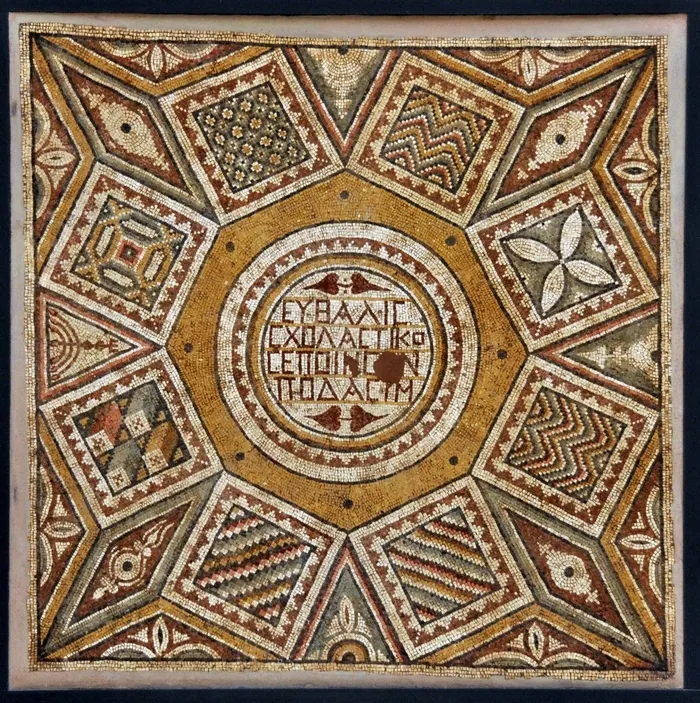
Only the plan and floor of the building were recovered, and the walls and elevation are unknown. The prayer hall was laid out on a north-south axis, with a square niche in the southern, Jerusalem-facing wall that held the Torah shrine; the niche is still visible in the excavated floor. The plan was published by Eleazar Sukenik shortly before the Brussels museum fires, and later study relies on it. The mosaic pavement covers about 120 square metres. It is arranged as a central carpet with two panels inside a decorative frame, with eight smaller carpets around it to the north and west. Each carpet has its own geometric design, several with a three-dimensional effect typical of Syrian mosaic work of the time; one pattern also appears on contemporary floors at Antioch. The southwestern carpet has a central medallion with the inscription of Euthalis, set in an octagon resting on eight outward-facing squares; between two of these squares is a small menorah, the only Jewish symbol in the floor. There are no human or animal figures. Dimensions of the hall and its capacity are unknown.
Life inside the synagogue
The floor itself is the main record of life in the building. Its twenty Greek inscriptions read like a register of the congregation: each donor is named with the length of pavement paid for, measured in feet, and at least one gift was made with a spouse and children in fulfilment of a vow. Euthalis the scholastikos paid for 140 feet, and Ilasios of Antioch for the 150 feet of the entrance. One inscription records that in the time of Nemias, hazzan and deacon, the entrance of the holy place was paved. The titles in the inscriptions, archisynagogos, gerusiarch, elder and hazzan, show an organised congregation with a council of elders and several officers. The Torah shrine stood in the niche of the southern wall, facing Jerusalem. The inscriptions end with formulas such as 'a blessing to all'. Nothing in the sources read describes the liturgy, the furniture or the rabbis of the congregation, and no Hebrew text is recorded apart from the menorah symbol.
Destruction
The synagogue stopped being used within about a generation of its floor being laid in 392 CE. Jean-Charles Balty dated the first phase of the Atrium Church, built directly over it, to about 415-420 CE, and the synagogue had been abandoned by then. The church, later associated with Saints Cosmas and Damian, covered the synagogue floor with a new pavement, which preserved the mosaics. Why the Jews of Apamea lost their building is unknown. The excavators found no sign of fire or earthquake damage, and no evidence that the mosaics were lifted or reused. Writers have linked the change to the anti-Jewish measures and attacks on synagogues in the Roman East in this period, including events at Antioch, and have suggested that building the church on the site was a deliberate act, but no source read documents a confiscation or an attack at Apamea itself. The cause is therefore given here as the replacement of the synagogue by a church, with the circumstances unknown.
The community’s fate
What happened to the Jewish community of Apamea after its synagogue was replaced by the Atrium Church is unknown from the sources consulted. The loss of the building in about 415-420 CE need not mean that Jews left the city, but no later synagogue at Apamea has been identified and no later Jewish inscriptions from the city were found in this research. The later history of Jewish settlement in the region, through the Persian and Arab conquests of the seventh century and the decline of Apamea, was not covered by the sources read, and should be checked in specialist works on the Jews of Byzantine Syria. The names in the 392 floor, Eusebius, Nemias, Phineas, Theodorus, Isaac, Saul, Ilasios, Euthalis and others, are the only individual members of the community known.
The site today
The site lies in the lower city of ancient Apamea, near the village of Qal'at al-Mudiq in Hama governorate, below the remains of the Atrium Church off the Cardo. Only the excavated floor level survived, and no walls of the synagogue stand. Parts of the mosaic pavement were lifted after the excavations of the 1930s and are now in the Royal Museums of Art and History in Brussels, where the Euthalis panel is displayed, and in the National Museum of Damascus. A report of 2014 described the colonnaded lower city as heavily looted during the Syrian civil war, with thousands of illegal pits; the present condition of the synagogue area itself was not documented in the sources read. Apamea is on UNESCO's Tentative List.
Notable names
Ilasios
fl. 392 CEArchisynagogos of the Jews of Antioch; donor of the entrance mosaicIlasios is named in a dedicatory inscription of the Apamea synagogue floor as archisynagogos, head of the synagogue, of the Antiochenes. He paid for the mosaic of the entrance, 150 feet of pavement, when the floor was laid in 392 CE. His gift shows close ties between the Jewish communities of Antioch and Apamea. Nothing else about him is known from the sources read; as a person known only from an inscription he has no portrait.
Biography or source →Nemias (Nehemiah)
fl. 392 CEArchisynagogos, hazzan and deacon of the Apamea synagogueNemias appears twice in the floor inscriptions. One names him with Eusebius and Phineas among the archisynagogoi in office when the mosaic was laid; another dated 9 March 392 CE says the entrance of the holy place was paved in the time of Nemias, the hazzan who was also deacon. He was therefore one of the officers responsible for the building when its floor was made. No other record of him was found.
Biography or source →Euthalis
fl. 392 CEDonor; scholastikos (man learned in law)Euthalis paid for 140 feet of the synagogue's mosaic floor in 392 CE. His inscription, in a medallion at the centre of the southwestern carpet beside the small menorah, calls him scholastikos, meaning a man trained in law. This panel was lifted after the excavations and is now displayed in the Royal Museums of Art and History in Brussels. Nothing more is known about him.
Biography or source →Do you have something to contribute?
Photographs, documents, family stories or memories of this synagogue and its community help keep its history alive.
- Art and Identity in Late Antique Synagogues of the Roman-Byzantine Diaspora (Arts 8/4, 164, 2019)
- Ghosts of Apamea
- Greek Inscriptions from Apamea, Syria
- Greek Inscription on Mosaic from Apamea, Syria
- Apamea, Synagogue, Mosaic, donated by Euthalis
- Mosaics (Material Religion teaching resource)
- Apamea, Atrium Church (vici.org place 23962)
- Afamia, Cardo maxima (OpenStreetMap way 216267055)
Share a memory or thought
No comments yet. Be the first to add one.