
הסיפור של Medieval Synagogue of Augsburg
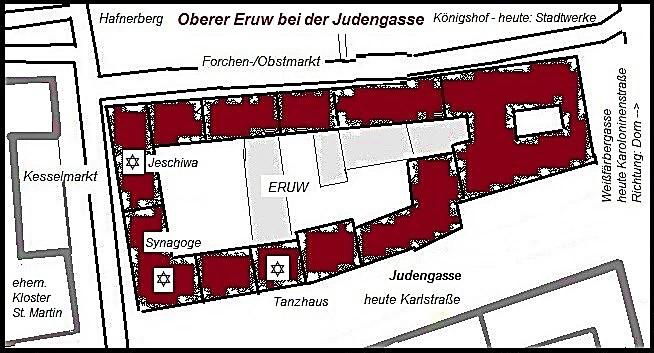
Augsburg had one of the important Jewish communities of southern Germany in the Middle Ages. Jews are documented in the city from the first half of the thirteenth century, and the synagogue is first named in the Augsburg city law of 1276, together with the cemetery; it probably existed earlier. It stood in the upper Jewish quarter along the Judengasse, today's Karlstraße, in a block of houses joined by shared courtyards that also held a yeshiva and a dance house built in 1290. A second, smaller quarter grew up at the Judenberg in the fourteenth century.
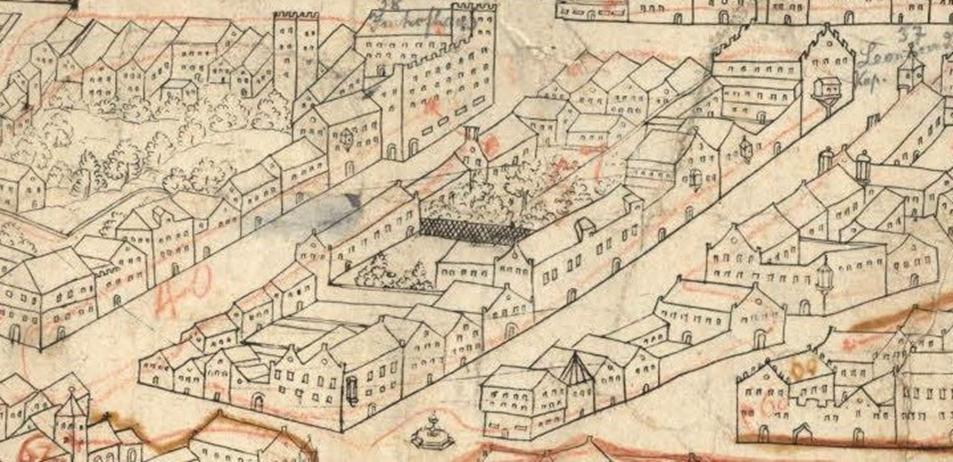
In 1298 fifteen representatives of the community pledged the synagogue and the community's other property as security for their promise to build a section of the city wall, later called the Judenwall. The community survived the massacre of November 1348 and was readmitted in the 1350s. On 8 July 1438 the city council decided that all Jews had to leave the imperial city within two years. By 1440 the last had gone; the council seized the synagogue, the dance house, the ritual bath and the cemetery. The synagogue and dance house were converted into houses, and gravestones from the cemetery went into public buildings, including the town hall. Jørg Seld's city plan of 1521 still shows the building.
Where it stood for 164 years
Historic: Judengasse, upper Jewish quarter, Augsburg (south side of the block between Judengasse and Forchenmarkt/Obstmarkt). Today: west end of Karlstraße, 86150 Augsburg, near the Kesselmarkt (approximate); an alternative identification places it at Karlstraße 21.
פתיחת מפה גדולה ←הקהילה היהודית
A Jewish community is documented in Augsburg from the first half of the thirteenth century, and the Jewish Encyclopedia notes a Jewish house mortgaged by Bishop Hartmann in 1259. In 1266 Konradin placed the Jews under the protection of the citizens, and the city law of about 1276 regulated their lending, butchery and bathing. The community used its own seal, which survives from 1298 and shows a double-headed eagle with a Latin and Hebrew inscription. It lent heavily to the city and to neighbouring rulers: Munich pledged its revenues to Augsburg Jews in 1316, and the community paid 22,000 gulden to the council in 1384. Kings and emperors repeatedly taxed or pledged it, and in 1429 King Sigismund pledged the Augsburg Jews to the Count of Pappenheim. Its cemetery north-west of the city served five Swabian communities. In 1434 the Jews were ordered to wear a yellow ring on their clothes. At the time of the expulsion decision in 1438 the community numbered about 150 people according to the Bavarian House of History; the Jewish Encyclopedia speaks of 300 expelled in 1440.
אדריכלות ועיצוב
No building record, plan or excavation of the synagogue is known. The only view is Jørg Seld's bird's-eye plan of Augsburg of 1521, drawn about eighty years after the expulsion, when the building already served as housing. Yehuda Shenef identifies on it, at the front left of the block between the Judengasse and the Obst- or Forchenmarkt and beside a public well, the large double building of the synagogue with a bay window (Erker) projecting towards the street. The plan shows a broad two-part house with gabled roofs, of a height similar to its neighbours. Whether the bay window and the double form belong to the medieval synagogue or to its conversion into dwellings after 1440 is unknown. The architect, building date, materials, interior arrangement and seating capacity are all unknown, and no fragment of the building is known to survive. A separate dance house for weddings stood beside it from 1290.
החיים בבית הכנסת
Almost nothing is recorded about worship in the building itself. The synagogue was the centre of a closed courtyard settlement which Shenef describes as an eruv, where houses were joined by shared inner courtyards so that objects could be carried between them on the Sabbath. Next to it stood the yeshiva and a dance house used for weddings and communal meals, and the quarter had its own bakery and tavern; the ritual bath lay about 350 metres away near the old hospital, where the council allowed a new bathhouse in 1290. Augsburg was a centre of learning. The Encyclopaedia Judaica notes that its yeshiva contributed to the development of pilpul, with a local method known as the Augsburg hillukim. The talmudist Jacob Weil lived in the city from 1412 to 1438, and the Jewish Encyclopedia records an aged scholar called Senior who was killed over his books in 1348. Names of medieval rabbis such as Baruch, Kalonimos Kohen and Abraham bar Pinchas survive from gravestones and tax records.
הרס
The community was attacked in November 1348. According to the Bavarian House of History, the ministerial Heinrich Portner stirred up hatred, and on 22 November 1348 about 130 Jews were murdered, probably with the help of the city council; survivors lost their property and the empty houses were confiscated and sold. Shenef links the violence to an uprising led by the Portner family. The sources do not say whether the synagogue was damaged then. The end of the building as a synagogue came through expulsion, not violence. After years of pressure from the clergy, the Augsburg city council decided on 8 July 1438 that all Jews must leave the imperial city within two years, and they had to sell their property below its value. Tax books list no Jews from 1439, and by 1440 the last had left. The council seized the synagogue, the dance house, the ritual bath and the cemetery. The synagogue and dance house were converted into residential houses, according to the Bavarian House of History from 1448. The cemetery was closed and its gravestones reused in public buildings.
גורל הקהילה
After the expulsion no Jews were allowed to live in Augsburg. In 1456 the city paid Emperor Frederick III and secured the right to admit or exclude Jews, and from then on Jews could enter only by day for business, though they were given refuge in wartime. The expelled first moved to other large cities of the empire that still granted protection. Two children's gravestones from the 1440s found at the Peutinger house suggest that some Jews still buried their dead at Augsburg for a few years. Some settled in villages around the city: communities are documented at Oberhausen from 1553, Kriegshaber from 1560, Pfersee from 1569 and Steppach from 1584.
האתר כיום
The Judengasse is today's Karlstraße in Augsburg's old town. The sources disagree on the exact plot. The Bavarian House of History suggests the synagogue stood by the former St Leonhard chapel, given as Karlstraße 21, near the corner of Karolinenstraße. Shenef's reading of the Seld plan places it at the west end of the block, near the well, the Kesselmarkt and the former St Martin's convent, and puts the Leonhard chapel opposite the later Imhof palace. Which building now stands on the plot, and whether anything of the medieval structure survives, is unknown; no archaeological investigation of the site was found. Medieval gravestones from the cemetery are kept in the Maximilianmuseum and in the courtyard of the Peutinger house.
שמות בולטים
Jacob Weil
active in Augsburg 1412-1438Talmudist and rabbi in Augsburg, 1412-1438The Encyclopaedia Judaica records that the talmudist Jacob Weil lived in Augsburg from 1412 to 1438, the community's last decades before the expulsion, and the Jewish Encyclopedia calls him one of the most distinguished German rabbis of the fifteenth century. His stay ended in the year the city council resolved to expel the Jews. His years in Augsburg coincide with the period when its yeshiva, beside the synagogue, was known for its own method of talmudic argument.
ביוגרפיה או מקור ←Senior
died 1348Scholar of the Augsburg communityThe Jewish Encyclopedia records that during the massacre of 1348 an eighty-four-year-old sage named Senior was killed in Augsburg while poring over his books. Nothing more is known of him, but he is the only named victim of the 1348 violence against the community whose synagogue stood in the Judengasse.
ביוגרפיה או מקור ←Abraham bar Pinchas
died 1405Rabbi in AugsburgYehuda Shenef names Rabbi Abraham bar Pinchas, who died in 1405, and his son Lazarus (Eleasar) among the Augsburg Jews recorded in the city's tax books. He was thus a rabbi of the community in the period between its readmission after 1348 and the expulsion, when the synagogue in the Judengasse was its place of worship.
ביוגרפיה או מקור ←יש לכם משהו לתרום?
תמונות, מסמכים, סיפורי משפחה וזיכרונות מבית הכנסת ומהקהילה שלו עוזרים לשמור על ההיסטוריה שלו בחיים.
Share a memory or thought
No comments yet. Be the first to add one.