
La storia di Avenches Synagogue
Avenches, the Roman Aventicum and in German Wiflisburg, is a small town in the Broye valley of canton Vaud. From 1826 Jewish horse dealers from Alsace settled there, and by about 1870 the community numbered some 260 people, around 14 per cent of the town. After worshipping first in a private house and then in a rented room, the community tried from about 1850 to build a synagogue. In February 1863 it signed the purchase contract for a dwelling house just outside the town walls, beside one of the medieval rampart towers, and had it rebuilt as a synagogue to plans approved by the town council in November 1864. The building was consecrated on 4 August 1865 by Rabbi Moïse Nordmann and the Geneva rabbi Joseph Wertheimer, in the presence of many local notables. The Historical Dictionary of Switzerland counts it among the first synagogues built in Switzerland after emancipation, alongside Geneva, Basel and Porrentruy. Besides the prayer hall it housed a ritual bath in the basement and the teacher's flat on the ground floor. From the 1870s the families moved away to Bern, Lausanne and other towns, services ceased in the 1930s, and the empty building was pulled down at the end of 1957. A stone placed in 1979 marks the site on the Chemin des Terreaux.
Where it stood for 92 years
Historic: Derrières les Terreaux, outside the town walls of Avenches, Vaud. Today: open parking area on the Chemin des Terreaux, 1580 Avenches, below the ramparts (approximate; exact plot not identified).
Apri la mappa grande →La comunità ebraica
Jews were barred from settling in most of Switzerland until the nineteenth century, and the community at Avenches was a new rural foundation. Its first members arrived in 1826; they were horse dealers, and the region's economy, built on horse breeding and farming, made them useful to it. Almost all came from Jewish communities in Alsace. A correspondent of the Allgemeine Zeitung des Judentums wrote in January 1847 that Avenches had about 27 families and that, though the town offered little news, the patriarchal hospitality of these Jews 'of Alsatian grain' deserved mention. The HLS article on Avenches records that most were horse dealers who lived in some comfort. Numbers peaked around 1870 at about 260, some 14 per cent of the population; the memorial stone speaks of up to 250 members. From the 1870s worsening conditions in the countryside drove families to Bern, Lausanne and larger towns. The Jüdisches Jahrbuch der Schweiz counted 74 Jews in Avenches in 1917, and by 1950 only two Jewish families remained.
Architettura e design
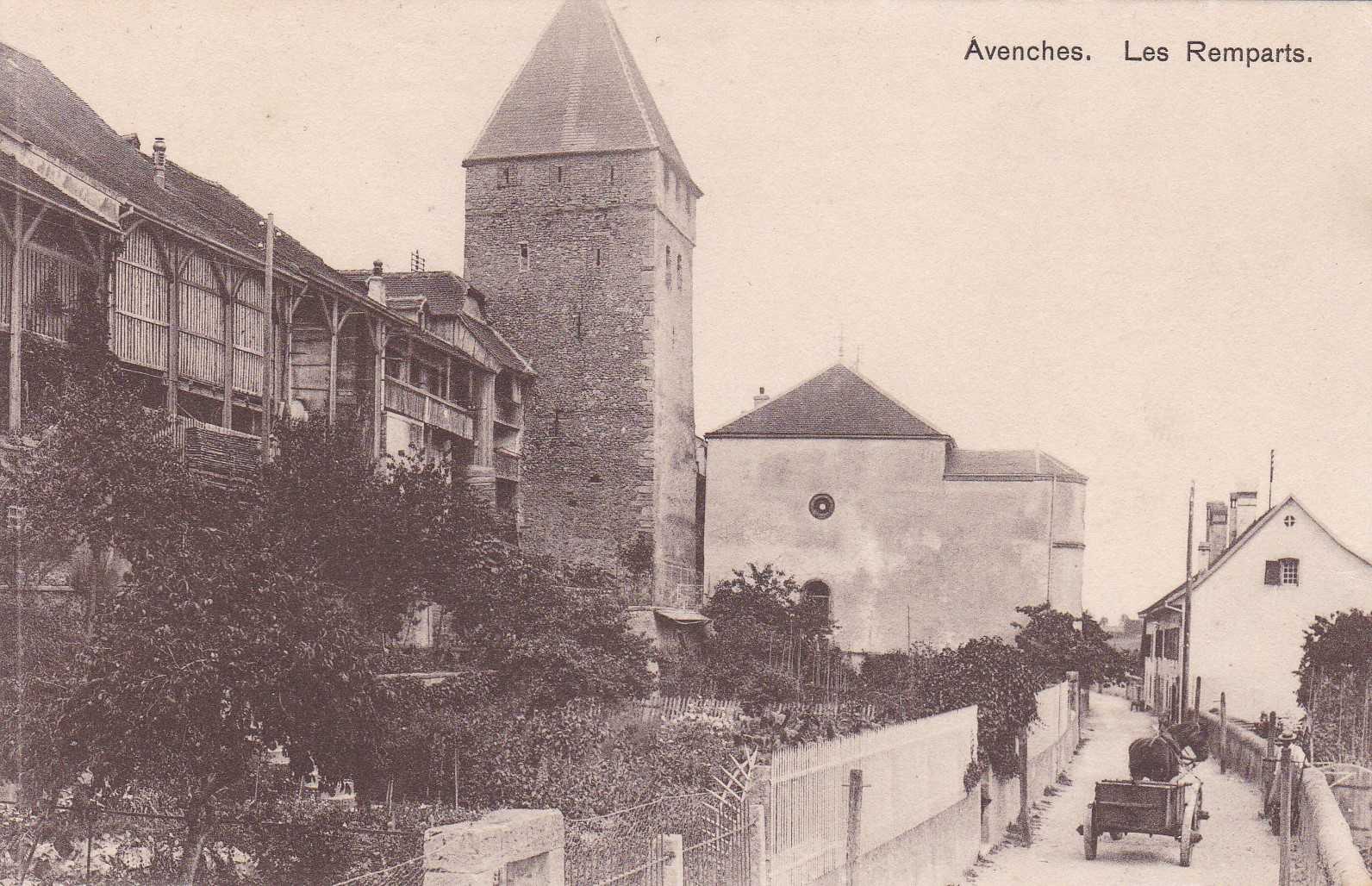
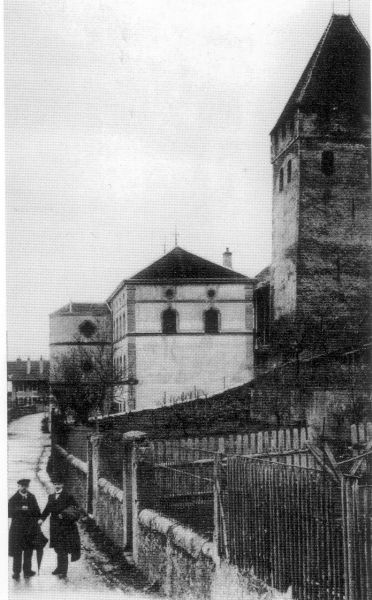
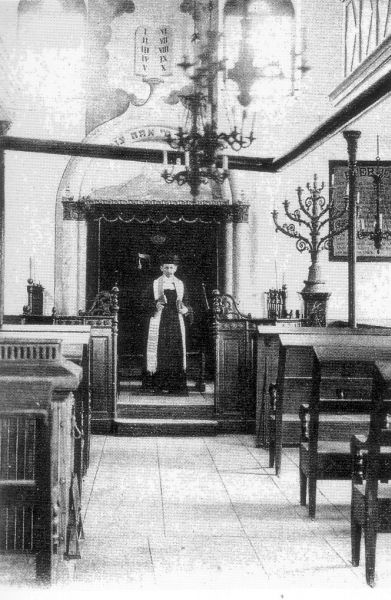
The synagogue was not a new building but a dwelling house outside the town walls, bought in 1863 and converted to plans that the town council approved in November 1864; the architect or builder is not named in the sources read. Old photographs reproduced by Ron Epstein-Mil and a postcard titled 'Avenches. Les Remparts' show it standing on a lane just beyond a tall square stone rampart tower with a pyramid roof. Seen from the west it was a plain, rendered block under a broad hipped roof, with a single round window in its gable-less end wall and a lower wing behind. Seen from the east it appears as a two-storey building with round-arched upper windows above smaller ones, a hipped roof and a low annex. Inside, the only known view shows a rectangular hall with benches in rows, an ark set in a round-arched niche hung with a fringed valance, the Ten Commandments tablets above it, a hanging brass chandelier, a branched candelabrum and a gallery along the right wall. The hall held 120 seats, sixty for men and sixty for women. A ritual bath was in the basement and the teacher's flat on the ground floor.
La vita nella sinagoga
The community employed one man as religion teacher, prayer leader (chazan) and ritual slaughterer (shochet), who lived in a flat on the synagogue's ground floor. B. Taube held the post around 1877 and 1878, signing advertisements in Der Israelit as religion teacher and 'ministre officiant'. The community advertised the vacancy repeatedly in the same Orthodox weekly: in 1893 its head, Nathan Bloch, sought a teacher and chazan able to teach in German and Hebrew, preferably an Alsatian; in 1901 and 1902 the president, the horse dealer Leopold Levy-Bloch, offered an unmarried chazan and shochet a fixed salary of 1,200 francs, with slaughtering paid extra; and in 1904 Levy offered 1,300 francs for a cantor alone, a sign that teaching was no longer needed. The community also kept a religion school. In 1887 the butcher Josef Bloch advertised kosher board and lodging for young men who came to Avenches to learn French. As families left, the congregation could no longer gather a quorum, and no services were held after the 1930s; the community was then dissolved.
Distruzione
No violence was involved. The synagogue was abandoned when the Jewish population dwindled: Alemannia Judaica, drawing on Epstein-Mil, states that no services were held after the 1930s, and the HLS article on Avenches says the building was left derelict. At the end of 1957 the synagogue was demolished. The plot was sold for 4,000 francs, a sum that covered the cost of the demolition, and the ritual objects were handed to the Jewish communities of Bern and Lausanne. The HLS dates the destruction to 1957-1958, suggesting the work ran into the new year. The sources read do not name who sold the plot, who bought it or who carried out the demolition; since only two Jewish families remained in 1950 and the community had been dissolved, the sale was presumably arranged by its last members or by the communities that received the ritual objects, but this is not stated.
Il destino della comunità
The Avenches community was not destroyed by persecution. Switzerland was not occupied in the Second World War, and its Jews were not deported. The community dwindled through migration: from the 1870s the horse-dealing families, facing a worsening rural economy, moved to Bern, Lausanne and other towns, so that the roughly 260 Jews of 1870 had fallen to 74 by 1917. Services ended in the 1930s and the community was dissolved; by 1950 only two Jewish families lived in Avenches. Its ritual objects passed to the communities of Bern and Lausanne in 1957, which suggests that many descendants of the Avenches families had joined those congregations. The sources read do not say what became of the community's records, of its religion school, or whether Avenches Jews had their own burial ground or buried their dead elsewhere.
Il luogo oggi
The synagogue stood behind the old town ramparts, at the place Alemannia Judaica calls 'Derrières les Terreaux', on the Chemin des Terreaux below the walls of Avenches. Photographs taken by Joachim Hahn in August 2008 show the plot as an open gravelled area used for parking, shaded by trees, at the foot of the medieval rampart tower that appears in the old views. Nothing of the building survives above ground. A stone with a French and Hebrew inscription, set up in October 1979 at the initiative of the former town archivist Yoland Gottraux, records that the synagogue of the Israelite community stood here. The map pin marks the middle of the Chemin des Terreaux and is approximate.
Nomi importanti
Joseph Wertheimer
rabbi of Geneva 1859-1908Rabbi of Geneva; co-officiant at the consecration in 1865Wertheimer, an Alsatian-born philologist, was the first academically trained rabbi in Switzerland, serving the Geneva community from 1859 to 1908 and lecturing at the University of Geneva from 1874 to 1906. With Rabbi Moïse Nordmann he consecrated the Avenches synagogue on 4 August 1865 before a gathering that included many local notables. As the leading rabbi of French-speaking Switzerland he was the natural spiritual authority for the small Alsatian congregation in Vaud.
Biografia o fonte →Moïse Nordmann
UnknownRabbi; co-officiant at the consecration in 1865Alemannia Judaica, summarising Epstein-Mil, names Rabbi Moïse Nordmann as the rabbi who consecrated the Avenches synagogue on 4 August 1865, together with Joseph Wertheimer of Geneva. The sources read do not say which community he served at the time or whether he had any continuing role at Avenches; his tie to the building rests on the consecration ceremony.
Biografia o fonte →B. Taube
UnknownReligion teacher, prayer leader and shochet, c. 1877-1878Taube was the community's religion teacher around 1877 and 1878, when he placed advertisements in the weekly Der Israelit, signing once as 'Religionslehrer in Avenches' and once as 'ministre officiant'. In June 1878 he sought a substitute shochet who could also lead prayers for four or five weeks. Like other holders of the post he would have lived in the teacher's flat on the synagogue's ground floor and led its services.
Biografia o fonte →Nathan Bloch
UnknownHead (Vorstand) of the Avenches community, 1893Bloch signed the community's advertisement in Der Israelit of 2 March 1893 as its head, announcing that the post of religion teacher and chazan was vacant. He asked for a single man or one with a small family, able to teach in German and Hebrew, and said an Alsatian would be preferred, a reflection of the congregation's Alsatian origins. As head he was responsible for the synagogue and its staff.
Biografia o fonte →Leopold Levy-Bloch
UnknownPresident of the Avenches community, 1901-1904Levy-Bloch, a horse dealer by trade, signed the community's advertisements in Der Israelit in 1901, 1902 and 1904, first for the board and then as president. He offered an unmarried chazan and shochet 1,200 francs a year with slaughtering paid extra, and in 1904 sought a cantor alone at 1,300 francs, showing the congregation still maintained regular services in its synagogue at the start of the twentieth century.
Biografia o fonte →Hai qualcosa da condividere?
Fotografie, documenti, storie di famiglia o ricordi di questa sinagoga e della sua comunità aiutano a mantenerne viva la storia.
Share a memory or thought
No comments yet. Be the first to add one.