
The story of Bačka Palanka Synagogue
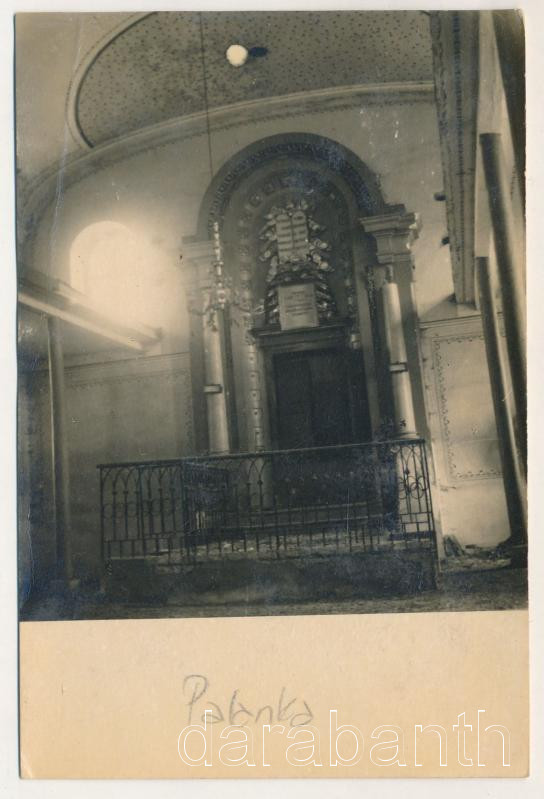
Bačka Palanka lies on the left bank of the Danube in South Bačka, Vojvodina. The present town grew out of three separate settlements: Stara Palanka, Nova Palanka, founded between 1765 and 1770, and Nemačka Palanka, founded by Danube Swabians in 1783; they merged into one town only in the twentieth century. Jews first settled here in 1771, and the synagogue was among the earliest in Bačka. Aleksandra Terzić and Željko Bjeljac, in their 2014 inventory of Jewish heritage in Bačka, and the 2021 survey by Rastislav Stojsavljević and Nikola Vujinović for the Archives of Vojvodina both date it to 1806; Goran Levi's catalogue, as reproduced in the English Wikipedia list, and a Hungarian auction description give 1807. The building stood at what is now Žarka Zrenjanina Street 62, and in 1835 the community added a ritual bath, a kosher butcher's shop and a Jewish elementary school beside it on the same street. A single surviving photograph shows its interior, with a classical Torah ark under a domed apse and a women's gallery. Under Hungarian rule from 1941 to 1944 the town lost its Jews, and the synagogue was pulled down in 1956.
Where it stood for 150 years
Historic: Jewish community complex, Palanka (Bácspalánka), Bács-Bodrog county; old street name unknown. Today: Žarka Zrenjanina 62, 21400 Bačka Palanka (site of the synagogue per the Darabanth auction note). Pin at the OpenStreetMap address point for no. 62 (approximate: address-level).
Open larger map →The Jewish community
According to a historical note accompanying a set of photographs sold by the Darabanth auction house, Jews first settled in Bácspalánka, the Hungarian name of the town, in 1771. Terzić and Bjeljac list Bačka Palanka among the places in Bačka where Jewish prayer houses existed already in the eighteenth century, together with Ada, Bezdan, Petrovac and Kanjiža, and they record a 'Nova Palanka' among the settlements that first admitted Jews, also with the year 1771. By 1806 or 1807 the community was able to build a synagogue, and in 1835 it extended its small communal complex on the same street with a mikveh, a kosher butcher's shop and an elementary school. The community also kept a cemetery, now at Gajdobranski put 161 on the road to Gajdobra, which still holds about 500 gravestones. No population figures for the Jews of Bačka Palanka, no names of its rabbis, cantors or presidents, and no indication of whether it followed the Neolog, Status Quo or Orthodox rite were found in the sources consulted.
Architecture and design
The architect, builder, dimensions and seating capacity are unknown, and no exterior view of the building was found. The only image located is a photograph printed as a postcard and captioned 'Palanka' in pencil, which shows the interior looking towards the Torah ark. The ark stands in a shallow apse roofed by a half-dome painted with small stars and edged with a moulded cornice. It is framed by a round arch with a decorated border, carried on two columns with ornate capitals, and has a panelled double door. Above the door is a small inscribed tablet and, above that, the Tablets of the Law in a carved, foliate surround. A low wrought-iron railing on a raised platform runs in front of the ark. On the left, a round-headed window lights the apse, and a gallery front on slender posts crosses the side wall; on the right, tall columns support what appears to be a women's gallery. The classical forms of the ark fit a building of the early nineteenth century, but no documented description of the exterior survives in the sources read.
Life inside the synagogue
Little is recorded about the religious life of the congregation. The building was the centre of a small communal quarter: from 1835 the ritual bath, the kosher butcher's shop and the community's elementary school stood next to it on the same street, so that worship, ritual purity, kosher food and the schooling of children were all concentrated on one plot. The interior photograph shows the arrangement of a traditional prayer hall, with the Torah ark raised on a platform behind an iron railing and a gallery, probably for women, carried on columns along the side walls. The tablet above the ark door and the carved Tablets of the Law above it were the main decorative features of the east wall. The names of the rabbis and cantors who served here, the rite of the congregation and the number of seats are unknown. Terzić and Bjeljac note that Jewish communities in Bačka maintained prayer houses from the eighteenth century, and Bačka Palanka's community kept its synagogue in use for well over a century.
Destruction
No source found records damage to the synagogue during the Second World War, when Bačka Palanka was under Hungarian occupation from 1941 to 1944. After the war the building no longer had a congregation large enough to use it. It was demolished in 1956, a date given independently by Terzić and Bjeljac, by the Archives of Vojvodina survey, by the English Wikipedia list based on Goran Levi's catalogue, and by two Darabanth auction descriptions. None of these sources says who ordered or carried out the demolition, or whether the building had first been sold. Terzić and Bjeljac write in general terms that most synagogues in Bačka were demolished between 1948 and 1962 and that Jewish buildings in the region were destroyed or converted after the war by the Communist authorities, but they give no specific detail for Bačka Palanka. The demolition therefore took place under Communist rule in Yugoslavia, but the actor in this case is not documented in the sources read. The adjoining mikveh, butcher's shop and school building are not mentioned in any source after 1835.
The community’s fate
In April 1941 Bačka was occupied and annexed by Hungary, and Bačka Palanka remained under Hungarian rule until 1944. According to Terzić and Bjeljac, the Jews of Bačka suffered first in the raid of January 1942, in which Hungarian army and police units killed about 870 Jews in Novi Sad alone, and adult Jewish men were sent to Hungarian forced labour service. After the Nazi German occupation of Hungary in March 1944, the Jews of Bačka were concentrated and deported; Terzić and Bjeljac give about 10,500 Jewish victims from Bačka, most of them killed at Auschwitz. The number of Bačka Palanka Jews who were killed, and the route of their deportation, are unknown from the sources read. Some survived: a Darabanth auction note records that a Jewish community of Bácspalánka was still active in October 1955. Terzić and Bjeljac describe the large emigration of Yugoslav Jews to Israel from 1948, but how many Palanka survivors left is unknown, and no Jewish community is recorded in the town today.
The site today
The synagogue stood at what is now Žarka Zrenjanina Street 62, in the centre of Bačka Palanka, according to the historical note in a Darabanth auction description; the present use of the plot was not established in the sources read. The Archives of Vojvodina survey records that a memorial plaque was placed on the site of the demolished synagogue in 2007. No fragment of the building is known to survive. The Jewish cemetery on Gajdobranski put, with about 500 gravestones, was cleaned in 2015 and is the main surviving trace of the community.
Do you have something to contribute?
Photographs, documents, family stories or memories of this synagogue and its community help keep its history alive.
- The Extermination of Jewish Population and Heritage in Bačka Region of AP Vojvodina (Serbia), TRAMES 18 (2014), no. 1, pp. 39-55
- Постанак и нестанак синагога на простору Аутономне покрајине Војводине (in Sinagoge, zbornik, Archives of Vojvodina 2021), pp. 17-30
- List of synagogues in Serbia
- Palánka, Bácspalánka, Backa Palanka; zsinagóga (1956-ban lebontották, ma egy emléktábla áll a helyén), belső (auction 520, lot 43958)
- 1955 Palánka, Bácspalánka, Backa Palanka - 38 db modern fotó képeslap: Holokauszt emlékmű avatása a zsidó temetőben (auction 520, lot 43959)
- Backa Palanka Jewish Cemetery
- Bačka Palanka
- Deportation of the Jews of Bačka in 1944 (eds. Aleksandar Bursać, Vladimir Todorović, Petar Đurđev, 2021)
- Žarka Zrenjanina 62, Bačka Palanka (OpenStreetMap node 11246913347)
Share a memory or thought
No comments yet. Be the first to add one.