

The story of Bácsalmás Synagogue
Bácsalmás is a small town in northern Bácska, close to today's Serbian border. Before 1945 about two thirds of its people were Danube Swabian Germans, living beside Bunjevci and Hungarians. Jews settled there in the 1750s and formed one of the older communities of the district, with a burial society from 1773 and a school from 1846. In 1888 the congregation, which belonged to the status quo ante trend, put up what the Magyar Zsidó Lexikon called a columned, ornate synagogue. A second date, 1902, taken by Anikó Gazda from a dedication report in the weekly Egyenlőség, may mark a rebuilding or rededication.
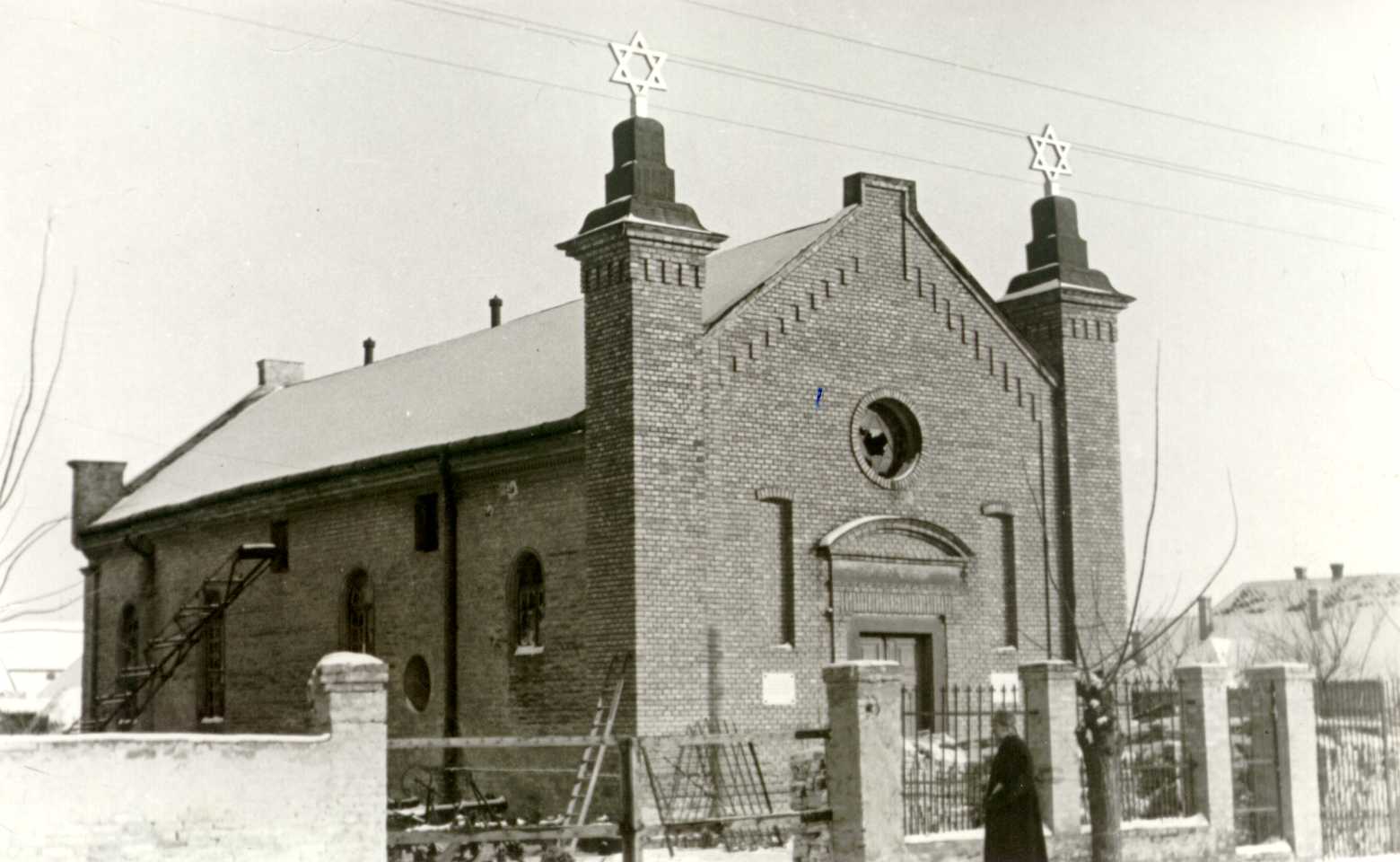
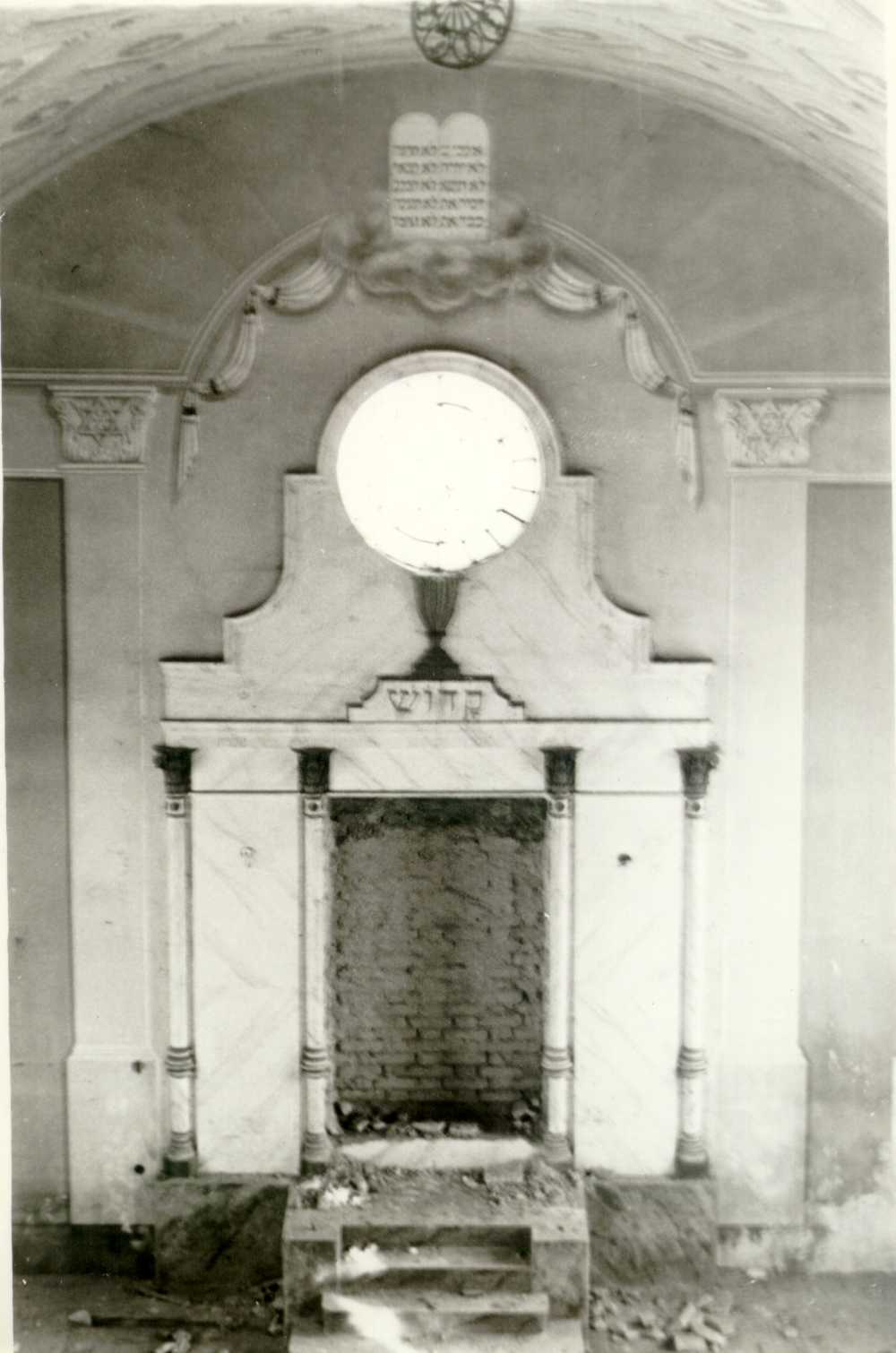
Photographs dated 1958 show an unplastered brick hall with a gabled front, a round window and two corner turrets carrying Stars of David; inside, a marble Torah ark stood beneath plaster drapery and the Tablets of the Law. By then the building was empty. In June 1944 the Hungarian authorities had turned the quarter around the synagogue and the Jewish school into a ghetto and collection camp for the Jews of northern Bácska, who were deported at the end of the month. The few survivors repaired the synagogue and set up marble tablets naming 168 victims, but could not keep a congregation going. The building was sold, a bricklayers' brigade from Mélykút pulled it down, and its bricks went into a Catholic church built there in 1959-61.
Where it stood for nearly 75 years
Historic: Bácsalmás, Bács-Bodrog county; street and house number Unknown, in the quarter of the Jewish school. Today: approximate pin on the former Jewish school building, Korona utca, 6430 Bácsalmás; the synagogue's own plot is not identified.
Open larger map →The Jewish community
According to the Magyar Zsidó Lexikon the community was founded between 1750 and 1760; its founding documents were lost in the great fire of 1850. The founders named are Mendel Beck, ancestor of the Beck family of Madaras, Izsák Krábl, who came from Moravia, B. Wolf Reich, Mandel Rosenberg of Tataháza and Moyses Roth. A Chevra Kadisha was set up in 1773 and an elementary school in 1846, teaching in Hungarian from 1869. The congregation organised itself on a status quo ante basis, joining neither the Neolog nor the Orthodox organisation. Anikó Gazda's gazetteer gives 81 Jews in 1828, 217 in 1910 and 186 in 1941. In 1929 the lexicon counted 52 families, 186 people and 58 taxpayers in a town of about 10,000, and noted that they were Hungarian-speaking although other nationalities formed the majority. Members included 26 shopkeepers, a wholesaler, a mill owner, a landowner, three lawyers, three doctors and an engineer. Forty men served in the First World War; seven fell and two died of wounds at home. The registry district took in Bajmok, Madaras, Katymár, Tataháza, Mátételke and Kunbaja.
Architecture and design
No architect, builder, plan or seating figure has been found. The lexicon of 1929 says only that the congregation built a columned, ornate temple in 1888. The two museum photographs dated 1958 are the best evidence. They show a free-standing hall of exposed brick under a pitched roof. The entrance front is a plain gable flanked by two square corner turrets with corbelled brick tops and stepped caps, each carrying a Star of David. A stepped brick frieze climbs the gable, a round window sits at its centre, and the doorway below has a rendered surround with a curved pediment. The side wall has round-arched windows and a small circular one. A wall with brick piers and iron railings closed the yard from the street. Inside, the ark wall was arched and plastered, with pilaster capitals bearing Stars of David. The marble ark had four slender columns, the Hebrew word kadosh (holy) on its cornice, and a shaped gable around a round window; above it hung plaster drapery and the Tablets of the Law. The ceiling was painted. The style label is our reading of the photographs, not a documented attribution.
Life inside the synagogue
The congregation followed the status quo ante rite and, as far as the sources read show, had no rabbi of its own: the lexicon of 1929 lists lay officers and a teacher, but no rabbi or cantor by name. Its institutions were considerable for some fifty families. Besides the synagogue it kept a ritual bath and a matzah bakery with modern equipment, a Talmud Torah, and a Hebrew course started in 1906 within the elementary school. The school was the community's pride: in 1900, under the presidency of Lipót Grauaug, it received a handsome two-storey building, and in 1929 it had 21 pupils and one teacher, the headmaster Salamon Gross, who also served as the community's notary. The budget for 1927-28 was 10,000 pengő, spent on worship, charity and welfare. A synagogue warden (templomgondnok), the landowner Miksa Krahl, looked after the building, and the burial society was chaired by the wholesaler Bernát Ripp. In the last years the schoolteacher Dezső Nussbaum also taught Jewish religion at the town's boys' civic school.
Destruction
No source read records damage to the synagogue during the war. In 1944 the quarter around it was fenced in as a ghetto, and its congregation was deported. Survivors who came home repaired the building and placed in it five marble tablets naming 168 victims, but according to Ernő Polgár too few men remained for a prayer quorum, and the Jews left the town in the 1950s. The synagogue was then sold; neither seller nor buyer is named. A bricklayers' brigade from the neighbouring village of Mélykút took it down, and a former headmaster of the Bácsalmás grammar school, Mihály Németh, remembered hundreds of carts hauling the bricks away. The Catholic church directory entry for Mélykút confirms that the Szent Erzsébet church, built in 1959-61, used brick from the demolished Bácsalmás synagogue. The date is disputed: Ernő Polgár gives 1950 and Wikipedia 1954, but the museum photographs of the standing, stripped building are dated 1958, which fits the church's building dates. This happened under Communist rule, but no source read says that a council or state body ordered it.
The community’s fate
After the Nazi German occupation of March 1944 the local Jews were first shut into a house at the corner of Kossuth and Holló streets, then into a ghetto formed around the synagogue and the Jewish school. In mid-June Bácsalmás was made one of the collection camps of deportation zone IV in place of Szabadka. Jews were brought from Baja, Szabadka, Jánoshalma, Mélykút and some twenty villages; Braham records 2,793 people there, while local estimates run far higher. They were crowded into houses, lofts and barns, more than 500 in the Krahl family's house and outbuildings alone. Hungarian gendarmes guarded them at first, then the Nazi German SS, whose headquarters was the boys' civic school, and finally a gendarme unit from Újvidék. Jakab Stein, a mill owner, died after a beating. Men born between 1895 and 1925 were taken for forced labour in early June. The rest were marched to the station and deported on 25-26 June 1944, most to Auschwitz; some wagons were diverted to Strasshof in Austria. The memorial tablets list 168 dead from Bácsalmás. About twenty-five named survivors returned, nearly all the men from forced labour.
The site today
The exact plot of the synagogue has not been identified in the sources read, so what stands on it today is Unknown. It stood in the same quarter as the Jewish school, whose building survives on Korona utca and is listed among the town's sights. The map pin for this entry marks that school building and is only an approximation of the synagogue's position. OpenStreetMap records a Holocaust memorial plaque on the school, and the five marble tablets from the synagogue now stand at the memorial in the courtyard of the Baja synagogue. The Jewish cemetery and its mortuary survive in Bácsalmás. Bricks from the synagogue are built into the Szent Erzsébet church at Széchenyi utca 115/b in Mélykút.
Notable names
Lipót Grauaug
UnknownPresident of the Bácsalmás congregation around 1900Grauaug was president of the community twelve years after the synagogue was built. The Magyar Zsidó Lexikon credits his term with what it calls the peak of the small congregation's cultural development: in 1900 it put up a handsome two-storey building for its elementary school, which stood in the same quarter as the synagogue. The former Jewish school that survives on Korona utca is presumably this building.
Biography or source →Dr. Arnold Pápa
UnknownPresident of the Bácsalmás congregation, in office in 1929Pápa, a physician who held the title of honorary county chief medical officer, is named in the Magyar Zsidó Lexikon as president of the Bácsalmás community in 1929. He headed a board that included the vice-president Izidor Rein, the treasurer József Schlesinger and the synagogue warden Miksa Krahl, and was responsible for the synagogue and a yearly budget of 10,000 pengő.
Biography or source →Miksa Krahl
UnknownSynagogue warden (templomgondnok), in office in 1929Krahl, a landowner, is recorded in 1929 as templomgondnok, the officer who looked after the synagogue building and its services. In 1944 the Krahl family's house and outbuildings, beside the main entrance of the ghetto, were packed with more than 500 people. A Miksa Krahl and his wife are named among the 168 victims on the memorial tablets once kept in the synagogue.
Biography or source →Bernát Ripp
UnknownPresident of the Chevra Kadisha, in office in 1929Ripp, a wholesale merchant, chaired the Bácsalmás burial society, founded in 1773 and the oldest institution of the community, according to the Magyar Zsidó Lexikon of 1929. He sat on the board that maintained the 1888 synagogue. Wholesalers named Mihály and Vilmos Ripp were among the few who returned to the town after 1945.
Biography or source →Salamon Gross
UnknownHeadmaster of the Jewish elementary school and notary of the congregation, in office in 1929Gross is listed in the Magyar Zsidó Lexikon as igazgató-tanító, the head and only teacher of the congregation's elementary school, which had 21 pupils in 1929, and as notary of the community. In a congregation that had no rabbi named in the sources, the schoolmaster was its one salaried educator and kept its records.
Biography or source →Dezső Nussbaum
UnknownTeacher at the Jewish school and instructor of Jewish religion at the boys' civic school, to 1944Nussbaum taught at the congregation's school in its last years and gave Jewish religious lessons at the town's boys' civic school, the building that became the SS headquarters in 1944. He and his wife were confined in the Bácsalmás ghetto around the synagogue. According to Ernő Polgár he died in forced labour; both are named on the memorial tablets.
Biography or source →Mendel Beck
UnknownFounder of the Bácsalmás congregation, 1750sBeck heads the list of founders in the Magyar Zsidó Lexikon, which calls him the ancestor of the Beck family of Madaras. With Izsák Krábl from Moravia, B. Wolf Reich, Mandel Rosenberg of Tataháza and Moyses Roth he established the community between 1750 and 1760, more than a century before the synagogue was built. Several people named Beck are listed among the victims of 1944.
Biography or source →Do you have something to contribute?
Photographs, documents, family stories or memories of this synagogue and its community help keep its history alive.
- Zsinagógák és zsidó községek Magyarországon: térképek, rajzok, adatok (Bács-Kiskun county table, p. 17)
- Bácsalmás (entry in Magyar Zsidó Lexikon, 1929, p. 74)
- Bácsalmási zsinagóga (photograph, inv. F70.21, dated 1958)
- Bácsalmási zsinagóga belülről: a frigyszekrény helye (photograph, inv. F70.22, dated 1958)
- Holocaust: Gettó a Délvidéken
- Itt születtem, ez a hazám!
- Árpád-házi Szent Erzsébet-templom, Mélykút
- Mélykút (entry in Magyar Katolikus Lexikon)
- A népirtás politikája: a Holocaust Magyarországon, p. 684 (Délvidék ghettos)
- A népirtás politikája: a Holocaust Magyarországon, p. 685 (Baja, Szabadka)
- A népirtás politikája: a Holocaust Magyarországon, p. 686 (zone IV, table 21.1)
- List of synagogues in Hungary
- Bácsalmás
- Bácsalmás
- Bács-Kiskun County, Hungary
- Bácsalmás város zsidó közösségének története (1750-1950), Bácsalmás 2006
- Pinkas Hakehillot Hungary: table of contents (Bácsalmás, p. 178, untranslated)
- volt zsidó iskola, Korona utca, Bácsalmás (OpenStreetMap way 298103871)
Share a memory or thought
No comments yet. Be the first to add one.