
The story of Ashkenazi Synagogue of Banja Luka
Banja Luka had four synagogues before the Second World War, according to the town's Jewish Cultural Centre Arie Livne: three Sephardic and one Ashkenazi. The Sephardic Jews, settled under Ottoman rule, built theirs in 1870, 1880 and 1936-37. The Ashkenazim arrived after the Austro-Hungarian occupation of Bosnia in 1878 and formed a separate congregation with its own rabbi.
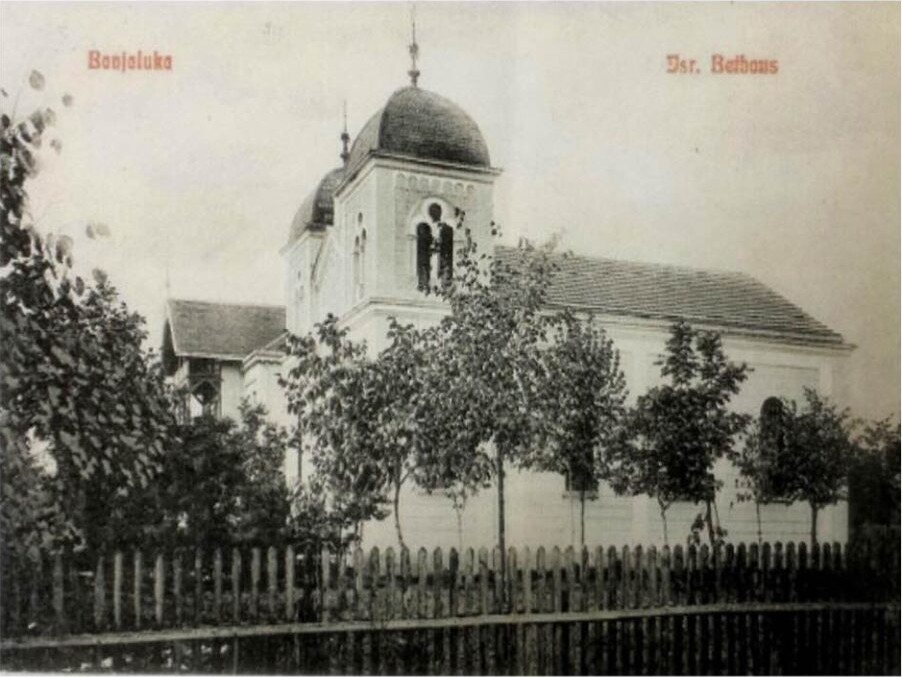
Between 1900 and 1902 they put up their own synagogue on the Carski drum, the Imperial Road, which is today Mladena Stojanovića street. The community's historians describe it as a building of exceptional beauty, and one photograph of it survives: a postcard captioned in German 'Banjaluka, Isr. Bethaus', showing a rendered hall with domed towers at its entrance front. The Encyclopaedia Judaica names two of its rabbis, Pinchas Keller and Mavro Frankfurter.
From 1936 the Ashkenazim also used the new Sephardic Jewish Home and temple in Jukićeva street, which already has its own entry on this site. The Ashkenazi synagogue was in use until the Second World War, when it was demolished; the sources do not say exactly when or by whom. A Red Cross building now stands on its site.
Where it stood for nearly 45 years
Historic: Carski drum, Banja Luka (exact plot unknown). Today: Ulica Mladena Stojanovića, Banja Luka, site of the Red Cross building (house number not confirmed); pin on the street, approximate.
Open larger map →The Jewish community
The Encyclopaedia Judaica traces Jews in Banja Luka to 1713, when local Jewish merchants asked the French government to make one of them its commercial consul in the town. The settled community was Sephardic until 1878. With the Austro-Hungarian occupation Ashkenazi Jews arrived and, as the Republic of Srpska Museum's article on the town's synagogues puts it, founded their own community and built this synagogue. The two congregations stayed formally separate: a local chronicle on the elmundosefarad site speaks of two Jewish communities, Sephardic and Ashkenazi, and says the record books of both were completely destroyed in the war. The Encyclopaedia Judaica counts 226 Jews in 1875, 336 in 1895 and 457 in 1927, without dividing them by rite, and the same chronicle gives about 400 on the eve of the Second World War. Each congregation had its own rabbi. Zionist activity in the town was led by Judah Levy and Hans Bramer.
Architecture and design
The only view found is a postcard printed in German, captioned 'Banjaluka' and 'Isr. Bethaus', which the Jewish Cultural Centre reproduces as the Ashkenazi synagogue. It shows a free-standing rendered hall with a long pitched roof of tiles, seen from the front corner behind a picket fence and a row of young trees. The entrance front has at least two square towers, each capped by a tall bulbous dome with a finial; the nearer tower has a pair of round-arched openings under a decorated cornice. A lower wing with its own tiled gable roof adjoins on the left, and a round-arched window is visible near the far end of the side wall. The overall character is the historicist synagogue type built across the Habsburg lands around 1900, but no source names the style. The architect, builder, seating capacity, interior and the direction the ark faced are all unknown, and no plan or interior photograph was found.
Life inside the synagogue
Almost nothing is recorded about worship in this building, because the registers and minute books of both Banja Luka congregations were destroyed during the war. The Encyclopaedia Judaica names Pinchas Keller and Mavro Frankfurter as rabbis of the Ashkenazim, without dates. Frankfurter, born in Holešov in Moravia in 1875, was later rabbi of Daruvar and from about 1914 chief rabbi of Vinkovci, and his Wikipedia biography does not mention Banja Luka, so his years there are not recorded. The congregation followed the Central European Ashkenazi rite, unlike the Sephardim of the town, and kept its own rabbinate. The two groups drew closer between the wars. The Jewish Cultural Centre writes that the new Sephardic Jewish Home of 1936 drew not only Sephardim but also Ashkenazim, who saw in it their hope for a better future, and at its consecration Chief Rabbi Isak Alkalaj was joined by the two Banja Luka rabbis Kon and Atijas. Whether services continued in the Ashkenazi building after 1936 is unknown.
Destruction
The Jewish Cultural Centre of Banja Luka states only that the synagogue served until the Second World War, when it was demolished, and the Republic of Srpska Museum repeats the same words. The Encyclopaedia Judaica says that both of the town's synagogues were destroyed during the Holocaust, and Samuel Gruber's 2011 survey for the US Commission for the Preservation of America's Heritage Abroad records that two pre-war synagogues in Banja Luka were destroyed. Banja Luka was part of the Ustaše-ruled Independent State of Croatia from April 1941, and a local chronicle says the Ustaše plundered Jewish property and wrecked Jewish places of worship and cemeteries; it does not mention this building by name. The Sephardic New Temple was hit by Allied bombing in May 1944. No source read says whether the Ashkenazi synagogue was pulled down by the Ustaše, destroyed in the bombing or the fighting, or cleared at the end of the war, and who demolished it is not recorded. The surviving photograph is the only trace of it.
The community’s fate
Immediately after the proclamation of the Independent State of Croatia at the end of April 1941, the Ustaše declared the Jews of Banja Luka outside the law and ordered them out of their homes in the town centre within 24 hours. The first round-up came in June 1941; those taken were driven off in an unknown direction and probably killed before reaching any camp. At the beginning of July Jewish men were again seized and killed, and on 16 July older Jews of both sexes were taken to Stara Gradiška, where all of them were murdered. On 28 July 1942 the remaining 170 Jews of the town were arrested and killed in various Ustaše camps. Rabbi Mavro Frankfurter, who had served the Ashkenazim, was murdered with his wife at Jasenovac in 1942. The chronicle reckons that about 150 Banja Luka Jews, 37.8 per cent, survived, mostly outside the town, and that only 24 returned home after the war.
The site today
The Jewish Cultural Centre locates the synagogue on the former Carski drum, today Mladena Stojanovića street, on the plot where the Red Cross building now stands. No surviving fragment of the synagogue and no marker on the site is recorded in the sources read. The house number of the Red Cross building was not confirmed, so the map pin marks a point on Mladena Stojanovića street rather than the plot itself. Banja Luka's small postwar Jewish community has its own synagogue, named after Ilona Weiss, in the Arie Livne Jewish Cultural Centre, opened in 2014.
Notable names
Mavro (Moše) Frankfurter
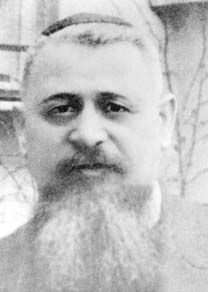
1875-1942Rabbi of the Ashkenazi congregation of Banja Luka (dates unknown)The Encyclopaedia Judaica names Frankfurter, with Pinchas Keller, as a rabbi of Banja Luka's Ashkenazi congregation, which worshipped in this synagogue. Born in Holešov in Moravia in 1875, he was later rabbi of Daruvar and from about 1914 chief rabbi of Vinkovci in Croatia, where he also taught religion at the gymnasium. His son David shot the Swiss Nazi leader Wilhelm Gustloff in 1936. Frankfurter and his wife were murdered by the Ustaše at Jasenovac in 1942. When he served in Banja Luka is unknown.
Biography or source →Pinchas Keller
UnknownRabbi of the Ashkenazi congregation of Banja Luka (dates unknown)Keller is named in the Encyclopaedia Judaica as one of the two rabbis of the Ashkenazi congregation of Banja Luka, which built this synagogue in 1900-1902 and used it until the Second World War. The encyclopaedia gives no dates for his service and no other details, and nothing further about his life or fate was found in this run.
Biography or source →Do you have something to contribute?
Photographs, documents, family stories or memories of this synagogue and its community help keep its history alive.
Share a memory or thought
No comments yet. Be the first to add one.