

The story of New Temple, Banja Luka
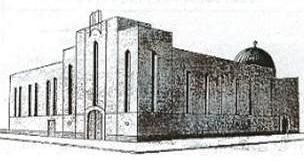
The New Temple stood at the corner of Jukićeva Street and Prince Paul Street (today Jevrejska, "Jewish Street") in the centre of Banja Luka, on the plot where the town's Sephardim had prayed since 1880. By the 1930s the old synagogue was too small for a growing congregation, and in 1934 the community applied to replace its buildings. Work began in earnest in 1936, and at the end of that year Chief Rabbi Isaac Alcalay of the Kingdom of Yugoslavia consecrated the new temple with the Banja Luka rabbis Kon and Atijas and the rabbi of Bihać; the town authorities recorded the works as finished in 1937. The synagogue formed one architectural ensemble with a Jewish cultural home that held a school classroom, a reading room and library, a council chamber, a large festive hall, offices and the rabbi's flat. Sephardim and Ashkenazim alike gathered there. After the Independent State of Croatia (NDH) was proclaimed in April 1941, the Ustaše banned public Torah reading and handed the building to a collaborator, who ran it as the "Linda bar", a tavern and brothel for German and Ustaše soldiers. It later housed the Nazi ethnic-German Kulturbund and the city radio. In May 1944 Allied bombing destroyed the prayer hall; the damaged cultural home survived as a shell until it was cleared after the 1969 earthquake. No photograph of the synagogue is known to survive; only its plans and a drawing.
Where it stood for nearly 10 years
Historic: corner of Jukićeva ulica and Ulica princa Pavla, Banja Luka. Today: corner of Ivana Franje Jukića and Jevrejska streets, Centar, Banja Luka.
Open larger map →The Jewish community
Individual Jewish merchants are recorded in Banja Luka from the late sixteenth century, but a settled Sephardic community formed only in the mid-nineteenth century, after the Ottoman reforms of 1840 allowed non-Muslims to build houses of worship. The Sephardic congregation was founded around 1848–1850, and its first wooden synagogue went up in 1870 on the left bank of the Crkvena river; it burned down in 1878, at the start of the Austro-Hungarian occupation. A second synagogue followed in 1880 on Jukićeva Street, built under Rabbi Jozef Nahmijas. Austro-Hungarian rule brought Ashkenazi newcomers, who formed their own congregation in 1883 and built a separate synagogue in 1900–1902. The Jewish population rose from 187 in 1879 to 421 in 1910 and about 480 to 500 on the eve of the Second World War. Leading Sephardic families such as the Poljokan (Levi) and Sarafić (Salom) were prominent merchants in the town.
Architecture and design
The plans of the new temple, signed and stamped in Banja Luka in March 1937, are titled "Jewish religious community in Banja Luka, Sephardic rite: construction of a temple in Prince Paul Street". They show a long, plain rectangular hall with tall, narrow round-headed windows along the Jukićeva Street side and a hemispherical dome, crowned by a Star of David, over one end of the hall, apparently above the ark. The sections show a hall raised on a stone plinth, a central space flanked by side aisles, women's galleries on columns and arches running around the hall, and a rose window with a Star of David above the ark. A surviving perspective drawing shows the same flat-roofed block with its corner dome. The synagogue was joined to a modern Jewish cultural home, and the whole plot measured about 835 square metres. In the 1880 synagogue on the same site the ark had stood, unusually for Sephardim, on the east wall, with the consent of the Sarajevo rabbinate. The name of the architect has not been established.
Life inside the synagogue
The New Temple was the main synagogue of Banja Luka's Sephardic congregation and the centre of its religious and social life in the late 1930s. Rabbi M. Atijas led the Sephardic community at that time, while Rabbi Sigmund Kohn served the Ashkenazim, and both took part in the consecration. The adjoining cultural home turned the site into a community campus: Jewish children attended the religious school classroom, adults used the reading room and library, the council met in its chamber, and weddings and celebrations filled the festive hall. A coffee house and tea room was registered in the Jewish Home in October 1937. Survivors recalled that their parents socialised in the Jewish Home, while young people met in the Zionist youth club, the Ken, next to the temple, holding gatherings for Purim, Hanukkah, Passover and the New Year. The building became a meeting place for Sephardim and Ashkenazim alike.
Destruction
The New Temple was destroyed by Allied bombing in May 1944, after three years of desecration under the Ustaše. When the Independent State of Croatia was proclaimed in April 1941, the Ustaše authorities banned public reading of the Torah in Banja Luka's synagogues and seized the community's registers, ritual objects and records. In mid-1941 the Sephardic temple and cultural home were handed to Husein Kabiljagić, who opened the "Linda bar", a tavern and brothel frequented by German and Ustaše soldiers; Jewish women were forced to clean and serve there. During 1942 the building was used by the Kulturbund, the Nazi organisation of Yugoslavia's ethnic Germans, and then by the local radio station and city loudspeaker service. In May 1944 an Allied air raid on Banja Luka destroyed the prayer hall, while most of the cultural home survived. Some accounts date the bombing damage to 1945.
The community’s fate
Soon after the Ustaše took power in April 1941, Banja Luka's Jews were stripped of their rights and property. On 5 May 1941 Jews and Serbs were ordered to leave the town centre within 24 hours, and Jewish shops were placed under commissioners. Under the Ustaše commander Viktor Gutić, arrests began in June 1941. On 24 July 1941, 31 Jews were sent to the Gospić camp, part of the Gospić–Jadovno killing complex. Older Jews were taken to Stara Gradiška in July 1941, and on 28 July 1942 the remaining Jews, around 170 people, were deported to Ustaše camps, including Jasenovac and Stara Gradiška. About 62 per cent of the community, some 300 to 350 people, were killed. Most of the roughly 150 survivors had left Banja Luka before the war or escaped, some to the Partisans and some to Italy. Only 24 Jews returned to the town after the war.
The site today
After the war the damaged cultural home and the site of the synagogue were nationalised and given to the youth radio station and the Glas printing house. In 1948 the Federation of Jewish Communities of Yugoslavia sold the 835-square-metre plot as a building site, and by 1952 the printing house held the title. What was left of the building was cleared after the earthquake of 1969, and nothing of the synagogue survives. The site lies at the corner of Ivana Franje Jukića and Jevrejska streets. In 2014 Banja Luka's small Jewish community opened the Arie Livne Jewish Cultural Centre and the Ilona Weiss synagogue elsewhere in the city.
Notable names

Isaac Alcalay
1881–1978Chief Rabbi of the Kingdom of YugoslaviaIsaac Alcalay, chief rabbi of Belgrade from 1909 and chief rabbi of the Kingdom of Yugoslavia from 1923, consecrated Banja Luka's new Sephardic temple at the end of 1936, together with the local rabbis Kon and Atijas and the rabbi of Bihać. He escaped from Yugoslavia in April 1941 and later led Sephardic Jews in the United States.
Biography or source →M. Atijas
UnknownSephardic rabbi of Banja LukaRabbi M. Atijas was the rabbi of Banja Luka's Sephardic congregation in the late 1930s, the community that built and used the New Temple. He took part in its consecration with Chief Rabbi Isaac Alcalay, and survivors remembered the Sephardic community as being led by him on the eve of the war.
Biography or source →Sigmund Kohn
UnknownAshkenazi rabbi of Banja LukaSigmund (Zigmund) Kohn was rabbi of Banja Luka's Ashkenazi congregation between the wars and taught religion at the town's grammar school from 1927 to 1935. He is probably the rabbi Kon who joined Chief Rabbi Alcalay and Rabbi Atijas at the consecration of the new Sephardic temple, a sign of the shared use of the Jewish Home.
Biography or source →Do you have something to contribute?
Photographs, documents, family stories or memories of this synagogue and its community help keep its history alive.
- Sinagoga
- Memoari na holokaust Jevreja Krajine
- Sarajevski Pinkas
- Jevreji Banja Luke (from Avram Pinto, Jevreji Sarajeva i Bosne i Hercegovine, 1987)
- Jewish Heritage Sites of Bosnia-Herzegovina (survey)
- Banja Luka
- Sinagoge u Banja Luci
- Mračne tajne najljepših zdanja u Banjaluci: Ustaše sinagogu pretvorile u javnu kuću
- Kako su banjalučke ulice mijenjale imena
- Ivana Franje Jukića (way 270670343)
- Isaac Alcalay
- List of synagogues in Bosnia and Herzegovina
- Rahela Perišić with her friends from the Ken
- Ostale vjerske zajednice u Banjaluci
- Vazdušna bombardovanja na teritoriji Jugoslavije u WWII
Share a memory or thought
No comments yet. Be the first to add one.