
La storia di Bátaszék Synagogue
Bátaszék is a small market town in Tolna county, in southern Transdanubia, largely resettled by German colonists in the eighteenth century. Jews arrived late and in small numbers: a census of 1829 counted thirteen. A congregation was organised in 1851 as a branch of the Orthodox mother community of Paks, and in 1862 its members paid for a synagogue of their own out of voluntary donations. The community later became independent, was led by a deputy rabbi rather than a full rabbi, and joined the Congress (Neolog) organisation after the split in Hungarian Jewry.
The congregation was always small, about thirty families in the late 1920s. It prospered while the local wine trade did, declined after phylloxera ruined the vineyards around 1890, and was still worshipping in its synagogue in 1941, when 135 Jews in Bátaszék and four neighbouring villages belonged to it. In 1944 they were deported, and about twenty survivors came back. The building did not outlast the community by long: it was demolished in 1949, and a survey of Transdanubian communities made for the Budapest Rabbinical Seminary in 1955 listed Bátaszék among eight places where the synagogue had already vanished. Anikó Gazda's national survey of the 1980s also recorded it as demolished. No photograph or drawing of it has been traced, which makes it one of the least documented lost synagogues of the county.
Where it stood for 87 years
Historic: Bátaszék, Tolna county; street and house number Unknown. Today: Unknown; placeholder pin at Szentháromság tér, 7140 Bátaszék.
Apri la mappa grande →La comunità ebraica
A single Jewish family of four is noted at Bátaszék in 1811, attending synagogue in Bonyhád, and the 1829 census recorded 13 Jews among nearly 5,000 inhabitants. The congregation founded in 1851 was led at first by Adolf Naschitz, Károly Klein, Fülöp Hoffmann, Salamon Wolf and Móritz Pollatsek. Most members were wine merchants and agents, and their early prosperity allowed them to build the synagogue in 1862 from their own gifts. In 1888 the community added a two-teacher school. When phylloxera destroyed the vineyards around 1890 members were impoverished and many moved away; the school closed within a few years and the building was let to the village. In the late 1920s the Magyar Zsidó Lexikon counted 30 families and 38 taxpayers, among them twenty shopkeepers, a wholesaler, two doctors, a lawyer and several clerks, with an annual budget of 3,200 pengő. Twenty members served in the First World War and one was killed. The town had 152 Jewish residents in 1910; the 1941 census found 103.
Architettura e design
Almost nothing is recorded about the building itself. The only firm facts are that it was put up in 1862 and paid for by the voluntary donations of the members; it was presumably a modest structure suited to a congregation of a few dozen families, but that is an inference, not a documented description. No architect or builder is named in the sources consulted, and the seating capacity, plan, materials and decoration are all unknown. No photograph, postcard, plan or drawing showing it has been found. The local historian who surveyed the Jewish monuments of Tolna county in 2017 reported that he could find no picture, and none of the Bátaszék postcards catalogued in the Hungaricana picture gallery is identified as showing it; they depict the Catholic church, the main street and the railway station. Its position within the town is likewise not stated in the published sources. Anything written about its style would be guesswork.
La vita nella sinagoga
The congregation began as an Orthodox-minded branch of Paks and, once independent, affiliated with the Congress (Neolog) movement. It never employed a full rabbi: services and religious duties were in the hands of a deputy rabbi (rabbihelyettes), an office held in the late 1920s by Salamon Stein, and a cantor. A cantor named Weiss from Bátaszék appears with his wife in an album of Hungarian Jewish communal employees that the museum record dates to 1883. The synagogue was also the registry seat for four surrounding villages; in 1941 its records covered 135 people in Bátaszék, Báta, Alsónyék, Sárpilis and Várdomb. The community ran its own school from 1888 until the 1890s. By 1929 its only remaining institution was the Chevra Kadisha burial society, chaired by Adolf Naschitz, and an eighth of the annual budget went to charity. The community was not spared hostility: in October 1882 eighteen to twenty local people smashed the windows of three Jewish merchants and of the deputy rabbi.
Distruzione
Nothing in the sources consulted records damage to the synagogue during the war. The violence of 1944 fell on the people. Within days of the Nazi German occupation of Hungary on 19 March, Gestapo and SS men, helped by local members of the Volksbund, seized about a dozen Jewish men, beat them at the Volksbund headquarters, ransacked their homes and extorted money. In May the Hungarian authorities moved the remaining Jews to the ghetto at Bonyhád, leaving the synagogue without a congregation. About twenty survivors returned. Across Tolna county such remnants could not maintain their synagogues, which were typically sold so cheaply that buyers took them for the building material. The Bátaszék synagogue was demolished in 1949, in the first years of Communist rule in Hungary. Who ordered or carried out the demolition, and whether the building had first been sold, is not stated in the sources found. A 1955 survey of southern and central Transdanubia confirmed that it had disappeared, and Anikó Gazda's field survey of 1980-87 likewise recorded it as a demolished synagogue.
Il destino della comunità
In 1941 the town had 103 Jewish residents and the congregation's district 135. After the assaults of late March 1944 the Tolna county administration designated Bonyhád as the ghetto for the Jews of the Völgység district and of Bátaszék. The ghetto was set up in mid-May (accounts give 12 or 15 May) and the Bátaszék Jews, 77 people according to one report, were taken there about a week later by the Hungarian authorities. At the beginning of July the ghetto's inmates were moved to the Lakits barracks in Pécs, the collection point for Baranya and Tolna counties, and deported from there to Auschwitz on 4 July 1944; one account gives 6 July. According to the congregation's records as cited in the Bátaszék Heimatbuch, 108 members died in the camps and only 20 returned; 83 of the dead were from the town itself. No organised community is recorded after the war. A memorial to the victims was erected in the Jewish cemetery.
Il luogo oggi
The plot on which the synagogue stood has not been identified in the sources consulted, so it is not possible to say what occupies it today. No part of the building is reported to survive, and no marker on the site is recorded. The map pin for this entry is a placeholder in the centre of Bátaszék, at Szentháromság tér, and should not be read as the synagogue's location. A memorial to those deported in 1944 was erected in the town's Jewish cemetery. Establishing the address will need the cadastral maps or land-registry records held in the Tolna County Archives, or the local-history collections in Bátaszék.
Nomi importanti
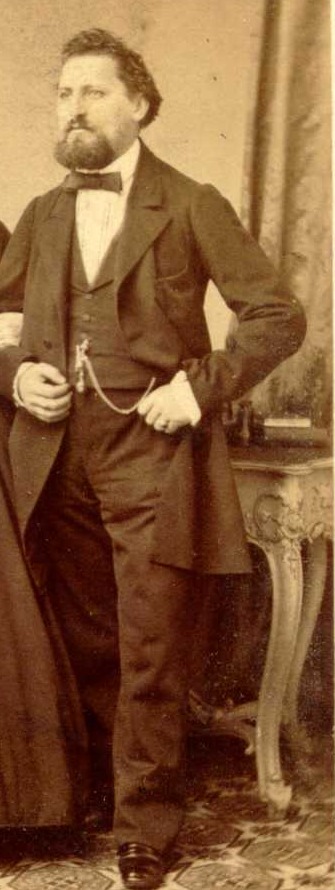
Weiss (given name Unknown)
UnknownCantor of Bátaszék, documented in 1883The Hungarian Jewish Museum and Archives holds a double portrait of 'Weiss, cantor of Bátaszék' and his wife, mounted in the album that members of the Hungarian Israelite Denominational Employees' Association prepared for Mór Friedmann's twenty-fifth jubilee. It shows that the small congregation employed its own cantor in the decades after the synagogue was built. His given name and dates are not recorded.
Biografia o fonte →Salamon Stein
UnknownDeputy rabbi (rabbihelyettes) of Bátaszék, in office in 1929Stein is named in the Magyar Zsidó Lexikon of 1929 as the deputy rabbi heading the Bátaszék congregation. The community never had a full rabbi after separating from Paks, so the deputy rabbi was its religious leader and led worship in the 1862 synagogue. Nothing further about his life or fate has been found in the sources consulted.
Biografia o fonte →Adolf Naschitz
UnknownFounding elder of the congregation; a man of the same name chaired the Chevra Kadisha in 1929Naschitz heads the list of the first elders of the Bátaszék congregation founded in 1851, the group under whom the synagogue was built in 1862 from members' donations. The Magyar Zsidó Lexikon of 1929 also names an Adolf Naschitz as president of the Chevra Kadisha, the community's only remaining institution; given the gap of almost eighty years this is probably a descendant.
Biografia o fonte →József Lávitz
UnknownPresident of the Bátaszék congregation, in office in 1929Lávitz is recorded in the Magyar Zsidó Lexikon as president of the Bátaszék Jewish community in 1929, serving alongside the deputy rabbi Salamon Stein, the treasurer Jenő Gerő and the controller Zsigmond Farkas. As lay head he was responsible for the synagogue and the community's modest budget of 3,200 pengő in its last decades.
Biografia o fonte →Hai qualcosa da condividere?
Fotografie, documenti, storie di famiglia o ricordi di questa sinagoga e della sua comunità aiutano a mantenerne viva la storia.
- Bátaszék (entry in Magyar Zsidó Lexikon, 1929, p. 93)
- Eldózerolt és megmentett zsinagógák
- Zsinagógák és zsidó községek Magyarországon: térképek, rajzok, adatok (Tolna county table, p. 37; PDF p. 40)
- A zsidó emlékek Tolna megyében. Bevezetés
- Bátaszék in the Tolna: A History (summary translation of Johannes Göbelt, Bátaszék, Heimatbuch der Grossgemeinde Bátaszék)
- A népirtás politikája: a Holocaust Magyarországon (Tolna county ghettos)
- Bonyhád (Encyclopaedia Judaica)
- Weiss kántor portréja (inv. IV/1-19.1)
- Magyarországi zsinagógák listája
- Pinkas Hakehillot Hungary: table of contents (Bátaszék, p. 166, untranslated)
- Szentháromság tér, Bátaszék (OpenStreetMap way 297789131)
Share a memory or thought
No comments yet. Be the first to add one.