
Historia Beek Synagogue
Beek lies in South Limburg, between Sittard and Maastricht. Jews lived in and around the village from the late seventeenth century, and for most of the nineteenth century the community worshipped in a room in a private house. In 1828 the Dutch Jewish consistory made Beek an independent community with the rank of bijkerk, a subsidiary congregation.
The search for a site began in 1861. The council refused the first plot, at the Platschj (now the Brugstraat), partly because it lay close to the municipal school and to the Catholic and Protestant churches. In 1863 the community exchanged it for an orchard on the Molenstraat, where only an old house stood, and in May that year the council authorised the building and offered a subsidy of 240 guilders. Raising the rest of the money took three years: the building contract was put out to tender in March 1866, and the synagogue was inaugurated in August 1866.
The congregation was never large. Its numbers peaked at about forty to fifty in the 1860s and 1870s and then fell, and from about 1900 Beek could no longer gather a minyan for weekly prayer. The building was then used only on the High Holy Days, with a visiting rabbi. After the Second World War the congregation was not re-formed; in 1954 it was merged with Maastricht and the synagogue was sold to the municipality of Beek.
Where it stood for nearly 120 years
Historic: Molenstraat, Beek (Limburg), on a former orchard; house number unknown. Today: corner of Molenstraat and Synagogepad, near Molenstraat 12A, 6191 KP Beek, where the 2004 plaque stands (approximate to the plot, exact for the plaque).
Otwórz większą mapę →Społeczność żydowska
The first Jew known by name in Beek is the butcher Meyer Joseph, who by the mid-1720s said he had lived there for 28 years; his daughter Helena was born in the village in 1690. Around 1740 two or three Jewish families lived in Beek, and by the end of the eighteenth century there were twelve. A house synagogue was re-established in 1794. In 1789 the heirs of its owner had handed the community's Torah scroll to a Maastricht banker, who sold it in Elsloo on condition that the Jews of Beek could buy it back at the same price. Seven families remained in 1808 and took fixed surnames under the French administration. Population figures differ slightly between sources: the Jewish Cultural Quarter gives 33 Jews in 1809, 34 in 1840, 53 in 1869, 26 in 1899 and 20 in 1930, while the Dutchjewry.org history gives 41 in 1869, 43 in 1879, 35 in 1889 and 15 in 1899. The community was too small to provide regular religious instruction, and it buried its dead in a cemetery on the present Putbroekerweg, in use from about 1850.
Architektura i projekt
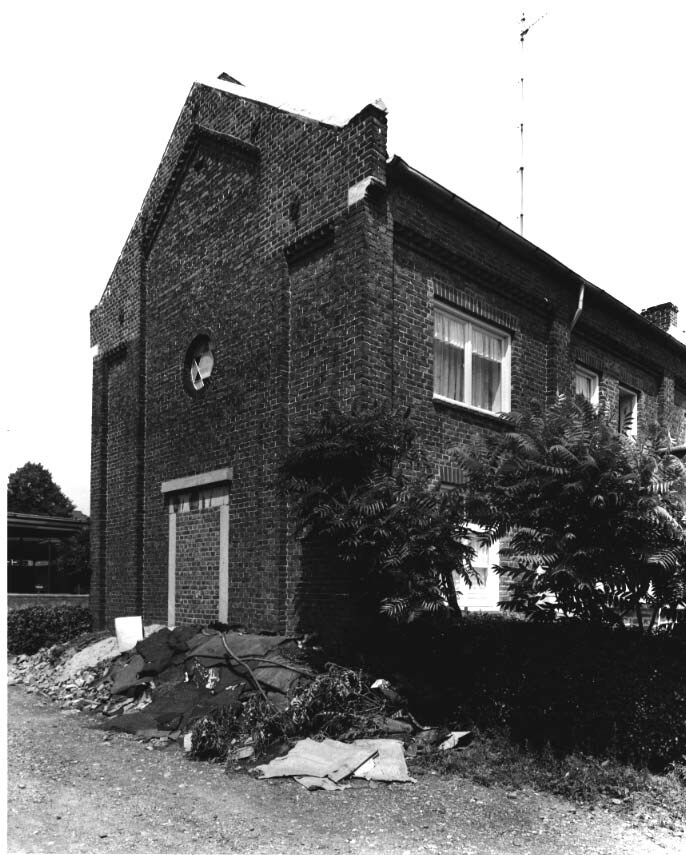
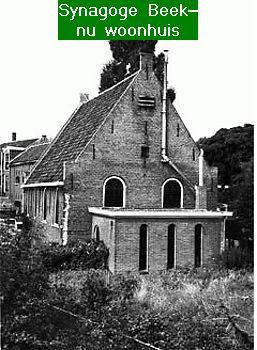
The synagogue was a very simple brick building. The local history published on Dutchjewry.org says its windows had segmental arches, and that over the entrance Psalm 118:20 was carved in Hebrew: 'This is the gate of the Lord, into which the righteous shall enter.' A low wall topped with an iron railing separated the plot from the road, and trees were planted around it. Inside, copper chandeliers hung from the ceiling and candlesticks stood on the floor and on tables. A 1967 photograph by the national monuments service, taken after the conversion into a house, shows a gabled brick building with stepped brick bands along the gable edge and a small round window high in the gable. The side wall by then had ordinary domestic windows. A second photograph, labelled 'Synagoge Beek - nu woonhuis', shows a steep-roofed brick hall with two round-arched windows in the gable end and a lower extension in front. The architect, the builder, the seating capacity and the arrangement of the ark and bimah are unknown.
Życie w synagodze
The inauguration in August 1866 was sung by the Jewish choir 'Halleluja' from Sittard. The Dutchjewry.org history mentions that the community employed cantors and teachers at different times, but it gives no names, and no rabbi of Beek is named in any source consulted. Weekly prayers were held until about 1900. After that the Jews of Beek, their numbers falling as families moved away or assimilated, went to Sittard for ordinary Sabbaths. Services were held in the Beek synagogue only on the High Holy Days, led by a rabbi who came from elsewhere. From 1890 the provincial authorities paid towards the upkeep of the building, but after 1900 little more maintenance could be done. In later years the synagogue came to be surrounded by an industrial area. No account of daily congregational life, of the officers of the community or of the synagogue's ritual objects has been found, and what became of its Torah scrolls is unknown.
Zniszczenie
The building suffered during the Nazi German occupation. H.A.J. van Rens, in his 2013 study of the persecution of Jews in Limburg, writes that after the liberation the synagogue of Beek was found to have been used as a warehouse and that its furnishings had been destroyed; he does not say who used it or who wrecked the interior. The congregation was not re-formed after the war, and in 1954, when it was merged with the Maastricht community, the synagogue was sold to the municipality of Beek. According to a caption in the Jewish Cultural Quarter collection and a local monument text, it was then converted into a house, and a photograph from the national monuments service shows it standing in that form in 1967. The house was demolished at some later date. Who demolished it, and when, is not recorded in the sources found. One memorial website gives 1954 as the date of demolition, but that is contradicted by the 1967 photograph. By 2004, when the municipality placed a plaque on the site, the building was gone.
Los społeczności
About twenty Jews lived in Beek when the Nazi German occupation of the Netherlands began in May 1940. According to the Jewish Cultural Quarter, twelve of them survived by going into hiding, and the others were deported and murdered in the camps. The text of the 1987 monument in the town centre gives slightly different figures: 26 members before the war, of whom 16 survived, most with the help of fellow villagers. The names of the victims were not found in the sources read for this entry. After the war the remaining Jews of Beek moved away, died, or converted to Catholicism, and no congregation was re-formed. In 1954 the community was formally merged with that of Maastricht. The Jewish cemetery on the Putbroekerweg, with stones from 1851 onwards, is maintained by the municipality, and a later burial ground on the Kloosterpad in nearby Urmond has one visible stone, dated 1892.
Miejsce dzisiaj
The synagogue stood on the Molenstraat, at the corner of the short street now called Synagogepad, near Molenstraat 12A. Nothing of the building survives above ground. A plaque placed by the municipality in 2004 marks the site, and a separate monument to the Jewish community stands about 90 metres away in the town centre. The present use of the plot itself was not documented in the sources consulted; the area around the old synagogue had become industrial during the twentieth century.
Czy masz coś do przekazania?
Zdjęcia, dokumenty, historie rodzinne lub wspomnienia o tej synagodze i jej społeczności pomagają zachować jej historię.
- Beek (Joodse gemeenten)
- Beek (Jewish communities)
- The Jewish community of Beek
- De vervolging van joden en Sinti tijdens de Tweede Wereldoorlog in de Nederlandse provincie Limburg, chapter 7 'Na de bevrijding' (p. 278)
- Beek Synagogue (marker)
- Jewish Monument, Beek (marker)
- Plaque Synagogue Beek
- Synagogepad, Beek (OpenStreetMap way 6772654)
Share a memory or thought
No comments yet. Be the first to add one.