
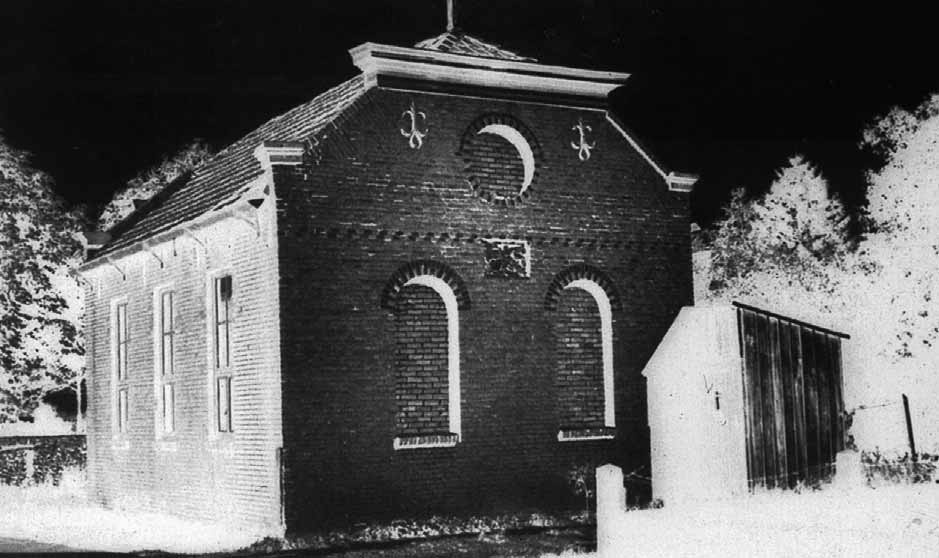
The story of Beilen Synagogue
Beilen is a village in central Drenthe, in whose municipality the Westerbork camp was later built. Jews had lived there since at least the early nineteenth century, trading in the surrounding countryside, and at first they worshipped in a house synagogue. In 1844 the merchants D.H. Trompetter and C.D. Rozeveld collected money for a room of their own, and in 1850 Beilen became a branch congregation. By 1880 the congregation had 59 members and its old prayer room had become what a contemporary called a 'miserable building'.
The new synagogue on the Schoolstraat was consecrated in 1885; the Jewish Cultural Quarter's community encyclopedia adds that non-Jewish residents of Beilen helped pay for it. The consecration address was given by M. Koekoek of Hoogeveen, and the next day the community held a ball with horn music from Groningen. Geheugen van Drenthe gives 1855 as the date of Beilen's own synagogue, which probably refers to the earlier prayer room. The synagogue's fiftieth anniversary was celebrated in 1935. After the war it was briefly used as a school room, passed to the municipality in 1951 and was demolished in 1952.
Where it stood for 67 years
Historic: Schoolstraat, Beilen, Drenthe; house number unknown. Today: Schoolstraat, 9411 PB Beilen, municipality of Midden-Drenthe (approximate; plot not identified).
Open larger map →The Jewish community
In 1809 Beilen and its surroundings had 21 Jewish inhabitants, in 1840 26, in 1869 71, in 1899 69 and in 1930 65, according to the Jewish Cultural Quarter's encyclopedia. Many were traders who travelled the countryside; the local historian H.M. Luning writes that many members were poor without needing relief, and that the one Beilen Jew on poor relief was supported by the Jewish board of Hoogeveen. A few Jews from Westerbork also attended services in Beilen. The congregation was organised from 1850 and was a branch of the community of Assen. In 1860 it founded a burial society and bought a cemetery on the open field (es) at Eursing, now within Beilen-Noord, which the municipality still maintains. Children were taught by teachers from neighbouring communities, and from 1903 religious lessons had their own building. Beilen had no ritual bath, so members used the ones in Assen and Hoogeveen. Luning describes the Jews of Beilen as wearing Drenthe dress and speaking the local dialect, using Yiddish among themselves.
Architecture and design
The only view found is a photograph reproduced by the Historische Vereniging Gemeente Beilen in 2007, captioned 'De synagoge aan de Schoolstraat'. It shows a small, free-standing brick hall with a pitched tiled roof. The gable front has a projecting stepped cornice with a small decorative finial at its peak, a round window with a brick surround in the gable, two iron wall anchors in the shape of fleurs-de-lis, a small rectangular stone between them, and two tall round-headed windows with arched brick hoods below. The side wall has several tall rectangular windows. The façade stone, now preserved, bears the Hebrew opening of Psalm 84:2, 'How lovely are your dwelling places, Lord of hosts', with the dates 1885 and 5645. The architect, builder, cost, seating capacity and interior arrangement are unknown, and no interior view has been found.
Life inside the synagogue
The consecration in 1885 was a village event: M. Koekoek of Hoogeveen gave the address, and the following day the congregation held a ball accompanied by a horn band from Groningen. Luning notes that these celebrations must have cost the small and largely poor community a great deal. No rabbi of its own is recorded; as a branch of Assen the congregation relied on teachers from neighbouring communities for religious instruction. When the congregation marked the synagogue's fiftieth anniversary in January 1935, the rabbis Hartz and Lichtenstein came from Groningen, and Hartz spoke of the Jewish nation finding a safe refuge in the Netherlands; the celebration ended with song and dance. The choice of Psalm 84 for the façade stone, Luning suggests, expressed both piety and the members' sense of being at home in Beilen. The congregation's own burial society cared for the cemetery at Eursing.
Destruction
After the Jews of Beilen were deported, the synagogue was looted. The Jewish Cultural Quarter's encyclopedia states that its contents were stolen and that the Nazi German occupiers then used the building as a garage. Luning writes that it was stripped of everything except its walls and roof; he does not say who did the stripping. After the liberation the municipality, with the consent of the Jewish community of Assen, converted the empty shell into a school room, spending money on it in 1947. In 1949 the Israëlitisch Kerkgenootschap, the national Jewish body, offered it for sale. Negotiations with the municipality stalled over the 1947 costs until the Roman Catholic board in Assen showed interest. In 1951 a council decision gave the old synagogue to the municipality free of charge, in exchange for repairing the cemetery fence and maintaining the cemetery permanently. The synagogue was demolished in 1952. The sources read do not record who carried out the demolition or why, although the municipality owned the building at the time.
The community’s fate
In May 1940 there were 52 Jews living in Beilen. Westerbork, built in Beilen municipality in 1939 as a camp for Jewish refugees from Germany, became from 1942 the transit camp through which most Dutch Jews were deported to the east. The Jews of Beilen were deported by the Nazi German occupiers to extermination camps, and only twelve of them survived the war. The Jewish Cultural Quarter's encyclopedia records that Beilen's mayor refused to cooperate with the deportations, and was dismissed and banished from Drenthe; his name is not given there. In the night of 2 to 3 October 1942 Jewish patients were also taken from the Beileroord psychiatric institution in Beilen and deported via Westerbork to Auschwitz. Too few Jews returned to sustain a congregation. In 1950 the independent Jewish community of Beilen was formally dissolved and merged into that of Assen.
The site today
The synagogue stood on the Schoolstraat in the centre of Beilen. The exact plot has not been identified in the sources read, and what stands on it today is unknown. Since 1991 the façade stone of the synagogue, with its Hebrew verse and the dates 1885 and 5645, has been displayed in the hall of the Beilen town hall. The Jewish cemetery at Eursing, bought in 1860, survives; after the Noordveld housing development of the 1990s it lies screened by a small public garden among houses in Beilen-Noord and is maintained by the municipality.
Notable names
M. Koekoek
UnknownGave the consecration address for the synagogue, 1885Koekoek, from the neighbouring Jewish community of Hoogeveen, delivered the consecration address when the new synagogue on the Schoolstraat in Beilen was inaugurated in 1885, according to H.M. Luning, who cites the Provinciale Drentsche en Asser Courant of 2 February 1885. His full name and office are not given in the source read; Hoogeveen was the larger neighbouring congregation that also supported Beilen's poor.
Biography or source →D.H. Trompetter
UnknownMerchant of Beilen; co-founder of the congregation's own prayer room, 1844Trompetter was one of the two Beilen merchants who in 1844 collected money for a prayer room of the community's own, the step that led to Beilen becoming a branch congregation in 1850 and eventually to the synagogue of 1885. He is named by H.M. Luning, citing F.J. Hulst's history of the Jews of Drenthe. Nothing further about his life was found.
Biography or source →C.D. Rozeveld
UnknownMerchant of Beilen; co-founder of the congregation's own prayer room, 1844Rozeveld, a Beilen merchant, collected money in 1844 together with D.H. Trompetter for a prayer room of the Beilen Jews' own, according to H.M. Luning. This initiative preceded Beilen's recognition as a branch congregation in 1850 and the building of the Schoolstraat synagogue in 1885. No further details of his life were found.
Biography or source →Do you have something to contribute?
Photographs, documents, family stories or memories of this synagogue and its community help keep its history alive.
Share a memory or thought
No comments yet. Be the first to add one.