

La storia di Fasanenstrasse Synagogue
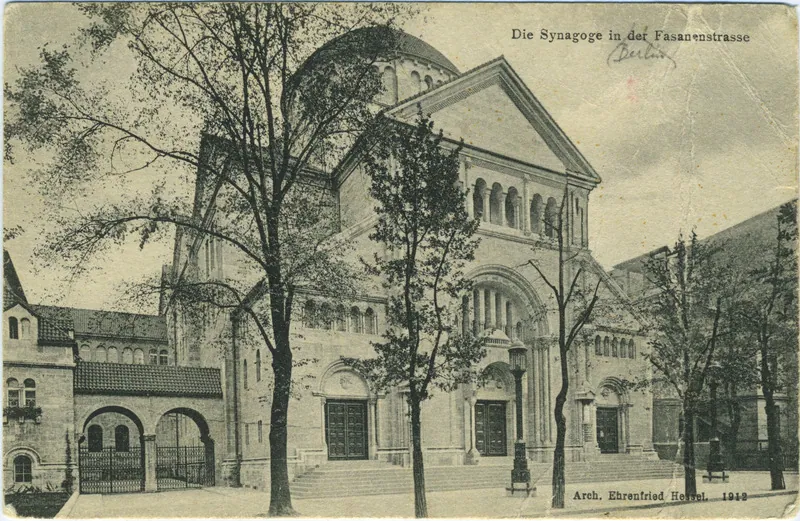
The Fasanenstrasse Synagogue stood at Fasanenstraße 79–80 in Charlottenburg, the prosperous 'new West' of Berlin, a few steps from the Kurfürstendamm. The Jewish community bought the plot in 1905 and held an architectural competition in 1907, which ended with three first prizes. The Berlin architect Ehrenfried Hessel's design was built between 1910 and 1912 under the community's master builder Johann Hoeniger, and the synagogue was dedicated on 26 August 1912.
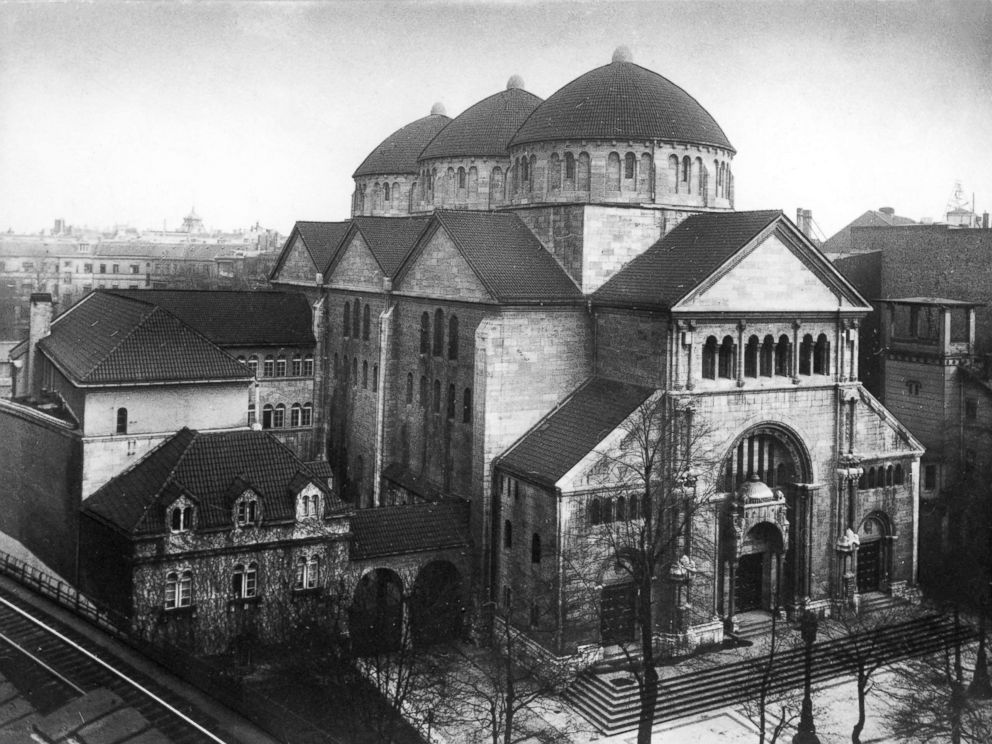
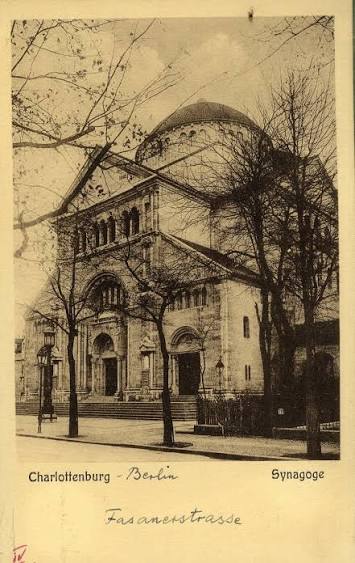
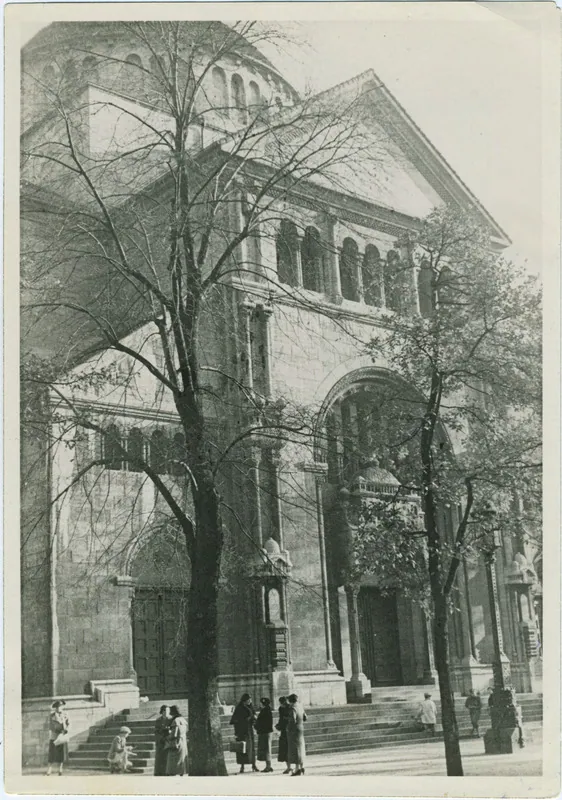
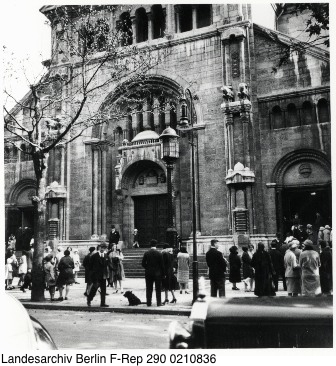
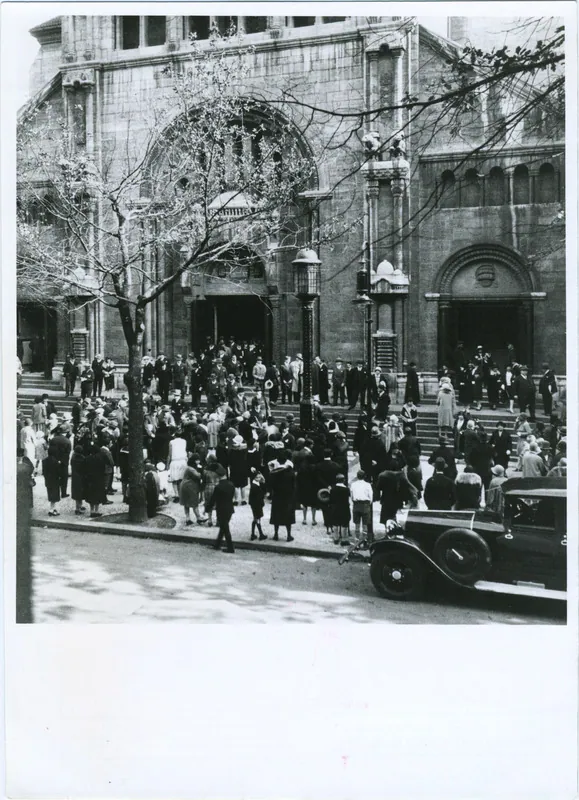
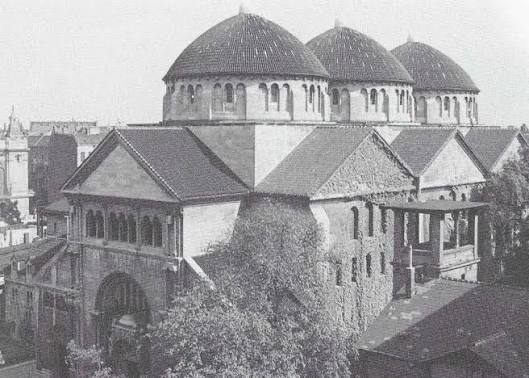
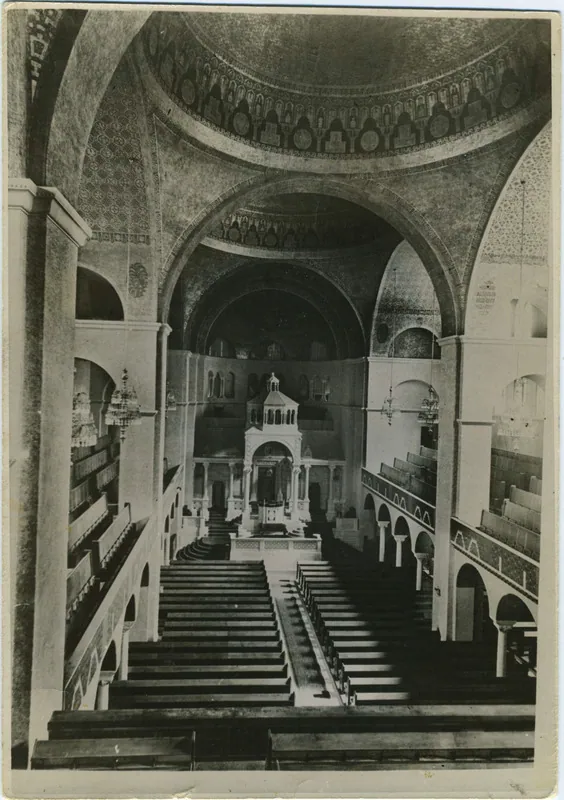
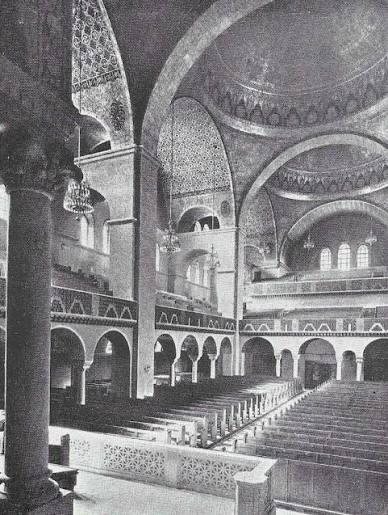
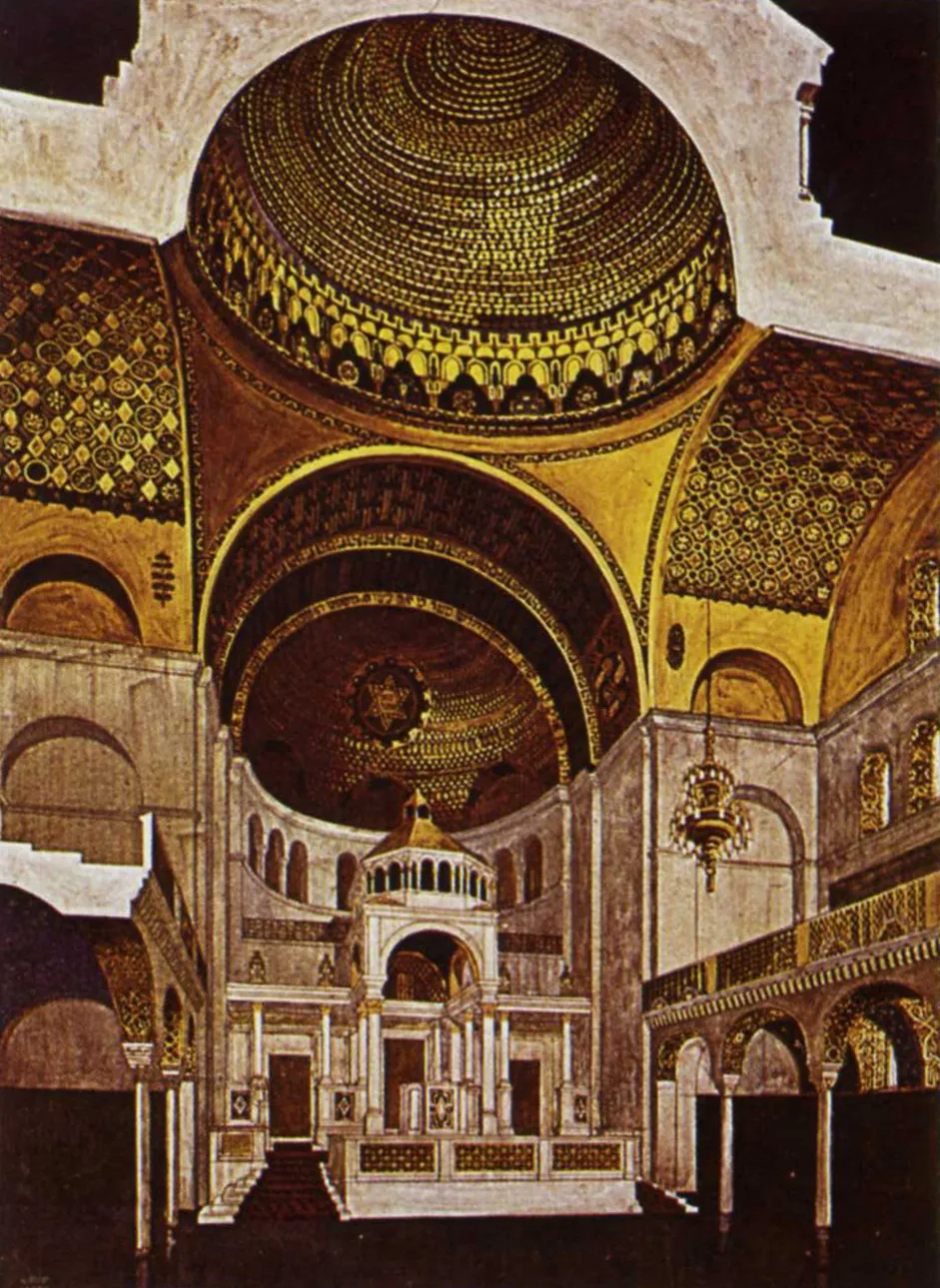
It was one of the largest and most important synagogues in Berlin, and the first large synagogue built outside the old city. Unlike the Rykestrasse Synagogue, hidden in a rear courtyard only a few years earlier, it faced the street openly behind a broad flight of steps, a confident statement by the liberal Jewish middle class of the western districts. Its three domes and neo-Romanesque, Byzantine-inspired forms echoed the nearby Kaiser Wilhelm Memorial Church.
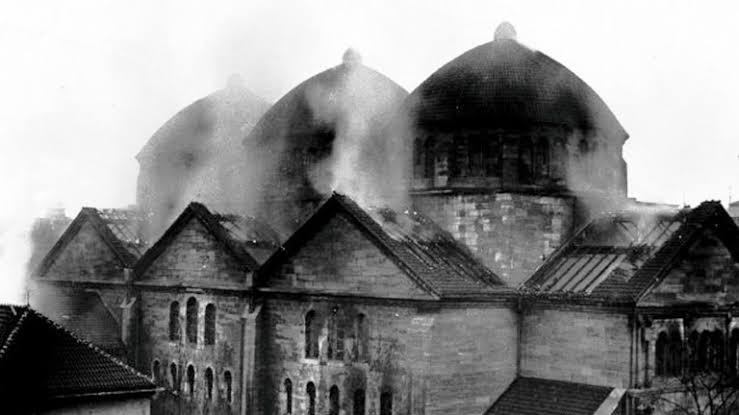
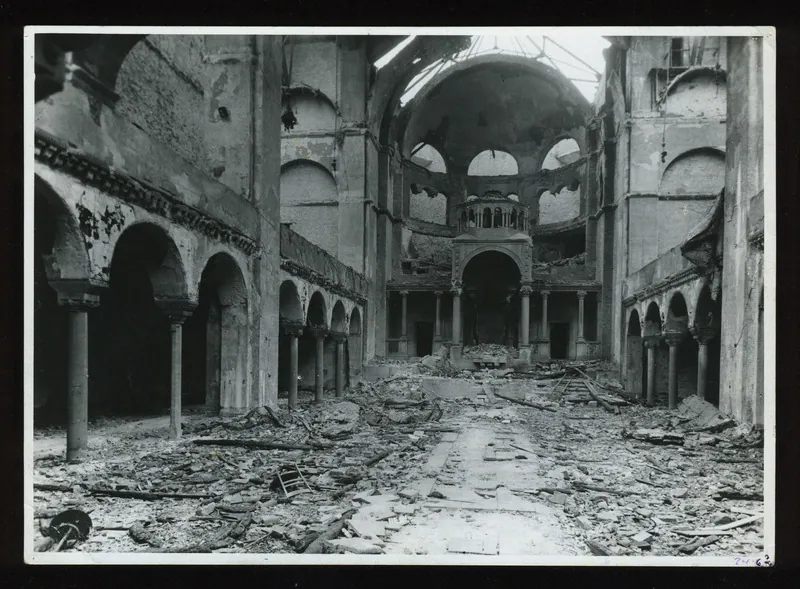
The liberal congregation worshipped with organ and choir. Leo Baeck, the leading thinker of German liberal Judaism, preached here as a community rabbi from 1912. On the night of 9–10 November 1938, during the November pogrom, Nazis broke in and set the building on fire while firefighters were stopped from putting it out. Bombing in 1943 damaged the ruin further, and it was demolished in 1957–58 to make way for today's Jewish Community House.
Where it stood for 26 years
Historic: Fasanenstraße 79–80, Charlottenburg, Berlin. Present: Jüdisches Gemeindehaus, Fasanenstraße 79–80, 10623 Berlin-Charlottenburg, which stands on the synagogue plot. Location approximate (plot and address confirmed; exact footprint not plotted).
Apri la mappa grande →La comunità ebraica
Charlottenburg, an independent city west of Berlin until it was absorbed into Greater Berlin in 1920, grew rapidly in the decades around 1900. Many prosperous Jewish families moved from the older districts of central Berlin to the new streets around the Kurfürstendamm; by 1910 around 22,500 to 23,000 Jews lived in Charlottenburg alone. Existing prayer rooms could not serve so many people, and in October 1905 the Jewish community decided to buy the plot at Fasanenstraße 79–80. A competition followed in 1907, with three first prizes awarded to Ehrenfried Hessel of Berlin, C. F. W. Leonhardt of Frankfurt am Main and the firm Heger & Franke. Hessel's scheme was chosen and carried out by the community's master builder Johann Hoeniger. The finished building showed how settled and self-assured the liberal Jewish middle class of western Berlin had become: a large house of worship placed openly on a street frontage rather than tucked behind apartment blocks.
Architettura e design
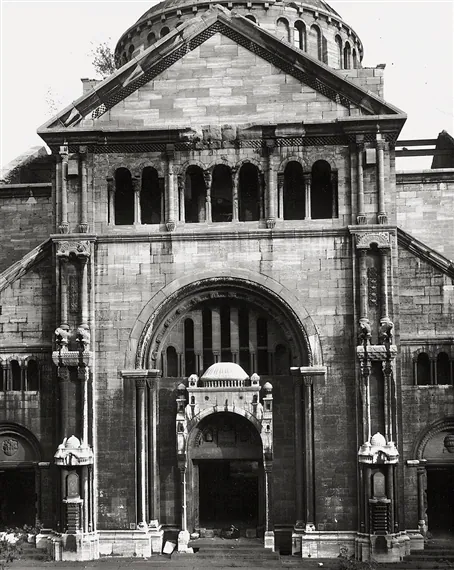
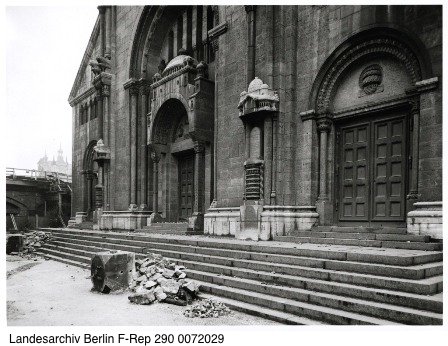
Hessel designed a longitudinal, three-aisled hall in reinforced concrete, roofed with barrel vaults and crowned by three large domes. Its neo-Romanesque forms drew on early Christian and Byzantine church architecture rather than the Moorish style used for many earlier German synagogues, and historians have described it as a clear break with the medieval-revival synagogues built before it. A wide flight of steps led up to a porch with a basilica-like cross-section; a smaller, richly carved portal was set within the great main arch of the pale limestone façade, framed by stacked pairs of half-columns on the central projection. Side wings grouped around a courtyard on the north side held a wedding hall, a weekday synagogue, the religious school, offices and staff flats. Sources report that the wedding hall was lined with majolica tiles from Emperor Wilhelm II's own Cadinen workshops, given by the Emperor. The main hall held about 1,720 worshippers; the competition brief and some later accounts speak of 2,000.
La vita nella sinagoga
The Fasanenstrasse Synagogue was a liberal synagogue of the Berlin Jewish community, with an organ and choir. From its dedication in August 1912 until its destruction, Magnus Davidsohn, a former opera singer who had sung under Gustav Mahler, served as chief cantor; from 1923 the blind organist and composer Richard Altmann played for services. Julius Galliner was a rabbi here and led the religious school in Charlottenburg; the district office gives his tenure as community rabbi as 1912 to 1938. Leo Baeck, appointed a Berlin community rabbi in December 1912, preached regularly at Fasanenstraße alongside the Lützowstraße and later Prinzregentenstraße synagogues. The complex also housed a weekday synagogue, a wedding hall and a religious school, making it a centre of Jewish education and family life for the western districts. From the early 1930s the synagogue faced growing antisemitic harassment, and some accounts state that the Nazi authorities forced it to close in 1936, though others describe the cantor serving until 1938.
Distruzione
During the nationwide pogrom of 9–10 November 1938, organised by the Nazi leadership after the shooting of the diplomat Ernst vom Rath in Paris, Nazi squads rampaged along the Kurfürstendamm smashing Jewish shops, homes and offices. Others went to Fasanenstraße, broke into the synagogue, wrecked the interior and set it on fire, reportedly using fuel from a nearby filling station. A Charlottenburg eyewitness recalled that the fire brigade arrived after passers-by raised the alarm but was not allowed to fight the fire: the Nazis stopped the crews from laying hoses, and the police turned their backs. The building burned out. It was one of the Nazis' most visible acts of destruction in western Berlin. In August 1939 the community was forced to sell the property to the Deutsche Reichspost for 350,000 Reichsmarks and to hand over the insurance money. Allied air raids on Charlottenburg in November 1943 destroyed much of what remained. The burnt-out ruin stood fenced off until the Jewish community and the Berlin Senate decided against rebuilding; it was demolished between November 1957 and May 1958.
Il destino della comunità
Around 160,000 Jews lived in Berlin in 1933, about a third of all Jews in Germany. Persecution drove roughly half of them to emigrate by 1939. Among the synagogue's own leaders, Rabbi Julius Galliner left for England in March 1939 and settled in New York, and chief cantor Magnus Davidsohn escaped to London in 1939, where he helped found the New Liberal Congregation, today's Belsize Square Synagogue. Leo Baeck stayed with the community as president of the Reich Representation of German Jews and was deported to Theresienstadt on 27 January 1943; he survived and died in London in 1956. The blind organist Richard Altmann, barred from his profession in 1935, was deported on 14 December 1942 and murdered in Auschwitz. Deportations from Berlin began in October 1941. More than 60,000 Berlin Jews were deported: over 10,000 to ghettos in eastern Europe, about 15,000 to Theresienstadt and more than 35,000 directly to killing centres in occupied Poland. Only a few thousand, mostly people who had survived in hiding or were protected by marriage to non-Jews, were still in Berlin in 1945. After the war a small community rebuilt itself under Heinz Galinski.
Il luogo oggi
Nothing of the synagogue stands in its original form. In 1957–59 the Jewish Community House (Jüdisches Gemeindehaus), designed by Dieter Knoblauch and Heinz Heise, was built on the site; its foundation stone was laid on 10 November 1957 and it opened on 27 September 1959. The community had hoped to keep the old street front, but only fragments were saved: the ornate domed portal of pale limestone now stands in front of the new entrance, so visitors still pass through it, and three stacked pairs of columns from the façade were reassembled as a free-standing column. Three shallow domes over the main hall recall the synagogue's three domes. A column capital was taken to Congregation Habonim in New York. The building, a listed monument, houses the Jewish adult education centre, a library and community offices. A memorial in the forecourt marks the site.
Nomi importanti
Leo Baeck
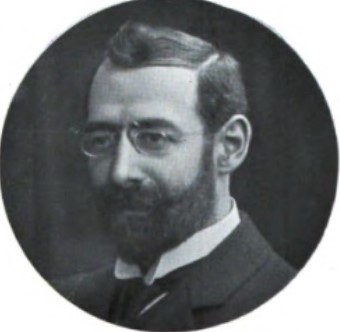
23 May 1873 – 2 November 1956Community rabbi and preacherThe leading rabbi and thinker of German liberal Judaism. Appointed a Berlin community rabbi in December 1912, he preached regularly at the Fasanenstrasse Synagogue, together with the Lützowstraße and Prinzregentenstraße synagogues. From 1933 he led German Jewry as president of the Reich Representation of German Jews, was deported to Theresienstadt in January 1943, survived, and died in London.
Biografia o fonte →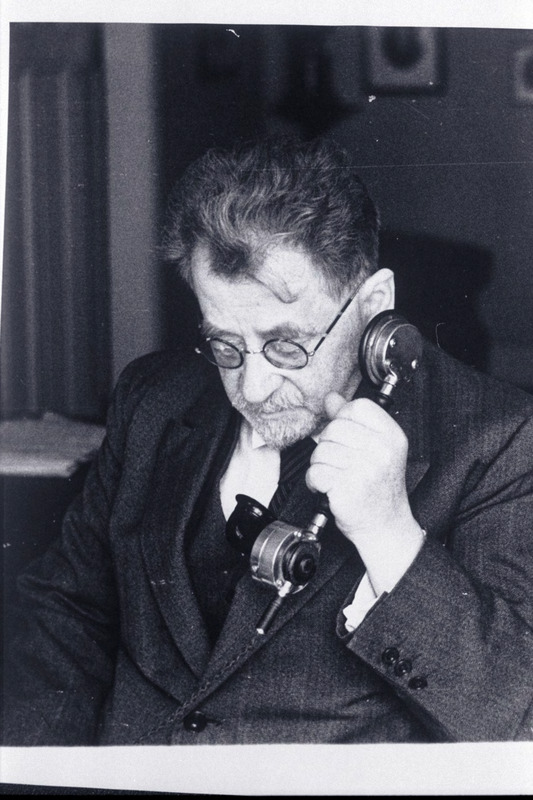
Julius Galliner
3 February 1872 – 7 September 1949Rabbi and head of the religious schoolRabbi and educator in Charlottenburg who preached at the Fasanenstrasse Synagogue and led the religious school; the Charlottenburg district office names him community rabbi from 1912 to 1938. Born in Zinten, East Prussia, he trained in Berlin and received his doctorate in 1897. After the synagogue's destruction he emigrated via England in March 1939 and died in New York.
Biografia o fonte →Ehrenfried Hessel
1877–1915 (years per Wikidata)ArchitectBerlin architect who shared first prize in the 1907 competition for the synagogue and whose design was built in 1910–12. His three-domed, neo-Romanesque and Byzantine-inspired scheme broke with the Moorish and medieval-revival styles of earlier German synagogues and placed a large Jewish house of worship openly on the street, making the building one of the most important synagogues in Berlin.
Biografia o fonte →Johann Hoeniger
1850–1913Community master builder (site architect)Master builder (Gemeindebaumeister) of the Jewish community, who supervised the construction of the synagogue from 1910 to 1912 to Ehrenfried Hessel's plans. Hoeniger turned the competition design into the finished reinforced-concrete, three-domed building with its side wings for the wedding hall, weekday synagogue, school and offices. He died a few months after its dedication.
Biografia o fonte →Magnus Davidsohn
2 November 1877 – 21 August 1958Chief cantorChief cantor (Oberkantor) of the Fasanenstrasse Synagogue from its dedication in August 1912 until the building was destroyed. A former opera singer who had performed at the Prague Opera and under Gustav Mahler, he was celebrated for his singing and his research into synagogue music. He fled to London in 1939 and helped found the New Liberal Congregation, today's Belsize Square Synagogue.
Biografia o fonte →Richard Altmann
18 June 1888 – after 14 December 1942OrganistBlind organist and composer, trained at the Klindworth-Scharwenka Conservatory, who played at the Fasanenstrasse Synagogue from 1923 after serving at the Levetzowstraße synagogue. Expelled from the Reich Music Chamber as a Jew in 1935, he still worked as an organist for the Jewish community in 1941. He was deported from Berlin on 14 December 1942 and murdered in Auschwitz.
Biografia o fonte →Hai qualcosa da condividere?
Fotografie, documenti, storie di famiglia o ricordi di questa sinagoga e della sua comunità aiutano a mantenerne viva la storia.
- Ehemalige Synagoge Fasanenstraße
- Jüdisches Gemeindehaus mit Portal der ehem. Synagoge und Mahnsäule (Obj. 09096152)
- Das Jüdische Gemeindezentrum in der Fasanenstraße 79/80 in Berlin-Charlottenburg (Ingolf Herbarth, Berliner Denkmaltage 2007)
- Synagoge Fasanenstraße 79-80
- Ein Haus für den »neuen Westen«
- Baeck, Leo Arje Lippmann
- Julius Galliner (photograph, 1935, F 3425)
- Magnus Davidsohn: "Wir beten Geschichte". Ein großer Berliner Kantor des 20. Jahrhunderts (Esther Slevogt)
- Fasanenstraße Synagogue - Berlin, Germany
- Destroyed synagogues of Berlin: Fasanenstrasse, Charlottenburg
- Synagoge Fasanenstraße
- Berlin
- Fasanenstraße 79, Berlin (address geocode)
- Richard Altmann (Sophie Fetthauer)
- Synagoge Fasanenstraße (Q820001)
Share a memory or thought
No comments yet. Be the first to add one.