
La storia di Beverwijk Synagogue
Beverwijk, a small town north of Haarlem in Noord-Holland, had Jewish residents from the late eighteenth century, and its congregation gained official standing in 1809. In 1810 it bought a house on the Breestraat called Spes Mea Deus ('God is my hope') and adapted it for worship. That building suffered badly in storms in 1853 and 1860, and the town warned that it might have to be closed and pulled down. The community answered with a joint effort that brought in money from the state, the province, the municipality and the Jewish communities of Amsterdam, The Hague and Rotterdam. The Joods Cultureel Kwartier describes the result as a new synagogue on the Breestraat, built in 1864 with a subsidy from the town; the local history on dutchjewry.org speaks of a restoration and reopening in 1863. Either way, the building that stood until after the Second World War dates from these years, and its silver jubilee was celebrated in 1889.
The synagogue served a congregation of roughly 120 to 135 people, which never had a rabbi of its own and was registered as a dependent congregation of Haarlem. It was renovated in 1922. In 1941 its interior was wrecked, and after the war the empty building was sold and demolished.
Where it stood for 81 years
Historic: Breestraat, Beverwijk, house number unknown. Today: Breestraat, Centrum, 1941 Beverwijk, Noord-Holland; site marked by a memorial (approximate pin on the street).
Apri la mappa grande →La comunità ebraica
The first trace of an organised Jewish community in Beverwijk is a circumcision register opened in 1793 by the gabbai David Davidson. A synagogue, probably a room in a private house, is mentioned in 1797, and around 1806 to 1808 the community rented a room for worship for 36 guilders a year. In 1808 the town counted 66 Ashkenazi Jews and no Portuguese Jews. Official recognition followed in 1809, when the community also bought a burial ground on De Kruiskrocht by the Kuikensweg at Wijk aan Zee. Numbers fell after the French period and around 1815 the congregation was in serious financial difficulty; 58 Jews were counted in 1821. It recovered by about 1840, when there were 81, and grew to 123 in 1869, 130 in 1899 and 135 in 1930. The community built a Jewish school in 1873. From the 1920s membership fell, partly because a lively community grew up in neighbouring Velsen. Between 1935 and 1938 young Zionist pioneers trained in farming at the 'Kibbutz Beverwijk' before emigrating to Palestine.
Architettura e design
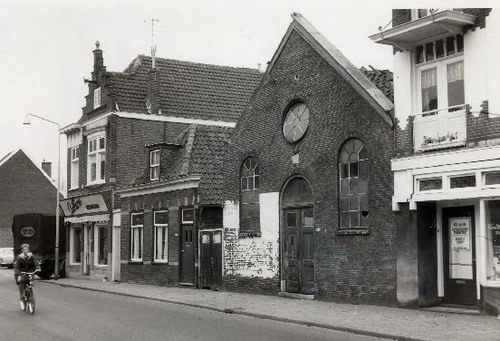
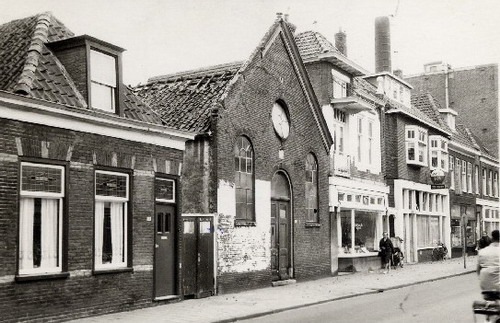
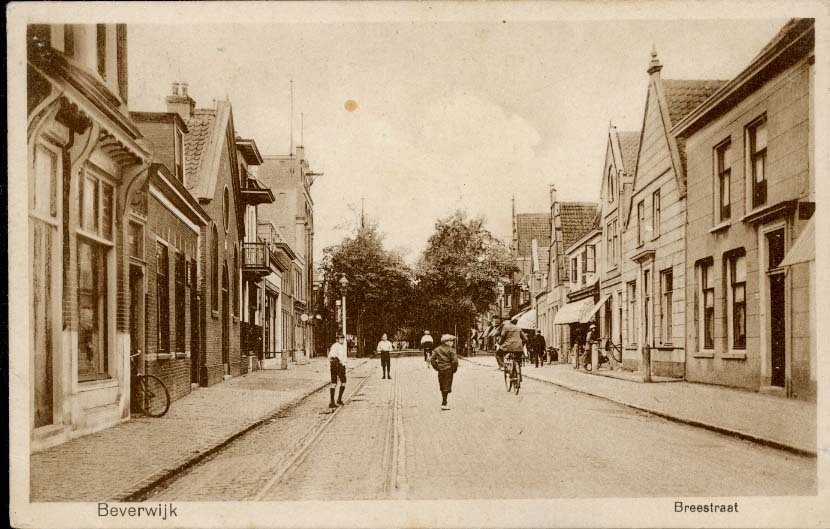
No plan, drawing or description of the building has been found, so its appearance is known only from photographs. A postcard of the Breestraat from about 1926 shows it as the third house from the left: a narrow brick building standing directly on the street line among ordinary town houses, distinguished by a steep pointed gable facing the street. Two later photographs show the front in more detail. The gable is outlined by a raised brick border and pierced near its apex by a large round window. Below it the front has two tall round-arched windows, and between them a round-arched doorway. A plain brick wing with a pitched tiled roof and a small door adjoins it on the left. The round arches and round gable window give the plain brick front a modest round-arched character. The architect, the builder, the seating capacity and the arrangement of the interior are unknown. The sources mention a tapestry for the Holy Ark and a red velvet cloth for the bimah, gifts at the silver jubilee of 1889.
La vita nella sinagoga
The congregation was too small and too poor to pay a rabbi, so special services were led by visiting rabbis, and daily worship depended on a cantor who also taught the children. One of the first parnassim, Jacob Levy Cohen, drew up rules of conduct for the synagogue. The early teacher David Lesser, appointed by 1806, taught reading and writing before leaving for Haarlem in 1809. The community's money troubles were constant: in 1829 its requests to drain the building into the street gutter were refused, and only in January 1830 was it allowed to connect to the Breestraat gutter on condition that a perforated plate was fitted. The synagogue's silver jubilee in 1889 was marked by redecoration and by gifts of a new curtain for the Holy Ark and a red velvet cover for the bimah. A general renovation followed in 1922, during which the community's archive was lost. Near by at Wijk aan Zee a foundation for a recovery and holiday home for Jewish children was set up around 1885, later known as the Joodsche Zee- en Boschkolonies.
Distruzione
During the occupation the synagogue was one of the buildings targeted in the anti-Jewish violence of 1941. The records of the Dutch Ministry of the Interior, now at the NIOD Institute for War, Holocaust and Genocide Studies, include a 1941 file titled 'Aanslag op de synagoge in Beverwijk' (attack on the synagogue in Beverwijk), among papers of the coordination committee of the Dutch Jewish denominations; its contents were not read. According to the local history on dutchjewry.org, in 1941 the interior of the synagogue was demolished by the Nazis, and services moved to the home of the cantor. What remained of the furnishings was confiscated in 1942. The Joods Cultureel Kwartier also records that the interior was badly damaged during the war. The brick shell survived. After the war the community, too small to continue, was merged into that of Haarlem in 1947, and the synagogue was sold and then demolished. Neither source gives the year of the sale or demolition, the seller or the buyer, so who demolished it is not recorded.
Il destino della comunità
After the Nazi German occupation of the Netherlands in May 1940, the Jews of Beverwijk were subjected to the same anti-Jewish measures as the rest of the country. In March 1942 they were ordered to leave the town and move to Amsterdam. From Amsterdam they were deported, first to the transit camp of Westerbork and from there to camps in Eastern Europe, where most of them were murdered. Several dozen escaped by going into hiding. According to the Joods Cultureel Kwartier about thirty Jews from Beverwijk returned alive from the camps after the war; the local history on dutchjewry.org counts 79 people who were deported and did not return and a remnant of 17 after the war. The survivors were too few to keep a congregation, and in 1947 the community was merged into that of Haarlem. In 1951 the Jewish cemetery on De Kruiskrocht was cleared and the remains were reburied in a special section of the Duinrust general cemetery, which the municipality of Beverwijk maintains.
Il luogo oggi
The synagogue stood on the Breestraat, one of the main streets of the old centre of Beverwijk, but no source consulted gives its house number, and the plot has not been identified on a map. The postcard of about 1926 shows it in a row of narrow town houses on a stretch of the street carrying tram tracks. The building has gone and nothing of it is known to survive. A memorial on the Breestraat, unveiled in November 1997, marks the place where the synagogue stood. The map pin for this entry is placed on the Breestraat in the town centre and marks the street, not the exact plot.
Nomi importanti
David Davidson
UnknownGabbai of the Beverwijk Jewish community, 1793Davidson was the gabbai who in 1793 opened the circumcision register of Beverwijk, the only one to survive and the earliest record of an organised Jewish community in the town; the first circumcision entered in it took place on 11 March 1793. At that time the community had no synagogue, and worship was held in private rooms, so he belongs to the congregation's earliest years, before the Breestraat building. Nothing further about his life was found.
Biografia o fonte →Jacob Levy Cohen
UnknownOne of the first parnassim of the Beverwijk congregationJacob Levy Cohen is named in the local history of the Beverwijk community as one of its first parnassim (lay leaders). He drew up the rules of conduct to be observed in the synagogue, which shows that he helped organise worship in the congregation's early decades, around the time it acquired its first building on the Breestraat. His dates and later life are unknown.
Biografia o fonte →Leendert Abrahams
UnknownTrustee of the Ashkenazi community of Beverwijk, 1808Abrahams was a trustee of the Ashkenazi community of Beverwijk. In 1808 he wrote to the authorities that the community had no church of its own and rented a room for worship, a letter that documents the congregation's situation shortly before it gained official status in 1809 and bought the house Spes Mea Deus on the Breestraat in 1810. Nothing more about him was found.
Biografia o fonte →David Lesser
UnknownTeacher (and probably cantor) of the Beverwijk community, by 1806 to 1809Lesser served the Beverwijk community by 1806 as its teacher, teaching the children reading and writing; in small Dutch congregations this post was usually combined with leading prayers. He left for Haarlem in 1809, the year the congregation was officially recognised, shortly before it acquired its synagogue building on the Breestraat. His later life was not traced.
Biografia o fonte →Hai qualcosa da condividere?
Fotografie, documenti, storie di famiglia o ricordi di questa sinagoga e della sua comunità aiutano a mantenerne viva la storia.
Share a memory or thought
No comments yet. Be the first to add one.