
Historia Bicske Synagogue
Bicske is a market town in Fejér county, near Budapest. Jews are said to have settled there in the eighteenth century, and Anikó Gazda's gazetteer records a first synagogue from the early nineteenth century. The community numbered 321 people in 1910 and 201 in 1941, when it was the largest Jewish community of the Vál district.
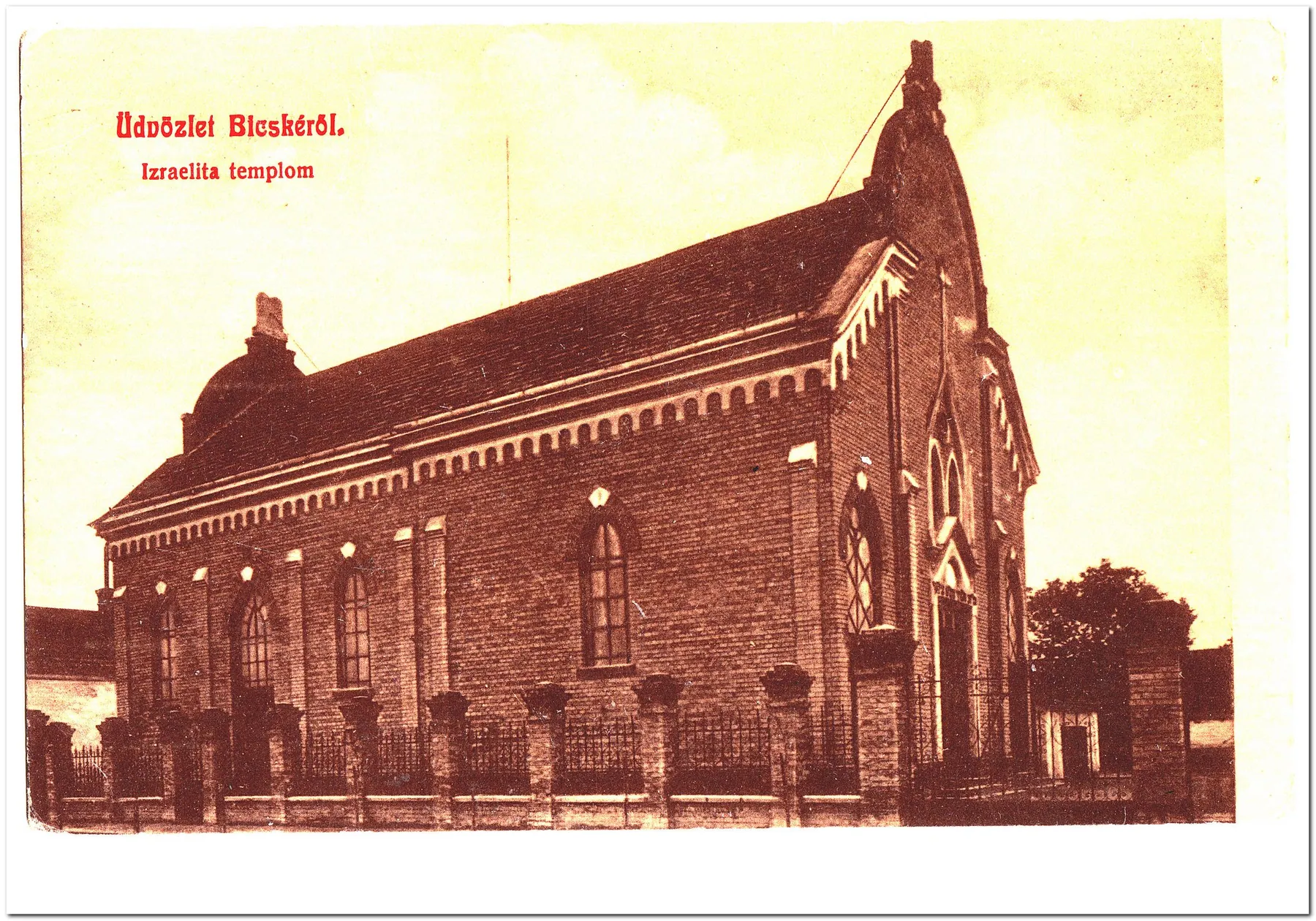
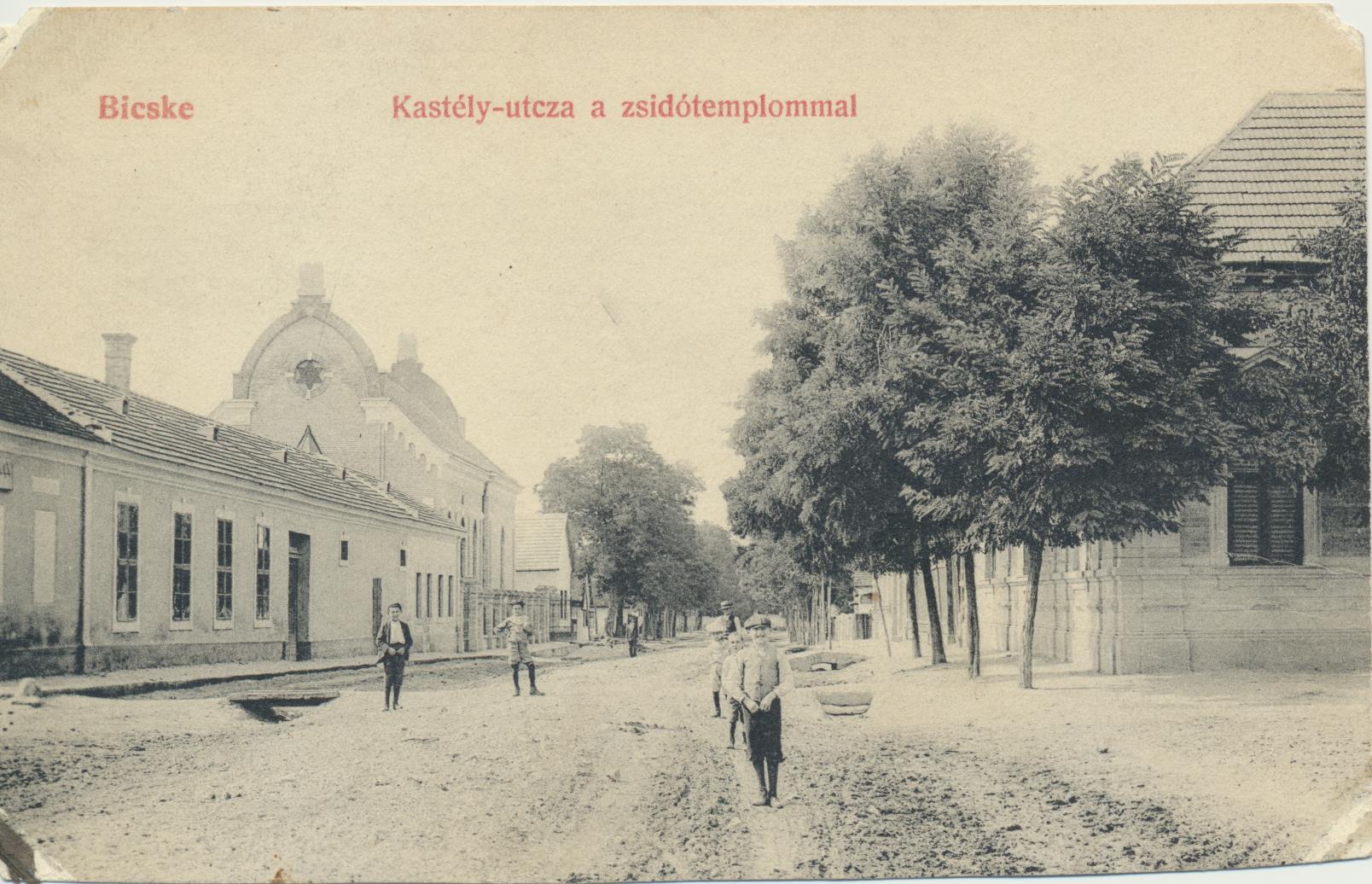
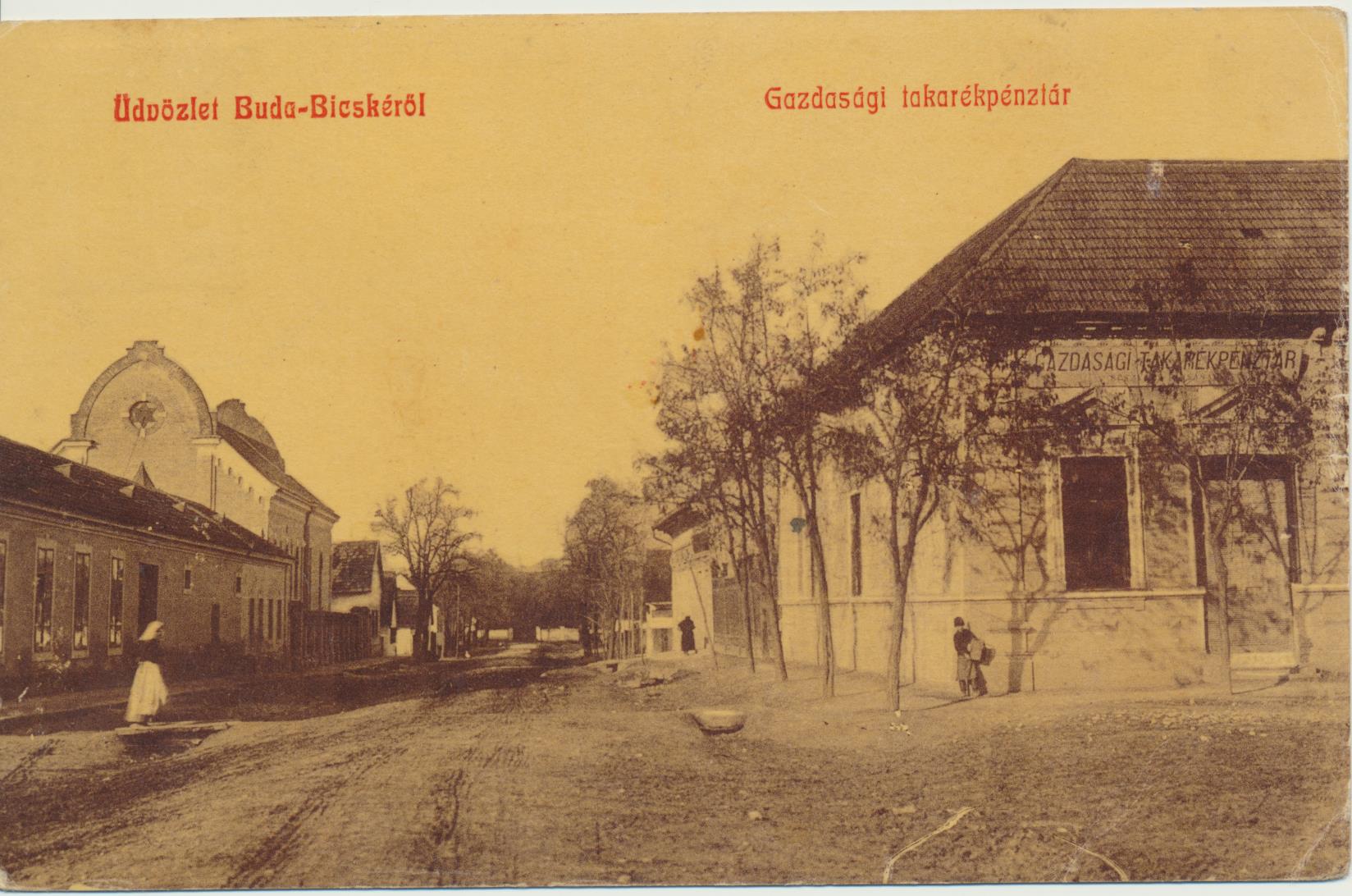
Gazda gives 1906 as the date of a second synagogue, and that is the building shown on postcards printed in the years that followed: a free-standing hall of pale brick on Kastély utca, the street running north-west from the market square, with pointed-arch windows and a curved gable carrying a Star of David. One postcard is captioned 'Kastély-utcza a zsidótemplommal', the street with the Jewish temple.
Most of the congregation followed the Neolog movement. Its rabbi, Dr Ernő Frenkel, and its president, Lipót Gottzier, were in office in 1944, when the Jews of Bicske were taken to the ghetto in the fortress of Komárom and deported to Auschwitz on 13 and 16 June.
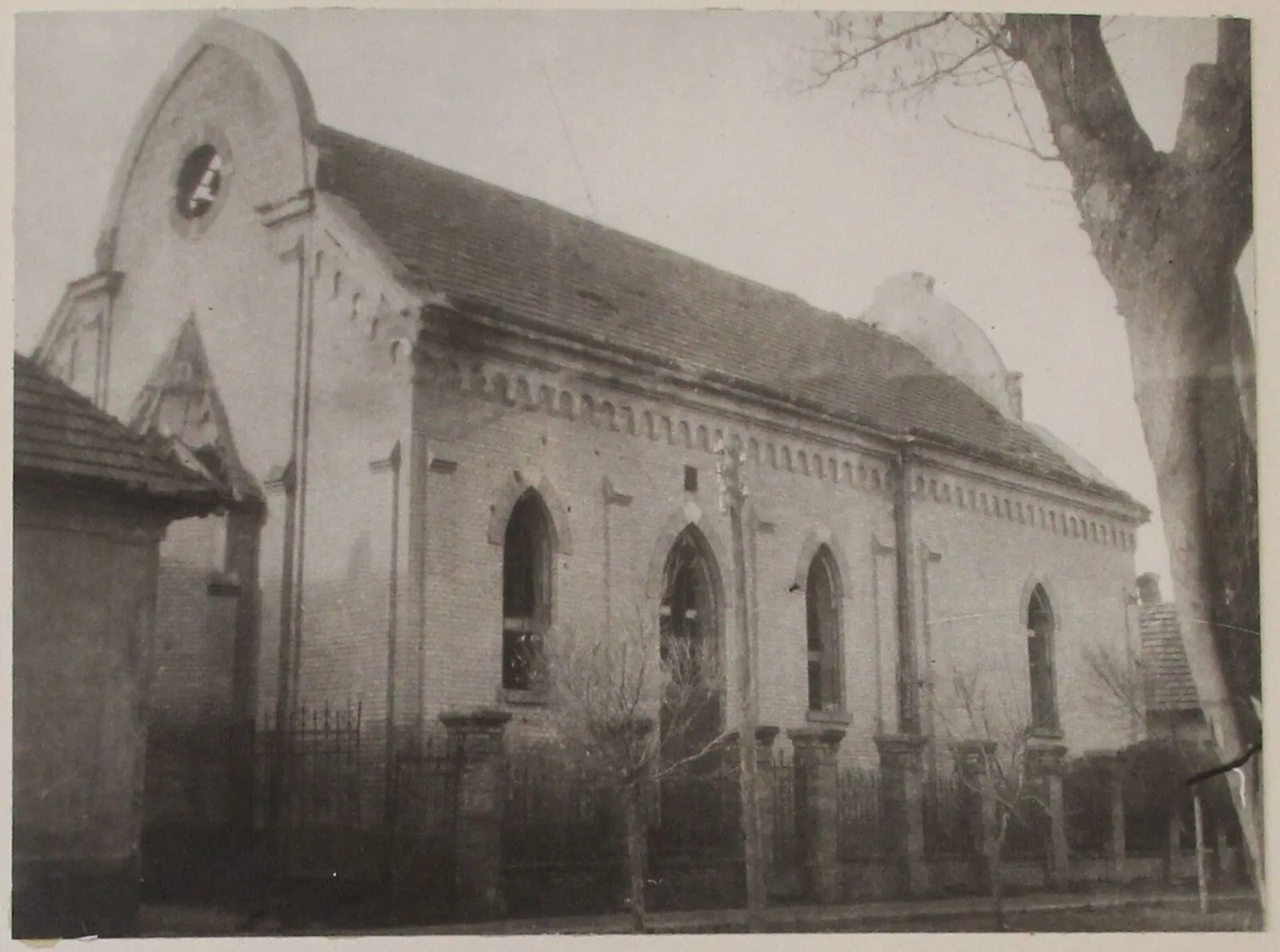
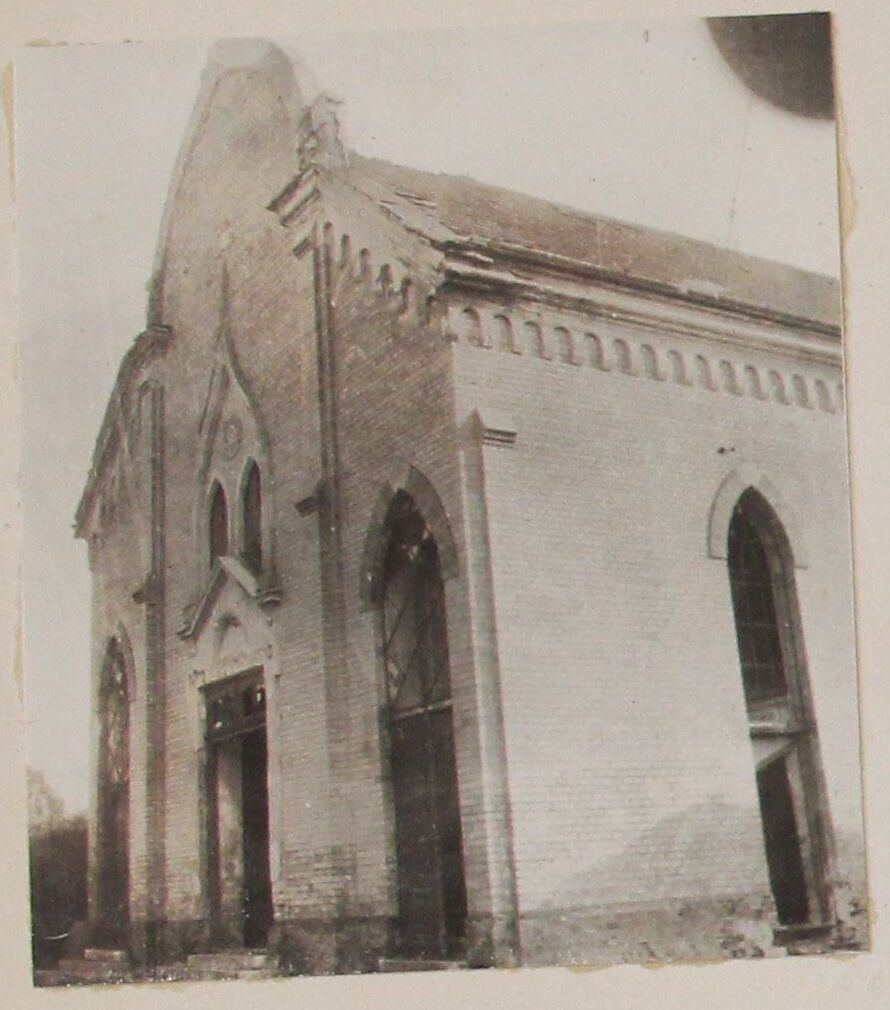
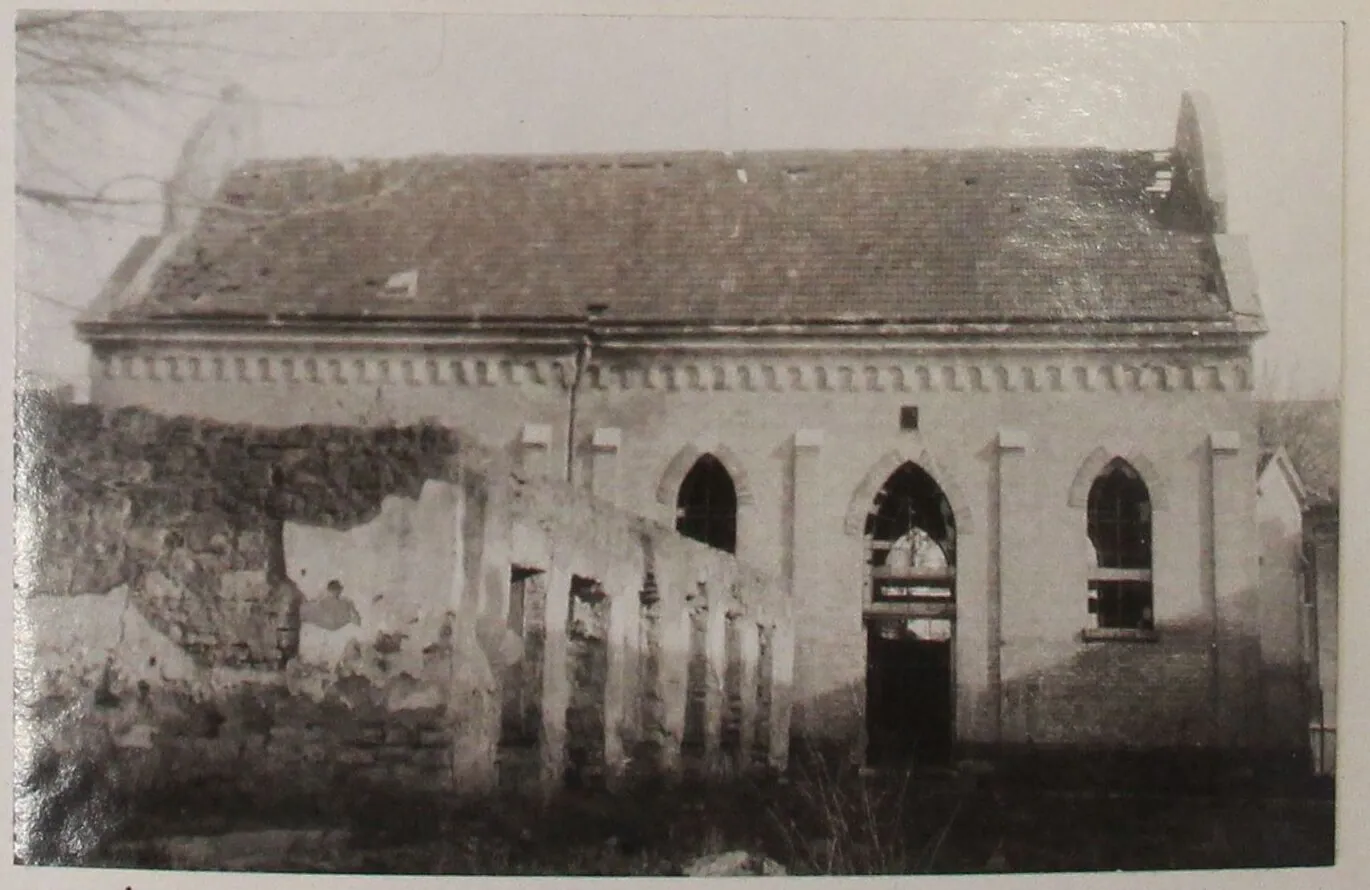
Four photographs dated 1949 in the Hungarian Jewish Museum and Archives show the synagogue still standing but stripped, with glassless windows, missing roof tiles and an empty interior. Gazda found it demolished when she surveyed the site between 1980 and 1987. No source found says when it was pulled down or by whom. A memorial unveiled on 12 December 2012 marks the site in today's Ady Endre utca.
Where it stood for nearly 65 years
Historic: Kastély utca (Kastély-utcza), Bicske, Fejér county; house number unknown. Today: Ady Endre utca, 2060 Bicske, near the Kossuth tér end, where the synagogue memorial stands; house number unknown (approximate).
Otwórz większą mapę →Społeczność żydowska
A Jewish community developed in Bicske in the eighteenth century, according to the Beit Hatfutsot summary quoted by English Wikipedia, and most of its members later identified with the Neolog movement. A local-history blog notes from archival correspondence that between 1856 and 1886 the births and deaths of Bicske Jews were entered in the registers kept at Zsámbék; by 1944 the town had its own registrar rabbi. Census figures show 231 Jews in 1880, 321 in 1910, 299 in 1920, 241 in 1930 and 201 in 1941, when they made up 2.4 per cent of the inhabitants and formed the largest Jewish community in the Vál district of Fejér county. The oldest dated stone recorded in the Jewish cemetery on Tompa Mihály utca is from 1882. English Wikipedia, citing the same Beit Hatfutsot text, says Jewish homes were looted and Jews were murdered in Bicske during the White Terror of 1919 to 1921. In 1944 the president was Lipót Gottzier and the rabbi Dr Ernő Frenkel. Dr Lajos Ullman, district physician from 1924 and remembered as the doctor of the poor, shared the community's fate in 1944.
Architektura i projekt
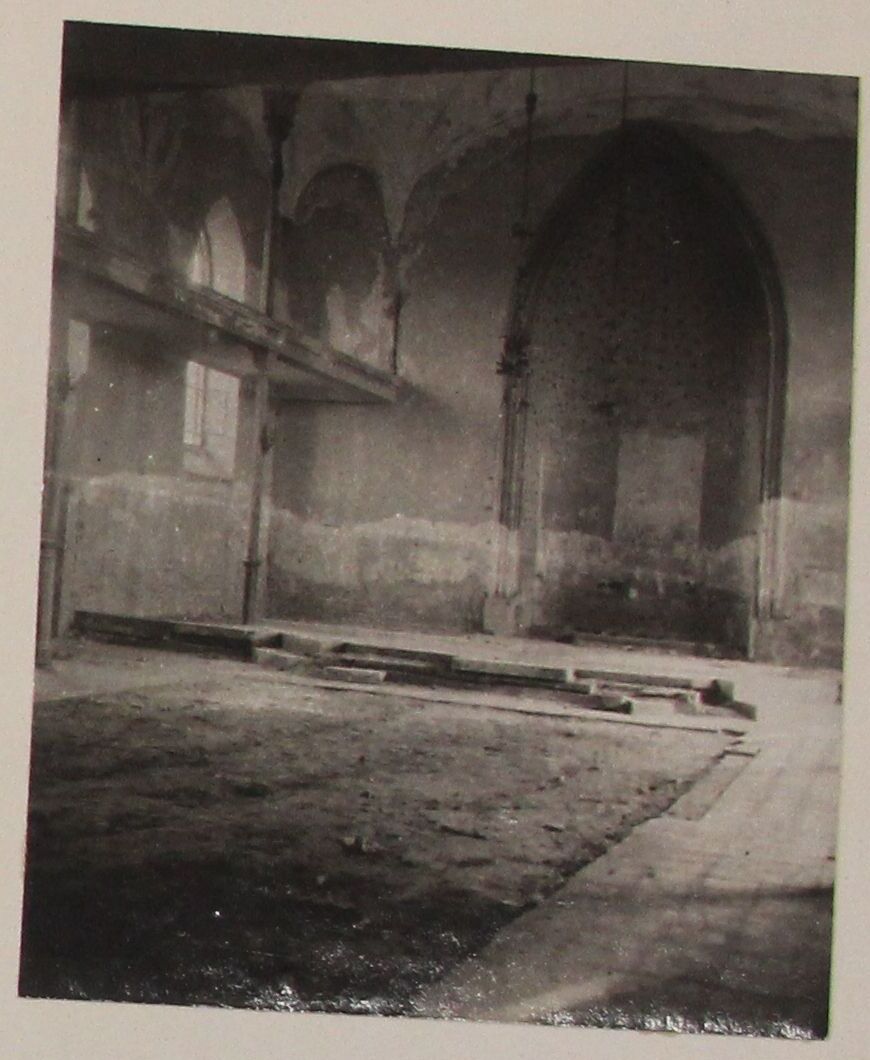
Postcards and the 1949 photographs show a free-standing rectangular hall of pale face brick under a pitched tiled roof, set behind a fence of iron railings between capped brick piers. The long walls had tall pointed-arch windows separated by flat pilaster strips, beneath a continuous arcaded brick frieze at the eaves. The entrance front, which in the street views faces the market square, had a central doorway under a steep pointed gablet, a pair of narrow pointed windows above it and a taller pointed window on either side. Over it rose a high curved gable pierced by a round window whose tracery formed a Star of David, crowned by a finial. At the opposite end a small dome stood above the roof. The interior photograph of 1949 shows a gallery on slender columns along the side wall, pointed arches painted or modelled on the upper walls, and a tall pointed-arched niche in the end wall with a low stepped platform in front of it. The pointed arches give the brick historicist design a Gothic character. The architect, the builder and the seating capacity are unknown.
Życie w synagodze
Most of Bicske's Jews followed the Neolog movement. The interior photograph of 1949 shows how the hall was arranged: a gallery carried on slender columns along the side wall, and a raised, stepped platform directly in front of the ark niche at the end of the room. The community also kept a school, which Christian children attended as well as Jewish ones, according to the Beit Hatfutsot summary quoted by English Wikipedia; in 1937 it had one rabbi and one teacher, with nine elementary and ten secondary pupils. In 1944 the burial society, the Szent Egylet, had 74 members and the women's society 40. Rabbi Ernő Frenkel wrote in the Neolog district bulletin, the Községkerületi Értesítő, in 1936 about how hard religious life was for a small provincial congregation: too few children and taxpayers to keep a school, none of the youth organisations that large communities had, and a heavier financial burden on each member. As registrar rabbi he kept the Jewish registers for Bicske, and a letter of August 1941 asked for the whole of the old Zsámbék registry to be transferred to the town.
Zniszczenie
The synagogue lost its congregation in 1944, when the Jews of Bicske were removed to the Komárom ghetto and deported. An album page in the Hungarian Jewish Museum and Archives, captioned 'Bicske templom 1949', holds four photographs of the building five years later. It was still standing and its walls and roof were whole, but the windows had lost their glass and most of their frames, tiles were missing from the roof, the walls of an adjoining structure lay in ruins, and inside nothing remained except the gallery, the empty ark niche and the steps of the platform. How this damage came about, whether through looting, wartime fighting or neglect, is not stated in any source found. Anikó Gazda, who surveyed synagogue sites across Hungary between 1980 and 1987, recorded the Bicske synagogue as demolished. It was therefore pulled down at some point between 1949 and the 1980s, under Communist rule. No source found gives the year, names who ordered or carried out the demolition, or says whether the building had first been sold by the surviving community or by the national Jewish office.
Los społeczności
After the Nazi German occupation of Hungary in March 1944, Rabbi Ernő Frenkel was made head of the local Jewish Council. A Mazsihisz report says the town's Jews were assembled on the market square, today's Kossuth tér, and taken to the main railway station. Randolph Braham lists Bicske among the places whose Jews were brought to the ghetto in the fortress of Komárom, from which nearly 5,500 people were deported to Auschwitz in two transports on 13 and 16 June 1944. The Berlin Holocaust memorial's biography of Dr Judit Hönigsfeld of Bicske says the Nazi SS, helped by Hungarian police, carried out the confinement. English Wikipedia, citing Beit Hatfutsot, adds that a ghetto was first set up in Bicske itself in May for the Jews of the town and nearby villages; it prints the year as 1940, an evident error for 1944. The physician Dr Lajos Ullman was among those who did not return. The number of survivors is unknown. A museum photograph shows a Holocaust commemoration at Bicske in the early 1960s with Rabbi László Hochberger and Endre Sós. The fenced Jewish cemetery on Tompa Mihály utca contains a Holocaust memorial.
Miejsce dzisiaj
The synagogue stood on the former Kastély utca, now Ady Endre utca, on the left-hand side as seen from Kossuth tér, the old market square. Nothing of the building is reported to survive. A memorial to the synagogue was unveiled on its site on 12 December 2012. The house number, and what else now occupies the plot, could not be established from the sources read. A local-history blog notes that a house seen beside the synagogue in an old market-day photograph is still standing. The map pin is an estimate worked out from the postcards, placed on the south-western side of Ady Endre utca near its Kossuth tér end, and is not a surveyed position.
Ważne postacie
Ernő Frenkel
UnknownRabbi and registrar rabbi of Bicske, in office by 1936 and until 1944Dr Ernő Frenkel was the congregation's rabbi and keeper of its registers in its last years. In 1936 he wrote in the Neolog district bulletin about the difficulties of small provincial communities, which lacked the children, taxpayers and youth organisations of the large ones. Anna Gergely's study of Fejér county names him as registrar rabbi in 1944 and says he was put at the head of the local Jewish Council after the Nazi German occupation. A local blog says he was appointed in 1931, but it confuses him with Jenő Frenkel of Szeged. His fate is unknown.
Biografia lub źródło →Lipót Gottzier
UnknownPresident of the Bicske Jewish community, in office in 1944Gottzier is named in Anna Gergely's study of the Jews of Fejér county as president of the Bicske community in 1944, alongside Rabbi Ernő Frenkel. As lay head of a congregation of about 200 people he was responsible for the synagogue on Kastély utca, the burial society and the women's society in the months before the deportation. Nothing more about his life or his fate was found.
Biografia lub źródło →Lajos Ullman
1896-1944District physician of Bicske, deported with the Jewish community in 1944Dr Lajos Ullman, born on 21 December 1896, began practising in Bicske in 1924 as the municipal district doctor and was remembered as the doctor of the poor. Mazsihisz, reporting the unveiling of the synagogue memorial in 2012, singled him out as the man who accepted the fate of the Jewish community in 1944; the circumstances and place of his death are not known.
Biografia lub źródło →Czy masz coś do przekazania?
Zdjęcia, dokumenty, historie rodzinne lub wspomnienia o tej synagodze i jej społeczności pomagają zachować jej historię.
- Zsinagógák és zsidó községek Magyarországon (Fejér county table)
- Bicske, zsinagóga, külső és belső (album page with four photographs, captioned 'Bicske templom 1949', inv. 16.015)
- Bicskei zsinagóga (postcard 'Bicske, Kastély-utcza a zsidótemplommal', inv. F01.296)
- Bicskei zsinagóga az utcaképpel (second scan of the Kastély-utcza postcard)
- Buda-Bicske (postcard 'Üdvözlet Buda-Bicskéről, Gazdasági takarékpénztár', inv. F02.172)
- Békesség legyen veletek - Képeslap az egykori bicskei zsinagógáról
- Posts tagged 'zsinagóga'
- Megemlékezés az egykori bicskei zsinagóga előtt álló emlékműnél
- Bicske teljes lakossága 1880-ban 5134 lélek, 1941-ben 8139
- Bicske utolsó főrabbija Tusnádfürdőn született 1902-ben...
- A Bicskei Zsinagóga hajdani épülete előtt emlékkövet helyeznek el
- A Fejér megyei zsidóság megsemmisítése (1938-1944)
- A népirtás politikája: a Holocaust Magyarországon, p. 659 (Zone III: Komárom)
- Dr. Judit Hönigsfeld (biography, Room of Names)
- Bicske
- List of synagogues in Hungary (Fejér county table)
- Bicske Jewish Cemetery
- Bicskei holokauszt megemlékezés (photograph, 1960/1965, inv. 2023.18)
- Photograph record with biography of Rabbi Jeno Frenkel
- Ady Endre utca, Bicske (OpenStreetMap way 87079994)
Share a memory or thought
No comments yet. Be the first to add one.