
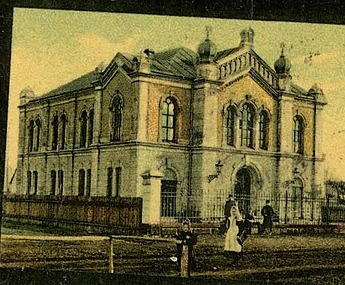
La storia di Bohumín Synagogue
Bohumín, a town on the present Czech-Polish border, was an important railway crossing in central Europe. Jews settled there in growing numbers because of the railway and the trade it brought, and they were for many years administered from the communities of Teschen and later Mährisch Ostrau. Around 1880 they appear to have formed the Israelitischer Cultusverein Oderberg, and an independent community was set up in 1911. The synagogue was the community's principal building. It stood in Nový Bohumín, the new town that grew up by the station, at the corner of the present Žižkova and Štefánikova streets. It was designed by Jakob Gartner, a Vienna-based architect born in Přerov who built many synagogues in the Habsburg lands. Sources disagree on its date: a local history and the Jewish Virtual Library give 1900, with a dedication on 9 September 1900, while a 2017 Vienna University of Technology thesis and the German Wikipedia article give construction from 1901 to 1904 and an opening on 30 October 1904. The building was burned after the Nazi German occupation of the town in 1939 and cleared by spring 1940. Its site is now a car park.
Where it stood for nearly 40 years
Historic: Neu-Oderberg (Nový Bohumín), corner of the present Žižkova and Štefánikova streets. Today: town car park at that corner, Nový Bohumín, 735 81 Bohumín (approximate).
Apri la mappa grande →La comunità ebraica
The beginnings of Jewish settlement in Bohumín are described as largely unclear. The Jewish Virtual Library reports that six Jewish families lived in various places of the Oderberg estate in 1751, and that Jews settled in the town itself early in the nineteenth century, drawn by its position as a border town and a major railway crossing; the town later also had an oil refinery. The first mention of a Jewish cemetery dates from about 1880, which is taken as the likely date of the religious association, the Israelitischer Cultusverein Oderberg. The community was administered first by Teschen and then by Ostrava before becoming independent in 1911. The 1910 census counted 585 people of the Jewish faith in a town of nearly 22,000, and in 1931 the community numbered 722, or 6.6 per cent of the population. A memorial book of 1925 says that much of the trade of Bohumín and its surroundings was in Jewish hands; Jews worked in commerce, finance and some industry. A Jewish centre opened in 1924, and in 1933 the town hosted a large Maccabi sports festival.
Architettura e design
The synagogue was a free-standing rectangular building of two storeys, about 26 by 17 metres according to the 2017 Vienna thesis by Danijela Ratkovic, which reconstructed it virtually from a postcard and a city map. It had a main nave with two side aisles and an apse at the east end. The women's gallery ran above the aisles and was reached by stairs inside two corner towers on the entrance front. The local history describes the style as neo-Gothic with Moorish elements, while the German Wikipedia article calls it Moorish, in the orientalising manner common in synagogues of the period. The entrance front had a large rose window under a gable or tympanum bearing the Tablets of the Law, and the towers were topped by onion domes. The architect was Jakob Gartner of Vienna, who was born in Přerov in 1861, set up his own practice in 1888 and designed many synagogues, several of them in historic Hungary. The provincial governor, Count Larisch-Mönnich, is recorded as contributing to the cost. Seating capacity, building contractor and the interior fittings are unknown.
La vita nella sinagoga
Very little is recorded about worship in the building. According to the local history, the dedication on 9 September 1900 took place about two weeks before the High Holidays and was attended by rabbis, state and town officials, representatives of the churches and of veterans' associations; Count Larisch-Mönnich and a representative of the Rothschild family sent greetings. The building had a separate women's gallery above the side aisles. Whether the congregation followed a liberal or Orthodox rite is not documented in the sources read, and no description of services, music or communal celebrations held in the synagogue was found. Beside the synagogue the community later had a community house on present Žižkova street, and a Jewish centre opened in 1924. The names of the rabbis, cantors and community presidents who served the synagogue were not found in the sources consulted.
Distruzione
Nazi German forces occupied Bohumín at the start of the Second World War. The Jewish Virtual Library states that the synagogue was burned on Rosh Hashanah 1939, that is in mid-September, in the first days of the occupation. The German Wikipedia article, based on the Alicke lexicon, says that the German occupiers set it on fire and demolished it in 1939 and 1940, with the destruction complete by spring 1940. The local history gives May 1940 and says that the Nazis burned the synagogue and that its debris was ground down, and the Ratkovic thesis says the building burned down completely between 1939 and 1940. Taken together, the sources indicate that Nazi German occupiers set the synagogue alight in the autumn of 1939 and that the burnt shell was cleared in the spring of 1940. None of the sources names the unit or the officials responsible for the arson or the clearance.
Il destino della comunità
During the occupation, according to the Jewish Virtual Library, Jews of Bohumín were made to rebuild a bridge that had been blown up by the retreating Poles. Later in 1939 most of the town's Jews were deported by the Nazis to Nisko in occupied Poland. What became of each of them afterwards, and how many were murdered in ghettos and camps, is not recorded in the sources read. The local history counts about 400 Jewish residents before the Holocaust and states that only eleven came back from the concentration camps in 1945; almost all of the survivors had died or emigrated by 1948. The community was not revived after the war. The Jewish cemetery survives with about forty gravestones; it was restored by the town in 2007, and two weeks later unknown vandals destroyed most of the stones that had been put back.
Il luogo oggi
The plot at the corner of Žižkova and Štefánikova streets in Nový Bohumín where the synagogue stood is now a car park owned by the town of Bohumín, according to the local history; no part of the building survives above ground. The former Jewish community house on Žižkova street still stands and houses a primary art school. A memorial to the Holocaust victims of Bohumín was unveiled in the town in 2004. The map pin for this entry uses the coordinates given in the German Wikipedia article, which lie close to the street corner named in the local history.
Nomi importanti
Jakob Gartner
1861-1921Architect of the synagogueGartner, born in Přerov in Moravia and active in Vienna from 1888, was one of the busiest synagogue architects of the late Habsburg monarchy. Both the local history and the 2017 Vienna thesis name him as the designer of the Bohumín synagogue, a towered temple with nave, aisles and apse, with women's galleries reached through two corner towers. No other link between Gartner and the congregation, such as a later commission, was found.
Biografia o fonte →Hai qualcosa da condividere?
Fotografie, documenti, storie di famiglia o ricordi di questa sinagoga e della sua comunità aiutano a mantenerne viva la storia.
Share a memory or thought
No comments yet. Be the first to add one.