
The story of Bolsward Synagogue
Bolsward is one of the old towns of south-west Friesland, a short distance from Sneek. Jews lived there from 1775, and in 1786 the town magistrate recognised their community and recorded its regulations in the town's police book. A first synagogue, described in 1790 as a small storeroom in which services were held, stood in the Kerkstraat behind the town hall. When the municipal architect declared it unsafe in 1838, the congregation bought a plot for 430 guilders and, with the help of the town, other denominations, Amsterdam Jews and the Leeuwarden community, raised the money for a new building on the same site. It was dedicated in 1840 and renovated in 1889.
From 1821 Bolsward was a ring synagogue under the chief synagogue of Leeuwarden. The congregation reached its peak of about 132 members in the 1840s and then shrank steadily as families moved to the larger cities. In 1911 it was merged into the Sneek community, and the synagogue, the schoolroom and the beadle's house were sold. The building was placed on the provisional list of monuments in 1930, but in 1941 its decorated front was demolished. After the war it served as a storeroom until it was pulled down; the Jewish Cultural Quarter dates the demolition to 1991, while W.M. Dooper reports a municipal decision to demolish it in 1993.
Where it stood for nearly 160 years
Historic: Kleine Kerkstraat, Bolsward, behind the town hall (house number unknown). Today: Kerkstraat area, 8701 Bolsward, municipality of Súdwest-Fryslân, Friesland; approximate.
Open larger map →The Jewish community
Jews are recorded in Bolsward from 1775. A text by H. Beem notes that Jewish residents swore an oath under the regulations of the Prince of Orange in 1748, and that in January 1786 the town allowed them a burial ground on the town rampart; in March 1786 the magistrate recognised the community. The first cemetery on the Stadswal was probably also used by Jews from Sneek. From 1829 the municipality let the community use part of the general cemetery. Under the national organisation of 1821 Bolsward became a ring synagogue of the Leeuwarden chief synagogue. A charitable society supported poorer members from 1828 to 1842. The Jewish population of Bolsward and its surroundings was 72 in 1809, 114 in 1840 and about 132 in 1846-47, then fell to 79 in 1869, 70 in 1890 and 32 in 1899. In 1886 there were fourteen families, ten of them observant. After the merger with Sneek in 1911 the remaining Jews went there for services, and in 1930 only one Jew lived in the town.
Architecture and design
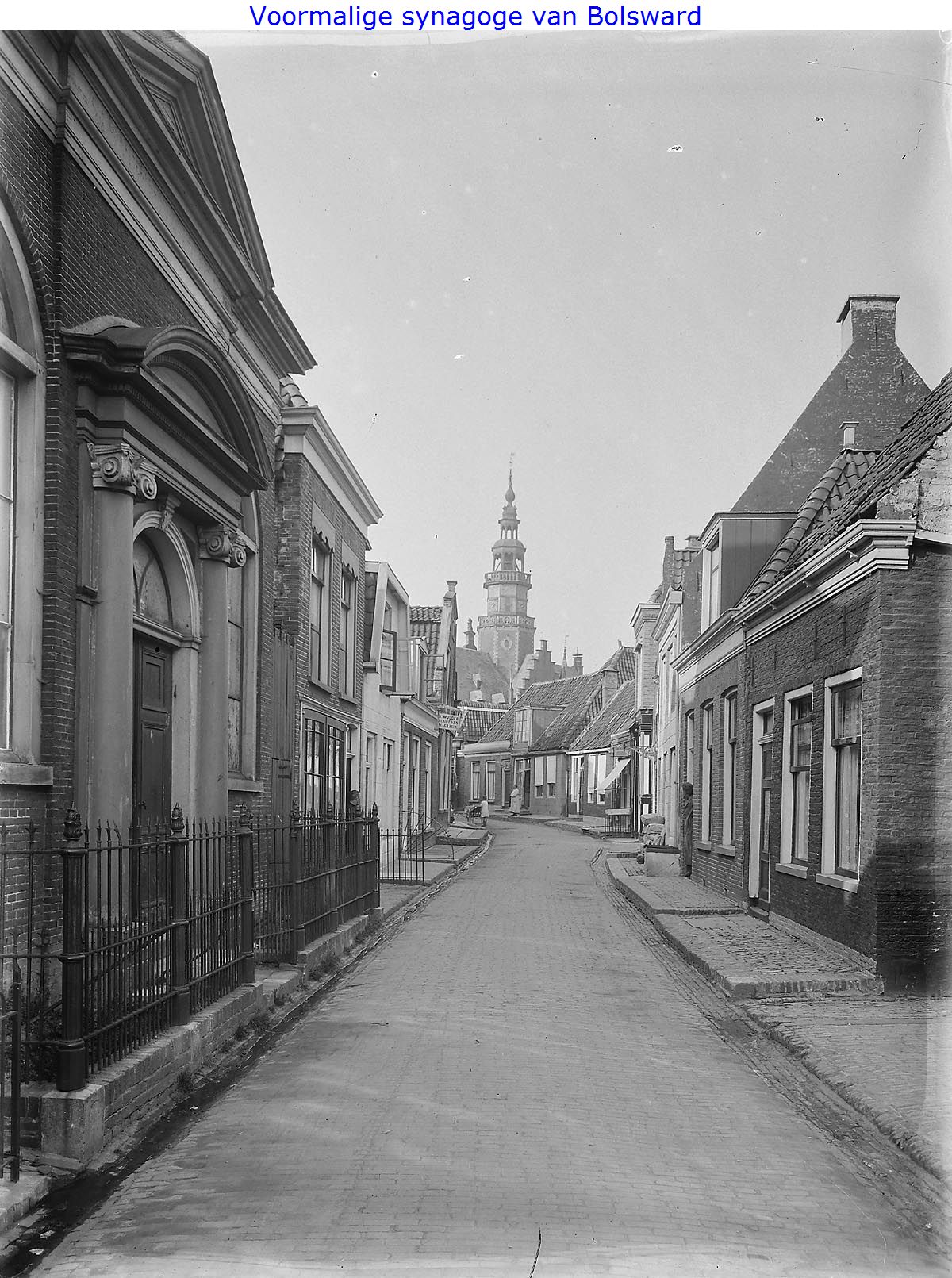
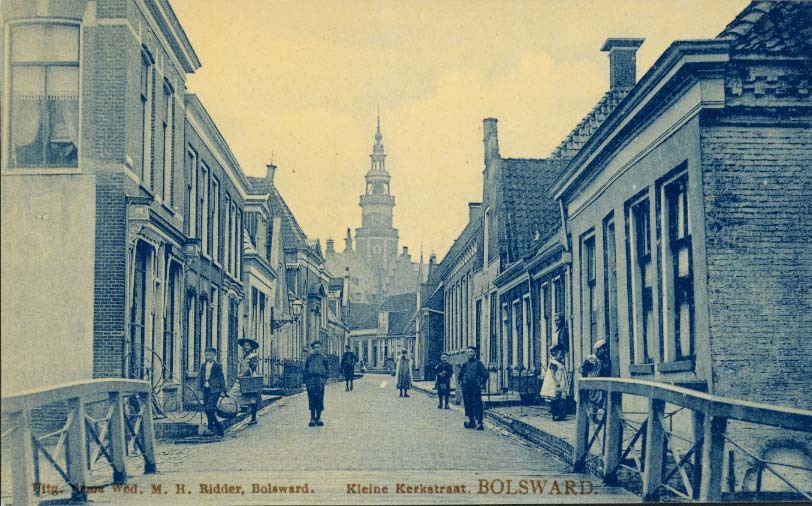
The synagogue of 1840 was a brick hall set back slightly from the street and separated from it by an iron railing. An undated photograph and a postcard of about 1920 show its street front: a tall gabled facade with a projecting central section, crowned by a triangular pediment, and a main entrance framed by two classical columns with Ionic-style capitals carrying an entablature and a curved pediment over an arched doorway with a fanlight. Tall round-headed windows flank the entrance. Dooper describes the same arrangement, a facade with a protruding decorated part and a main entrance with two classical pillars and pediments. The new building was estimated to cost 3,600 guilders, of which the congregation itself held 1,600. Following the practice of Gorredijk and Sneek, three seats were reserved for the parnassim. The older building on the site was kept and reused as a schoolroom, a home for the shamash and a mikveh. The architect, the seating capacity and the interior layout are unknown, and no interior view was found.
Life inside the synagogue
The congregation was always small. Services were led by a teacher who also acted as hazzan and shochet according to Dooper, and the parnassim sat in three reserved seats. Religious instruction was given from the late eighteenth century in the schoolroom beside the synagogue, but by the late nineteenth century the number of pupils had fallen so far that the school closed for good. The building was renovated in 1889 and formally reopened. On that occasion the congregation's Torah scroll was sent to a scribe in Leeuwarden, who reported errors in the text; Dooper records that the Bolsward Jews rejected his finding as impossible. The Leeuwarden chief rabbi had authority over the congregation as a ring synagogue. The names of its teachers, readers and wardens were not found in the sources read. After 1911 the synagogue no longer held services.
Destruction
The synagogue went out of use in 1911, when the congregation was merged into that of Sneek, and the building was sold to buyers who are not named. Although it was placed on the provisional monuments list in 1930, in 1941, during the Nazi German occupation, it was badly damaged: according to Dooper its decorated facade was demolished and two windows were bricked up. No source read says who carried this out or why, and it cannot be said whether it was an act of the occupiers, of Dutch Nazis or of the owner. Dooper adds that several objects disappeared during the war, again without naming who took them. After 1945 the much altered building served as a storeroom. The Jewish Cultural Quarter states that it was demolished in 1991; Dooper writes that the municipality of Bolsward decided to demolish it in 1993. The sources do not say who carried out the demolition.
The community’s fate
By the time of the Second World War the Jewish community of Bolsward had ceased to exist. It had dwindled through the nineteenth century as families left for larger towns, merged with Sneek in 1911, and counted a single Jewish resident in 1930. The fate during the Holocaust of any Jews still living in Bolsward in 1940, and of former Bolsward families who had moved to Sneek, Leeuwarden or Amsterdam, is not described in the sources read for this entry. H. Beem notes that the Jewish burial grounds suffered during the war, when hedges, trees and gravestones were destroyed or damaged, though other remains survived. A curtain from the synagogue's Torah ark, photographed around 1945, is held in the NIOD image collection. No Jewish community was re-established in Bolsward after the war. Both Jewish cemeteries survive and are maintained by the municipality.
The site today
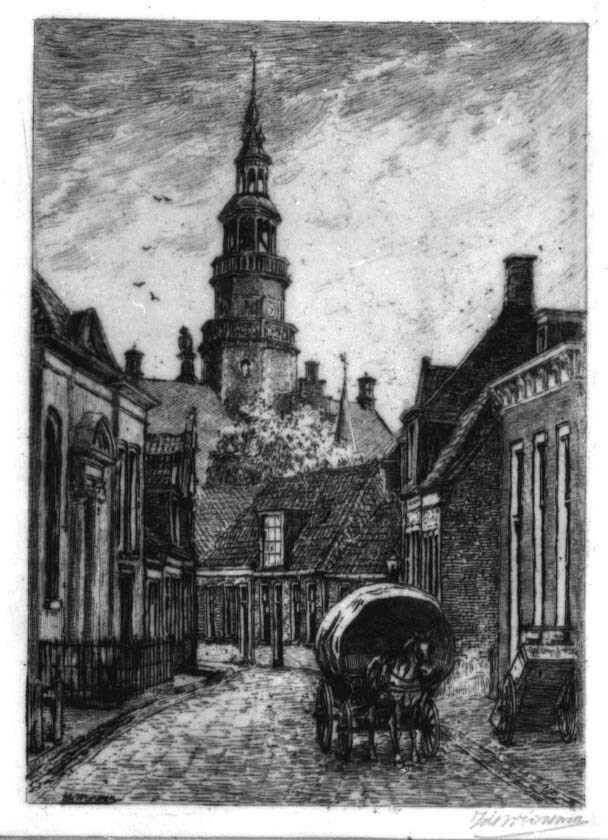
The synagogue stood in the Kleine Kerkstraat, in the Kerkstraat area behind the town hall, a narrow street of low brick houses with a tall tower at its end in the old photographs. The building was demolished around 1991-1993, and no source read describes what now stands on the plot. The exact house number and parcel have not been identified, so the pin marks the Kerkstraat in Bolsward's old centre only approximately. Nothing of the building is known to survive in place. The town's two Jewish cemeteries, the older one on the former town rampart and the later section of the general cemetery, are still maintained by the municipality of Súdwest-Fryslân.
Do you have something to contribute?
Photographs, documents, family stories or memories of this synagogue and its community help keep its history alive.
- Bolsward (Joodse gemeenten)
- Bolsward (Jewish communities, English version)
- The Jewish Community of Bolsward (after W.M. Dooper, De Joden van Bolsward)
- Ut de skiednis fan de Joaden yn Fryslân
- Voorhang uit synagoge in Bolsward, circa 1945 (NIOD image collection, item 161233)
- Kerkstraat, Bolsward (OpenStreetMap way 6562783)
Share a memory or thought
No comments yet. Be the first to add one.