

История Bova Marina Synagogue
The synagogue at San Pasquale, in the Deri district of Bova Marina, is the second synagogue of Roman date found in Italy. The Italian culture ministry calls it the oldest in the West after Ostia Antica and the only architectural evidence of a Jewish presence in Calabria between the 4th and 6th centuries. It came to light by chance in the 1980s during work on the Ionian coast road, the SS 106, and was first taken for a Roman villa until a floor mosaic with a seven-branched menorah was uncovered. The Soprintendenza Archeologica della Calabria excavated it, with Liliana Costamagna as scientific director.
According to Costamagna's report, as summarised by later writers, the building went up at the beginning of the 4th century and was largely rebuilt at the beginning of the 6th, when an apse for the Torah scrolls was added. It belonged to a small roadside and coastal settlement that is probably the Scyle of the Roman itineraries. The finds include a hoard of 3,079 bronze coins hidden in a jug and amphora handles stamped with a menorah.
Between the end of the 6th century and the beginning of the 7th the settlement shows traces of fire and violent destruction, and it was never reoccupied. The mosaic has been lifted and is displayed in the museum of the Archeoderi archaeological park, which surrounds the remains.
Where it stood
No ancient address is known. Today: Museo e Parco archeologico Archeoderi, località San Pasquale (contrada Deri), SS 106 Jonica, 89035 Bova Marina (RC), Italy. The pin marks the excavated remains and is approximate.
Открыть большую карту →Еврейская община
Nothing is known of the congregation from written sources. No inscription naming a member or an officer is reported in the sources consulted, and the size of the community is unknown. What is known comes from the excavation. The synagogue stood in a small settlement on the Ionian coast which scholars identify, with good probability, with Scyle, a stopping place on the Roman road between Reggio and Locri that is named in the Tabula Peutingeriana and by the Ravenna Cosmographer; the culture ministry reports structures of the 3rd to 6th centuries at San Pasquale. Pottery suggests that the place was also a landing for trade with North Africa. An information sheet prepared at the Università Mediterranea of Reggio Calabria in 2017 says that a sizeable Jewish community settled in the 4th century on the site of a 2nd-century villa. Amphora handles stamped with a menorah were found, and Enrico Tromba's 2015 doctoral thesis on the site has a section on amphorae of the type Keay LII carrying that stamp. Two burial grounds lay beside the building, one to the north-east and one to the south-east.
Архитектура и дизайн
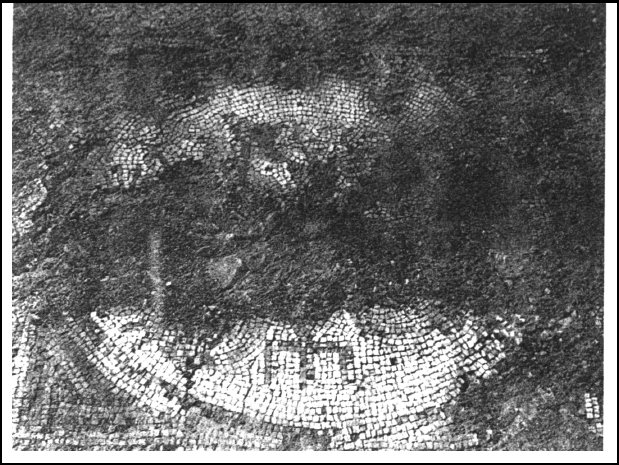
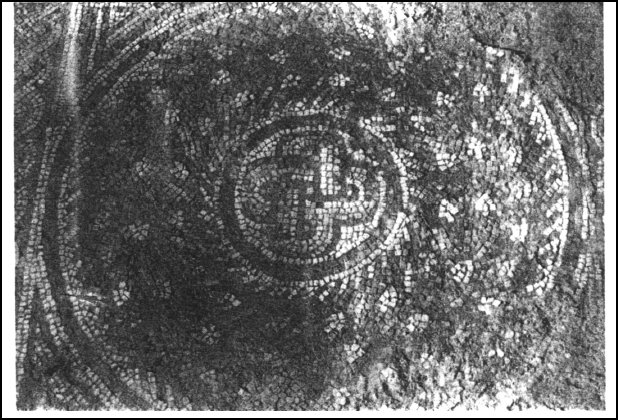
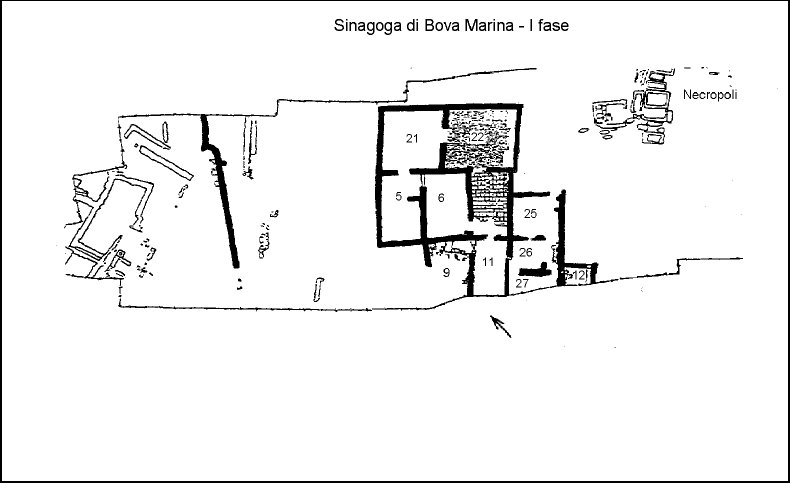
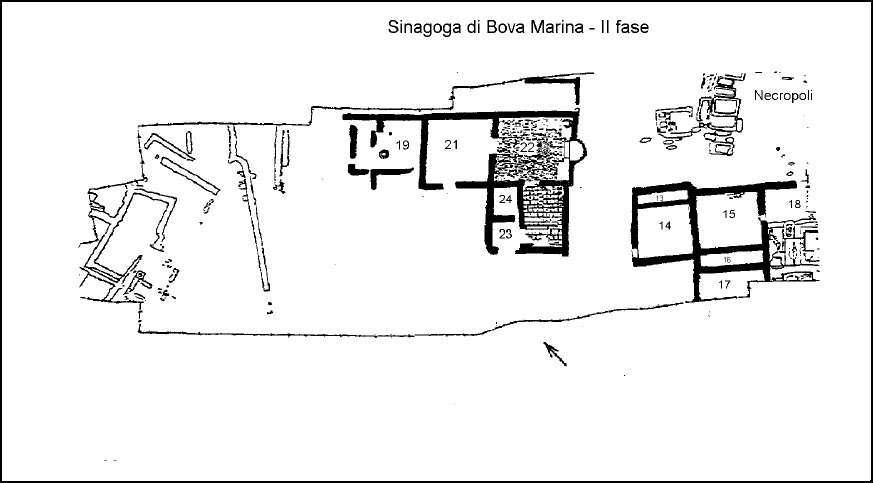
The first building, which Costamagna dated to the beginning of the 4th century, was roughly square and aligned north-west to south-east, with three rectangular rooms on its south-west side and two square rooms on the north-east. The southern square room was the prayer hall. Its floor, of about 30 square metres, is a polychrome mosaic of sixteen panels framed by a double braid within a border of leaves and fruit; each panel holds a roundel with either a Solomon's knot or a rosette. One roundel shows the menorah on a three-footed base, its seven branches ending in lit lamps, flanked by a palm branch, a citron and a ram's horn. The panels along the entrance wall were laid only in half for lack of space. At the beginning of the 6th century the south-eastern part was pulled down and rebuilt, giving an L-shaped plan, and the hall received an apse on its east wall, raised on a step, closed by a balustrade and paved with a cruder mosaic imitating the first. The building was turned towards Jerusalem. Its overall dimensions, wall heights and roof are not given in the sources read.
Жизнь в синагоге
The fittings found in the excavation show how the hall was used. The apse on the east wall held the Torah scrolls; it stood on a raised step enclosed by a balustrade, which Augusto Cosentino's study reads as a bema. The mosaic set the symbols of the festival of Sukkot, the palm branch and the citron, and the shofar beside the menorah. In the east corner a large jar sunk into the floor contained fragments of lamps of Palestinian type and seven wick holders made of folded lead sheet, probably the fittings of a menorah whose perishable parts have gone; fragments of glass oil lamps were found as well. Three rooms on the south side of the first building may have been a school, according to the Reggio information sheet; in the 6th century they were replaced by a wider side entrance and two small storerooms, one of which still held many amphora fragments. A further building added to the south-east, with square and elongated rooms, may have served as a hostel or a place of study. The names of the people who led prayers here are unknown.
Разрушение
The sources agree that the synagogue went out of use around 600 CE but describe the end differently. The fullest account, Agazio Fraietta's summary of Augusto Cosentino's study, which rests on Liliana Costamagna's excavation report, says that between the end of the 6th century and the beginning of the 7th the settlement shows traces of a fire and of violent destruction, and that the coin hoard left in its jug in the north-west room points to a sudden and final abandonment; the latest datable find is a sherd of African red slip ware of the first half of the 7th century. The 2017 sheet from the Università Mediterranea likewise speaks of a violent destruction between the 6th and 7th centuries, after which the area was completely abandoned. Visit Jewish Italy says only that the complex was destroyed in about the 6th century. The Diarna survey states that the cause is unknown and mentions two theories: anti-Jewish violence in the Gothic period, or an earthquake that liquefied the ground beneath the building. None of these sources names who set the fire or attacked the settlement.
Судьба общины
What became of the Jews of San Pasquale after the settlement burned is unknown. No source consulted records where they went, whether any were killed, or whether a community formed again nearby. Burials were found beneath the collapsed walls of the building added to the south-east, and two burial grounds lie beside the complex. Visit Jewish Italy suggests that these probably date from the time when the area was abandoned, while Enrico Tromba's 2015 thesis proposes new readings of both. Whether the people buried there belonged to the congregation is not stated in the sources read. The hoard of 3,079 bronze coins was never recovered by whoever hid it, which is taken as a sign that the inhabitants left suddenly and did not come back. The place was not settled again, and the remains stayed underground until the road works of the 1980s. In recent years the ruins have again been used for Jewish ceremonies: a wedding was celebrated on the site in June 2019.
Место сегодня
The remains lie in the San Pasquale valley beside the SS 106 Jonica road, inside the Parco Archeologico Archeoderi, which opened in June 2010 and is run by the regional museums directorate of Calabria. The sources describe what is visible simply as the remains or ruins of the synagogue: two main groups of rooms and a third area that was probably the entrance. The mosaic floor of the prayer hall is no longer in the ground. It was lifted and is shown in the park's museum, together with the coin hoard and its jug, lamp fragments and a Roman milestone of 364-367 CE from nearby Amigdalà. The site has never been fully excavated, and Tromba noted in 2015 that thirty years after the discovery it had been published only in part. A short new excavation took place that year.
Вам есть чем поделиться?
Фотографии, документы, семейные истории и воспоминания об этой синагоге и её общине помогают сохранить её историю.
- La sinagoga di Bova Marina (post of 28 February 2008, based on Augusto Cosentino's study of the site)
- Museo e Parco archeologico di Bova Marina (Archeoderi)
- Parco Archeologico ArcheoDeri
- Nuovi dati sulla sinagoga di Bova Marina nel contesto dell'archeologia ebraica della Calabria tardo antica (doctoral thesis, 2015; introduction and table of contents read)
- Prime attestazioni e il sito di Bova S. Pasquale (information sheet for the Giorno della Memoria, 27 January 2017)
- Synagogue of Bova Marina
- Synagogue Complex of Bova Marina
- Sinagoga di Bova Marina
- Bova Marina Synagogue
- Parco Archeologico Archeoderi
- Former Italian synagogue sees first Jewish wedding in centuries
- File:BovaMarinaSinagogaMenorah(3).jpg
- Scavi archeologici della sinagoga di Bova Marina (OpenStreetMap node 2661451076)
Share a memory or thought
No comments yet. Be the first to add one.