

The story of Boxmeer Synagogue
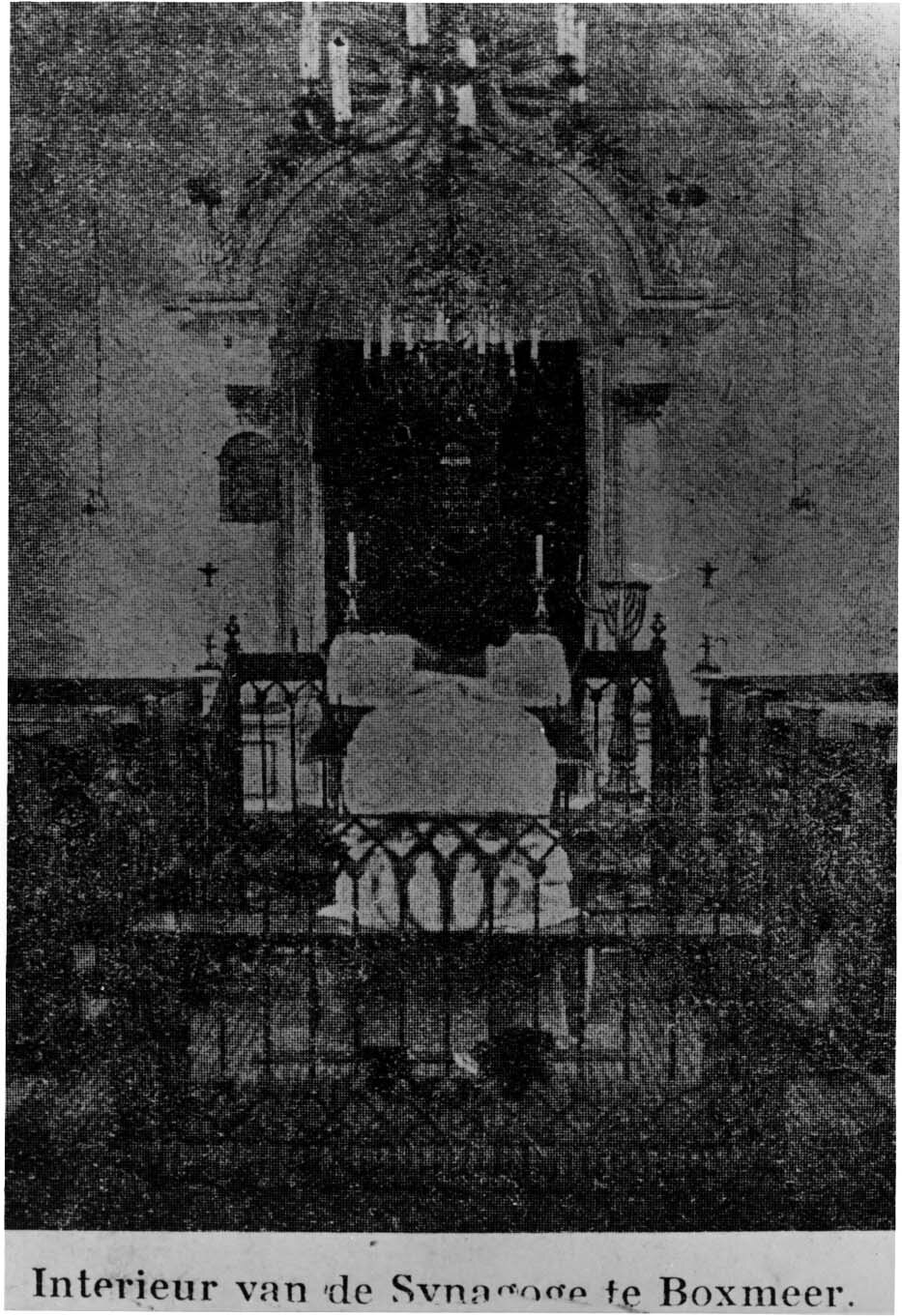
Boxmeer lies on the Maas in the Land van Cuijk, in the north-east of Noord-Brabant. Jews had lived there before 1730, when the authorities forced them to leave. A small rural community formed again in the nineteenth century, first as part of the congregation of Cuijk; in 1858 Boxmeer became an independent congregation. Seven years later, in 1865, it took into use its own synagogue in Manenbiest, a street name that is no longer in use. The congregation was never large: 31 Jews lived in Boxmeer and its surroundings in 1809, 53 in 1869 and 32 in 1930. Its economic weight was greater than its size, because the export slaughterhouse of the Jewish firm Lion en De Wijze contributed much to the growth of the town. The community celebrated the synagogue's sixtieth anniversary in 1925, and in 1930 the dwindling congregation of nearby Vierlingsbeek was joined to it. Two photographs published by the Jewish Cultural Quarter in Amsterdam show the building: an exterior of a modest rendered hall behind a walled forecourt, and an interior view of the Torah ark and the railed platform in front of it. The synagogue lost its congregation in 1942, was damaged in acts of war and was demolished in 1944. The Boxmeer congregation was formally merged into that of Eindhoven in 1947.
Where it stood for 79 years
Historic: Manenbiest, Boxmeer, Noord-Brabant; house number unknown. Today: street name no longer in use, location unknown; placeholder pin at the centre of Boxmeer (approximate).
Open larger map →The Jewish community
The Jews of Boxmeer were few but long established. Their presence before 1730 ended with an expulsion ordered by the government of the day, and the families who settled later belonged at first to the congregation of Cuijk before forming their own in 1858. The community counted 31 souls in 1809, 39 in 1840, 53 in 1869, 46 in 1899 and 32 in 1930, figures that include the surrounding villages. The export slaughterhouse of the Jewish firm Lion en De Wijze was one of the town's important businesses. Albert Jacob, a butcher born in Boxmeer in 1877, served as a warden of the synagogue. The congregation buried its dead at the Jewish cemetery of Vierlingsbeek, whose oldest surviving stone dates from 1784, and in 1930 the Vierlingsbeek congregation was merged into Boxmeer's. In the 1930s Jewish refugees from Germany roughly doubled the town's Jewish population. After the war no congregation was re-formed, and in 1947 Boxmeer was officially joined to the Jewish community of Eindhoven.
Architecture and design
No plan, architect or written description of the building has been found, so what is known comes from two photographs. The exterior view shows a small free-standing hall with rendered walls under a steep tiled saddle roof, with a chimney at one end and two small roof lights. The visible long wall has two tall round-arched windows with glazing bars and a lower round-arched opening with a fanlight, and to the right a plain rectangular sash window, which may belong to a schoolroom or an attached dwelling. The building stood back from the street behind a curving rendered wall with square gate piers and an iron gate opening onto a paved path. The interior photograph shows the Torah ark set in a deep arched niche framed by moulded pilasters and a plaster crest, lit by a branched chandelier with candles. In front of it stood a platform enclosed by an openwork wrought-iron railing with pointed arches, carrying candlesticks. The capacity and the arrangement of the seating and any women's gallery are unknown.
Life inside the synagogue
The congregation maintained its synagogue through a voluntary society for the building's upkeep, kept a burial society and arranged Jewish education for its children. No rabbi, teacher or cantor of Boxmeer has been named in the sources consulted. The wardens (kerkmeesters) managed the building; one of them was the butcher Albert Jacob, who lived at Kerkpad 5. The interior photograph shows a carefully furnished prayer hall, with a decorated ark surround, candlesticks, a chandelier and an iron railing around the platform before the ark. In 1925 the congregation marked the synagogue's sixtieth anniversary with festivities. A Torah pointer (yad) used in this synagogue left Boxmeer and resurfaced decades later at an auction in Tel Aviv, where it was spotted by Dick Jetten, chairman of the local historical society Nepomuk. The society bought it for 2,000 euros, with the municipality paying half, and it was brought back to the Netherlands by Alfred Drukker, a grandson of Albert Jacob living in Israel.
Destruction
The synagogue fell out of use when the last Jews of Boxmeer were deported by the Nazi German occupiers in November 1942, and it stood empty from then on. The community encyclopaedia of the Jewish Cultural Quarter in Amsterdam, which goes back to the Encyclopedia of Jewish Communities in the Netherlands, states that the building was damaged in acts of war ('beschadigd bij oorlogshandelingen') and demolished in 1944; its English version says it was badly damaged during the war and razed in 1944. A report by Omroep Brabant says only that the synagogue stood until 1944, when it was demolished. No source found says when in 1944 the damage happened, whether it was caused by shelling, bombing or ground fighting, or whose action caused it. Who demolished the building, and whether it was Nazi German forces, Allied troops or the local authority, is not recorded in any source consulted. The only parts known to survive are a wrought-iron railing, later built into a monument, and the Torah pointer that turned up in Tel Aviv.
The community’s fate
In 1930 the Boxmeer congregation, including the villages around it, had 32 members; refugees from Germany later doubled the Jewish population. Under the Nazi German occupation all Jews still living in Boxmeer were deported in November 1942. The community encyclopaedia states that none of them survived the camps. Individual records on the Joods Monument show what this meant for one family: Albert Jacob, the synagogue warden, born in Boxmeer in 1877, was murdered at Sobibor on 2 July 1943, and his wife Sijbilla Jacob-Franken, his brother Jacob, his sister Sara and his son Julius all died in 1943. According to the same record one of the couple's two children survived the war, and a grandson, Alfred Drukker, later lived in Israel. No congregation was re-established after liberation, and in 1947 the Boxmeer community was formally merged into the Jewish community of Eindhoven. Since 1961 a foundation chaired by the mayor has cared for the Jewish cemetery at Vierlingsbeek, where the Jews of Boxmeer had buried their dead.
The site today
The synagogue stood in Manenbiest, a street name no longer found on present-day maps of Boxmeer, and the exact plot has not been identified in the sources consulted, so what occupies the site today is unknown. No part of the building remains in place. A wrought-iron railing from the synagogue was preserved and is built into the Jewish monument unveiled in Boxmeer in May 1995. The Torah pointer bought back from Tel Aviv is to be exhibited in Boxmeer. The map pin for this entry marks the centre of Boxmeer and should not be read as the synagogue's location; locating Manenbiest will need old cadastral maps or the archive of the historical society Nepomuk.
Notable names
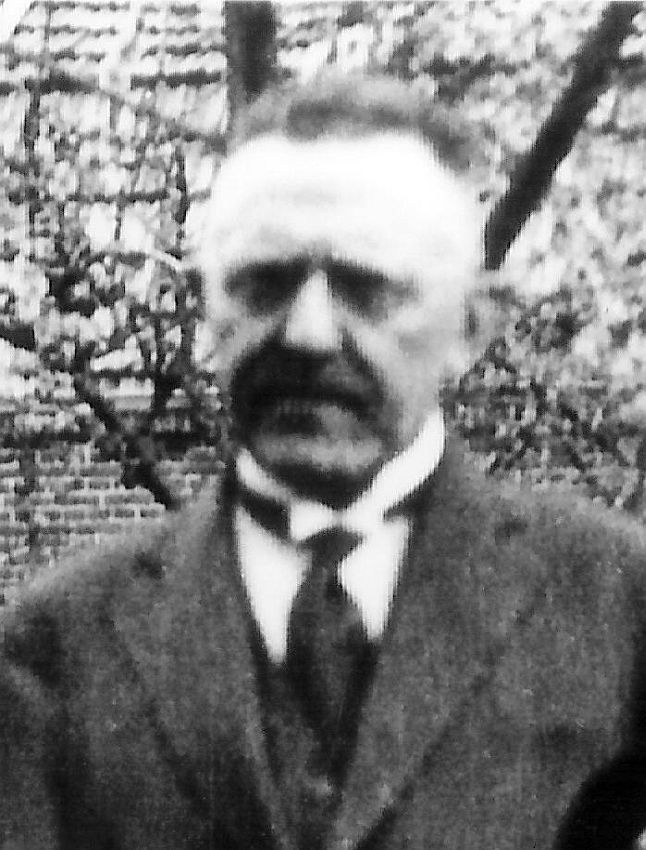
Albert Jacob
1877-1943Warden (kerkmeester) of the Boxmeer synagogueJacob was born in Boxmeer on 5 April 1877 and worked there as a butcher, living at Kerkpad 5. Omroep Brabant names him as a kerkmeester, one of the wardens who managed the synagogue. He was deported with the Jews of Boxmeer and murdered at Sobibor on 2 July 1943; his wife Sijbilla, a son and two siblings also died. His grandson Alfred Drukker, living in Israel, brought the synagogue's recovered Torah pointer back to the Netherlands.
Biography or source →Do you have something to contribute?
Photographs, documents, family stories or memories of this synagogue and its community help keep its history alive.
Share a memory or thought
No comments yet. Be the first to add one.