
Historia Synagogue of Brodnica (Strasburg in West Prussia)
Brodnica lies on the Drwęca river in north-central Poland. After the first partition of Poland in 1772 it came under Prussian rule as Strasburg, and Jewish families began to settle in the town: 27 Jewish residents are recorded in 1783, and a first rabbi, Abraham Mendel, was appointed in 1792. In 1839 the community built a synagogue on a plot between today's Kilińskiego, Strzelecka and Pocztowa streets. The street beside it was named Synagogenstrasse after it. The community reached 571 people in 1885 but declined as families moved west, and after the town returned to Poland in 1920 only a few dozen Jews remained. It grew again in the 1930s, to 523 members in 1939. After the German invasion, on 29 September 1939, Nazi German soldiers set fire to the synagogue and stood guard so that no one could extinguish it. The rubble was cleared, the ground levelled and a crude barrack-like residential building put up on the site. Today the site is a car park.
Where it stood for 100 years
Historic: Synagogenstrasse / Pocztowa Street, Strasburg (Brodnica). Present day: car park between Kilińskiego, Strzelecka and Pocztowa streets (Pocztowa 9), Brodnica, Poland.
Otwórz większą mapę →Społeczność żydowska
Before the first partition of Poland in 1772, 303 Jews lived in the villages around Brodnica, but none permanently in the town itself. Under Prussian rule Jews were allowed to settle: 27 Jewish residents were recorded in 1783, and in 1792 the community appointed its first rabbi, Abraham Mendel, and laid out a cemetery south of the town on today's Podgórna Street. In 1816 there were 370 Jews in the Brodnica district, 150 of them in the town. The community reached 571 people in 1885, but fell to 286 in 1910 as Jews moved to Germany's growing cities. After Brodnica became part of Poland again in 1920 only 56 Jews remained in the town. Most Brodnica Jews were merchants, running shops in the town centre.
Architektura i projekt
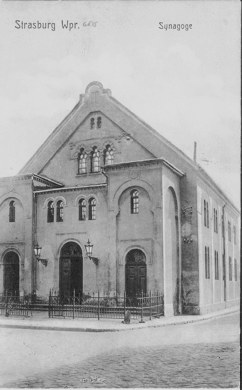
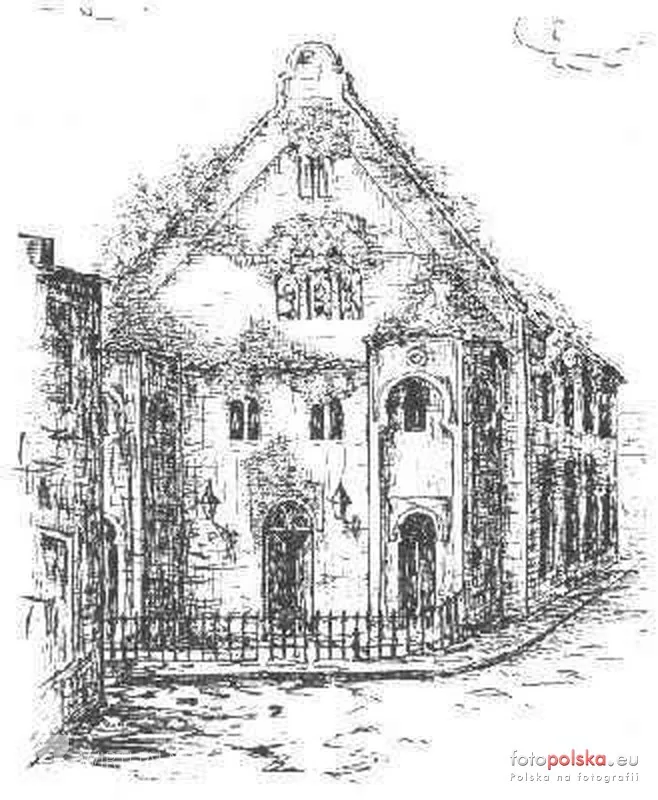
The synagogue was built in 1839 on a plot the community had bought between today's Kilińskiego, Strzelecka and Pocztowa streets, at what is now 9 Pocztowa Street. German Wikipedia describes it as a historicist building. An early twentieth-century postcard shows a plain, gabled masonry building standing on a street corner, with round-arched windows in the gable, a symmetrical front with three arched doorways, and a lower wing at the side. The adjoining street, now Strzelecka, was known in German times as Synagogenstrasse. No plans, dimensions or description of the interior have been found in the sources consulted for this entry.
Życie w synagodze
The synagogue served Brodnica's Jewish community for exactly a century. It stood near the community's other institutions in the town centre, close to the shops that most Jewish families ran. The community had its own rabbis from 1792, when Abraham Mendel was appointed. In the interwar years, when Brodnica was again part of Poland and the small community was rebuilding, Mordechaj Rajsmüller became rabbi in 1924, followed in 1931 by Moses Srebrnik. By the late 1930s the congregation had grown again to more than 500 people. The names of cantors and other details of religious life are not recorded in the sources consulted.
Zniszczenie
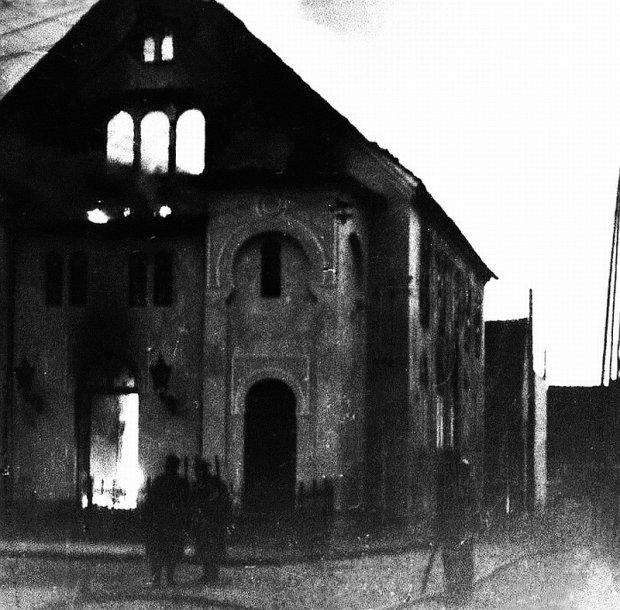
German troops occupied Brodnica in the first days of the invasion of Poland in September 1939. According to Polish Wikipedia and the local newspaper Czas Brodnicy, on 29 September 1939 Nazi German soldiers set the synagogue on fire and then stood guard to make sure no one could put out the burning remains. The Virtual Shtetl history of the community gives the date as 29 November 1939, the day the town's remaining Jews were arrested. The building was reduced to a heap of bricks. The rubble was then cleared away, the ground levelled, and a primitive residential barrack put up on the site. The Jewish cemetery on Podgórna Street was also destroyed: its gravestones were broken up and used to pave streets.
Los społeczności
In the 1930s the small community had grown again, from 351 members in 1934 to 418 and 415 in the following years and 523 in 1939. After the German invasion Brodnica was annexed to the Reich. According to Virtual Shtetl, those who remained were arrested by the Germans on 29 November 1939 and shot together with a group of Poles. In 1944 about 1,700 Jewish women prisoners were brought to the Brodnica area for forced labour, and in January 1945 they were evacuated as the Soviet army approached. The number of Brodnica Jews murdered in the Holocaust is not recorded in the sources consulted.
Miejsce dzisiaj
Nothing of the synagogue survives. After the war the site between Kilińskiego, Strzelecka and Pocztowa streets was used in turn as a bus station and a marketplace, and it is now a car park. In German times the street beside the synagogue, today's Strzelecka, was called Synagogenstrasse after it; the name disappeared along with the building. The Jewish cemetery on Podgórna Street was also destroyed during the occupation, its gravestones used as paving. There is no mention in the sources consulted of any marker at the synagogue site.
Ważne postacie
Abraham Mendel
18th centuryRabbiAbraham Mendel was appointed in 1792 as the first rabbi of Brodnica, then the Prussian town of Strasburg, soon after Jews were first allowed to settle there. The same period saw the community lay out its cemetery south of the town. Nearly half a century later, in 1839, the community he helped found built its synagogue.
Biografia lub źródło →Moses Srebrnik
20th centuryRabbiMoses Srebrnik became rabbi of Brodnica in 1931, succeeding Mordechaj Rajsmüller. He led the community in its last years, as it grew to more than 500 members by 1939. That autumn German troops burned the synagogue, and the Jews who remained in Brodnica were arrested and shot. His own fate is not recorded in the sources consulted.
Biografia lub źródło →Czy masz coś do przekazania?
Zdjęcia, dokumenty, historie rodzinne lub wspomnienia o tej synagodze i jej społeczności pomagają zachować jej historię.
Share a memory or thought
No comments yet. Be the first to add one.