
The story of Brtnice Synagogue
Brtnice, called Pirnitz in German, is a small town about 12 km south-east of Jihlava in the Vysočina region. Jews are recorded there in the fourteenth century and settled permanently from the late sixteenth or early seventeenth century, living apart from the Christian townspeople in their own quarter of some 45 to 50 houses. The synagogue stood in this quarter north of the town square, beside a school and the community's town hall. The regional tourist authority dates it to 1629, while the German local-history site Jüdische Gemeinden says only that it is thought to go back to the middle of the seventeenth century.
The community reached more than 500 people around the middle of the nineteenth century and then shrank quickly as families moved away to larger towns. In the 1880s the synagogue was nevertheless enlarged and given a women's gallery. In 1925 a fire destroyed the roof of the prayer hall together with the community's archive. After the Nazi occupation of 1939 the stone tablets of the Ten Commandments were removed from the building and smashed, and the empty synagogue became a storeroom. It survived the war and four decades of Communist rule as a warehouse, until in 1988 it was pulled down with the rabbi's house and the other remaining houses of the Jewish quarter.
Where it stood
Historic: former Jewish quarter north of the town square, Brtnice (Pirnitz), Moravia; house number unknown. Today: site of the department store built after 1988, marked by a memorial plaque, Brtnice, okres Jihlava (approximate).
Open larger map →The Jewish community
Jews lived in Brtnice at least intermittently from the fourteenth century, and a permanent community formed in the late sixteenth or early seventeenth century. Its first cemetery lay near the parish church; it was levelled on the orders of the authorities and replaced in the second half of the sixteenth century by a burial ground far outside the town, which was later extended. In the eighteenth century the Jews lived in a separate quarter of about 45 houses. The community counted 418 people in 1834, about 12 per cent of the town, and 540 in 1857. Emigration to larger towns then reduced it sharply: there were 123 Jews in 1900, 52 in 1921 and 33 in 1930. A great town fire in 1899 hastened the decline. A one-class Jewish school, approved in 1872 according to the regional tourist site, taught in German; it closed in 1918 after the death of its long-serving teacher Josef Glaser, and the remaining children went to the Czech town school, receiving religion and German lessons from private tutors. The literary critic Baruch Kurzweil was born in Brtnice in 1907 into a family of rabbis.
Architecture and design
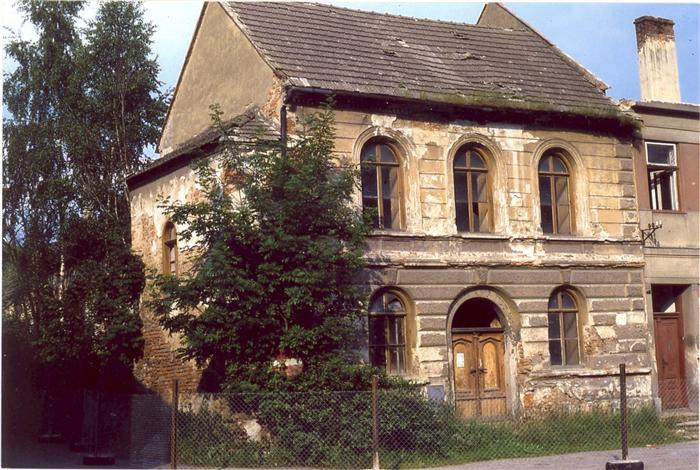
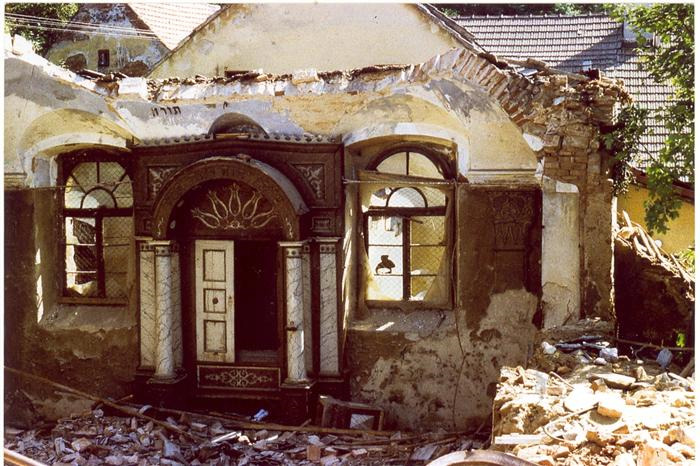
The two photographs found, taken around 1985 shortly before demolition, show a plain two-storey rendered building with a steep tiled gable roof, standing directly on the street between neighbouring houses. The street front has three tall round-arched windows on the upper floor and, below, a round-arched entrance with a double wooden door flanked by two round-arched windows; the surfaces are lined with horizontal rustication, much of it flaking by then. A smaller wing with another arched window adjoins on the left. The upper row of windows probably lit the women's gallery added in the 1880s, but no source says so. The second photograph, taken inside after the roof had been removed, shows the east wall still standing: a tall wooden Torah ark painted to imitate marble, with turned columns, a carved round-arched crown with a sunburst motif and Hebrew lettering above, set between two round-arched windows with lattice glazing. The age of the fabric, the architect, the layout of the hall and the number of seats are unknown.
Life inside the synagogue
Very little is recorded about worship in the building. The congregation was large enough in the 1880s, although already shrinking, to enlarge its synagogue and add a gallery for women. The synagogue stood next to the community's school and its town hall, so that religious, educational and administrative life was concentrated in one part of the Jewish quarter, near the rabbi's house, which was demolished together with the synagogue in 1988. Lessons at the school were given in German until 1918; the teacher Josef Glaser taught there for many years. The fire of 1925 that destroyed the roof of the prayer hall also burned the community's whole archive, including its forms and statutes, which is why so little documentation of congregational life survives. By the 1930s only a few Jewish families remained to use the building. The names of the community's rabbis while the synagogue functioned were not found in the sources read.
Destruction
The synagogue had already been damaged once, when fire destroyed the roof of the prayer hall in 1925, but it was repaired and remained in use. After the Nazi occupation of Bohemia and Moravia in March 1939 its two stone tablets of the Ten Commandments were removed and destroyed; the source does not say by whom. The building then stood empty and was used as a storeroom. It survived the war and remained a store under Communist rule. In 1988, shortly before the Velvet Revolution, the synagogue, the rabbi's house and the last remaining houses of the former Jewish quarter were demolished to make way for a department store; the memorial plaque on the site gives the year as 1988 and Jüdische Gemeinden says the late 1980s. Photographs taken around 1985 show the roof stripped and the interior full of rubble while the painted Torah ark still stood. The sources read do not name the authority or enterprise that ordered or carried out the demolition.
The community’s fate
By 1930 only 33 Jews lived in Brtnice. After Germany occupied the rest of Czechoslovakia in March 1939 and set up the Protectorate of Bohemia and Moravia, the Jews of Brtnice were subjected to Nazi persecution like those of the rest of the country. According to Jüdische Gemeinden they were deported by the Nazis via the Theresienstadt ghetto to extermination camps, and only two of them survived. The dates and numbers of their transports were not found in the sources read; they are not given on the pages consulted. No Jewish community was re-established in Brtnice after the war. The old Jewish cemetery, far outside the town, survives with about 250 gravestones and has been a protected cultural monument since the late 1980s; a Taharah house also remains there. The quarter itself, once some fifty houses, has disappeared except for the so-called Jewish Bridge that linked it with the town.
The site today
The synagogue site, north of the town square in the former Jewish quarter, is now occupied by the department store built after the 1988 clearance. Nothing of the synagogue survives above ground. A trilingual plaque on the site, put up in 2007, states that the seventeenth-century synagogue of the Jewish community of Pirnitz stood there and was taken down in 1988. The map pin for this entry is taken from the Wikidata record for that plaque, which a source says stands at the place where the synagogue stood, so it should be close to, but not exactly on, the former building's footprint. The street address of the synagogue was not found.
Notable names
Josef Glaser
died 1918Teacher of the Jewish school of Brtnice (Pirnitz) for many years until 1918Glaser was the long-serving teacher of the community's German-language Jewish school, which stood in the Jewish quarter beside the synagogue. According to Jüdische Gemeinden the school closed in 1918 after his death, and the community's remaining children then went to the Czech town school, receiving religious instruction and German lessons from private tutors. Nothing else about his life was found.
Biography or source →Do you have something to contribute?
Photographs, documents, family stories or memories of this synagogue and its community help keep its history alive.
Share a memory or thought
No comments yet. Be the first to add one.