
La historia de Cahal Cicu Synagogue (Spanish Small Temple), Bucharest
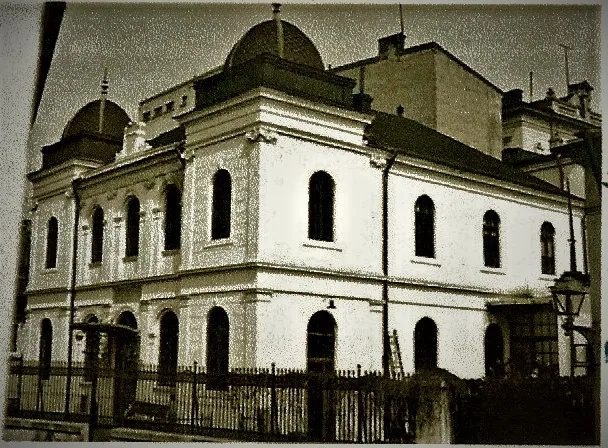
The Cahal Cicu ('small congregation') was the smaller of the two Sephardic synagogues of Bucharest, the larger being the Cahal Grande, or Great Spanish Temple. It stood at 37 Banu Mărăcine Street in the old Jewish quarter south of the Dâmbovița, close to the Dudești and Văcărești streets, in a city that had at least sixty-six synagogues around 1900. The synagogue followed the Sephardic rite (Nusach Hasefaradim) and was completed in 1846, of brick. A photograph dated to about 1900 shows a two-storey rendered building with domed corner towers and tiers of round-arched windows, standing behind an iron railing.
During the Legionnaire rebellion and pogrom of January 1941, the far-right Legionnaires (Iron Guard) devastated the building. It was rebuilt after the war, and according to a Romanian-language source cited by English Wikipedia it was renovated after the 1977 earthquake and reopened in 1978. In the mid-1980s the Communist regime of Nicolae Ceaușescu rebuilt central Bucharest far beyond what the earthquake damage required, and the synagogue was demolished, most sources say in 1986, to make room for Union Boulevard (Bulevardul Unirii). A report of late July 1986 described the bulldozing of the last Sephardic synagogue of Bucharest despite assurances from the Romanian ambassador in Washington that it would not be affected.
Where it stood for 140 years
Historic: Strada Banu Mărăcine 37, Bucharest (old Jewish quarter, south-east of Piața Unirii). Today: area of Bulevardul Unirii, Sector 3, Bucharest; exact plot not identified (approximate).
Abrir mapa ampliado →La comunidad judía
Jews of Turkish and Sephardic origin formed the earliest Jewish community of Bucharest and later one of its two branches of Bucharest Jewry alongside the larger Ashkenazi community, and in the 1930s Bucharest had the largest Sephardic community in Romania. The community maintained two synagogues known by the Judeo-Spanish names Cahal Grande ('great congregation') and Cahal Cicu ('small congregation'); the Cahal Grande on Negru Vodă Street dated from 1818 or 1819 and was rebuilt in 1890, while the Cahal Cicu was completed in 1846. The Sephardim also had their own cemetery on Calea Șerban Vodă. Membership figures for the Cahal Cicu congregation, the names of its founders, its presidents and its officiants were not found in the sources read for this entry. Its survival into the 1970s and 1980s, when it was repaired and used again, made it one of the few working Sephardic houses of prayer left in Eastern Europe, a point stressed in the international press when it was pulled down.
Arquitectura y diseño
The only image found is a photograph dated to about 1900. It shows a free-standing, two-storey building finished in pale render, seen obliquely from the street. The street front and the long side are divided into two tiers of tall round-arched windows, separated by a moulded string course and crowned by a heavy cornice. At the front corners rise square towers carrying domes: a broad ribbed dome on a high drum over the right-hand corner and a smaller dome topped by a finial over the left. The corners are marked by pilaster strips with small consoles under the cornice. A pitched roof covers the hall behind. An iron railing on a low wall runs along the street, with a gate, and a lantern hangs from the corner of the building. English Wikipedia states that the building was of brick. The architect, the builder, the seating capacity, the interior arrangement and the changes made in the postwar rebuilding are all unknown, and no interior photograph or plan was found.
La vida dentro de la sinagoga
The congregation prayed according to the Sephardic rite, recorded as Nusach Hasefaradim, the liturgy of the Judeo-Spanish speaking Jews of the Ottoman Balkans, as distinct from the Ashkenazi rite used in most Bucharest synagogues. Beyond the rite, almost nothing about worship in the building was found in the sources read: no rabbi, cantor or lay leader of the Cahal Cicu is named, and no description of its interior, its Torah ark or its festivals survives in them. What can be said is that the building outlived the destruction of 1941 and returned to use. It was rebuilt after the war, and after the earthquake of 1977 it was renovated and reopened in 1978, so the small Sephardic congregation of the capital was still worshipping here in the last decade before the demolition. An American Jewish Committee official told the press in 1986 that he had been assured it would be spared, which suggests it was still regarded as a working synagogue.
Destrucción
The building was damaged twice. In January 1941, during the Legionnaire rebellion against Ion Antonescu, the far-right Legionnaires (Iron Guard) attacked the Jewish quarter of Bucharest, murdering Jews and sacking synagogues; English Wikipedia states that the Spanish Small Temple was devastated by the Legionnaires in 1941. It was rebuilt after the war.
The final destruction came under Communist rule. In the reconstruction that followed the 1977 earthquake, the Ceaușescu regime went far beyond repairing damaged districts and razed large parts of old Bucharest; the Jewish quarter was among the worst affected. The Spanish Small Temple was demolished, together with the Malbim Synagogue, other synagogues, houses and historic churches, to make room for Union Boulevard. English Wikipedia's article on the building gives 1986. A Californian Jewish newspaper reported on 1 August 1986 that Bucharest's remaining Sephardic synagogue had been bulldozed the week before, after the Romanian ambassador had said the urban renewal project would not affect it, and Rabbi Moses Rosen confirmed in September 1986 that the Sephardi synagogue had been demolished; neither report names the building. Other articles give 1985 or 1987. The Communist authorities carried out the demolition.
El destino de la comunidad
Bucharest had nearly 75,000 Jews in 1930, more than a tenth of the city's population, with about forty synagogues. On 21 to 23 January 1941, during the Legionnaires' rebellion against Ion Antonescu, the Legionnaires (Iron Guard) attacked the Jewish boroughs of Dudești and Văcărești, murdered 125 Bucharest Jews, looted synagogues and burned down the Cahal Grande, the main Sephardic synagogue. Many Jewish men were later taken for forced labour, but enough of the community survived the war for it to remain large under Communism: about 50,000 Jews still lived in the city in 1969. By the 1980s the Cahal Cicu was described abroad as the last Sephardic synagogue of Bucharest. When it was demolished in 1986, the Chief Rabbi of Romania, Moses Rosen, publicly reported the loss while saying that the demolition involved no prejudice. Today about 7,000 Jews live in Romania, most of them in Bucharest, which has three active synagogues.
El lugar hoy
The building stood at 37 Banu Mărăcine Street, in the old Jewish quarter between Piața Unirii and the Dudești area. The sources say it was demolished to make room for Union Boulevard (Bulevardul Unirii), laid out under Communist rule in the 1980s, so the site is most likely under or immediately beside the boulevard or the buildings lining it. No source read gives the exact position of the plot on a modern map, and whether any part of Banu Mărăcine Street still exists was not established. No remains of the synagogue are recorded. The map pin uses the coordinates given in the English Wikipedia article and should be treated as approximate.
¿Tiene algo que aportar?
Fotografías, documentos, historias familiares o recuerdos de esta sinagoga y su comunidad ayudan a mantener viva su historia.
- Spanish Small Temple
- Grand Spanish Temple
- Malbim Synagogue
- List of synagogues in Bucharest
- The Lost Synagogues of Bucharest
- Romanian synagogue torn down after assurances it would remain (The Jewish News of Northern California, 1 August 1986)
- Synagogue gone (The Australian Jewish News, Melbourne, 12 September 1986)
- Sephardim in Romania
- Bucharest (Romania / Wallachia)
- Legionnaires' rebellion and Bucharest pogrom
- The Jews of Bucharest
- File:Spanish Small Temple, "Ca'al Cicu" synagogue ... 37 Banu Maracine Street in Bucharest, Romania, 1900.jpg
Share a memory or thought
No comments yet. Be the first to add one.