
Die Geschichte von Malbim Synagogue, Bucharest
The Malbim Synagogue stood at 4 Strada Bravilor in the Jewish quarter of Bucharest, the district that spread east of Piața Unirii towards Dristor and was centred on the Choral Temple. Radio Romania International and English Wikipedia say it was built in 1864 on the initiative of the chief rabbi Meir Leibush Wisser, better known by his acronym, the Malbim, who led the Bucharest rabbinate from 1858 or 1859 until 1864 and whose name the building carried. The Bucharestian city guide instead links it to an Orthodox Jews Society named after the rabbi and dates the synagogue to 1848, so the founding date is not settled. The building was reconstructed in 1912 (1928 in one source). Radio Romania International called it the most impressive of the Bucharest synagogues it lost.
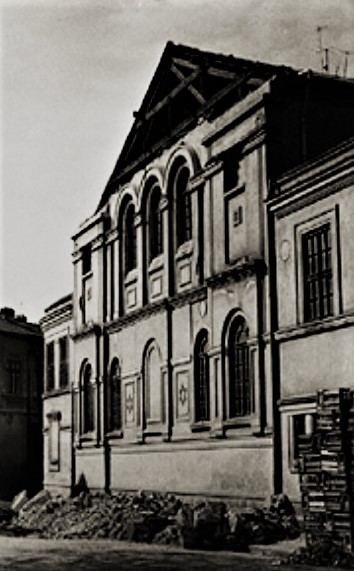
In 1941 Legionnaires of the Iron Guard devastated the synagogue; a photograph dated January 1941 shows its roof stripped to the rafters and rubble piled in front. It was rebuilt after the Second World War and repaired again after the earthquake of 4 March 1977. In the mid-1980s it stood in the path of the Victory of Socialism Boulevard, today Bulevardul Unirii, part of the rebuilding of central Bucharest under Nicolae Ceaușescu's Communist regime after the 1977 earthquake. It was pulled down together with the surrounding neighbourhood; sources give 1985, 1986 or 1987. The National Library of Romania now stands on the site.
Where it stood for nearly 130 years
Historic: Strada Bravilor 4, Jewish quarter, Bucharest (street no longer exists). Today: site of the National Library of Romania, Bulevardul Unirii 22, sector 3, Bucharest (approximate).
Größere Karte öffnen →Die jüdische Gemeinde
Bucharest had a Jewish population from at least the sixteenth century, when Sephardic Jews settled around the Popescului neighbourhood east of today's Union Square. According to the Bucharestian guide it numbered about 6,000 people in 1860, some 40,000 at the end of the century, 44,000 in 1912, 70,000 in 1921 and 98,000 in 1941. The Malbim Synagogue served the traditional Orthodox part of this community. Its namesake, Rabbi Malbim, arrived from Kempen in Prussian Poland and fought the modernising Jews of the city, led by Dr Iuliu Barasch, who wanted changes to the prayer book and to dress, and he opposed the building of the Choral Temple with its choir and organ. The synagogue named after him therefore stood for the Orthodox side of a split that shaped Bucharest Jewry in the 1860s. It lay in the densely built Jewish quarter around the Choral Temple, near several other synagogues that Radio Romania International lists as also lost, among them the Fraterna temple, the Cahal Grande temple, the Carpenters' Temple and the Gaster Temple.
Architektur und Gestaltung
The only image found is a photograph dated January 1941, taken after the building had been wrecked. It shows a tall rendered street front of two storeys under a steep triangular gable, whose roof covering has been stripped away to leave the rafters bare. Each storey has a row of tall round-arched windows set between flat pilasters, three across the upper part of the gable front, and there are further round-arched windows along the side. Square panels below the windows carry the Star of David in relief, and a moulded cornice divides the two storeys. A lower two-storey house with rectangular windows adjoins on the right, and a smaller building on the left. Rubble lies along the base of the wall. English Wikipedia gives the material as brick. The architect, the builder, the seating capacity and the arrangement of the interior are unknown, and it is not known how much of what the photograph shows dates from 1864 and how much from the reconstruction of 1912 or 1928. The style label 'round-arched' is taken from the photograph, not from a written source.
Leben in der Synagoge
Very little about worship in the building is recorded in the sources read. The Bucharestian guide says that Rabbi Malbim, chief rabbi of Bucharest and Romania from 1858 to 1864, preached in the synagogue that bore his name, and it ties the congregation to an Orthodox Jews Society named after him. Malbim was a celebrated Bible commentator and a strict defender of traditional observance: he refused to alter the prayer book, insisted on daily inspection of the ritual slaughterers' knives and resisted the reforms of the city's modernising Jews. His opponents among the communal staff and the upper class denounced him, and he left Romania in 1864 after Sir Moses Montefiore intervened to free him from threatened imprisonment. The synagogue continued in use after his departure. In the twentieth century it remained a place of prayer: Gavril Marcuson, interviewed by Centropa, recalled that he used to go to the Malbim Synagogue and liked it a lot. The congregation repaired the building after the 1941 attack and again after the 1977 earthquake, which shows it was still in use until shortly before demolition.
Zerstörung
The synagogue suffered twice. In 1941 it was devastated by the Legionnaires of the Iron Guard. The Bucharestian guide dates the Legionary pogrom to 22-23 January 1941, when 98 Jews were killed, synagogues were set on fire and Jewish shops were wrecked by the Legionary Police and activists. A photograph dated January 1941 shows the Malbim Synagogue with its roof stripped to the rafters and rubble in front of the façade. The building was rebuilt after the war. It was damaged again in the earthquake of 4 March 1977, which Radio Romania International describes as giving Ceaușescu the opportunity to remake the centre of Bucharest far beyond what reconstruction required. The Jewish quarter was among the worst affected areas. The Malbim Synagogue stood in the way of the planned Victory of Socialism Boulevard, and the Communist authorities demolished it together with the whole neighbourhood around it. The Bucharestian guide says plainly that the Communists demolished it. The year is given as 1985 by Centropa's editors, 1986 by Radio Romania International and the Bucharestian guide, and 1987 by English Wikipedia; no source read names the official body or the date of the order.
Das Schicksal der Gemeinde
The community suffered the Legionary pogrom of January 1941, in which 98 Jews were killed; the Bucharestian guide notes that by 23 August 1944 only about half of Romania's Jews alive in spring 1940 remained. According to the same guide the Bucharest community still reached its peak of about 150,000 in 1948, and migration, especially towards Palestine and the United States, had already begun during the 1940s. After the founding of Israel in 1948 emigration grew and emptied it. Radio Romania International records that Jews who applied to emigrate lost their jobs, waited years for approval and had to hand over their renovated homes; the Bucharestian guide says the Communist state effectively sold its Jews to Israel. The city's Jewish population fell to 15,000 by 1966 and is about 4,000 today. Of Bucharest's many synagogues, Radio Romania International names only the Choral Temple, the Great Synagogue and the Holy Union Temple as surviving remnants of the religious community.
Der Ort heute
Two sources place the synagogue where the National Library of Romania now stands: the In Your Pocket city guide says it stood exactly where the library is today, and Centropa's editors note that the library's construction site occupied its spot near Bulevardul Unirii. The library stands at Bulevardul Unirii 22. Strada Bravilor, the synagogue's street, no longer exists; the whole neighbourhood around the synagogue was demolished with it in the 1980s, and the old Jewish quarter now lies under the boulevard and the buildings along it. Nothing of the synagogue is known to survive. The map pin marks the library building and is approximate.
Bedeutende Namen
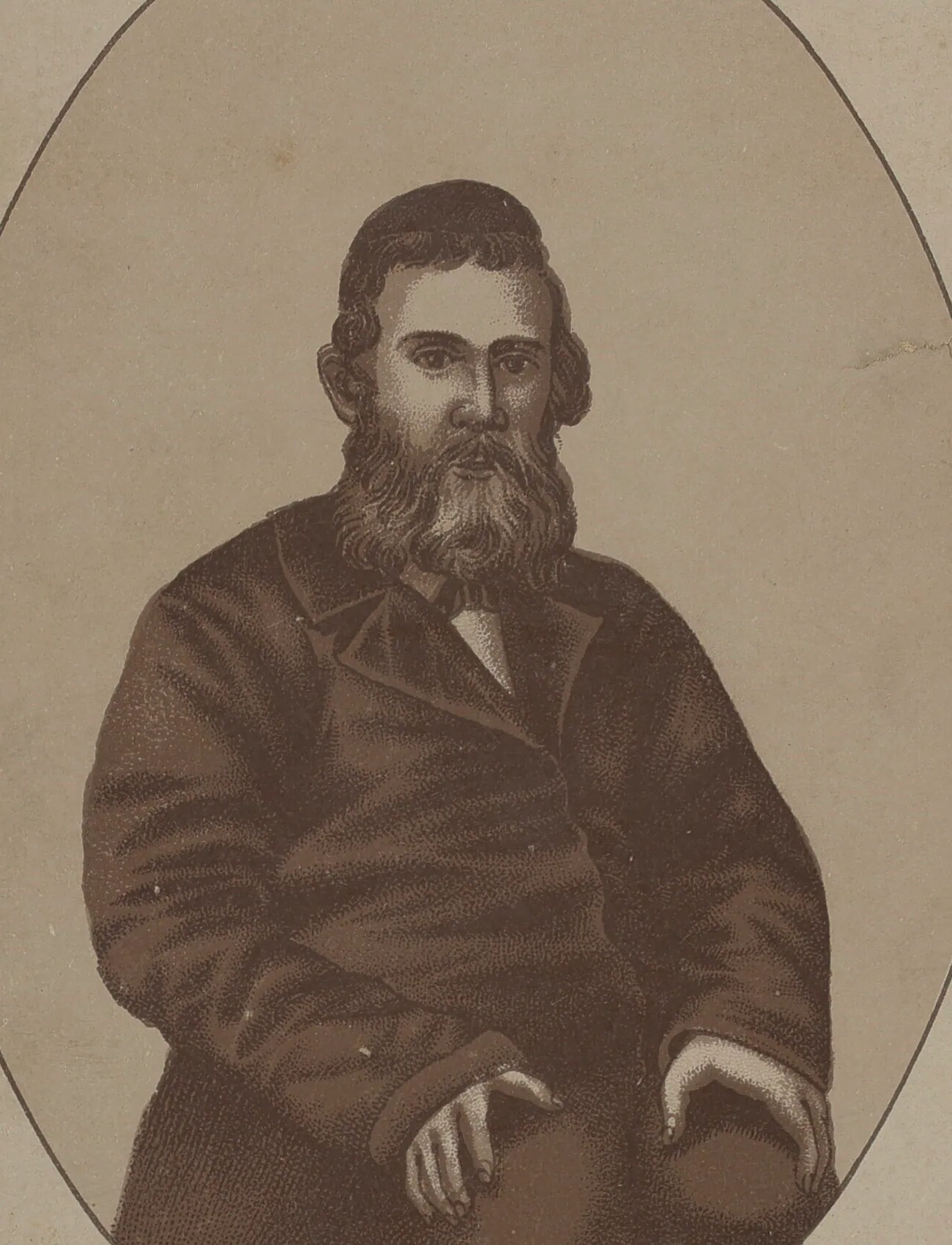
Meir Leibush Wisser (the Malbim)
1809-1879Chief rabbi of Bucharest, 1858/1859-1864; initiator and namesake of the synagogueBorn in Volochysk, Volhynia, the Malbim was rabbi of Wreschen and Kempen before becoming chief rabbi of Bucharest. Radio Romania International and English Wikipedia say the synagogue was built in 1864 on his initiative, and the Bucharestian guide says he preached in the synagogue that bore his name. A strict defender of Orthodox practice, he clashed with the city's modernisers and left Romania in 1864. He is famous for his Bible commentary.
Biografie oder Quelle →Haben Sie etwas beizutragen?
Fotos, Dokumente, Familiengeschichten oder Erinnerungen an diese Synagoge und ihre Gemeinde halten ihre Geschichte lebendig.
- Malbim Synagogue
- The Lost Synagogues of Bucharest
- Jews in Romania
- Interview with Gavril Marcuson (tagged text)
- Jewish Bucharest
- Malbim
- Porträt R. Malbim (Meir Löw/Leibusch ben Jechiel Michael Weiser), Inv. Nr. 1422
- File: Malbim Synagogue ... on 4 Strada Bravilor, in Bucharest, January 1941.jpg
- Biblioteca Națională a României (OpenStreetMap relation 1670647)
Share a memory or thought
No comments yet. Be the first to add one.