
La storia di Buda Small Synagogue (Medieval Jewish Prayer House), Budapest
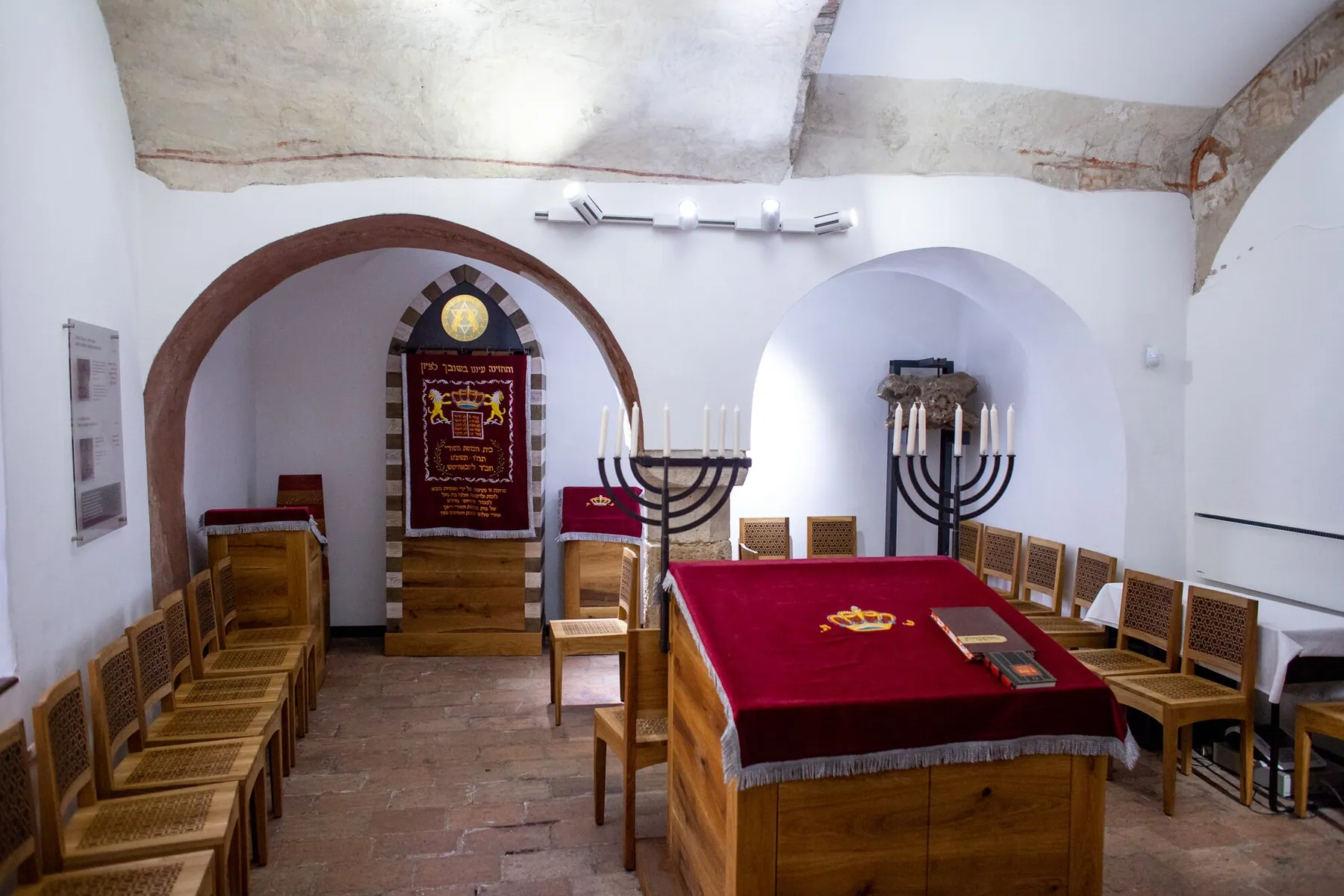
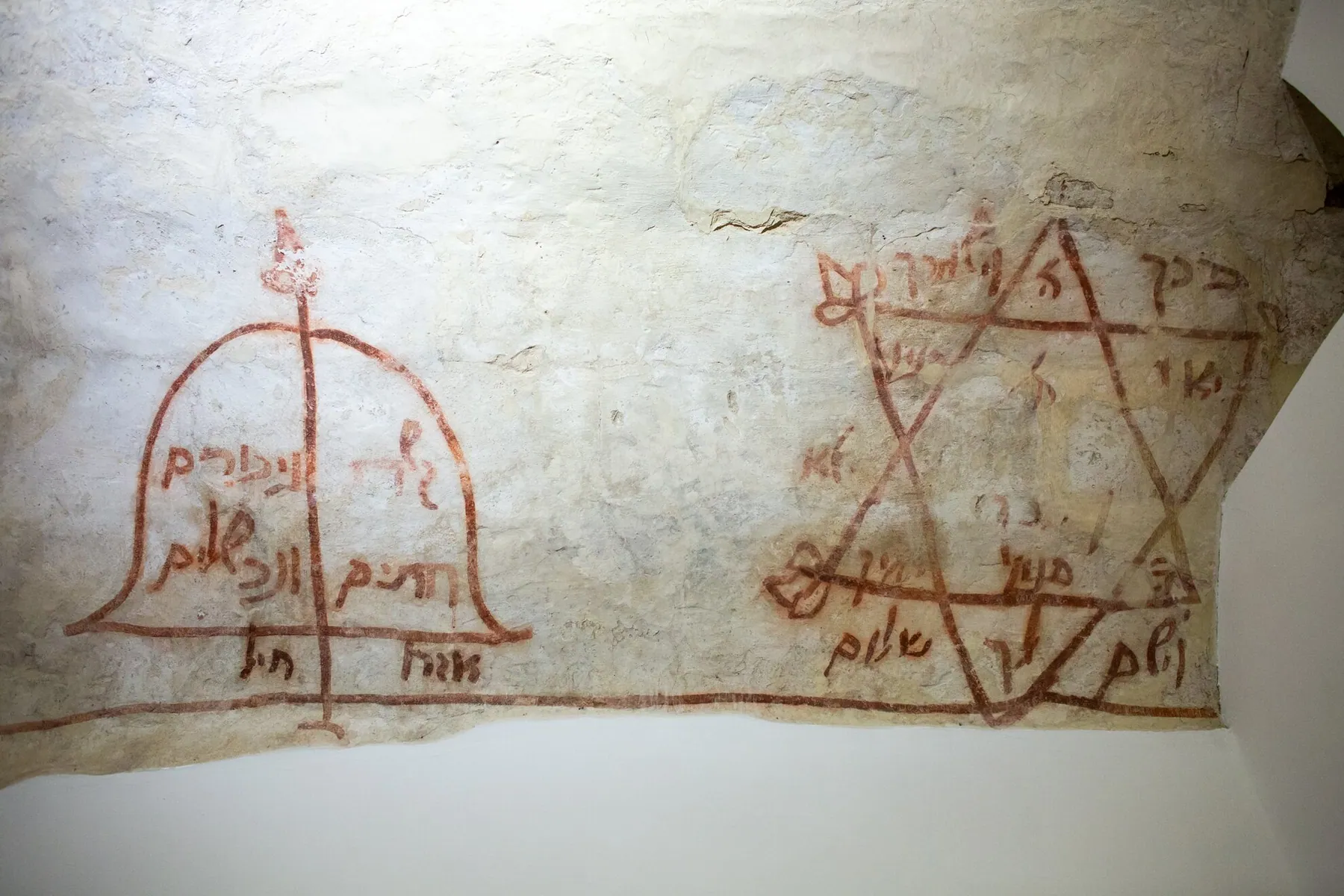
The prayer house stands in the northern part of Buda Castle, on the street the medieval town called Zsidó utca (Jewish Street), now Táncsics Mihály utca. Buda's Jews had lived in the town since its foundation in the mid-thirteenth century, first near the Fehérvári Gate on the road to the royal palace and, from the early fifteenth century, in this street, where they stayed with a short break until 1686. The building at number 26 began as a residential house; Szegő Dóra and Szegő György date it probably to the late thirteenth century, while the museum portal museum.hu dates the prayer house to the late fourteenth century. It served as a smaller place of worship facing the great synagogue across the street, built around 1461 on the plot of the Jewish prefect Jakab Mendel. Several writers connect the small room with Buda's Sephardi Jews of the Ottoman period. After Christian armies retook Buda in 1686 and the Jewish community was killed, scattered or ransomed, the room was forgotten. During restoration of the war-damaged house in 1964, painted figures with Hebrew inscriptions were found on its vault. The room was restored, opened as a museum of the Budapest History Museum, and since autumn 2018 has again been used for services. The building itself was never demolished.
Where it stood for roughly 290 to 320 years
Historic: Zsidó utca (Jewish Street), Buda Castle. Today: Táncsics Mihály utca 26, 1014 Budapest, District I (exact; the building still stands).
Apri la mappa grande →La comunità ebraica
Jews are recorded in Buda from the time King Béla IV founded the town after the Mongol invasion. The first Jewish quarter lay near the Fehérvári Gate, along the road to the royal palace; its synagogue, near the corner of today's Palota út and Dísz tér, was found about 1.5 metres below ground in 2005. Around 1420, under King Sigismund, the quarter was given up because of work on the royal palace, and the community moved to the northern end of the castle hill, to the street then called Zsidó utca. Under King Matthias a Jewish prefecture was set up and the Mendel family settled in Buda; Jakab Mendel's great synagogue was built on the street around 1461. After the Ottoman capture of Buda, Sultan Suleiman allowed Jews to return to their houses, and the community lived on in the same street, with Sephardi as well as Ashkenazi congregations, until the siege of 1686. How many people prayed in the small house at number 26 at any period is unknown.
Architettura e design
The prayer house occupies the ground floor of a residential building in Táncsics Mihály utca. Its street front carries a row of protruding Gothic arches resting on stone brackets, and above them is a reconstructed window in a stone frame, which Szegő Dóra and Szegő György suggest may have linked a women's prayer room with the main room. Inside, the prayer room is covered by a vault carried on two Gothic pillars. On the vault restorers found painted figures accompanied by Hebrew inscriptions; the Jewish heritage guide jguideeurope.org describes one fresco showing a bow pointed towards the sky and another showing a Star of David, with an inscription the guide renders as 'Powerful men equipped with bows were corrupt, while the weak were invested with power'. Sándor Scheiber identified the lettering as Sephardi in style and dated the inscriptions to the Ottoman period. Two further fresco fragments were found in the gateway passage. The room holds about 70 people. The original builder and the date at which the house was fitted out as a prayer room are unknown.
La vita nella sinagoga
Little is recorded about worship in the small house during its first life. Szegő Dóra and Szegő György state that the building, though originally a dwelling, certainly functioned as a prayer house from the time the great synagogue opposite was built, and that historians have linked it either with the Sephardi community of Ottoman Buda or with non-Ashkenazi Jews close to the Turks. The great synagogue across the street, the Mendel synagogue, was the main, probably Ashkenazi, house of worship, so the small room seems to have served a separate congregation of its own. The Sephardi script of the vault inscriptions, identified by Sándor Scheiber, supports the Sephardi attribution, and jguideeurope.org reads the verses chosen for the paintings as an expression of the community's fear of Christian attack. The last prayers of the old community were said there during the Ottoman period. The names of its rabbis, cantors and wardens are unknown.
Distruzione
No source read describes the small prayer house being wrecked or burned. It stopped being a synagogue when Buda's Jewish community came to a violent end in 1686, during the siege and recapture of Buda from the Ottomans by Christian armies. Accused of siding with the Ottomans, many Jews took refuge in the great synagogue across the street, which was first defended and then stormed by the Christian forces; those inside were killed and the building was set on fire. Survivors were carried off as captives to Eisenstadt, Győr, Komárom and elsewhere, and many were later ransomed by Samuel Oppenheimer and others. No congregation remained to use the small room, and its painted vault stayed hidden until the twentieth century. The great synagogue's ruins were filled with debris and forgotten until 1964. Whether the small room was damaged in 1686 or simply abandoned is unknown.
Il destino della comunità
The siege of 1686 ended the medieval and Ottoman-era Jewish community of Buda. According to the account on riowang.com, which follows the chronicle of Isaac Schulhof, Jews who sheltered in the great synagogue were killed when Christian troops broke in, Schulhof's wife and son among them, and the synagogue was burned; excavators later found a layer of ash mixed with human bones, and the remains were reburied in the Kozma utca Jewish cemetery. Survivors were scattered: about ten were taken to the Esterházy estate at Eisenstadt, many to Győr and Komárom, and a few to Berlin. Samuel Oppenheimer ransomed captives, and Alexander Tausk bought the freedom of 274 Jews with the support of Charles of Lorraine. Schulhof and Oppenheimer later settled in Nikolsburg.
Il luogo oggi
The house at Táncsics Mihály utca 26 still stands, and the medieval prayer room on its ground floor was reconstructed after the Second World War, following the discovery of its painted vault in 1964. What survives is the original Gothic room with its two pillars, the fresco fragments and Hebrew inscriptions, and the street arcade, with a reconstructed stone-framed window above; the furnishings are modern. The Budapest History Museum shows an exhibition there on the medieval and Ottoman Jewish quarters, with stone fragments from the great synagogue at number 23 and medieval Jewish gravestones. Since autumn 2018 the Unified Hungarian Jewish Congregation (EMIH) has used it for services as the Budavári Zsinagóga, with an ark, bima and seating designed by Tibor Somlai. The separate great synagogue across the street, excavated in 1964-65, was re-buried and remains underground.
Hai qualcosa da condividere?
Fotografie, documenti, storie di famiglia o ricordi di questa sinagoga e della sua comunità aiutano a mantenerne viva la storia.
- Synagogues (Our Budapest series), p. 13
- Medieval House of Prayer
- Középkori Zsidó Imaház Budapest
- Egy zsinagóga reneszánsza: középkori imaházat újítottak fel a Várban
- Budapest (Buda Castle Jewish sites)
- Synagogue under the ground
- Eltemetett zsinagóga: Mátyás kori Budavári Nagyzsinagóga
- Táncsics Mihály utca 26, Budapest (OpenStreetMap way 379872126)
Share a memory or thought
No comments yet. Be the first to add one.