


The story of Bzenec Synagogue
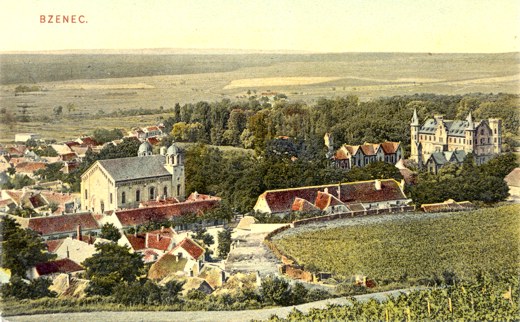
Bzenec, called Bisenz in German, lies in the wine country of South Moravia, and its Jewish community was counted among the oldest in Moravia; a medieval chronicler called the town a 'nest of Jews'. Its old synagogue, said to have stood for some 500 years, was pulled down in 1859. In 1863 the community, by then a self-governing political municipality, laid the foundation stone of a new 'representative' synagogue, attributed to the Viennese architect Ludwig Förster, designer of the Leopoldstadt Temple in Vienna and the Dohány Street Synagogue in Budapest. It was a free-standing brick building with two towers on its west front, standing at the end of the former Jewish street opposite the castle avenue, close to the castle and the baroque church.
The synagogue was built just as the community began to shrink: from 965 Jews in 1857 the numbers fell to 138 by 1930 as families moved to the cities. It was thoroughly renovated in 1925. On 22 June 1941 members of the local Nazi party wrecked its interior, and in October 1941 it was closed on the orders of the Nazi Reichsprotektor Reinhard Heydrich. After the war it served as a furniture workshop; a plan to turn it into a culture house damaged it in 1957, and it was demolished around 1960. A casino now occupies the site.
Where it stood for nearly 100 years
Historic: Bzenec (Bisenz), end of the Judengasse opposite the Schlossallee, main entrance towards Zámecká; no house number recorded. Today: junction area of Krále Vladislava and Zámecká streets, 696 81 Bzenec; plot now occupied by a late-1980s shop building used as a casino (approximate).
Open larger map →The Jewish community
Jews probably settled in Bzenec in the second half of the fourteenth century, and the town was one of the oldest Jewish centres in Moravia. The Jewish quarter lay in the town centre between the lower square and the castle. It was destroyed in 1458 and again in 1605, yet in 1604 some 400 Jews lived in 49 houses and kept their own hospital. Old privileges allowed Jews to own and work vineyards; in the later seventeenth century about a fifth of the town's vineyard land is said to have been in Jewish hands. Prussian invasion in 1742 and a fire in 1777, which burned 93 Jewish houses, brought heavy losses. In 1798 the number of Jewish families was capped at 130. The community reached 965 people in 1857, the largest it ever was, and from 1852 formed its own political municipality. It ran a German-language elementary school, a matzah bakery operated in the town, and Rudolf Auspitz owned a sugar refinery there. Emigration to the cities then reduced the community to 138 people by 1930; in 1919 the Jewish and Christian municipalities were merged.
Architecture and design
The building is attributed to Ludwig Förster, although the 1985 catalogue of his works does not list it; Förster died in June 1863, the year the foundation stone was laid. It was a free-standing brick building in a Neo-Romanesque manner with Byzantine touches. The interior measured about 29.7 by 20.8 metres and was divided into a nave and two aisles under Bohemian vaults spanning 13.3 metres, with women's galleries on three sides. There were about 300 men's seats on the ground floor and 116 women's seats in the galleries. The bimah stood towards the east, the almemor was finished in stucco marble, and the furnishings were mostly wooden. The symmetrical west front had two towers topped by domes, spires and Stars of David, reaching about 29 metres. Between them a central bay held a portal reached by five steps, a round window, two round-arched windows framed by columns, a clock and a tablet with a prayer in the gable. Round-arched friezes ran along the walls, lanterns crowned the corner piers and buttresses were added later. The east front had a central apse. There were five entrances in all.
Life inside the synagogue
By the time the synagogue opened, Bzenec was known as one of Moravia's reform-minded congregations, and it attracted learned rabbis. Nehemiah Brüll, a scholar of the Wissenschaft des Judentums, was rabbi from 1866 until 1870, when he left for Frankfurt am Main on Abraham Geiger's recommendation; he published a volume of his sermons in 1869, during his time at Bzenec. Moses Rosenmann served as rabbi from 1894 to 1897. The synagogue long doubled as a place of religious instruction, and the community also kept its own German-language elementary school, which became a four-class public school in 1878 while the community continued to pay the teachers. Little else is recorded about the order of services, the cantors or the lay leadership in the sources read. In 1925, with the congregation much reduced, the building was given a thorough renovation by the Brno builder Hindeisen at a cost of 88,818 crowns, half of it paid from the estate of Alfred Löwy. The synagogue's ritual objects and the community archive were later taken to the Central Jewish Museum in Prague.
Destruction
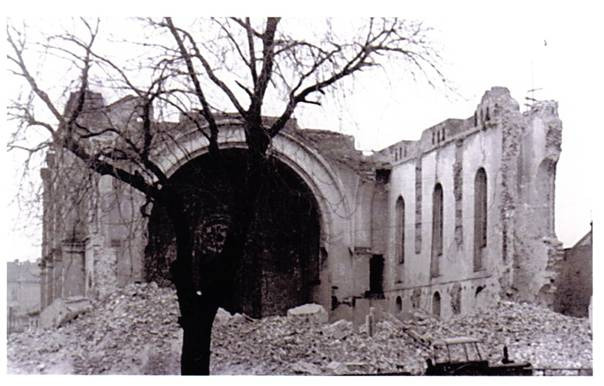
The synagogue survived the first two years of the Nazi German occupation intact, one of the few in the Czech lands to do so. On 22 June 1941 members of the local Nazi party (NSDAP) broke into the building and devastated and partly destroyed it; according to Tavacıoglu, residents of the town prevented them from setting it on fire. In October 1941 the synagogue was closed on the orders of the Nazi Reichsprotektor Reinhard Heydrich, its ritual objects and archive were sent to the Central Jewish Museum in Prague, and it served as a storeroom until 1945. After the war the furniture cooperative Družstvo Pickel Bzenec used it until the mid-1950s. The town, under the Communist regime, then planned to convert it into a culture house to designs by the engineers Cigánek and Vozka, but building work in 1957 damaged the structure so badly that demolition became almost unavoidable. The building stood empty and was pulled down in the early 1960s; a photograph dated 1960 shows the demolition, and its masonry was reused in the new culture house. Who ordered and carried out the demolition is not recorded in the sources read.
The community’s fate
By the 1930s only about a hundred Jews remained in Bzenec; the 1930 census counted 138, 3.4 per cent of the population. After the Nazi German occupation of Bohemia and Moravia in March 1939 they were subjected to the anti-Jewish laws of the Protectorate and lost their synagogue in 1941. In January 1943 the remaining Jews of Bzenec were deported by way of Kyjov to the Theresienstadt ghetto, and most of them were later murdered in Auschwitz and other Nazi death camps. The exact number of victims from Bzenec is unknown in the sources read. The linguist Norbert Jokl, born in Bzenec in 1877 to a Jewish merchant family, was arrested in Vienna in 1942 and died during his deportation. After the war a small congregation was re-formed in Bzenec under the administration of the Jewish community of Kyjov, but it did not use the synagogue again. The Jewish cemetery beside the town cemetery, with about a thousand gravestones going back to the late seventeenth century, and remains of the former Jewish quarter have been protected monuments since 1988.
The site today
The synagogue stood at the end of the former Jewish street, opposite the castle avenue (today Krále Vladislava street), with its main entrance towards Zámecká street, near Bzenec castle and the baroque church. In the late 1980s a two-storey self-service shop was built on the plot, and according to Tavacıoglu's study of 2015 the building now houses a casino. No trace of the synagogue survives above ground, and in 2015 there was no marker at the site. The synagogue's appearance survives in photographs and in the plans collected by the architect Jaroslav Klenovský, which Yıldız Tavacıoglu used for a virtual reconstruction at the Vienna University of Technology. The Jewish cemetery of Bzenec survives.
Notable names
Ludwig Förster
1797-1863Architect to whom the synagogue's design is attributedFörster, a Vienna-based architect born in Ansbach, was the leading designer of synagogues in the Habsburg lands, with the Leopoldstadt Temple in Vienna, the Dohány Street Synagogue in Budapest and the synagogue of Miskolc to his name. Tavacıoglu's 2015 study attributes the Bzenec synagogue to him and says it was built to his plans, while noting that the 1985 catalogue of his work does not list it. He died in June 1863, the year the foundation stone was laid, so he cannot have supervised the building.
Biography or source →Nehemiah Brüll
1843-1891Rabbi of Bzenec, 1866-1870Born in Rousínov in Moravia, Brüll was called as rabbi to Bzenec, then regarded as one of Moravia's reform-minded congregations, and served in the new synagogue from 1866 to 1870. A volume of his sermons appeared in 1869. In 1870 he resigned to become rabbi of Frankfurt am Main on Abraham Geiger's recommendation, and he later became known as a scholar and the editor of the Jahrbücher für jüdische Geschichte und Literatur. He died in Frankfurt in 1891.
Biography or source →Moses Rosenmann
UnknownRabbi of Bzenec, 1894-1897The Encyclopaedia Judaica names Moses Rosenmann as rabbi of Bzenec from 1894 to 1897, one of the two rabbis of the community it singles out. He served the congregation in the synagogue of 1863 at a time when emigration was steadily shrinking it, from 965 people in 1857 to a few hundred by the 1890s. Nothing further about his life was read in this research.
Biography or source →Alfred Löwy
UnknownBenefactor whose estate funded the 1925 renovationAccording to Tavacıoglu's study, half of the 88,818 crowns spent on the thorough renovation of the Bzenec synagogue in 1925, carried out by the Brno builder Hindeisen, came from the estate of Alfred Löwy. The bequest kept the building in good repair for the shrinking congregation in its last years of use. No other details of his life were found in the sources read.
Biography or source →Do you have something to contribute?
Photographs, documents, family stories or memories of this synagogue and its community help keep its history alive.
- Jüdische Gemeinde Bisenz (Mähren)
- Virtuelle Rekonstruktion der Synagoge in Bzenec (Bisenz) (diploma thesis, full text)
- Virtuelle Rekonstruktion der Synagoge in Bzenec (Bisenz) (repository record and abstract)
- Bzenec, Czech Republic (Encyclopaedia Judaica entry)
- Bzenec
- Nehemiah Brüll
- Ludwig Förster
- File:Bzenec Synagogue -04.jpg (historical postcard)
- Kr. Vladislava and Zámecká, Bzenec (OpenStreetMap ways 127168178 and 345315468)
Share a memory or thought
No comments yet. Be the first to add one.