
La historia de Capernaum Synagogue (White Synagogue)
Capernaum, Kfar Nahum in Hebrew, was a Jewish fishing village on the north-western shore of the Sea of Galilee. Its houses were built of the local black basalt, but in late antiquity the community raised a synagogue of white limestone brought from quarries in the hills west of the town. Set on a platform about two metres above the surrounding houses, with streets on all four sides, it was a basilica whose decorated southern facade faced Jerusalem. A colonnaded courtyard was added on its eastern side. How old the building is remains one of the best-known disputes in the archaeology of ancient synagogues. Carl Watzinger and Heinrich Kohl, who studied it in 1905, dated it to the late 2nd or early 3rd century on grounds of style. The Franciscan excavators Virgilio Corbo and Stanislao Loffreda, digging from 1968, found coins and pottery sealed beneath the floor and dated the hall to the second half of the 4th century and the courtyard to the 5th; Jodi Magness argues that the latest coins point to the 6th century. Beneath the limestone hall lie basalt walls of an earlier building, which Loffreda took to be a 1st-century synagogue. The synagogue was ruined, probably in the early 7th century, and the town was abandoned in the 11th. The Franciscans, who bought most of the site in 1894, partly re-erected the building from 1926, and it stands today as a restored ruin.
Where it stood
Historic: Kfar Nahum (Capernaum), north-western shore of the Sea of Galilee. Today: Franciscan archaeological site of Capernaum, Emek HaYarden regional council, Northern District, Israel; pin on the mapped synagogue building (exact to the building).
Abrir mapa ampliado →La comunidad judía
Capernaum appears in the Gospels as the town on the Sea of Galilee where Jesus taught in the synagogue, and the Gospel of Luke credits a Roman centurion with building a synagogue there; neither passage refers to the limestone building now standing, which is later. Excavation shows a village of basalt houses with the synagogue raised on its platform among them, and an octagonal church, built over the house traditionally linked to Peter, a short distance to the south. The two dedicatory inscriptions found in the synagogue name members of the congregation who paid for columns: Halfu son of Zebida son of Yohanan in Aramaic, and Herod son of Monimos with his son Justus and their children in Greek. The pilgrim Egeria, who visited about 381, described a building of dressed stone reached by many steps. The size of the Jewish population, the names of its leaders and the details of its religious life are unknown from the sources read. According to the Israel Ministry of Foreign Affairs the town declined and was abandoned in the 11th century.
Arquitectura y diseño
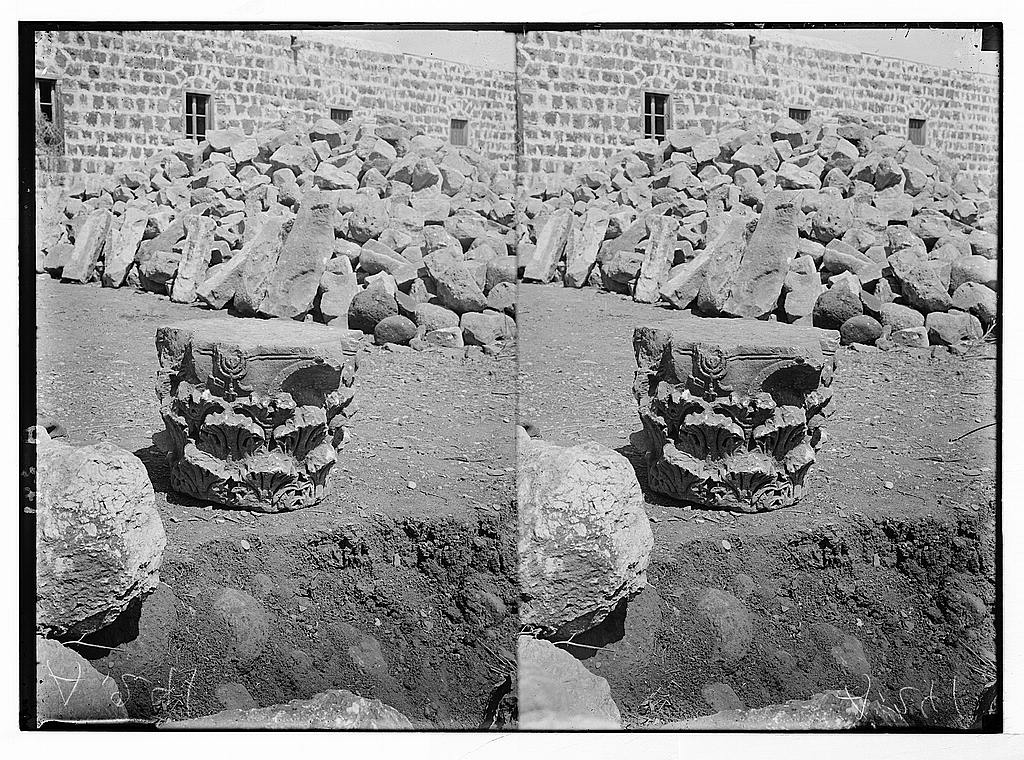
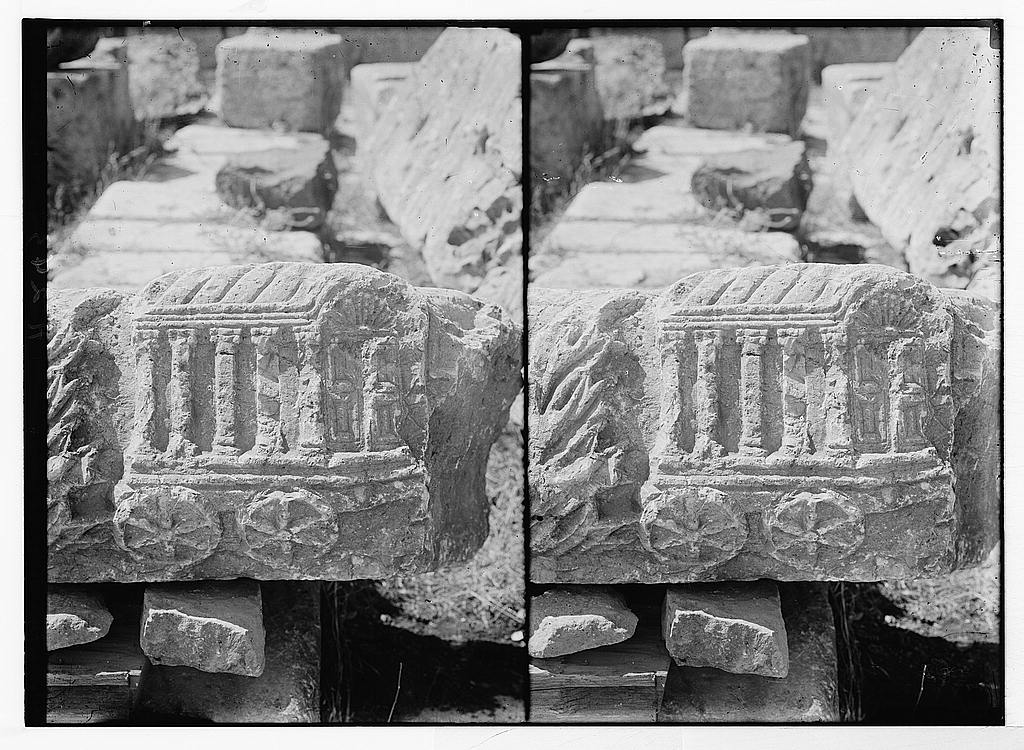
The synagogue was built almost entirely of white limestone, in contrast to the grey basalt of the village around it, and stood on a raised platform reached by staircases on both sides of a porch about four metres wide that ran along the southern facade. Three doorways led from the porch into the prayer hall. Published measurements differ: the Israel Ministry of Foreign Affairs gives 20.5 by 18.5 metres, other summaries 24.4 by 18.65 metres. Inside, a row of sixteen columns on high pedestals with Corinthian capitals divided the hall into a nave and aisles, and stone benches lined the east and west walls. The outer walls carried flat pilasters, and the inside was finished with painted plaster and stucco. Whether there was an upper gallery is disputed. On the east a courtyard of about 20.5 by 11 metres, a later addition, had covered porticoes on three sides and high windows. The carved decoration is exceptionally rich: vine and fig leaves, pomegranates, five- and six-pointed stars, eagles, a capital with a seven-branched menorah, ram's horn and incense shovel, and a relief of a wheeled shrine usually read as the Ark of the Covenant. The architect is unknown.
La vida dentro de la sinagoga
Very little is known about worship in the building beyond what its plan and finds suggest. The hall faced south towards Jerusalem, and the benches along its side walls seated the congregation. Two column inscriptions record the generosity of members. One, in Aramaic, reads in translation: Halfu, the son of Zebida, the son of Yohanan, made this column; may blessing be his. The other, in Greek, records that Herod son of Monimos (or Mokimos) and Justus his son, together with the children, erected a column. The menorah, shofar and incense shovel carved on a capital, and the wheeled shrine on a frieze block, show the symbols the community chose for its house of prayer. Beneath the floor the excavators found tens of thousands of small bronze coins, more than 25,000 according to Magness, together with pottery; their meaning for the date of the building is disputed. Nothing is recorded about rabbis, cantors or officers of the congregation, and the date at which regular services stopped is unknown.
Destrucción
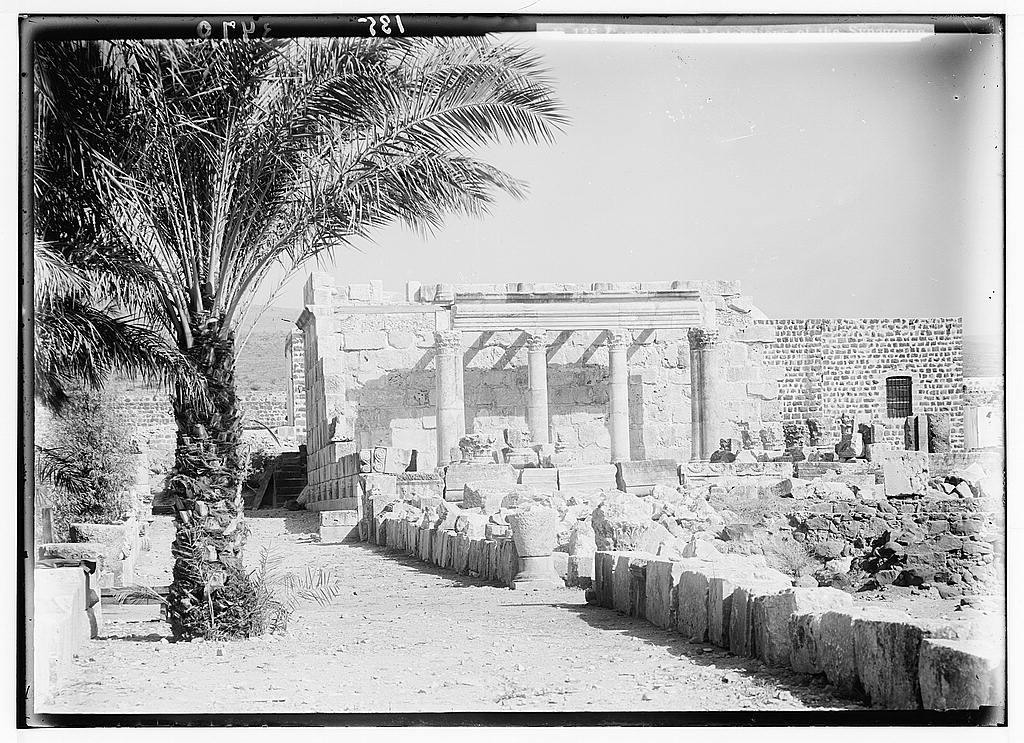
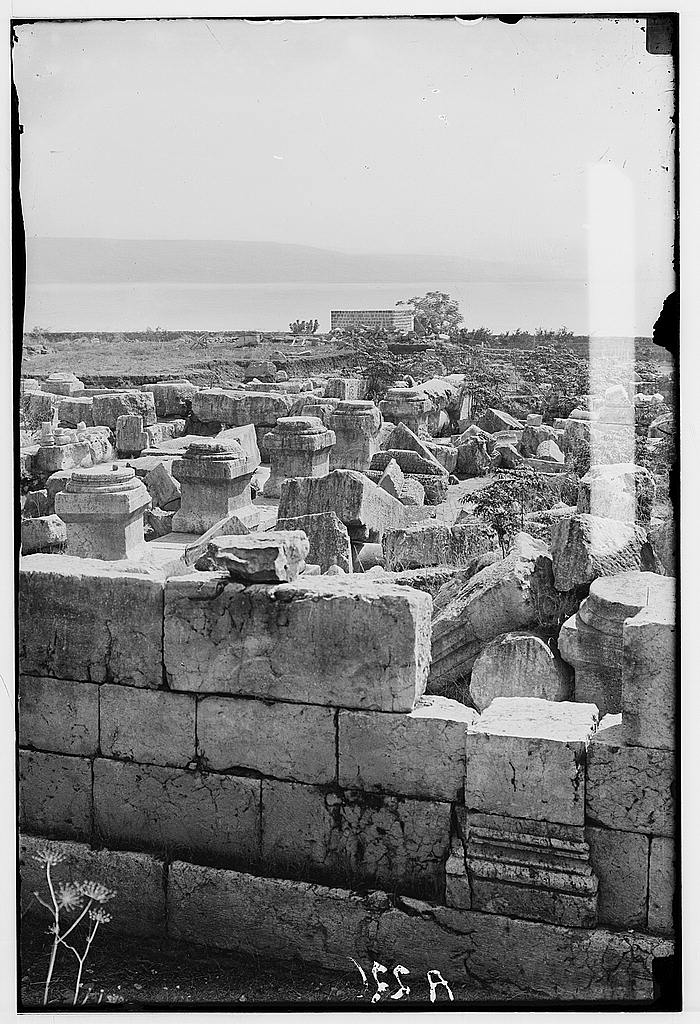
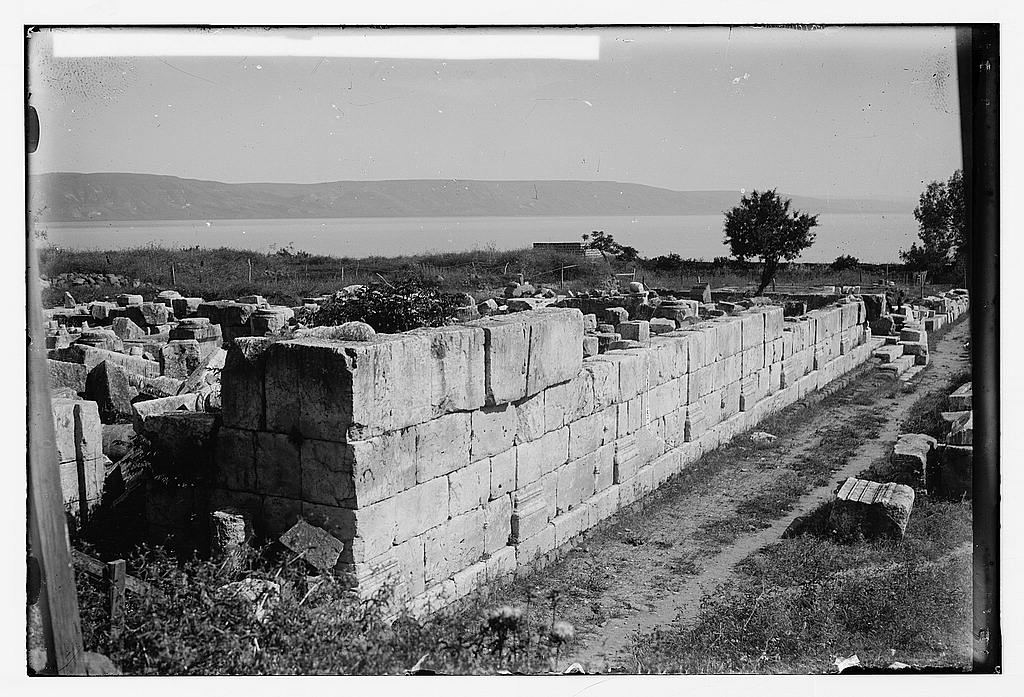
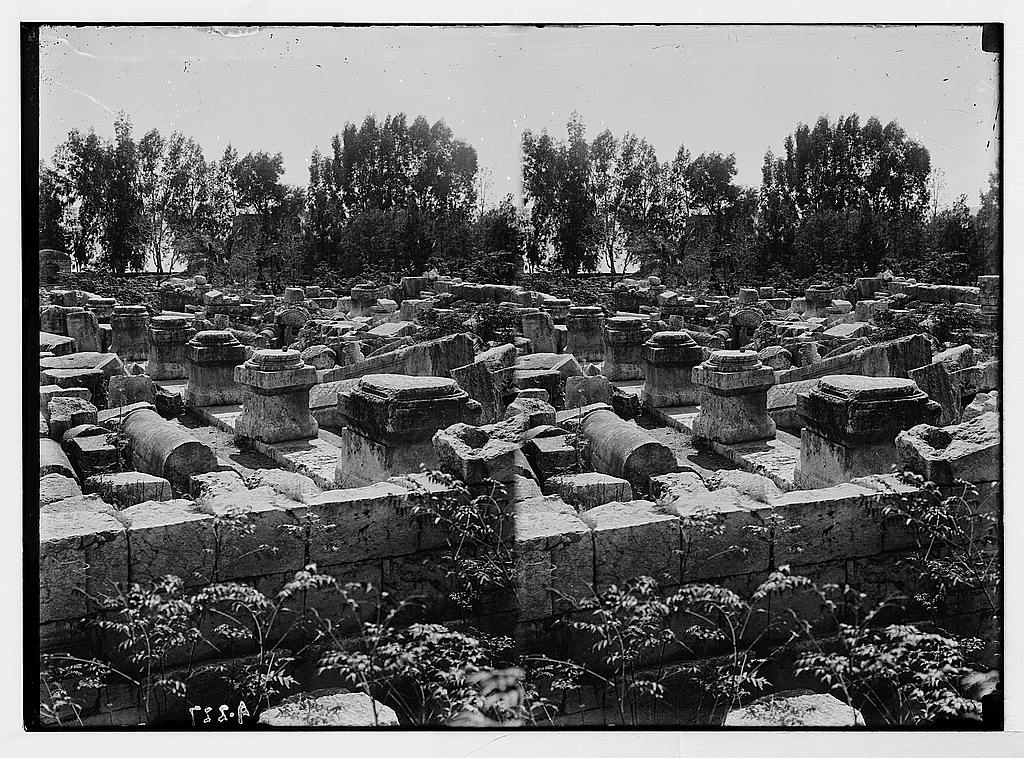
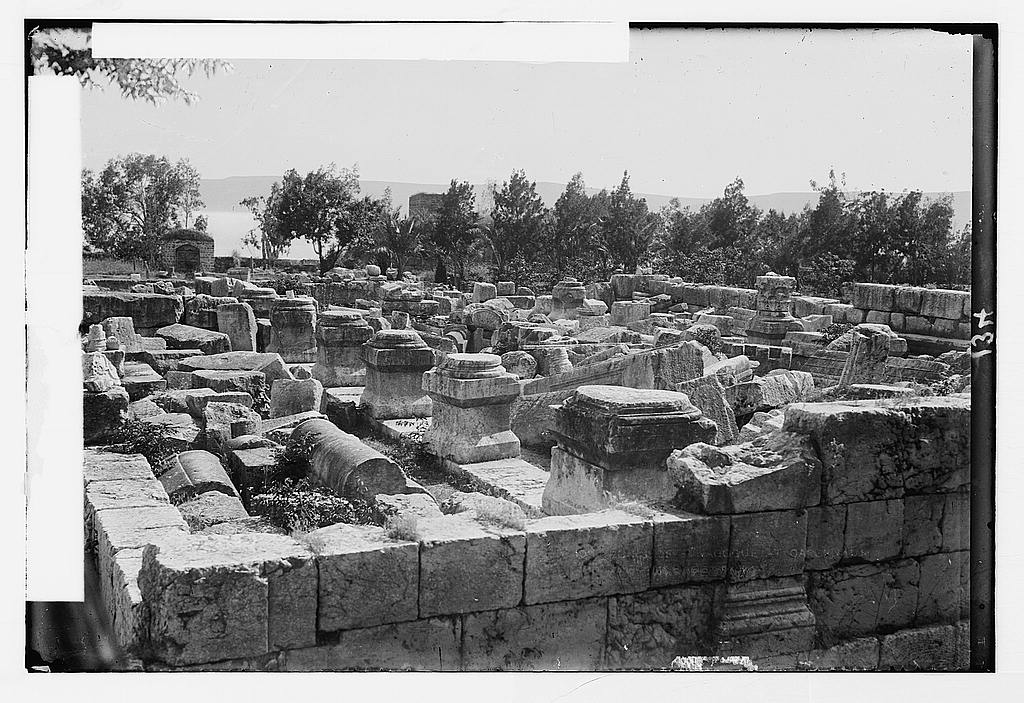
No source read gives a firm date or cause for the ruin of the synagogue. The Jewish Virtual Library, following the Israel Ministry of Foreign Affairs, states that the synagogue and the church at Capernaum were both destroyed in the early 7th century, before the Arab conquest of 636. It reports the suggestion that the church fell during the Persian invasion of 614 and the synagogue about fifteen years later, in reprisals after Byzantine rule returned, but presents this only as a possibility. BibleWalks instead says the village was partly destroyed in the Persian conquest and that the synagogue and church were destroyed in the Arab period. Others connect damage in the area with the earthquake of 363, but that concerns the earlier village beneath the platform. Whatever the cause, the building collapsed: photographs taken around 1900 show only the lower courses of the walls, pedestals in place and columns, capitals and frieze blocks lying in heaps. Who brought it down is unknown. The town lived on until it was abandoned in the 11th century.
El destino de la comunidad
What became of the Jews of Capernaum after the synagogue was ruined is not documented in the sources read. The Israel Ministry of Foreign Affairs says only that the town declined and was abandoned in the 11th century, and BibleWalks that it went on functioning for some time after the 7th-century destruction before it was totally ruined. Whether a Jewish congregation survived into the early Islamic period, and whether it used another building, is unknown. The site then lay deserted. Edward Robinson noted the ruins in 1838 without connecting them to Capernaum, and Charles William Wilson identified Tell Hum as Capernaum in 1866. In 1894 the land was bought, two thirds by the Franciscans and one third by the Greek Orthodox Church. No Jewish community has worshipped in the building since antiquity, and the names of its last members are unknown.
El lugar hoy
The synagogue stands today as a partly reconstructed ruin in the Franciscan archaeological park at Capernaum. Gaudenzio Orfali excavated and began restoring it between 1921 and 1926, using a contract agreed with a German builder in 1926, and Virgilio Corbo resumed the restoration from 1976. Re-erected walls of the prayer hall and courtyard, a stretch of the colonnade with its entablature and the stairways now stand, built largely from the fallen limestone blocks seen in photographs of about 1900; how much is original stone in place and how much is reset or new is not quantified in the sources read, and no wall height is given. The basalt walls of the earlier building can be seen beneath the hall, and carved fragments are displayed nearby.
Nombres destacados
Halfu son of Zebida son of Yohanan
Unknown (4th–5th c. CE)Donor of a column, named in the Aramaic inscriptionHalfu is known only from an Aramaic inscription carved on a column of the synagogue, which reads in translation: Halfu, the son of Zebida, the son of Yohanan, made this column; may blessing be his. He was evidently a member of the congregation who paid for part of the building. The Jewish Virtual Library notes that the Greek forms of his and his father's names, Alphaeus and Zebedee, also occur in the New Testament. Nothing else is known of him.
Biografía o fuente →Herod son of Monimos
Unknown (4th–5th c. CE)Donor of a column with his son Justus, named in the Greek inscriptionHerod is known from a Greek inscription found in the synagogue recording that Herod son of Monimos (the reading could also be Mokimos) and Justus his son, together with the children, erected a column. The inscription shows a family of the congregation sharing the cost of the building, and that some members recorded their gifts in Greek while others used Aramaic. Nothing else is known of Herod or of Justus.
Biografía o fuente →¿Tiene algo que aportar?
Fotografías, documentos, historias familiares o recuerdos de esta sinagoga y su comunidad ayudan a mantener viva su historia.
- Capernaum
- Capernaum
- Capernaum Synagogue (White Synagogue)
- The Synagogue at Capernaum
- Capernaum: City of Jesus and its Jewish Synagogue
- Ancient Synagogues in Palestine: A Re-evaluation Nearly a Century After Sukenik's Schweich Lectures
- Capernaum, Stratum A earthquake (?)
- Aramaic Inscription on Column from Capernaum, Central Galilee
- Greek Inscription on Column from Capernaum, Central Galilee
- Synagogue Where Jesus Preached Found at Capernaum
- Capernaum synagogue of pre-Christian era to be rebuilt
- Capernaum
- Matson (G. Eric and Edith) Photograph Collection: Capernaum synagogue
- בית הכנסת כפר נחום (OpenStreetMap way 124018117)
Share a memory or thought
No comments yet. Be the first to add one.