
The story of Carei Orthodox Synagogue
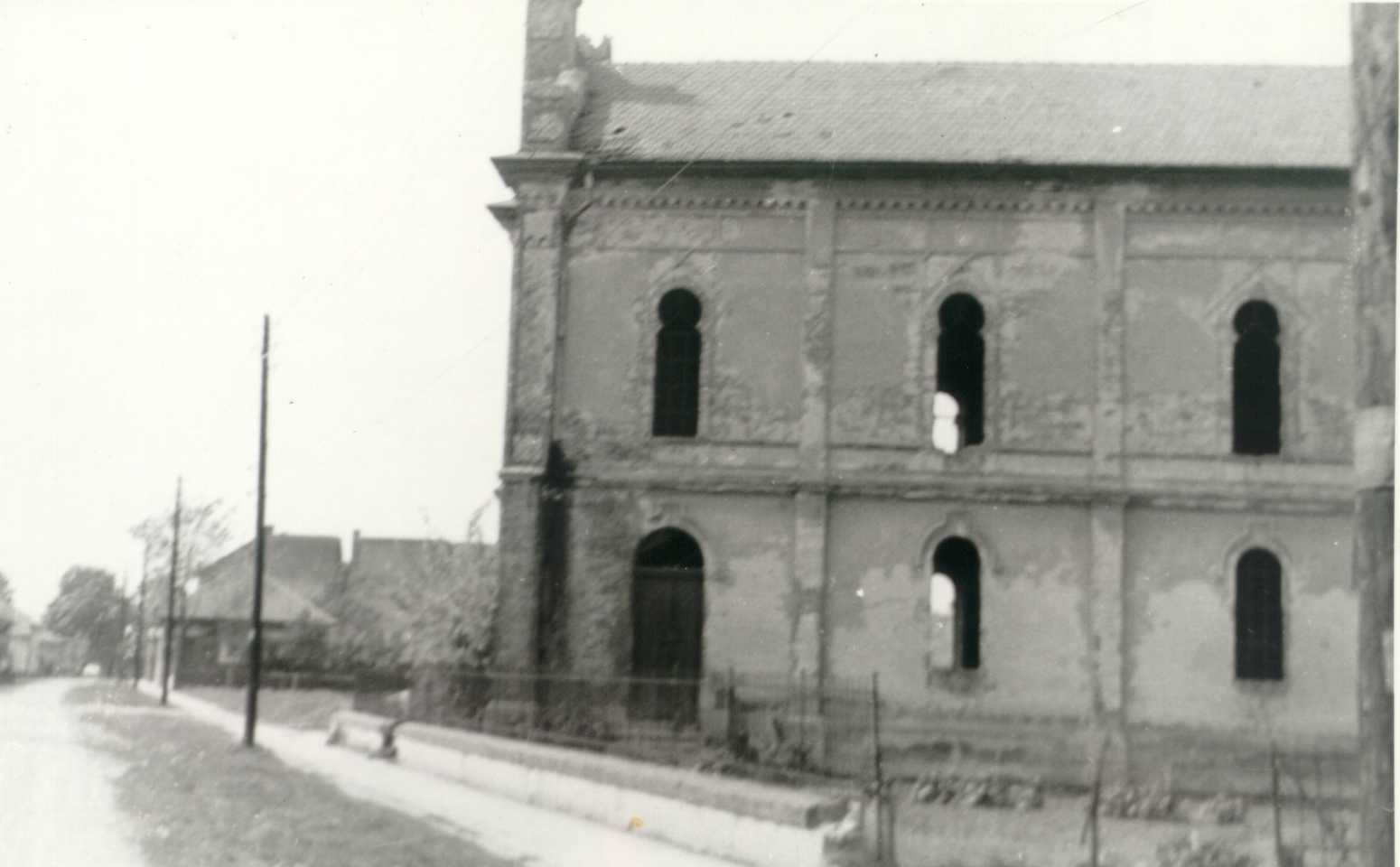
Carei (Nagykároly in Hungarian) lies in Satu Mare county in north-western Romania, close to the Hungarian border. Its Jewish community dates from about 1720, when the Károlyi family, lords of the town, settled Jews from Galicia on their estate. By the late nineteenth century more than two thousand Jews lived there, and the community split: the Encyclopaedia Judaica records that an Orthodox congregation was founded in 1881 and that two large synagogues were built, in 1870 and 1901. The main synagogue, begun in 1866 and remodelled in 1890, still stands on Strada Progresului. According to the Satu Mare county heritage site, the Orthodox community built a smaller synagogue nearby, which no longer exists. This entry concerns that second building. The only image found is an undated photograph in the Hungarian Jewish Museum and Archives (MILEV), catalogued as 'the burnt-out, demolished Orthodox synagogue of Nagykároly'. It shows a two-storey rendered hall with horseshoe-arched windows, empty window openings and a damaged gable, standing behind an iron fence on a quiet street. The Jews of Carei were ghettoised and deported by the Hungarian authorities in 1944. When the synagogue burnt, who set the fire, and when the ruin was pulled down are not recorded in any source read.
Where it stood
Historic: Nagykároly (Carei), Szatmár county; street unknown, near the main synagogue. Today: approximate pin at the surviving main synagogue, Strada Progresului 6, Carei, Satu Mare county (approximate).
Open larger map →The Jewish community
According to the Encyclopaedia Judaica, the lord of the town invited twelve Jewish families in 1720, and the community was organised in that year. Explorecarpathia, citing local history, says that Jews came from Galicia from 1720 and that in 1741 Count Sándor Károlyi granted fifty plots of land to Jews beside his castle; the Hungarian Jewish Museum holds a rabbi's contract from Nagykároly dated 1835. In 1784 Jews were the town's bakers, butchers, candle makers and soap makers. The Encyclopaedia Judaica counts about 66 Jews in 1740, 56 families in 1770, some 300 families in the 1860s, 2,073 Jews in 1891, 2,491 in 1910 and 2,394 in 1930. A first Jewish school opened in 1785 and a yeshivah in 1883. After the Hungarian schism of 1869 the community at first stood in the status quo ante camp; an Orthodox community was founded in 1881, and the encyclopaedia adds that the older community later became Orthodox as well, so there was no Neolog congregation. Joel Teitelbaum, later the Satmar Rebbe, was rabbi of Carei from 1926 to 1934.
Architecture and design
The architect, builder, date of construction and seating capacity of the Orthodox synagogue are unknown. The Encyclopaedia Judaica dates the town's two large synagogues to 1870 and 1901, but does not say which belonged to which congregation, and the Satu Mare county heritage site calls the Orthodox building smaller than the main synagogue. The one photograph found shows the long side and corner of a free-standing, two-storey rendered hall under a tiled pitched roof. The side wall is divided into bays by flat pilasters and a moulded string course, with a band of small corbels under the eaves. Each storey has tall, narrow windows with horseshoe-shaped heads set in pointed, Moorish-style surrounds; the ground floor has a larger arched doorway with a panelled double door. A heavier corner pier rises to a stepped, decorated gable, part of which has broken away. The building stands behind a low plinth wall topped with an iron railing, beside an unpaved street with telegraph poles and single-storey houses.
Life inside the synagogue
No description of worship in this building was found. The Encyclopaedia Judaica notes that settlers from Galicia brought Hasidic currents into the Carei community, that a yeshivah was founded in 1883 and that Joel Teitelbaum served as rabbi of the town from 1926 to 1934, but it does not say which synagogue he used. Klara Markus, a Carei Jew interviewed by Centropa, remembered three houses of prayer in the town: an Orthodox temple whose congregants were very religious, a larger synagogue with a women's gallery on the upper floor, and a third prayer house. She recalled that the Orthodox women's screen was made of wood, while the other congregation's let the women see more. She says the Orthodox temple still stands as a monument, which conflicts with the museum's caption for the burnt-out building and suggests that the names of the town's congregations and buildings have been used in different ways by different sources.
Destruction
No source read gives a date, a cause or a perpetrator for the fire that gutted the Orthodox synagogue, or for its demolition. The only direct evidence is the photograph in the Hungarian Jewish Museum and Archives, whose catalogue title describes the building as burnt out and demolished. It shows the walls and roof still standing, but the windows empty and part of the gable broken away. The museum filed this photograph with two photographs of the surviving main synagogue dated 1978, but gives no date for this one. The Satu Mare county heritage site says only that the smaller Orthodox synagogue does not exist today. Neither source says whether the fire happened during the Hungarian occupation and the deportations of 1944, in the fighting of autumn 1944, or later, and none names who pulled the ruin down. Without that evidence this entry does not attribute the destruction to anyone.
The community’s fate
Northern Transylvania, including Carei, was annexed by Hungary in 1940. According to the Encyclopaedia Judaica, Jews classed as foreign were deported in 1941 to Kamenets-Podolski, where they were murdered. When the Hungarian deportations began in 1944, 2,255 Jews lived in Carei. In the summer of 1944 the Hungarian authorities confined them in a ghetto and then moved them to Satu Mare (Szatmárnémeti), from which they were deported to the death camps. By 1947 about 590 Jews lived in the town, including survivors who had returned, and many of them later emigrated to Israel. About 40 Jews remained in 1969 and about 20 in 1977, and the community has since almost disappeared. The 1866 main synagogue survives, but Explore Carpathia lists it as abandoned and Wikipedia's list of Romanian synagogues says it is not in good condition.
The site today
The exact plot of the Orthodox synagogue has not been identified. The Satu Mare county heritage site says only that it stood near the main synagogue, which survives at Strada Progresului 6, and the photograph shows it on a broad, then unpaved street lined with single-storey houses. No fragment of the building is known to survive and no source describes what now occupies the site. The map pin marks the surviving main synagogue as the nearest documented point and should be read as approximate. Cadastral maps or the archive of the Satu Mare county museum would be needed to fix the location.
Do you have something to contribute?
Photographs, documents, family stories or memories of this synagogue and its community help keep its history alive.
Share a memory or thought
No comments yet. Be the first to add one.