

The story of Great Synagogue of Chișinău
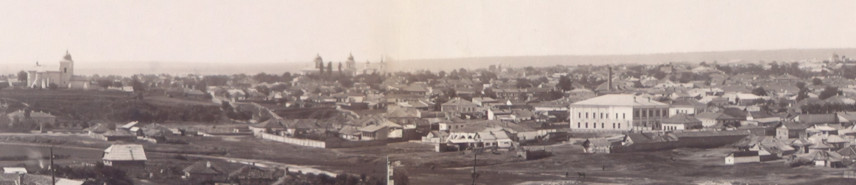
The Great Synagogue stood in the lower, so-called Asian, part of Kishinev, the tangle of crooked streets near the River Bîc where the town began. With the Orthodox Old Cathedral of the Archangels Michael and Gabriel and the Armenian church nearby, it formed one point of a triangle of houses of worship, each the centre of its own quarter: Moldovan, Armenian and Jewish. Irina Shikhova of the Jewish Museum of Moldova writes that it was consecrated in 1806, and that an earlier building of the late eighteenth century may have been badly damaged by the earthquake of 1802 and rebuilt. Other accounts date the work to about 1812, or to a foundation stone laid in 1816. Its address is recorded as Synagogue Lane 6, and the street that took its name from the synagogue has since disappeared from the city plan. It was known as the Triple Synagogue because, besides the main hall, it had two small prayer rooms to the right and left of the entrance. Kondratsky's panorama of 1889 shows it as a large, pale two-storey building rising above the low houses of the lower town. The synagogue survived the earthquake of 1940 and the bombing of the Second World War, which destroyed much of Kishinev. It did not survive Soviet rule: around 1960, during Khrushchev's anti-religious campaign, the Soviet authorities blew it up, together with the Old Cathedral, and built a hospital for construction workers on the site.
Where it stood
Historic: Synagogue Lane (Синагоговский переулок) 6, lower old town, Kishinev, near the Old Cathedral. Today: lower town near Bulevardul Grigore Vieru, Chișinău (exact plot not identified).
Open larger map →The Jewish community
Jews lived in Kishinev long before the synagogue was built: the statutes of a burial society, signed by 144 members in 1774, are the earliest firm evidence of an organised community, and the town's old Jewish cemetery lay in the lower town, around today's Ismail and Albișoara streets. After the Russian annexation of Bessarabia in 1812 Kishinev became the provincial capital and grew rapidly, drawing Jews from across the Russian Empire. The community numbered 10,509 people, about 12 per cent of the population, in 1847, and 50,237, about 46 per cent, in 1897. By the early twentieth century the city was said to have 77 synagogues and prayer houses. The Great Synagogue was the oldest focus of this community, the centre of the Jewish quarter of the old town, before the city expanded uphill onto its regular nineteenth-century grid.
Architecture and design
Little is known about the architect or plan of the synagogue. Sources describe it as a large masonry building, the Great Stone Synagogue, and the 1889 panorama by the photographer Pavel Kondratsky shows a long, pale, two-storey block with regular rows of windows and a hipped roof, set behind a wall above an open slope of the lower town. One end of the façade appears to have pilasters or an arcaded section. Its popular name, the Triple Synagogue, came from its layout: in addition to the main prayer hall it had two smaller prayer rooms on either side of the entrance. The building that stood until the Soviet period is thought to be at least the second on the site, rebuilt after the 1802 earthquake. No interior photographs, measured drawings or seating figures have been found.
Life inside the synagogue
The Great Synagogue served as the principal synagogue of the old Jewish quarter in the lower town from the early nineteenth century. According to the Encyclopaedia Judaica, Rabbi Hayyim ben Solomon Tyrer of Czernowitz, one of the early Hasidic leaders and author of Be'er Mayim Hayyim, laid the foundation stone of the Great Synagogue; he is also named as a rabbi in Kishinev. The side prayer rooms that gave the building its name allowed several congregations to pray under one roof. As the city grew, the main centres of Jewish life moved uphill, to synagogues such as the Wood Synagogue of about 1835 and the Choral Synagogue of 1913, but the Great Synagogue remained in use in the old town into the twentieth century. No source found names its later rabbis or cantors.
Destruction
The synagogue survived the strong earthquake of November 1940 and the bombing and fighting of the Second World War, in which by some estimates Kishinev lost nearly 90 per cent of its buildings. After the war Soviet rule brought the closure of most of the city's synagogues. At the turn of the 1950s and 1960s, as part of Nikita Khrushchev's campaign against religion, the Soviet authorities blew up the Great Synagogue, at the same time as the nearby Old Cathedral, and cleared the site for new construction. Irina Shikhova of the Jewish Museum of Moldova records that a hospital for construction workers was built where the synagogue had stood, while a cinema, later the Eugène Ionesco Theatre, rose on the site of the cathedral. The exact date of the demolition has not been found.
The community’s fate
Romanian and German forces entered Kishinev on 17 July 1941. In the first days thousands of residents, most of them Jews, were murdered by Einsatzkommando 11a and Romanian gendarmes. A ghetto was set up in late July 1941 in the poorest, bomb-damaged part of the city, holding about 11,000 to 15,000 people in terrible conditions. From October 1941 its inmates were deported on foot to Transnistria by the Romanian fascist authorities, and many died on the death marches; the last 127 people left in the ghetto were murdered in 1942. Of about 65,000 Jews in Kishinev in 1941, some 53,000 perished. Many others survived because they had been evacuated or mobilised into the Red Army. After the war a smaller community returned, but by 1964 all but one of the city's synagogues had been closed.
The site today
The synagogue was blown up around 1960 and a hospital for construction workers was built on the site. The old streets of the lower town were largely replanned in the Soviet period: the street named after the synagogue has disappeared, and the nearby site of the Old Cathedral is now occupied by the Eugène Ionesco Theatre on Grigore Vieru Boulevard. The exact plot of the synagogue has not been identified against the modern street plan. No part of the building is known to survive.
Notable names
Hayyim ben Solomon Tyrer
c.1760–1816/1817Hasidic rabbi; rabbi in KishinevHayyim ben Solomon Tyrer of Czernowitz, an early Hasidic leader and author of Be'er Mayim Hayyim, served as a rabbi in Kishinev. The Encyclopaedia Judaica credits him with laying the foundation stone of the Great Synagogue, dated there to 1816; other sources say he had left for Safed by 1813, so the date is uncertain.
Biography or source →Do you have something to contribute?
Photographs, documents, family stories or memories of this synagogue and its community help keep its history alive.
- Кишинев — город 7 холмов и 77 синагог. История еврейской общины
- Другие синагоги Кишинёва
- О происхождении кишинёвских улиц начала XIX века
- Kishinev, Moldova (Encyclopaedia Judaica, 2007)
- Kishinev – my native town: History of Jews and Genealogy
- Kishinev, destroyed Jewish Cemeteries
- История евреев Молдовы
- Старый Собор. История
- Teatrul Național „Eugene Ionesco”, Bulevardul Grigore Vieru 11
- Chaim Tyrer of Tchernovitz
Share a memory or thought
No comments yet. Be the first to add one.