



The story of Chorazin Synagogue
Chorazin was a Jewish village of the Roman and Byzantine periods on a basalt plateau about four kilometres from Capernaum, above the northern shore of the Sea of Galilee. The Gospels of Matthew and Luke name it among the towns that Jesus rebuked, and Eusebius, writing in the 4th century, described it as lying in ruins. Its synagogue stood at the centre of the village beside a paved square and was its grandest building. Built of the local black basalt in the Galilean style, it measured about 23 by 17 metres, faced south towards Jerusalem with three doorways, and had twelve columns arranged in a U-shape inside. Its facade and friezes were carved with vines, animals, lions, an eagle, a Medusa head, a menorah and wine-making scenes.
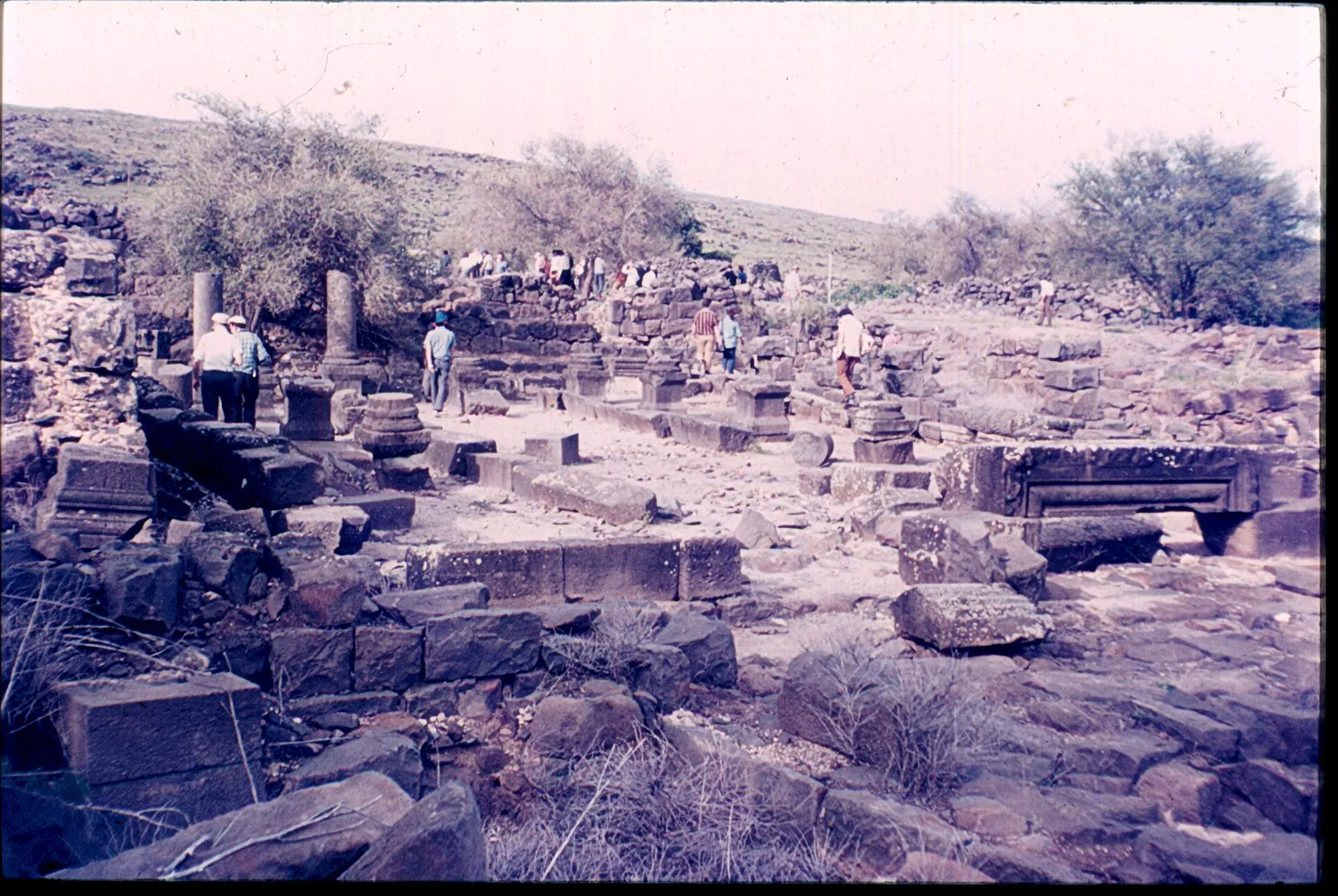
The excavator, Ze'ev Yeivin, dated its construction to the end of the 3rd or start of the 4th century CE and found that an earthquake partly destroyed it later in the 4th century. It was restored and remained in use, with repairs and changes, into the Early Islamic period, until the town declined from the 8th century and was abandoned. The building was excavated from 1905 onward, and between 1980 and 1983 it was partly rebuilt as the centrepiece of Korazim National Park. Its inscribed stone seat, the Seat of Moses, is in the Israel Museum.
Where it stood
Historic: centre of the ancient village of Chorazin (Khirbet Karraza), Upper Galilee. Today: Korazim National Park, north of the Sea of Galilee near the town of Korazim (approximate to within a few metres: synagogue site marker).
Open larger map →The Jewish community
Chorazin's Jewish community was a farming village rather than a city. The main settlement dates to the 3rd and 4th centuries CE and covered about 25 acres in five quarters, with the synagogue, a ritual bath just north of it, public buildings, houses and olive-oil presses that point to an economy based on olives. The Talmud praised the wheat grown by its people. The earliest finds so far date the village to about the mid-3rd century, although the national parks guide places the first occupation in the 1st or 2nd century CE. After the 4th-century destruction the town was rebuilt on the same plan and within the same limits, and it went on, with repairs and additions, into the Early Islamic period. The names of its inhabitants are almost entirely unknown: the only one recorded in the synagogue is Yudan son of Ishmael, who paid for part of its furnishings. No record of the size of the congregation, its leaders or its rabbis survives.
Architecture and design
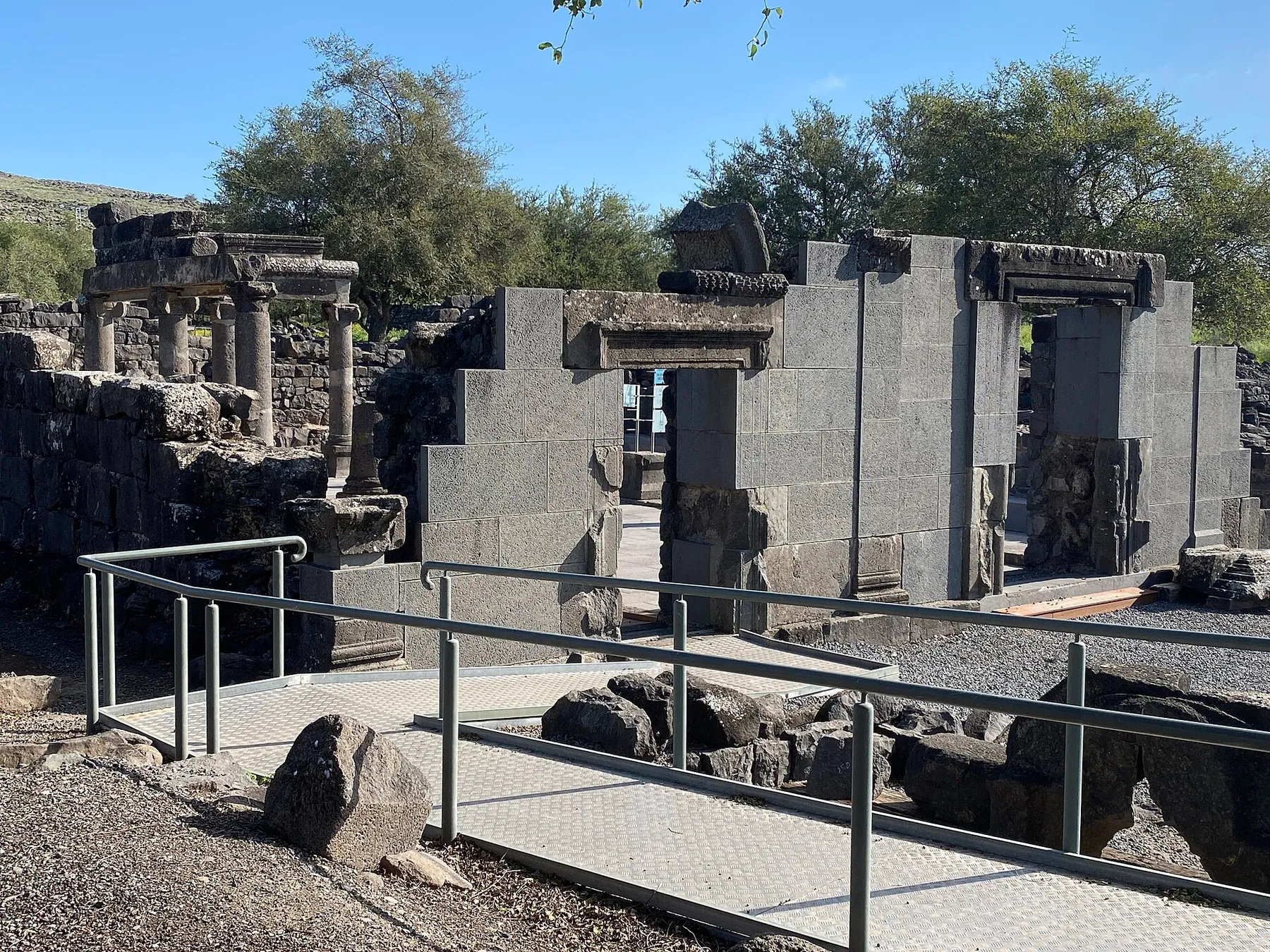
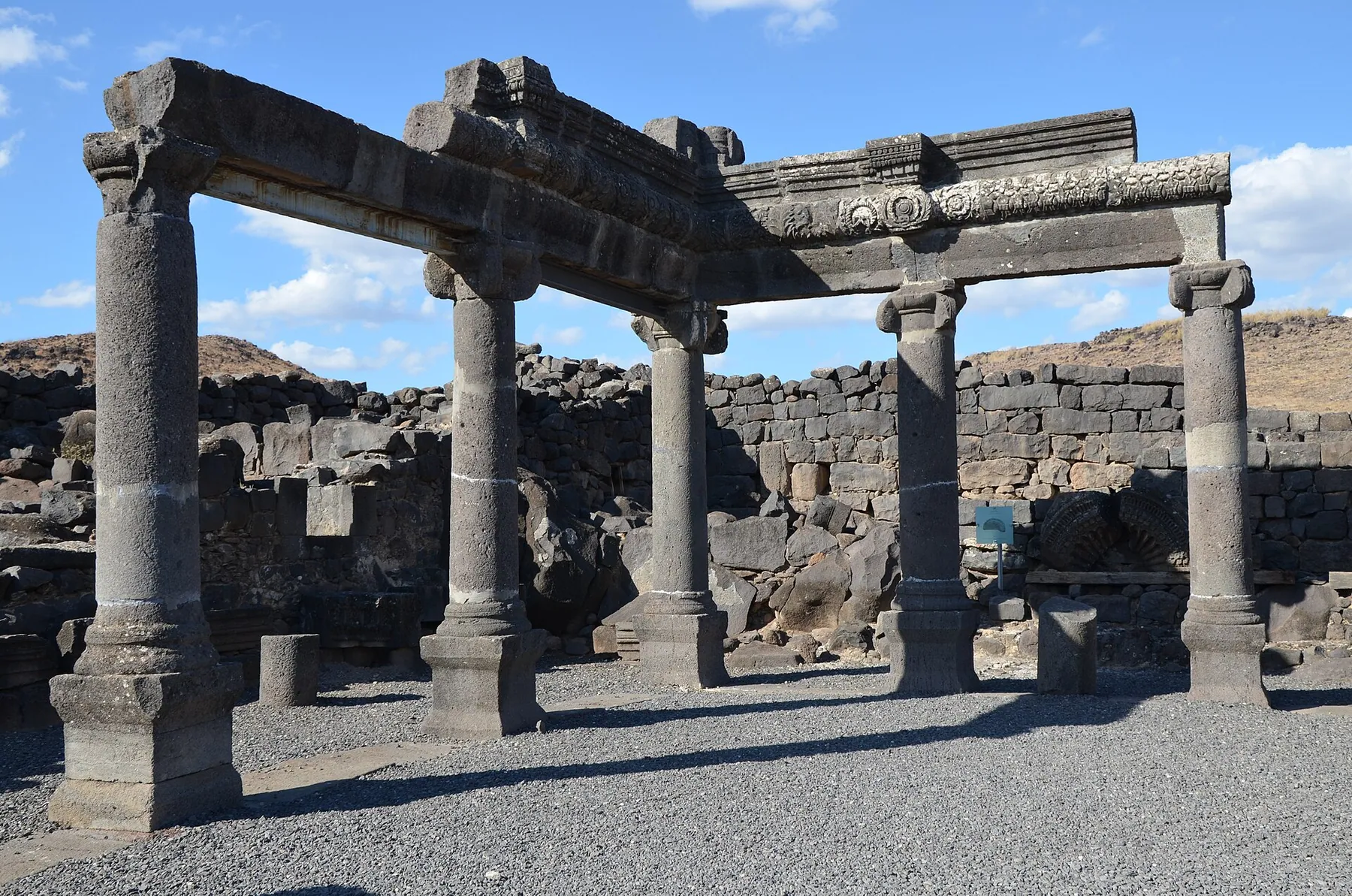
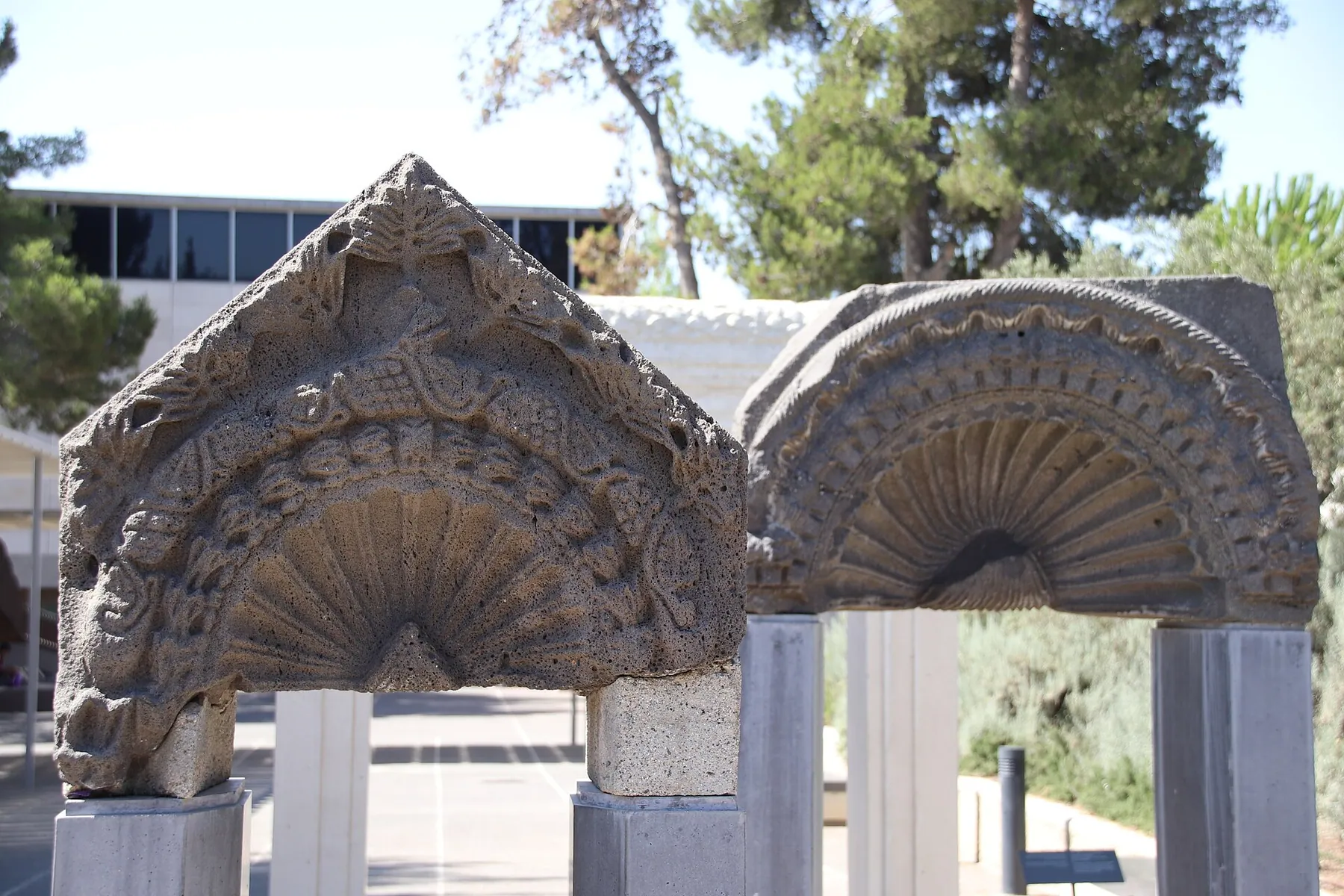
The synagogue is a rectangular basilica of black basalt, about 23 metres long and 17 metres wide, standing on a raised platform reached by a staircase from the main street. Its facade faced south towards Jerusalem and had three doorways, a high, wide central entrance flanked by two smaller ones, and was crowned by a richly carved gable. Inside, twelve columns in a U-shape divided a large central hall from three narrow aisles, with windows in the upper walls. The floor was paved with stone, without mosaics. On either side of the main door stood a raised platform: a Torah ark niche on one side and a reader's platform on the other, each probably topped by a carved gable with a shell-shaped half-dome; two such gables are now in the Israel Museum courtyard. The side doors had lintels carved with menorot and knotted wreaths. The decoration includes lions carved in the round, birds, vines, a Medusa head, an armed soldier, an eagle and wine-making scenes, probably once brightly painted.
Life inside the synagogue
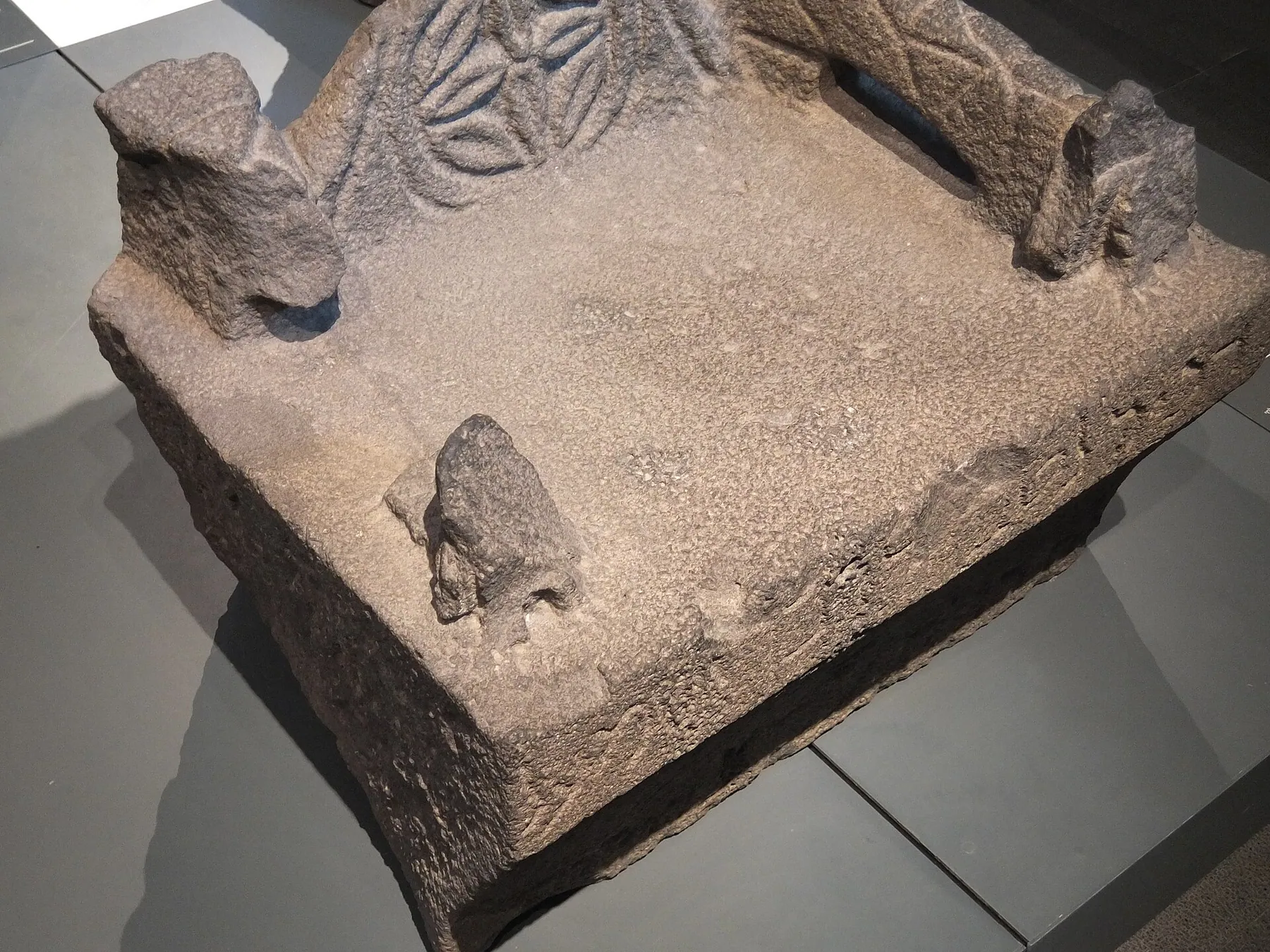
Very little is recorded about worship in the building beyond what its furnishings show. Prayer faced south, towards Jerusalem, through the main doors. Yeivin's reconstruction places the Torah ark in a semicircular niche on a platform beside the central doorway, and a reader's platform on the other side where the Torah was read in public. Beside it stood a basalt seat, found in 1926 near the southern wall and known as the Seat of Moses, which Yeivin thought was used by the Torah reader. It bears a four-line Aramaic inscription: 'Remembered for good be Yudan son of Ishmael, who made this stoa and its steps; may he have a portion with the righteous.' The word read as stoa is uncertain and may mean a colonnade, a small platform or a shelf. The inscription is the only one known from the site and is dated to the 5th or 6th century CE.
Destruction
The synagogue was not destroyed by an enemy. According to the excavator, Ze'ev Yeivin, it was built at the end of the 3rd or beginning of the 4th century CE and was partly destroyed by an earthquake in the second half of the 4th century; other summaries of his work put the destruction in the early 4th century, and one study has linked the damage to the earthquake of 419 CE, a link the archaeologist Jodi Magness has disputed. Eusebius, writing about 370, described Chorazin as a ruined town. The building was restored at the end of the 4th or in the 5th century, with many repairs and changes to the original, and remained in use, altered again in the Early Islamic period, until about the 8th century. From then on the town declined until it was abandoned, and the synagogue fell into ruin; how and exactly when its walls came down is unknown. Only a sparse village existed on the site from the 12th or 13th century.
The community’s fate
No source read describes a single event that ended the Jewish community of Chorazin. The excavations show that the village was rebuilt after the 4th-century destruction and remained inhabited, with repairs and additions, into the Early Islamic period. From the 8th century the town declined until it was abandoned. Why its Jewish inhabitants left, and where they went, is unknown. A small, sparse settlement grew up on the site in the 12th or 13th century and was still there in the 16th and 17th centuries. In the Ottoman period the ruins were known as Khirbet Karraza and were occupied by Bedouin of the Zangariyye tribe, with a shrine of Sheikh Ramadan; this village was depopulated on 4 May 1948. The nearby modern Israeli town of Korazim takes its name from the ancient site.
The site today
The synagogue stands in Korazim National Park, run by the Israel Nature and Parks Authority. It was excavated by Kohl and Watzinger in 1905-1907, by Makhouly and Ory in 1926, and by Ze'ev Yeivin in 1962-1964 and 1980-1984, and was conserved and partly rebuilt between 1980 and 1983. Today the raised platform, the south facade with two of its three doorways, sections of the basalt walls and several columns of the interior colonnade, with their architraves, stand again, and a reconstructed gable lies on the floor of the outer court. The sources read do not give the height of the walls or say how much of the standing masonry is original. The Seat of Moses on site is a replica; the original is in the Israel Museum, Jerusalem.
Notable names
Yudan son of Ishmael
Unknown (inscription dated 5th-6th c. CE)DonorYudan son of Ishmael is the only member of the Chorazin congregation known by name. The Aramaic inscription on the basalt seat found in the synagogue asks that he be remembered for good because he made the 'stoa' and its steps, and that he share a portion with the righteous. The word may mean a colonnade, a small roofed platform or a shelf. Nothing else about him is known.
Biography or source →Do you have something to contribute?
Photographs, documents, family stories or memories of this synagogue and its community help keep its history alive.
- Chorazin
- Korazim – Chorazin
- Khorazin (Earthquake Catalog of the Dead Sea, archaeoseismic sites)
- Khorazin destruction discussion
- Korazim National Park (visitor leaflet en-026)
- The synagogue at Chorazin
- Chorazin synagogue (historical marker)
- CHOR0001 (Chorazin chair inscription)
- How we reconstructed the niche for the Torah ark and the reader's niche at Chorazin
- Chorazin (Korazim)
- Chorazin: introduction
- Inscribed chair from Korazim (File:Chorazin Synagogue - Stone Seat.jpg)
- Northern views. Ruins of a synagogue at Chorazin
- גן לאומי כורזין (OpenStreetMap relation 12876384)
Share a memory or thought
No comments yet. Be the first to add one.