
La historia de Medieval Synagogue of Cologne
The synagogue of medieval Cologne stood in the middle of the Jewish quarter, next to the town hall. Late medieval chronicles place its building in 1012 or 1040, and excavation agrees that the first synagogue on the site belongs to the early eleventh century. It was the centre of one of the oldest Jewish communities north of the Alps, used for prayer and study and as the seat of the rabbinical court. Crusaders sacked it in 1096; the community rebuilt it, and about 1270 to 1280 refitted it in Gothic style with a stone bimah carved by masons of the cathedral workshop.
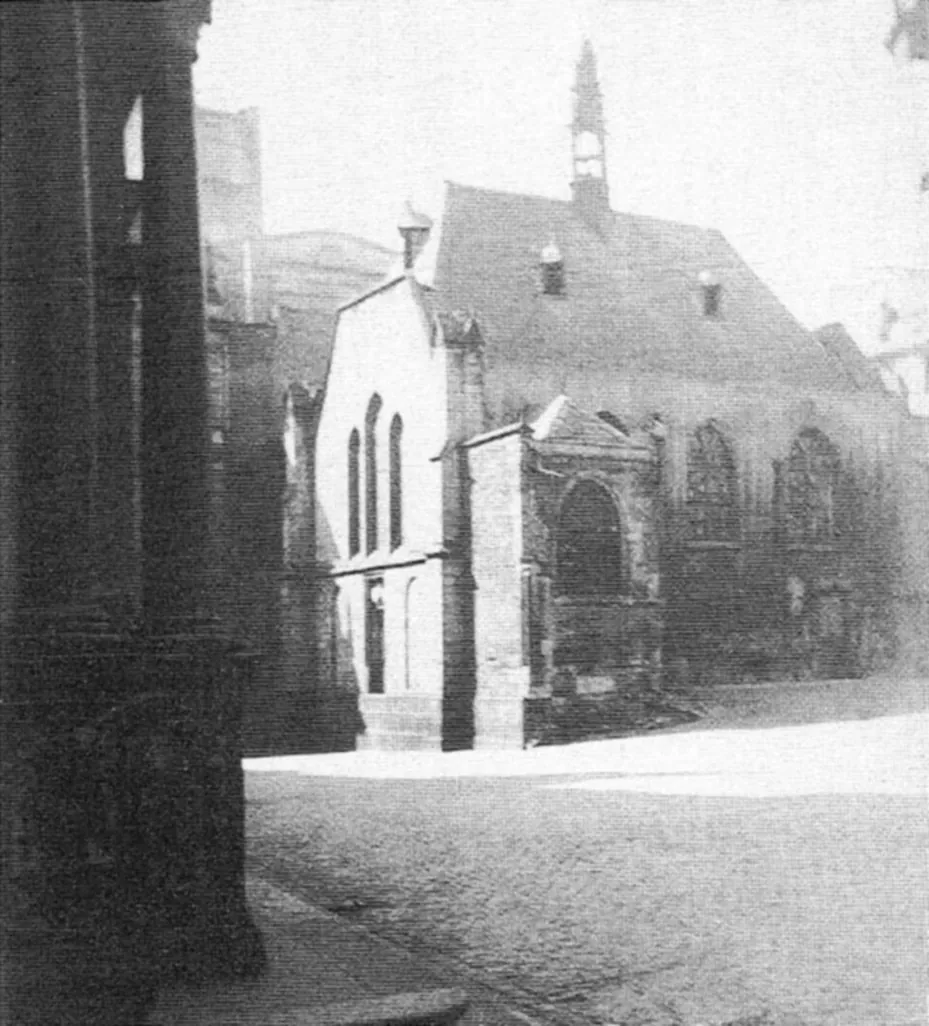
On the night of 23 to 24 August 1349 a mob stormed the Jewish quarter and the community was murdered. The synagogue was plundered and its bimah broken up. A few families returned in 1372 and rebuilt it on a smaller scale. In 1423 the city council refused to renew the Jews' right of residence, which ran out in October 1424, and the council turned the building into its chapel, St. Maria in Jerusalem, consecrated on 8 September 1426. As a chapel the walls stood for another five centuries, until Allied bombs destroyed the building in the Second World War. The ruin was buried under the square, excavated in 1956 to 1957 and again from 2007, and its foundations are now being built into the MiQua museum. The mikveh beside it survives.
Where it stood for nearly 310 years
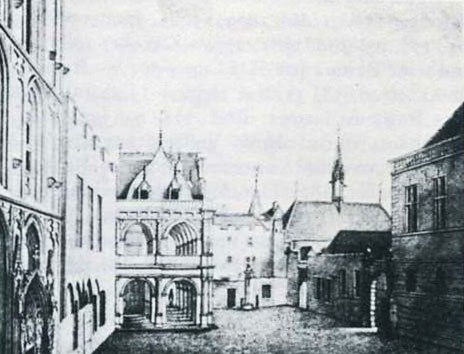
Historic: the synagogue courtyard in the medieval Jewish quarter, on the Judengasse opposite the town hall, Cologne. Today: Rathausplatz / Judengasse, 50667 Köln (Altstadt-Nord), inside the MiQua museum building site (exact).
Abrir mapa ampliado →La comunidad judía
A decree of Emperor Constantine of 321 is the first written evidence of Jews in Cologne, but the medieval community is documented only from the eleventh century; the Jewish quarter is attested between 1056 and 1075. It covered about 1.35 hectares west of the town hall, and the communal buildings (synagogue, mikveh, bakehouse, hospital and a hall for weddings and festivities) took up about a sixth of it. The community, known as the Kahal Kolonia, governed itself through a council headed by an officer whom Latin sources call the Jews' bishop; seven holders of the office are known between 1135 and 1417. Estimates of its size differ: about 700 to 800 people in the mid-fourteenth century according to one account, 800 to 1,000 at its height according to the excavators. The city built its town hall in the twelfth century in the middle of the quarter. A register of property in the quarter, the Judenschreinsbuch, was compiled about 1135 and lets the excavated houses be matched with written records. After the return of 1372 the community never had more than 31 taxpaying households, or about 200 people.
Arquitectura y diseño
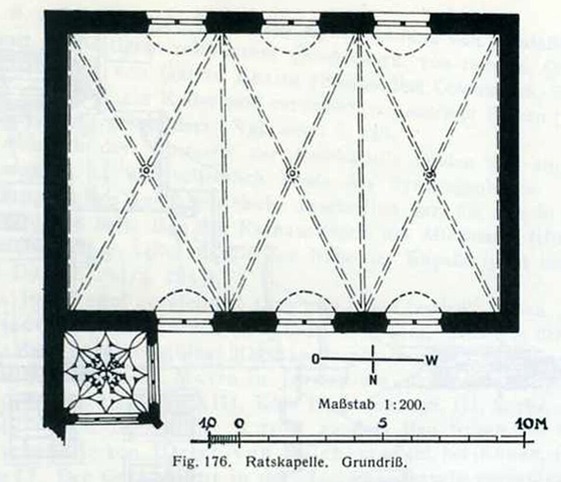
The synagogue was a rectangular, two-storey stone hall of about 9 by 15 metres, standing in a courtyard near the middle of the quarter. Otto Doppelfeld, who excavated it in 1956 and 1957, distinguished four successive building phases, the oldest dated by pottery to about 1000 and the youngest to the end of the fourteenth century. The walls inside were plain white, with inscribed stones set below a beamed ceiling, and some fittings were cut from the marble-like lime deposit of the Roman aqueduct. A dispute of about 1140 concerned windows with pictures of animals. A women's synagogue was attached to the men's hall and joined to it by narrow slits in red sandstone; one account places it at the north-east corner and dates it to the remodelling of about 1270, when the entrance was also moved. The Gothic bimah of about 1270 to 1280 stood in the centre over a small cellar: a canopied platform with clustered columns, leaf capitals and cusped arches carved with birds and small animals. The foundation block of the Torah ark was found overturned in 2014. As a chapel the hall measured about 14.5 by 9.2 metres inside.
La vida dentro de la sinagoga
The building was the community's house of prayer, its place of study and the seat of the rabbinical court, and a courtyard beside it, the curia Judaeorum, was used for assemblies and weddings. The earliest written mention of the synagogue concerns Saturday 4 December 1075, when, according to a life of Archbishop Anno written about 1180, the Jews of Cologne mourned the archbishop there. Rabbis, judges, readers, slaughterers and beadles served the congregation, and women followed the service from their own room through the wall slits. The cellar under the bimah probably held valuables, documents and worn-out ritual objects. The Amsterdam Machzor, a manuscript festival prayer book following the Cologne rite, was probably made about 1250 for use in this synagogue. In a pit under the women's synagogue the excavators found about 107,000 fragments of slate thrown in during the plunder of August 1349; more than 220 carry writing or drawings, among them school exercises, lists of names and sums of money, and part of a knightly tale in Old Yiddish.
Destrucción
The synagogue was destroyed in stages. In 1096 crusaders pillaged the Jewish quarter, tore up and defiled the Torah scrolls and sacked the synagogue; the survivors rebuilt it. On the night of 23 to 24 August 1349, during the Black Death persecutions, a mob stormed the quarter while the city council stood by; it later blamed outsiders joined by poor townspeople. A medieval report that Jews burned themselves inside the synagogue is doubted: the excavators concluded that the building was still standing after that night and was plundered afterwards. The Gothic bimah was smashed, its iron fittings were taken and its cellar was filled with the fragments. The synagogue rebuilt in 1372 was lost when the council let the Jews' residence right lapse in October 1424 and converted the building into its chapel between 1424 and 1426; the bimah was removed and an altar took the place of the Torah ark. The chapel was secularised in 1798 or 1799. Allied bombing ruined the building in the Second World War, in the 'thousand-bomber raid' of 1942 according to the City of Cologne, in 1943 by another account. It was not rebuilt, and the ruin disappeared under asphalted rubble.
El destino de la comunidad
The community was attacked three times. In 1096 crusaders killed many of Cologne's Jews and forced others to be baptised; one account gives about 300 dead. In August 1349 the whole community perished, about 800 people by one estimate; some killed themselves to escape forced baptism, and gravestones from the Jewish cemetery were reused in the archbishop's buildings. Jews are documented in the city again from 1372, when a few families were admitted under an archbishop's privilege that was renewed every ten years until 1414. On 16 August 1423 the city council decided not to renew their residence right, and in October 1424 they had to leave 'for all eternity'; appeals to the archbishop, the emperor and the pope changed nothing. One account explains the expulsion by the struggle for power between the council and the archbishop. Some families settled across the Rhine in Deutz under the protection of Archbishop Dietrich von Moers, and many others emigrated eastwards. For centuries no Jew was allowed to stay overnight in Cologne. The first Jewish couple was permitted to settle there again in 1798, and a new synagogue was built in the Glockengasse in 1857 to 1861.
El lugar hoy
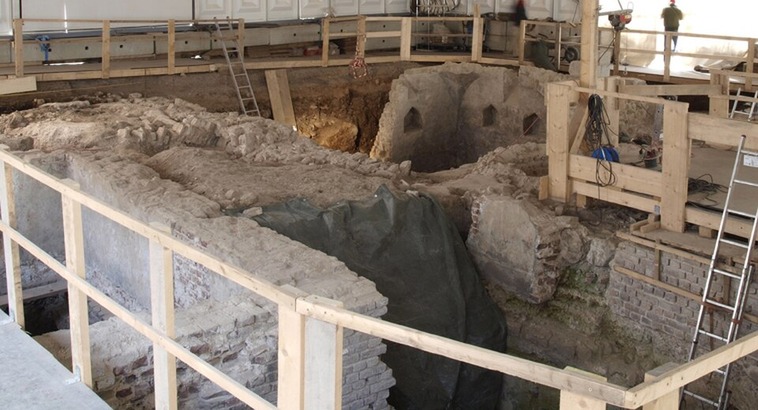
The site lies under the Rathausplatz, in front of Cologne's historic town hall. After Doppelfeld's excavation the remains were covered over again and the outline of the building was marked in the paving of the square. Excavations from 2007 to 2015 uncovered the synagogue once more, with the cellars of the surrounding houses. The remains are low walls and foundations, reaching up to seven metres below ground; they have been underpinned and enclosed in the new MiQua museum, the LVR Jewish Museum in the Archaeological Quarter, which is being built over them. In November 2020 the foundation block of the Torah ark was set back in the future exhibition space. The museum announces its opening for 2029. The neighbouring mikveh, first mentioned in 1270, survives with its shaft about 16 metres deep and belongs to the same underground circuit.
Nombres destacados
Moses Kohen Zedek
died 1096Rabbi and cantor of the Cologne communityThe Encyclopaedia Judaica names Moses Kohen Zedek as rabbi and cantor of Cologne and records that he was killed as a martyr in 1096. That was the year in which crusaders pillaged the Jewish quarter, tore up and defiled the Torah scrolls and sacked the synagogue in which he had led the prayers. Nothing else about his life was found in the sources read.
Biografía o fuente →Jekuthiel ben Moses Möln ha-Levi
15th century; dates unknownRabbi of Cologne at the time of the expulsionThe Jewish Encyclopedia names Jekuthiel ben Moses Möln ha-Levi as the rabbi of Cologne at the time of the banishment. He was therefore the last rabbi of the congregation that had rebuilt the synagogue after 1372, and he held office when the city council refused to renew the Jews' right of residence and the building was taken over and converted into the council chapel. His later life is not recorded in the sources read.
Biografía o fuente →¿Tiene algo que aportar?
Fotografías, documentos, historias familiares o recuerdos de esta sinagoga y su comunidad ayudan a mantener viva su historia.
- Mittelalterliche Synagoge Köln
- St. Maria in Jerusalem
- Ratskapelle St. Maria in Jerusalem (KuLaDig object KLD-355832)
- Ratskapelle St. Maria in Jerusalem, print view with coordinates (KLD-355832)
- Archaeological Zone / Jewish Museum Cologne: history of the Jewish quarter
- Cologne
- Cologne (Encyclopaedia Judaica, 2nd ed.)
- Archäologische Zone Köln
- Jüdische Geschichte in Köln
- History of the Jews in Cologne
- Tief unter der Erde
- Versunkene Parallelwelt
- Ein historischer Überblick: Jüdisches Leben in Köln von der Antike bis heute
- Archäologie und Ingenieurswesen arbeiten Hand in Hand für das MiQua
- Ausgrabungen des jüdischen Viertels
- MiQua, LVR-Jüdisches Museum im Archäologischen Quartier Köln (home page)
- Excavations in central Cologne
- File:Köln, Ratskapelle von Nordosten, 1873-1876.jpg
- File:Köln-Rathausplatz-von-Norden-um-1827.jpg
- File:Grundriss Sankt Maria in Jerusalem.jpg
- File:Bimah.JPG
- File:Rathausplatz und Umfeld 1571.jpg
- File:Zone.JPG
Share a memory or thought
No comments yet. Be the first to add one.