
The story of Sephardic Temple of Constanța
Constanța, the Black Sea port of Dobruja, had two Jewish congregations by the late nineteenth century: an Ashkenazi one and a Sephardic one whose members, according to the English Wikipedia article on the building, came from Anatolia while the region was still Ottoman. The Sephardic congregation built its first synagogue in 1866 or 1867 on central land donated by Ismail Kemal Bey. As the community grew it asked the municipality for a larger temple; approval came in May 1903, and the new Israelite Temple of the Spanish Rite was designed by the Austrian architect Adolf Lintz and funded by local and foreign donations and charity performances. Konstantin Ardeleanu's history of Constanța says it was ready about 1905; Wikipedia gives 1905 to 1908. It stood on Mircea Street, on the site of the first synagogue, and its interior was painted by Moritz Finkelstein.
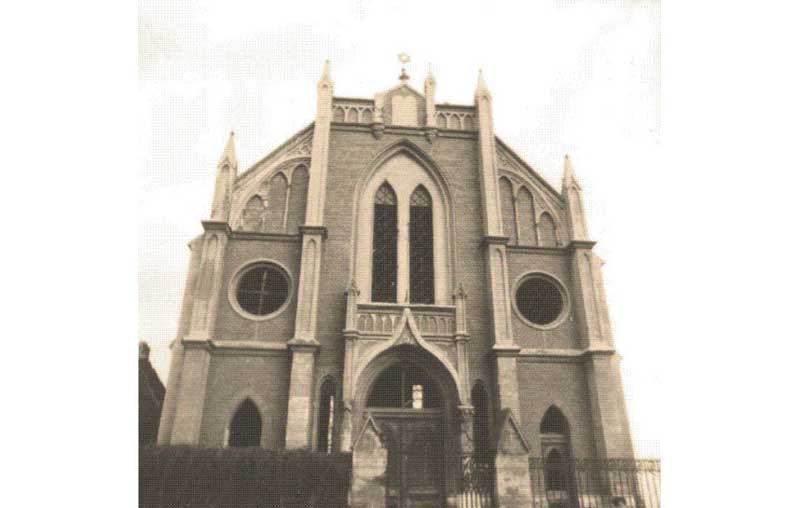
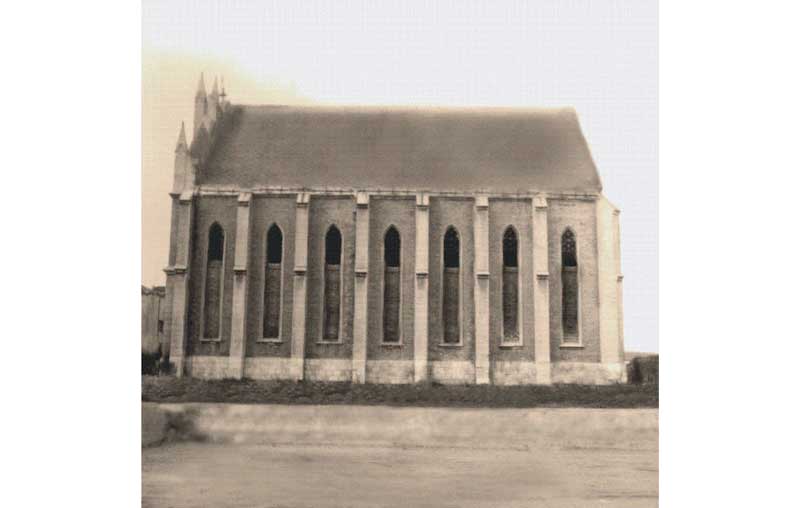
Two surviving photographs show a tall brick hall in a pointed-arch Gothic manner, crowned by a Star of David. The building was badly damaged during the Second World War, when it was used as an ammunition store, and again by the earthquake of 4 March 1977. It was demolished in 1989, in the last year of Nicolae Ceaușescu's Communist rule. The Ashkenazi Great Synagogue on C. A. Rosetti Street, a ruin for years, survives and was restored in 2026.
Where it stood for 84 years
Historic: Strada Mircea (no. 18 per Wikipedia), Constanța, near the Greek church. Today: Strada Mircea cel Bătrân, Zona Centrală, Constanța; exact plot unknown (approximate).
Open larger map →The Jewish community
Jews are recorded in Dobruja from the Middle Ages, but figures for Constanța begin only after the region passed from the Ottoman Empire to Romania in 1878. Because they had been Ottoman subjects, the Jews of northern Dobruja automatically became Romanian citizens, unlike most Jews in the Old Kingdom. The Encyclopaedia Judaica dates the Ashkenazi community to 1828 and the Sephardic one to later; the city's Jewish cemetery opened in 1854. Ardeleanu gives 234 Jews in 1880, 855 in 1894, 812 in 1905 and 1,092 in 1916; the Encyclopaedia Judaica gives 957 in 1899 and 1,821 in 1930. Each community kept its own boys' school around 1899. The Sephardim had their own temple from 1866 but were formally organised as a separate community only in 1921. The Ashkenazim, led in 1896 by an eight-member board under M. Bujes and later by Pincus Şapira, built the Great Synagogue on C. A. Rosetti Street between 1910 and 1914. Zionist circles appeared among the city's Jewish youth from 1900.
Architecture and design
The temple was designed by the Austrian architect Adolf Lintz and built of brick; Wikipedia describes its style as Catalan Gothic. Two old photographs reproduced by Ardeleanu from a Constanța local-history blog show what it looked like. The entrance front was a tall gabled brick facade framed by buttresses rising into slender pinnacles. In the centre a deep pointed portal with a gabled hood stood beneath a small balcony and a tall pair of lancet windows set under a pointed arch. On either side of the portal were round rose windows above smaller lancet openings, and blind tracery ran under the stepped edges of the gable. A small gabled turret at the apex carried a Star of David. The side elevation shows a long nave of seven bays divided by plain pilaster buttresses, each bay lit by one tall narrow lancet window, under a steep pitched roof, with the pinnacled entrance front rising above it. The interior was decorated with paintings by Moritz Finkelstein. Dimensions, seating capacity and the arrangement of the ark and galleries are unknown.
Life inside the synagogue
Very little about worship in the temple was found in the sources read. It served the Sephardic congregation of Constanța, which followed the Sephardic rite and, according to Wikipedia, traced its origins to Jews from Anatolia who settled in the city in the Ottoman period. Its official name, Israelite Temple of the Spanish Rite, marked it off from the Ashkenazi synagogue a few streets away on C. A. Rosetti Street; the two congregations kept separate schools and, after 1921, separate communal organisations. Konstantin Ardeleanu notes that until the communities were formally recognised, their synagogues were the centres of Jewish communal life, and that the cost of the 1903 to 1905 building was met partly by charity performances staged in Constanța as well as by donations from the city and abroad. The names of its rabbis, cantors and lay leaders were not found, and no description of services, festivals or the painted interior survives in the sources consulted.
Destruction
The English Wikipedia article states that the temple was heavily damaged during the Second World War while it was used as an ammunition warehouse. It does not say who used it in this way. Romania was allied with Nazi Germany from 1940, a German military representative was stationed in Constanța from the autumn of that year, and Jews were barred from the port, but no source read says that Nazi German or Romanian forces stored munitions in this building; a 2019 Adevărul article attributes a German military arms depot to the Ashkenazi synagogue instead, so the two buildings may have been confused. The damaged temple suffered further in the earthquake of 4 March 1977. It was demolished in 1989 under Nicolae Ceaușescu, that is, by the Communist authorities in the last year of the regime; the sources read do not name the body that ordered or carried out the demolition, nor whether the shrinking community was consulted. The same Adevărul article says a building on Mircea cel Bătrân Street near the Greek church was pulled down after the 1977 earthquake, a phrase that may refer to this temple.
The community’s fate
The Encyclopaedia Judaica records 1,532 Jews in Constanța in 1942. After Romania joined Nazi Germany's invasion of the Soviet Union on 22 June 1941, all the city's Jews were arrested and sent to a camp at Cobadin, and men and women were put to forced labour. In November 1941 they were allowed back to Constanța but confined to a special district. The community survived the war and was enlarged by refugees from Bukovina, numbering 2,400 in 1947. Until 1951 Constanța served as a port of departure for Jews emigrating to Israel, and many local Jews left too: by 1956 only 586 remained, and in 1969 about 60 families, with one synagogue and a rabbi. The census of 2004 counted 128 Jews. The Sephardic temple, already damaged and with a dwindling congregation, was demolished in 1989, leaving the Ashkenazi Great Synagogue as the only Jewish house of worship building in the city.
The site today
The temple stood on Mircea Street, today Strada Mircea cel Bătrân, in the old peninsular centre of Constanța, at number 18 according to Wikipedia; a 2019 report places it near the Greek church. No source read describes what now occupies the plot, and no surviving fragment of the building is recorded. The map pin marks the old-town section of Strada Mircea cel Bătrân and not the exact plot. The Ashkenazi Great Synagogue at 2 C. A. Rosetti Street, a few minutes away, survived as a roofless ruin and reopened after restoration in 2026.
Notable names
Adolf Lintz
UnknownArchitect of the Sephardic Temple (1903-1905/1908)Lintz, described by Wikipedia as an Austrian architect and spelled Linz by Ardeleanu, drew up the plans for the Israelite Temple of the Spanish Rite after the Constanța municipality approved the Sephardic congregation's request for a larger building in May 1903. His design was a brick hall in a pointed-arch Gothic manner, called Catalan Gothic by Wikipedia, with a pinnacled gabled front, rose windows and tall lancets. Nothing further about his life was found.
Biography or source →Moritz Finkelstein
UnknownPainter of the temple's interiorAccording to the English Wikipedia article on the building, Moritz Finkelstein carried out the painted decoration of the Sephardic Temple's interior when it was built between 1905 and 1908. No description or photograph of his paintings was found, and nothing else about his life or other work was found in the sources read during this research.
Biography or source →Ismail Kemal Bey
UnknownDonor of the land for the first Sephardic synagogue (1866/67)Both Ardeleanu and Wikipedia say that Ismail Kemal Bey, in the Ottoman period, donated the plot in central Constanța on which the Sephardic congregation built its first synagogue in 1866 or 1867; the temple of 1905-1908 later rose on the same site on Mircea Street. Whether he is the Ottoman official and later Albanian statesman Ismail Qemali is not stated in the sources read, so no portrait has been attached.
Biography or source →Do you have something to contribute?
Photographs, documents, family stories or memories of this synagogue and its community help keep its history alive.
- Sephardic Temple (Constanța)
- History of synagogues (Constantza)
- Synagogues of Constantza (table)
- Jewish community of Constantza
- Constanța (Encyclopaedia Judaica, 2008)
- Great Synagogue (Constanța)
- Demers al societății civile: sinagoga din Constanța
- Strada Mircea cel Bătrân, Constanța (OpenStreetMap way 1450363349)
Share a memory or thought
No comments yet. Be the first to add one.