



The story of Csabrendek Synagogue
Csabrendek is a large village beside Sümeg, today in Veszprém county and historically in Zala. Because the village was divided among several lesser noble families, while Sümeg was a bishop's estate closed to Jews, it became the main Jewish settlement of the district; the communities of Zalaszentgrót and Sümeg were at first its dependencies, and Sümeg separated only in 1885. Anikó Gazda's survey counts 421 Jews here in 1828 and 534 in 1851.
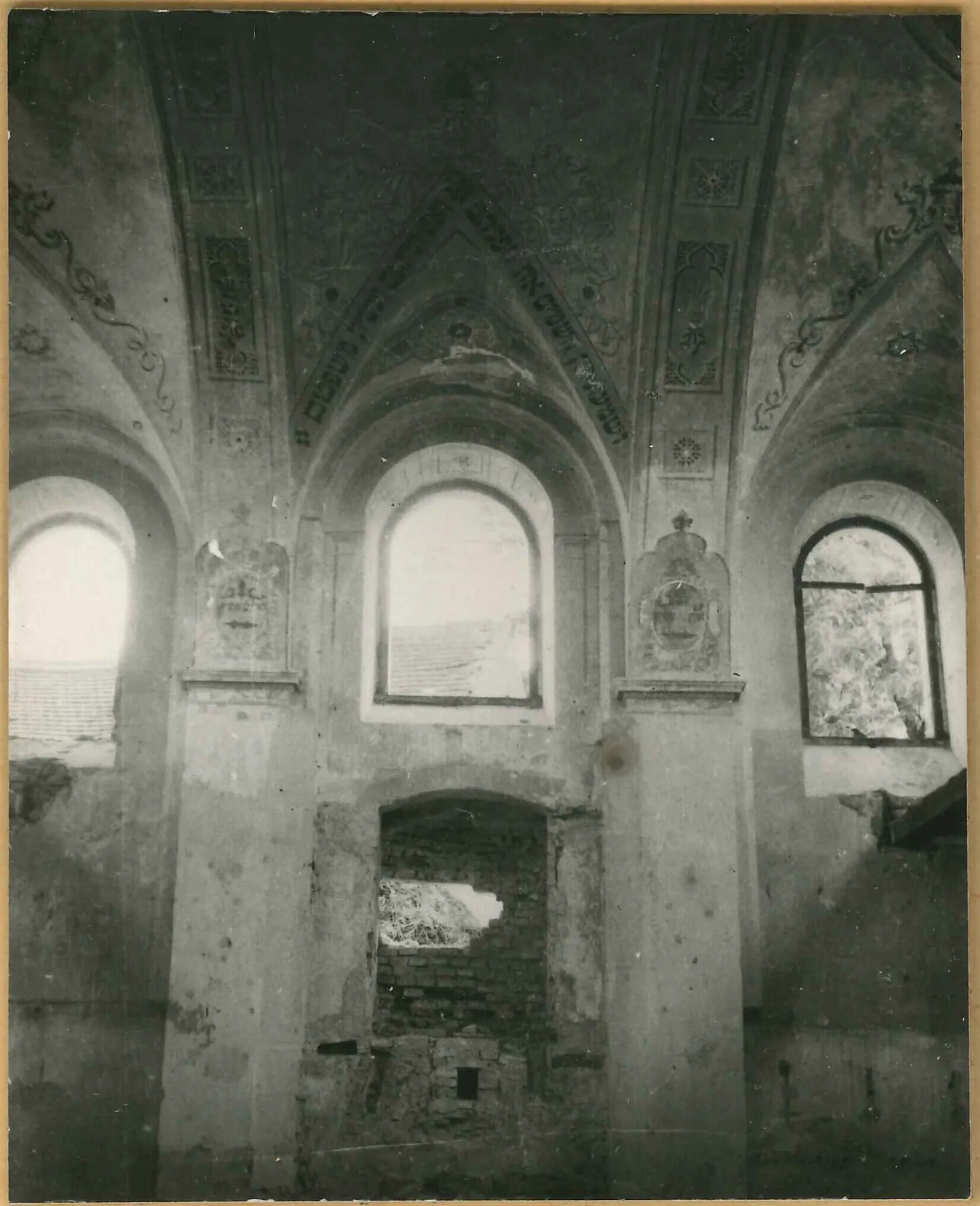
Gazda, following Pinkas Hakehillot, dates the synagogue to 1782 and records a renovation in 1862; the village's local-history site says it was built around 1785 and stood in what is now Magyar utca. Photographs in the Hungarian Jewish Museum and Archives show a tall rendered block under a steep hipped roof, with an open loggia of five arches on columns above the entrance, and a vaulted interior painted with scrollwork, Hebrew inscriptions and a landscape scene.
The community shrank to 242 by 1910 and to a few dozen by the 1930s. Its last rabbi, Béla Gottselig, served from 1941 to 1944, where the record of the congregation breaks off. A museum album page dated 1949 shows the synagogue standing but stripped, its ark torn out and its roof failing. When Gazda surveyed the site in 1980-87 the building had been demolished. No source read says when this happened or who did it.
Where it stood for nearly 190 years
Historic: Csabrendek (Csáb-Rendek), Zala county; the synagogue stood in what is now Magyar utca, house number unknown. Today: Magyar utca, 8474 Csabrendek, Veszprém county; pin at the midpoint of the street (approximate).
Open larger map →The Jewish community
When the first Jews came to Csabrendek is not known. The village's local-history site says the community existed from 1635, a date that sits oddly with its own account of resettlement after the Ottoman wars and could not be checked. The site explains the growth by ownership: the village was divided among several lesser noble families instead of one lord, while Sümeg was a bishop's estate closed to Jews and Devecser belonged to the Esterházys. By the Reform Era local trade was in Jewish hands. Gazda's survey gives 421 Jews in 1828 and 534 in 1851; Elek Fényes's 1851 gazetteer, quoted locally, also has 534, beside 2,400 Catholics. In February 1828 the Jews of Csabrendek petitioned Zala county for a fair assessment of their toleration tax, and that July the estate lawyer József Oszterhueber submitted a draft statute for the Rendek Jewish community to the manorial court. Numbers then fell as families moved away or emigrated to America: 242 in 1910 and about two per cent of 3,407 inhabitants in 1934. Presidents named include Dávid Weiszfeld (1836-1848), Mór Weisz (1886), Ignác Reich (1889), Vilmos Böhm (1892, 1895), Sámuel Rabinek (1912), Sándor Rabinek (1918) and Vilmos Kohn (1944).
Architecture and design
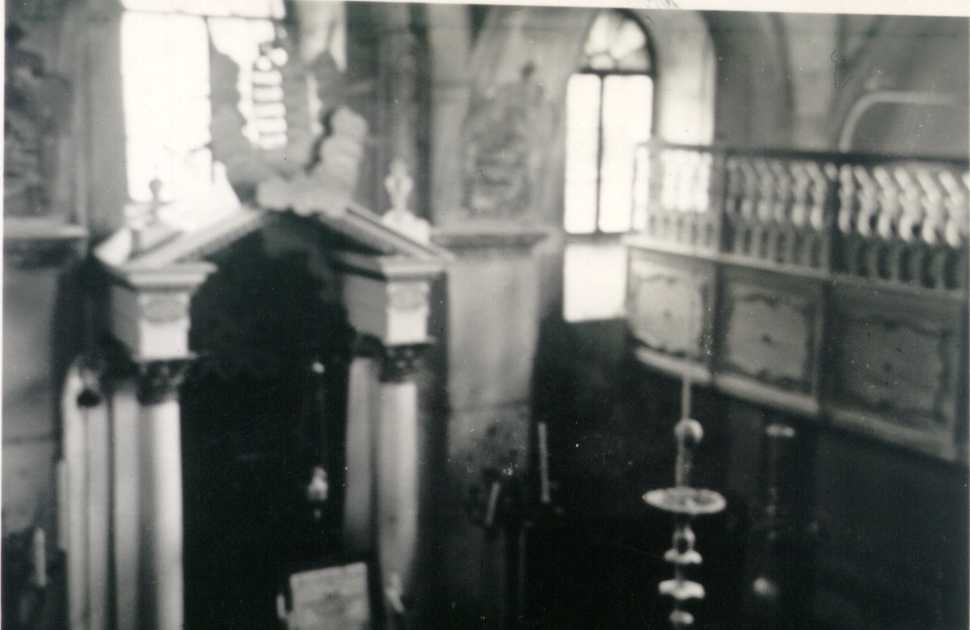
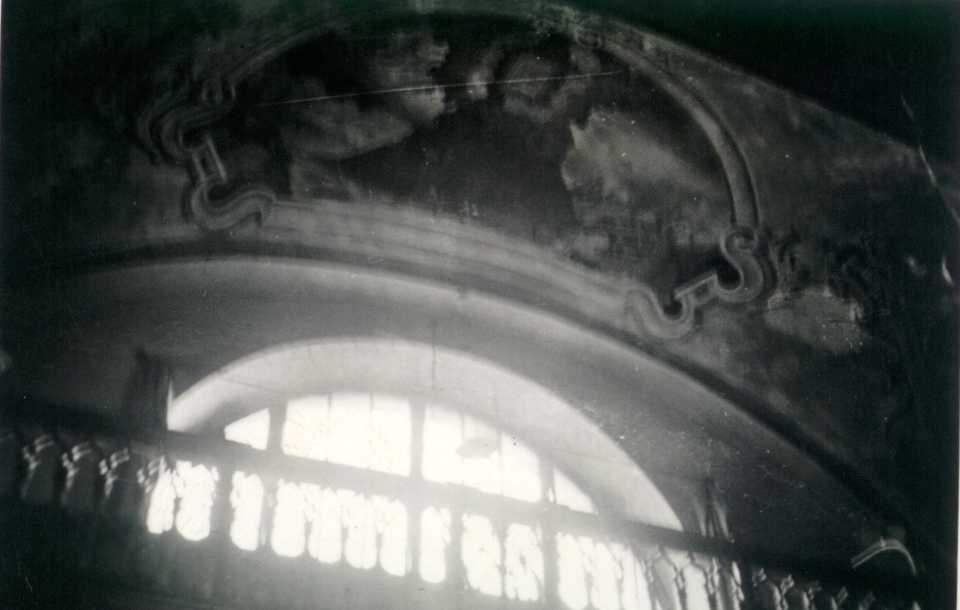
No published description of the building was found, so this account rests on the museum photographs. The synagogue was a tall, compact, rendered block under a steep hipped roof of shingles or flat tiles. Its entrance front had two levels: a plain ground floor with a central doorway under a small gabled porch and a shuttered window beside it, and above it an open loggia of five round arches on six plain columns, one bay deep, with a further arch on the visible side. A central arched opening pierced the wall behind the loggia, and the side wall had round-headed windows. Inside, the hall was vaulted, with lunettes cutting into the vault above three round-headed windows in the east wall. Pilasters between the windows ended in painted crowned cartouches, and the vaults carried painted panels, rosettes, scrollwork and bands of Hebrew lettering. One lunette held a landscape with a mountain and an inscribed tablet in a scrolled frame. The Torah ark had paired columns and a broken pediment with finials, and a gallery with a turned balustrade ran along the side. The style label is a reading of these photographs, not a sourced classification. Architect and capacity are unknown.
Life inside the synagogue
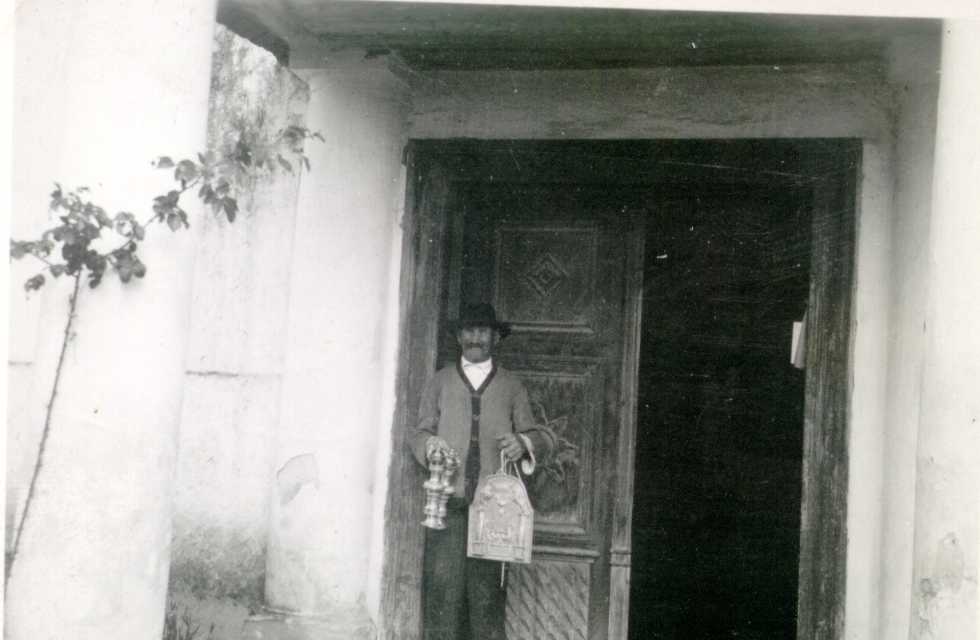
The synagogue was the seat of a district rabbinate. The village's local-history compilation names the rabbis: Dávid Weiszfeld (to 1833), Ábrahám Freider or Freunder (1835-1848), Dr Izsák Weisz (1872-1876), Imre Fischer (1880), Zsigmond Brüchler (1885-1886) and Salamon Müller (1889-1890); after five years without a rabbi came Dr Sándor Winkler, who served twenty-nine years (1895-1924), then Adolf Klein (1929-1939) and Béla Gottselig (1941-1944). Cantors recorded are József Goldstein (1898), Mór Grünwald (1902) and Vilmos Funk (1902-1907). A Jewish school was founded in the first half of the 1830s, and the same source says it had nine teachers in 1859. One was Adolf Weiszfeld, father of the politician Vilmos Vázsonyi and of Jenő Vázsonyi, later president of the Hungarian State Railways. Other teachers were Ignác Lőb, who became director of the village savings cooperative, and Soma Hirschler, who reported on Csabrendek for the regional newspapers. After the First World War the congregation followed the Neolog trend. An undated museum photograph shows an elderly man in the synagogue doorway holding a pair of Torah finials and a Torah shield.
Destruction
The record of the congregation ends in 1944, the year of its last rabbi's final term and of the last burials in its cemetery. What happened to the synagogue afterwards is known only from photographs in the Hungarian Jewish Museum and Archives. An album page captioned 'Csabrendek, templom, 1949' shows the building still standing but derelict: pieces of the roof covering missing, the arched opening behind the loggia broken through, and inside, a ragged hole in the brickwork of the east wall where the Torah ark had stood, though the painted vaults were still largely intact. Undated photographs in the same collection, which must be earlier, show the ark and the gallery in place. Who stripped the interior is not recorded in any source read. When Anikó Gazda surveyed Hungarian synagogue sites in 1980-87 she recorded the Csabrendek synagogue as demolished. The building was therefore pulled down at some point between 1949 and the 1980s, under Communist rule. No source found gives the year, says who ordered or carried out the demolition, or whether the building had first been sold.
The community’s fate
Gazda's table gives no figure for 1941. The local-history site puts the Jewish share at about two per cent of 3,407 inhabitants in 1934, which would be roughly seventy people; that is a calculation, not a count. Béla Gottselig was rabbi from 1941 and Vilmos Kohn was president in 1944. No source read in this research describes the removal of the Jews of Csabrendek itself. The village adjoins Sümeg, and the Pinkas Hakehillot entry for Zalaegerszeg records that in 1944, after the Jews of that town were moved into a ghetto in May, Jews from Keszthely, Tapolca, Zalaszentgrót, Zalabér, Sümeg, Lenti and Türje were added to them. Hungarian gendarmes tortured prisoners to make them reveal hidden valuables, and on 4 July they were loaded into sealed railway cars, seventy to eighty people to a car, and sent to the Nazi German camp at Auschwitz; that transport is estimated at 1,200 people. It is likely, but not confirmed, that the Csabrendek families went the same way. Burials in the Jewish cemetery stopped in 1944. The number of victims and survivors is unknown, and no community is recorded after the war.
The site today
The local-history site of Csabrendek says the synagogue stood in what is now Magyar utca, but gives no house number, and no source read identifies the plot or what occupies it today. The map pin therefore marks the midpoint of Magyar utca, not the building's footprint. No marker on the site is recorded. The Jewish cemetery survives south-west of the village on the north-western slope of Rendeki-hegy: a walled enclosure among pines with about 200 gravestones, the earliest dated 1823/24. Most of its marble and granite stones have been toppled or carried off, and a 2020 study listed it among three Hungarian Jewish cemeteries in very poor condition. The municipality has cleared it, pupils of the Lauder Javne School in Budapest worked there in 2016 and 2018, and the stone wall has been almost completely rebuilt.
Notable names
Dávid Weiszfeld
Unknown; in office until 1833Rabbi of Csabrendek, until 1833Weiszfeld is the earliest rabbi of Csabrendek named in the village's local-history compilation, which ends his entry at 1833; a Dávid Weiszfeld is also listed as president of the community from 1836 to 1848, and it is unclear whether this is the same man. He was the grandfather of the politician Vilmos Vázsonyi and of Jenő Vázsonyi, president of the Hungarian State Railways, whose father Adolf Weiszfeld taught in the community's school.
Biography or source →Dr Sándor Winkler
Unknown; in office 1895-1924Rabbi of Csabrendek, 1895-1924Winkler became rabbi in 1895 after the community had been without one for five years, and held the post for twenty-nine years, far longer than any other rabbi in the local-history list, which marks his tenure with an exclamation mark. His term covered the First World War. The Hungarian Jewish Museum and Archives holds a 1937 photograph of the tombstone of a Sándor Winkler at Csabrendek.
Biography or source →Adolf Klein
Unknown; in office 1929-1939Rabbi of Csabrendek, 1929-1939Klein is listed as rabbi of Csabrendek from 1929 to 1939, after a gap of five years following Sándor Winkler. The local-history site notes that he appears as the Israelite rabbi in a mid-1930s description of the village, when Jews were about two per cent of its 3,407 inhabitants. Nothing more about his life or his fate was found.
Biography or source →Béla Gottselig
Unknown; in office 1941-1944Last rabbi of Csabrendek, 1941-1944Gottselig is the last rabbi in the village's local-history list, serving from 1941 until 1944, the year in which burials in the Jewish cemetery stopped and the record of the congregation ends. He was therefore the rabbi of the synagogue in its final years of use. His origins and what happened to him in 1944 were not found in any source read.
Biography or source →Adolf Weiszfeld
1833-1917 (local-history site: 1836-1918)Teacher in the Jewish community school of CsabrendekWeiszfeld, son of Rabbi Dávid Weiszfeld, taught in the Csabrendek community school; his son Jakab, later Jenő Vázsonyi, was born in the village in 1864. The family then lived in Sümeg and moved to Budapest. He was the father of the politician Vilmos Vázsonyi and of Jenő Vázsonyi, president of the Hungarian State Railways. The two sources give his dates as 1833-1917 and 1836-1918.
Biography or source →Vilmos Kohn
UnknownPresident of the Csabrendek congregation, in office in 1944Kohn is named in the village's local-history list as president of the Jewish community in 1944, the last holder of the office, alongside Rabbi Béla Gottselig. He was the lay head of the congregation in the year its record ends and the synagogue fell out of use. Nothing about his life or his fate was found in the sources read.
Biography or source →Do you have something to contribute?
Photographs, documents, family stories or memories of this synagogue and its community help keep its history alive.
- Zsinagógák és zsidó községek Magyarországon (county tables; Csabrendek row)
- Zsidótemető: Zsidóság Csabrendeken (QR-kódos Helytörténeti kiállítás)
- Csabrendek, zsinagóga külső és belső (F16.020; album page with three photographs, captioned 'Csabrendek, templom, 1949')
- Csabrendeki zsinagóga (F70.85)
- Csabrendeki zsinagóga romos belső képe (F97.285)
- Csabrendeki zsinagóga mennyezete, részlet (F70.86)
- Csabrendeki zsinagóga keleti falának ablaka, felfestés részlete (F70.88)
- Csabrendeki zsinagóga frigyszekrénye a karzatról (F70.89)
- Csabrendeki zsinagóga bejárata, előtte idős férfi Tóradíszekkel (F70.87)
- Winkler Sándor síremléke (XIX_317_F061), Csabrendek, 1937
- Table of contents of a source volume on the Jews of Zala county, 1716-1849 (file zgy52tart.pdf), documents 33 and 34
- Zalaegerszeg (Pinkas Hakehillot Hungary, English translation)
- Pinkas Hakehillot Hungary: table of contents
- Sümegi zsinagóga
- Vázsonyi Jenő
- Csabrendek
- A magyarországi zsidó temetők kutatása és védelme (Regio 28/3, 2020, pp. 24-38)
- Magyar utca, Csabrendek (OpenStreetMap way 164165857)
Share a memory or thought
No comments yet. Be the first to add one.