

La historia de Great Synagogue of Csenger
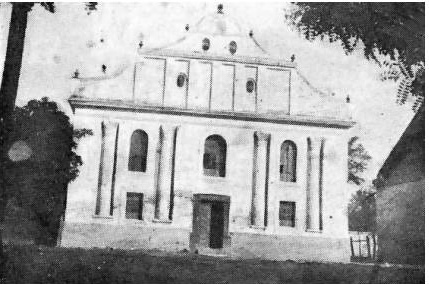
Csenger is a town in Szabolcs-Szatmár-Bereg county, in historic Szatmár, close to the Romanian border. According to the town's memorial book, published in Tel Aviv in 1966, Jews settled there early in the eighteenth century and formed a community that began with about 150 people. Anikó Gazda's gazetteer records 451 Jews in 1828, 440 in 1851, 605 in 1910 and 537 in 1941. The 'big shul' stood near the main square in a courtyard shared with the Jewish school, the ritual bath and the houses of the two slaughterers. The memorial book dates it to 1794 in two places, while a memoir in the same book says it was built about 1820; Gazda notes only that it was already standing in 1828.
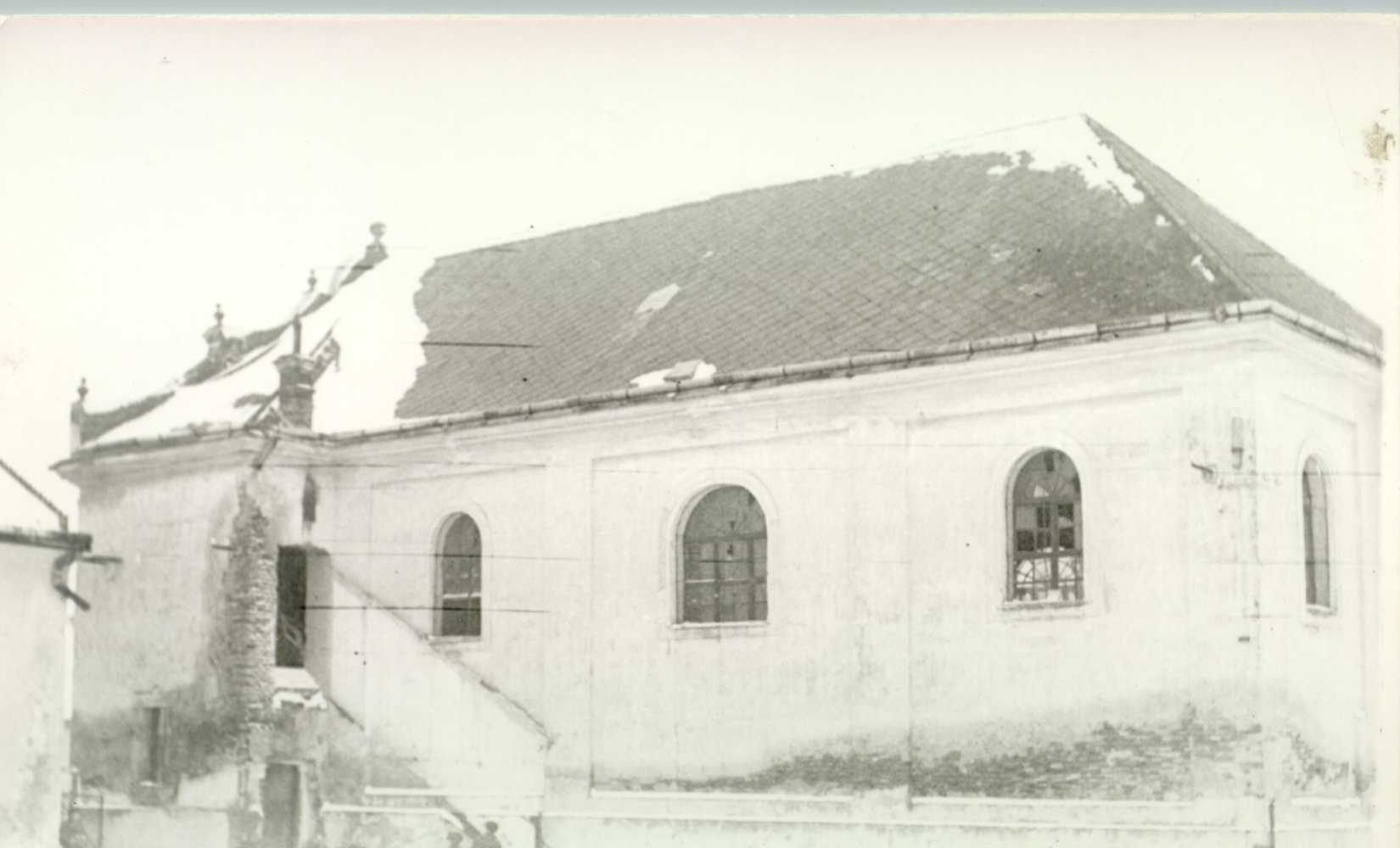
Csenger was an autonomous Orthodox community known for its rabbis. Osher Anshel Yungreis, the 'Menuchas Osher', served from 1834 to 1874, his son Avrohom until 1904 and a second Osher Anshel Yungreis until 1944. After Passover 1944 Hungarian police made the young men empty the synagogue, and a policeman broke open the ark with a hatchet. Jews from the surrounding villages were held in the building before being carted to the Mátészalka ghetto, and 602 people from Csenger were deported to Auschwitz. Photographs given to the Jewish Museum in Budapest in 1958 show the building standing but derelict. The memorial book says that after the last Jew had left, the government sold the plot and the synagogue was torn down in 1963.
Where it stood for nearly 170 years
Historic: centre of Csenger, near the market square, in the courtyard of the Jewish school and ritual bath; street and house number unknown. Today: plot not identified; pin on Hősök tere, 4765 Csenger, Szabolcs-Szatmár-Bereg county (approximate).
Abrir mapa ampliado →La comunidad judía
The memorial book says the first Jews came to Csenger at the start of the eighteenth century and that the organised community started with about 150 people. Jewish shops lined the market square, which the book calls 'Piatz Teer', and the rabbi of Csenger was the religious authority for the villages around it, such as Tyukod, where one ritual slaughterer served three or four villages. Gazda's figures show 451 Jews in 1828 and 440 in 1851, rising to 605 in 1910 and standing at 537 in 1941; a 2014 report of the Reformed Church in Hungary speaks of 600 Jews before the Holocaust. The congregation was an autonomous Orthodox community that kept its own records of marriages and divorces under the rabbi. It was run by a Rosh Hakohol (chairman) and a gabbai, with a separate Chevra Kadisha responsible for burials, charity and the cemetery. Yosaif Greenfeld, who sold timber and roof tiles, was chairman for fourteen years; Yosaif Freedman was gabbai from 1924; Shmuel Berger headed the community in 1944. Most members prayed in the Ashkenazi rite, while a Hasidic group kept a small prayer house of its own.
Arquitectura y diseño
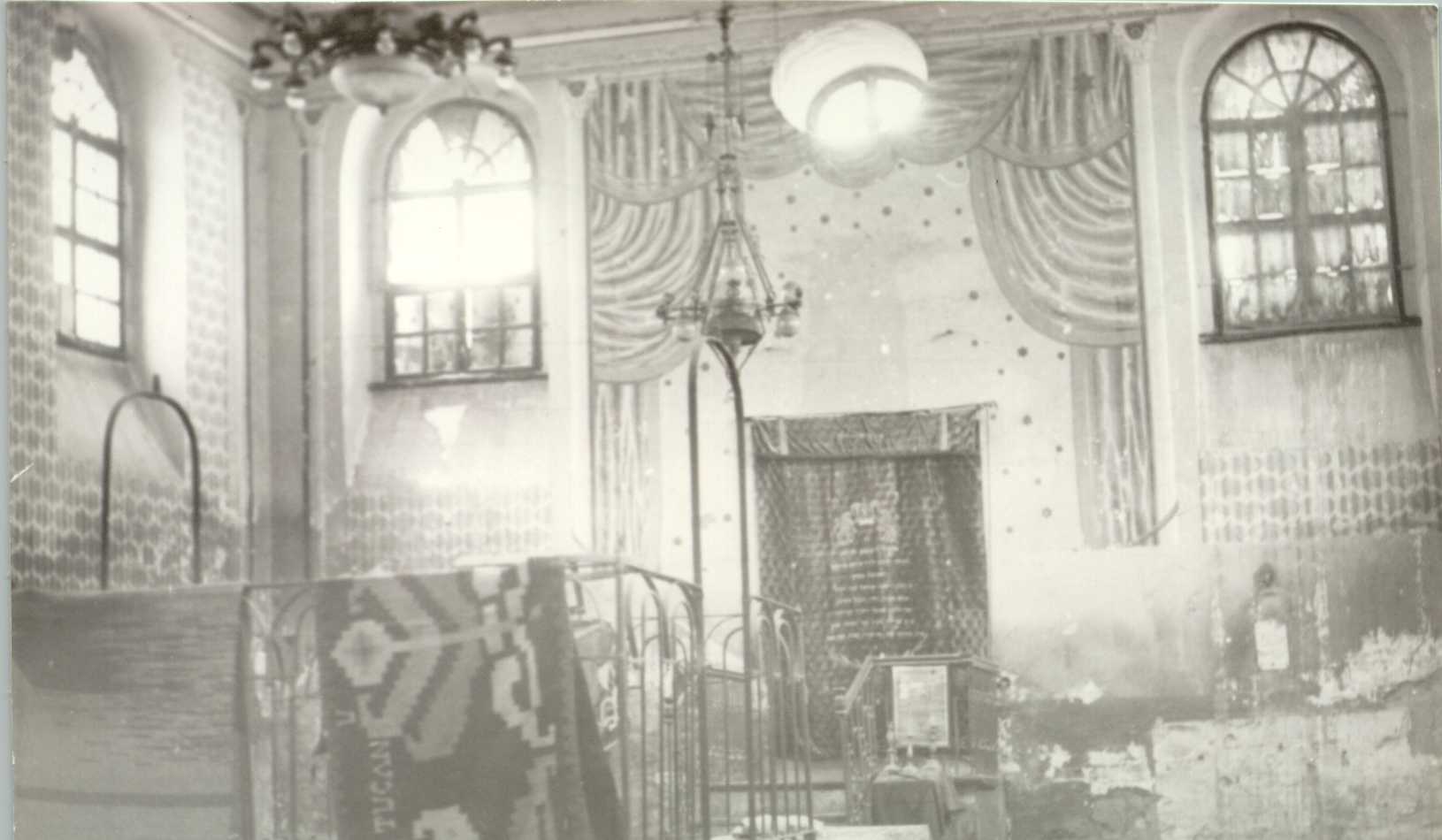
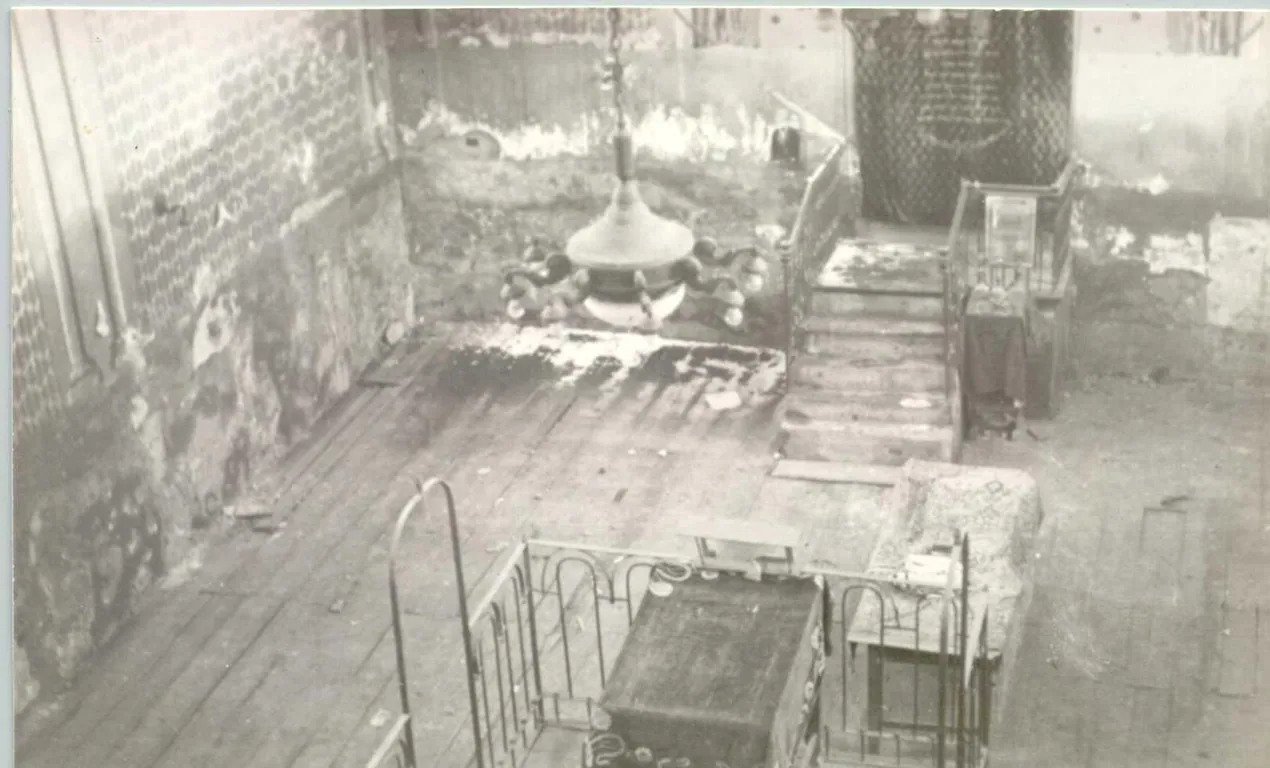
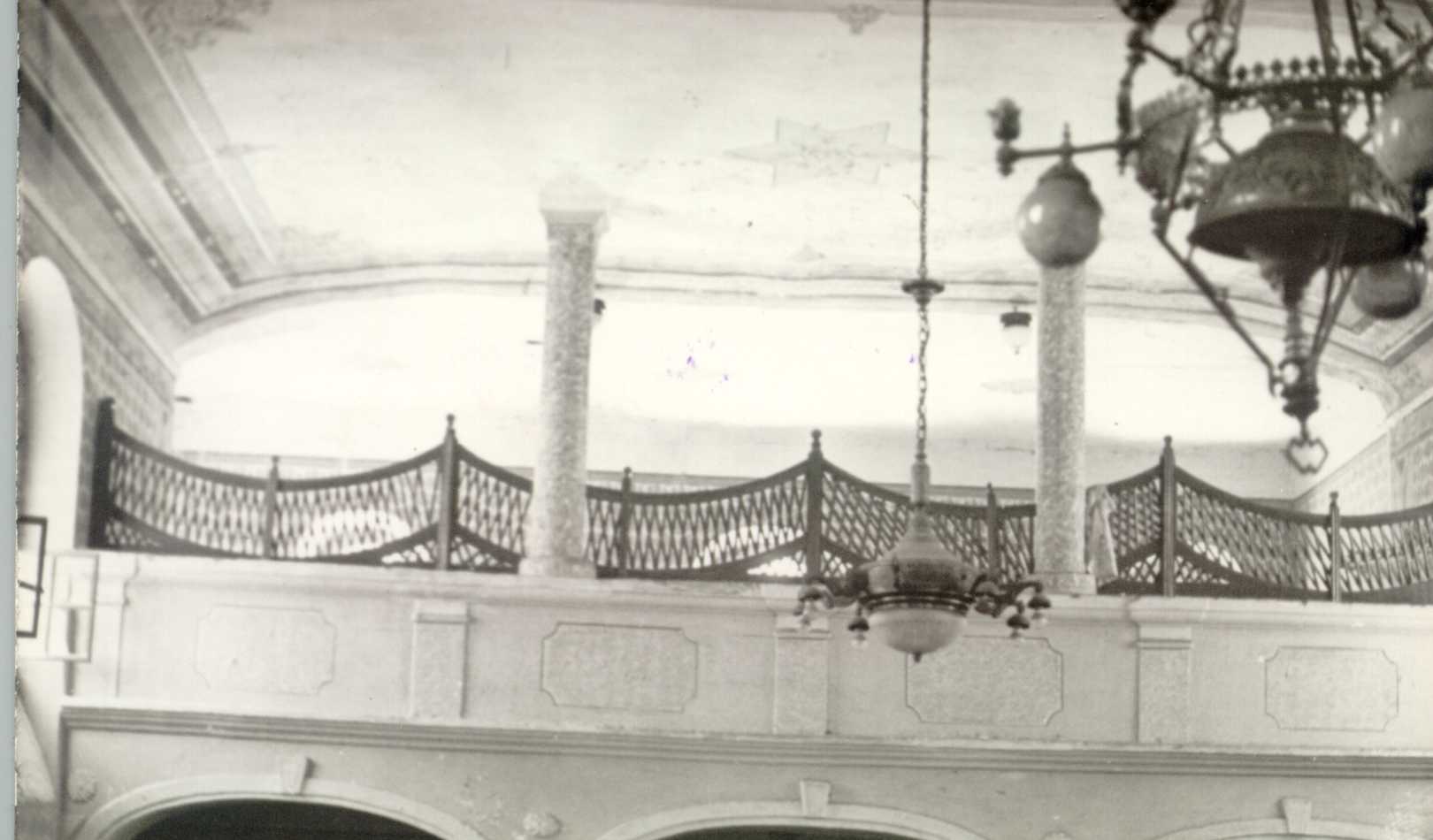
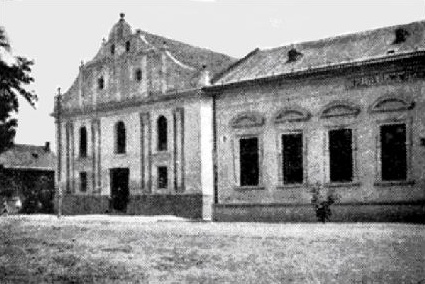
This description rests on two pre-war views printed in the memorial book and on five photographs of about 1958 in the Hungarian Jewish Museum and Archives. The synagogue was a rendered rectangular hall under a tiled hipped roof. Four giant pilasters divided the entrance front into three bays, each with a round-arched window above; a framed doorway stood in the middle bay and small rectangular windows in the outer ones. Above a heavy cornice rose a panelled attic with two oval windows between concave roof slopes, then a smaller second stage with two more oval openings, crowned by a small dome. Urn finials marked the corners of each stage. The long side wall had four round-arched windows, and an open stair at the entrance end climbed to a door at gallery level. Inside, the ark wall was painted with looped curtains and stars around the ark niche, the side walls carried a stencilled pattern and the ceiling a Star of David. A wrought-iron railing enclosed the central bimah. The women's gallery had a panelled parapet topped by a wooden lattice. A memoir by László Kasovits credits the ark and the main entrance to his great-great-grandfather.
La vida dentro de la sinagoga
The synagogue was the centre of a strictly observant community. Services followed the Ashkenazi rite; the Hasidim, who prayed in the Sephardi rite, organised a small prayer house of their own, and there were also private homes where people prayed. Opposite the synagogue stood the rabbi's house, said to be older than the synagogue, with a building beside it that served as the rabbi's own prayer room and study hall and housed a small yeshiva for the youths of the town and district. A side door in the synagogue corridor led to the cheder for boys of six to twelve; younger children learned the alphabet in a hall of the Jewish public school next door, and in 1930-32 the community bought the neighbouring plot and put up a further building for the teachers. Men met daily to study and had a large library. In 1944 the ark held forty-two Torah scrolls. Chaim Peketeh and Mendel Daskal, both ritual slaughterers, served as cantors and led the High Holiday prayers, and Yehoshua Shatun preached each week on the Torah portion. Rabbi Avrohom Yungreis was remembered for sermons that moved his listeners to tears.
Destrucción
The memorial book describes how the synagogue was desecrated in the spring of 1944, after the Nazi German occupation of Hungary on 19 March. After Passover the authorities ordered the young Jewish men to the synagogue at six o'clock, where Hungarian police commanded them to clear it. They carried out the benches, the chandeliers and the shelves of religious books. When they refused to touch the ark and clung to its four pillars, a policeman took a hatchet from the slaughterer Chaim Peketeh, broke the ark and tore off its doors; the youths then carried out the forty-two Torah scrolls. Jews from nearby villages were afterwards held in the emptied building for a night and a day before being taken to Mátészalka. The building survived the war. Photographs that the national Jewish office (MIOK) gave the Jewish Museum in Budapest in 1958 show it standing but decayed, with broken windows, fallen plaster and a curtain hanging over the ark niche. The memorial book states that after the last Jew left Csenger the government sold the plot and the synagogue was torn down in 1963, under Communist rule. It does not name the buyer or say who carried out the demolition.
El destino de la comunidad
On the last day of Passover 1944 the authorities demanded from the community head, Shmuel Berger, a list of all its men within three hours. The Jews of Csenger and of the villages around it were then taken on horse-drawn wagons to the ghetto at Mátészalka, which the memorial book says held 18,000 Jews of the district; 602 people were taken from Csenger itself. The book says the trains left Mátészalka for Auschwitz at the end of May, with eighty or ninety people to a wagon, and that Rabbi Osher Anshel Yungreis was killed at Auschwitz on 15 Sivan 1944 with most of his congregation. The preacher Yehoshua Shatun and the gabbai Yosaif Freedman died in the Mátészalka ghetto, and the chairman Yosaif Greenfeld was also killed. A few survivors came back in the spring of 1945, but they decided they could not go on living there, and most left for Palestine, where some fought in the 1948 war. By 1966 about a hundred former Csenger Jews lived in Israel and others in Europe, America and Australia; the book says not one Jew was left in Csenger.
El lugar hoy
The exact plot has not been identified in the sources read. The memorial book places the synagogue in the centre of the town, near the main square, in a courtyard with the Jewish school and the ritual bath, with the rabbi's house opposite. It says the state sold the plot before the demolition of 1963 but not what was built there afterwards. The map pin for this entry is therefore set on Hősök tere, the present main square in the part of town that OpenStreetMap labels Piac (market), and is only approximate. The Jewish cemetery of Csenger survives: a survey by the ESJF European Jewish Cemeteries Initiative counted 410 gravestones, the latest dated 1942, together with two ohel tombs and a Holocaust memorial. Elderly members of the community had a concrete wall built around it in 1962.
Nombres destacados
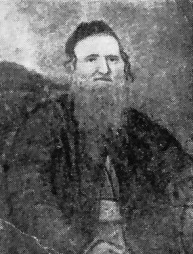
Osher Anshel Halevi Yungreis (the 'Menuchas Osher')
1806-1874Rabbi of Csenger, 1834-1874Born in 1806 in Nógrád county, he studied under the Chasam Sofer in Pressburg and was installed as rabbi of Csenger in 1834. He led the congregation for forty years, until his death on 5 Kislev 1874. The memorial book remembers him as a healer and wonder-worker who fasted often and gave away large sums to orphans, widows and the poor; he is known by the title of his book, 'Menuchas Osher'. He was buried in the old cemetery of Csenger, where the community built an ohel over his grave.
Biografía o fuente →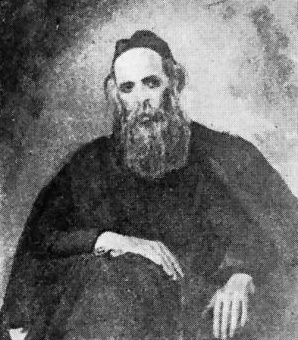
Avrohom Halevi Yungreis
died 1904Rabbi of Csenger, 1874-1904, and head of its yeshivaBorn in Csenger and taught at home by his father, the 'Menuchas Osher', he succeeded him as rabbi in 1874 and served for thirty years; he headed the yeshiva for more than forty years and many of his pupils became rabbis. The memorial book describes his charity and the warm sermons he gave in the synagogue, which brought his listeners to tears. He died on 19 Sivan 1904.
Biografía o fuente →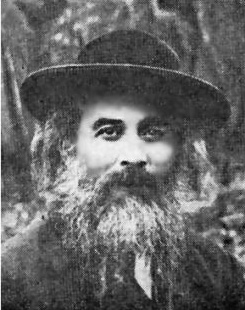
Osher Anshel Halevi Yungreis (the last rabbi)
1875-1944Rabbi of Csenger, 1904-1944Born in 1875, he was rabbi of Csenger from 1904 until 1944; his child wrote in the memorial book that he led the community for forty years 'peacefully, and with justice and kindness'. In the spring of 1944 he was driven out of the town with his congregation to the Mátészalka ghetto and deported, and he was killed at Auschwitz on 15 Sivan 1944 together with most of his community.
Biografía o fuente →Moshe Shpitz Halevi
c. 1761-1818Second rabbi of Csenger, for 26 years until 1818The second rabbi of Csenger named in the memorial book, he was a pupil of Rabbi Yechezkel Landau, the 'Noda b'Yehuda', and of Rabbi Nosson Adler, and served the community for twenty-six years. If the synagogue was built in 1794, as the book says, it went up during his rabbinate. He died on Friday 25 Tammuz 1818, aged fifty-seven, after lecturing to his students from his deathbed.
Biografía o fuente →Yosaif Greenfeld
Unknown; killed in the HolocaustRosh Hakohol (chairman) of the Csenger congregation for fourteen yearsGreenfeld, who sold timber and roof tiles, served as Rosh Hakohol, the lay head of the Csenger community, for fourteen years with short interruptions. The memorial book remembers him rising at three in the morning to study Talmud. As chairman he was responsible, with the gabbai, for the synagogue and the community's institutions. He was killed in the Holocaust.
Biografía o fuente →Yosaif Freedman (Yosaif ben Naftoli)
c. 1894-1944Gabbai of the synagogue, 1924-1944Freedman was gabbai of the Csenger synagogue, the officer who managed it and collected its donations, for twenty years from 1924. He was the father of an author of the town's memorial book. In 1944 he was taken with the community to the Mátészalka ghetto, where he was killed at the age of fifty.
Biografía o fuente →Chaim Peketeh
Unknown; deported to Auschwitz in 1944Ritual slaughterer and cantor of the congregationPeketeh served the Csenger community as shochet and as cantor, known for his pleasant voice, and led prayers on Rosh Hashanah and Yom Kippur. When Hungarian police had the synagogue cleared in the spring of 1944, it was from his hand that a policeman took the hatchet used to break open the ark. He was deported to Auschwitz with his family.
Biografía o fuente →¿Tiene algo que aportar?
Fotografías, documentos, historias familiares o recuerdos de esta sinagoga y su comunidad ayudan a mantener viva su historia.
- Zsinagógák és zsidó községek Magyarországon (Szabolcs-Szatmár county table, row for Csenger)
- Memorial Book of the Martyrs of Csenger, Porcsalma and Vicinity (Sefer yizkor le-kedoshei Csenger, Porcsalma ve-ha-seviva): title page and contents
- History of the Jewish Community of Csenger (memorial book pp. 11-16)
- Religious Institutions of Csenger; The Rabbonim of the Town (memorial book pp. 17-32)
- The Rabbonim of the Town (continued); The Holocaust (memorial book pp. 33-46)
- Destruction of the Jewish Community; Period Following the Holocaust (memorial book pp. 47-56)
- Different Personalities of Csenger; Memories (memorial book pp. 57-82)
- The Wonders of Asher; Life and Passing of the 'Old Rabbi'; Past, Present and Future (memorial book pp. 83-101)
- Csengeri zsinagóga (télen), photograph F70.91.1
- Csengeri zsinagóga oldala, photograph F70.91.3
- Csengeri zsinagóga belső képe: frigyszekrény, photograph F70.93.1
- Csengeri zsinagóga belső képe: frigyszekrény és bima a karzatról, photograph F70.93.2
- Csengeri zsinagóga karzata, photograph F70.92
- Csenger Jewish Cemetery
- Common Past of Jews and Reformed
- Hősök tere, Csenger (OpenStreetMap way 1479403408)
Share a memory or thought
No comments yet. Be the first to add one.