

La historia de Orthodox Synagogue of Csorna
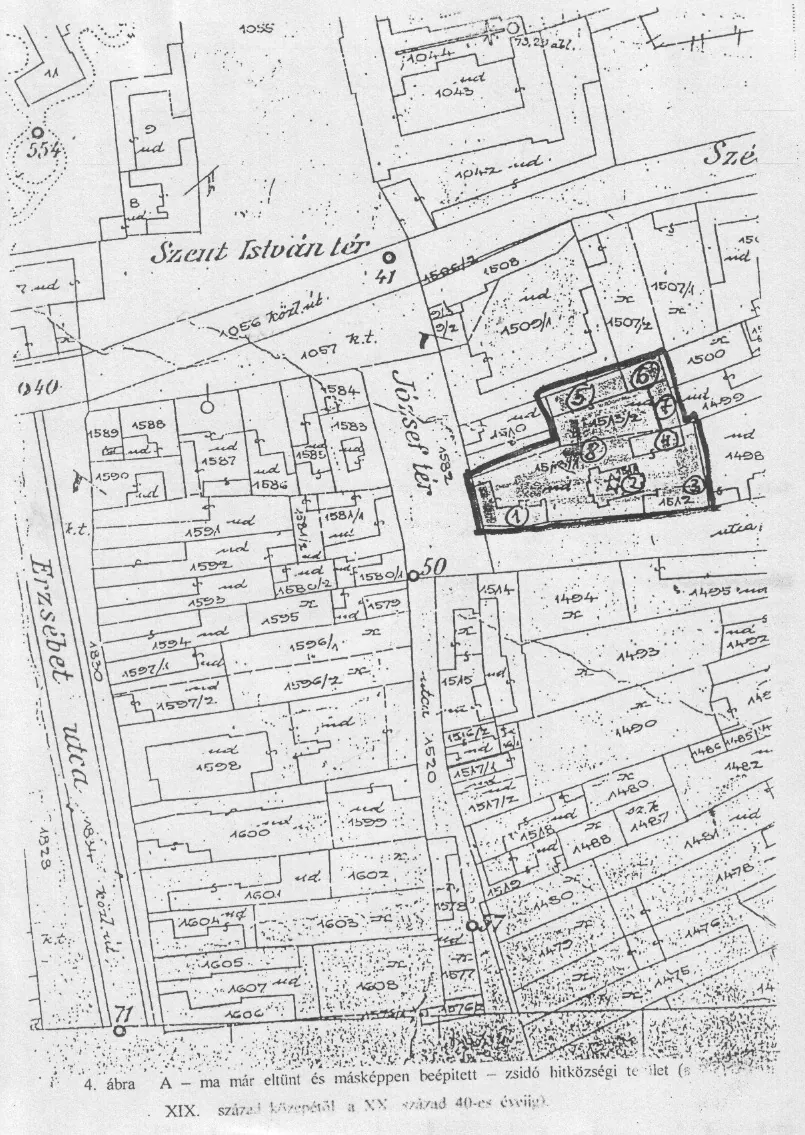
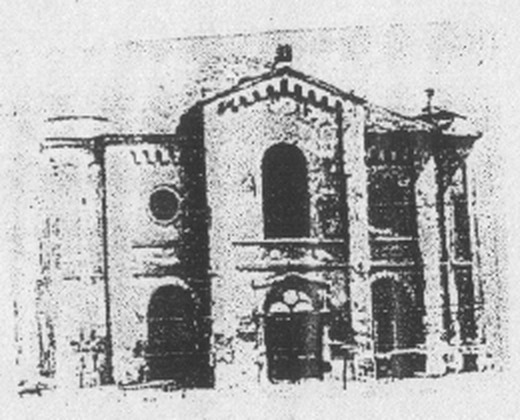
Csorna, the market town of the Rábaköz in north-west Hungary, had only a few dozen Jews until the middle of the nineteenth century, when most of the district's Jews still lived in nearby Farád. A community was formally organised in 1853 and opened a prayer house; the synagogue followed in 1854 (the Magyar Zsidó Lexikon of 1929 gives 1853). It was enlarged in 1884, by which time the congregation had grown from about 150 people to nearly 500. The building stood in the middle of the 'templomudvar', a yard at the corner of József tér and Eötvös utca that also held the rabbi's house, the school, the mikveh, the slaughterhouse and a community hall, and it served an Orthodox congregation that counted about 900 members in the 1920s. In May 1944 the Hungarian authorities, acting under Nazi German occupation, laid out the town's ghetto around it, and in June the Jews of the town and district were taken away; most were murdered at Auschwitz. Some survivors returned, but emigration, especially in 1956, emptied the community. The one known photograph shows the synagogue already dilapidated, with building materials stacked in front of it; it later housed a joinery workshop and a warehouse. It was sold and demolished in the 1980s, and a block of flats and shops now covers the corner. That photograph, a cadastral plan and a small plaque are all that record it.
Where it stood
Historic: József tér 3, at the corner of Eötvös utca, Csorna (Sopron County). Today: Mártírok tere 3 / Eötvös József utca 1, 9300 Csorna, Győr-Moson-Sopron County, Hungary.
Abrir mapa ampliado →La comunidad judía
Jews are recorded in Csorna from the eighteenth century, when they settled under the protection of the Esterházy estate; a count of 1785 found 29. Numbers stayed small until the 1840s and then rose quickly as the railways made the town a trading centre: 152 in 1853, 512 in 1880, 748 in 1910 and 836 in 1920. The community was organised in 1853 with Sámuel Gestetner as its first president and Náthán Freuder as its first rabbi. A prayer house was opened that year and the synagogue was built in 1854, according to the Magyar Zsidó Lexikon from the congregation's own resources. A primary school teaching in Hungarian opened in the same year. After the split in Hungarian Jewry that followed the Congress of 1868–69 the community belonged to the Orthodox organisation, and its rabbi kept the registers for the Jews of the surrounding villages as well. Most members were shopkeepers, grain, livestock and timber merchants and craftsmen, and Jewish owners ran a steam mill, a brickworks and a distillery. David Gestetner, inventor of the stencil duplicator, was born into the community in the early 1850s.
Arquitectura y diseño
No architect or builder is recorded, and no plans or interior views have been found. The one known photograph shows a compact, free-standing, two-storey rendered building under a hipped roof, in the round-arched Romantic manner common among Hungarian synagogues of the mid-nineteenth century; how much of what it shows dates from 1854 and how much from the enlargement of 1884 is Unknown. The entrance front had a projecting centre bay ending in a gable trimmed with an arched corbel frieze and crowned by a finial that appears to be the Tablets of the Law. A tall round-arched window stood above the main door, which had a semicircular fanlight. The bay on either side had a round window above a round-arched opening, and the corners were treated as slender turret-like piers carrying small domed caps with finials. A memory plan drawn by the local historian Endre Berecz shows an oblong building with stepped projections at both ends, set lengthwise in the yard parallel to Eötvös utca with its entrance front towards József tér. The seating capacity and the arrangement of the women's gallery are Unknown.
La vida dentro de la sinagoga
The synagogue was the temple of the Csorna Autonomous Orthodox Israelite Community. Around it in the yard stood the rabbi's house and office, the primary school (opened in 1854 and kept up until 1944, with 84 pupils in its last year), a small prayer house called Etz Chaim, a room for boys' religious instruction, the mikveh, the slaughterhouse and the shochet's flat, a matzah bakery, the community office and a hall used by the Chevra Kadisha; kosher butchers' shops faced Eötvös utca. A Talmud Torah was founded in 1883 and the burial society opened the town's Jewish cemetery in 1885. In 1929 the community counted 910 people in 197 families, with a women's society, a 'penny' charity, a Bikur Cholim society and a library of 5,000 to 6,000 volumes. Rabbi Farkas Kohn, known in Hebrew as Zeev Wolf Kahana, led the congregation for many years, and its Machzikei Hadas association published a Hungarian-language handbook of the laws of Jewish married life in 1920. In September 1937 a burglar stole all the synagogue's ritual silver; the police arrested a suspect in Pápa.
Destrucción
No source consulted reports that the synagogue was burned or wrecked in 1944, although the ghetto was laid out around it and Jewish property in the town was inventoried and, according to a contemporary witness, widely plundered. The building outlived its congregation. An undated photograph, which Endre Berecz describes as showing its fairly ruinous state in the 1950s, has bricks and timber stacked in front of it. A regional newspaper states that a joinery workshop operated in the building, and Anikó Gazda's survey of 1980–87 recorded it at Mártírok tere 3 as a warehouse that had lost its religious character. According to Berecz it was sold, 'in the complete absence of worshippers', and demolished in the 1980s, the last decade of Communist rule in Hungary. Whether the Communist local council, a state enterprise or another owner had it pulled down is not recorded in the sources consulted; nor are the seller, the buyer or the exact year.
El destino de la comunidad
After the Nazi German occupation of Hungary on 19 March 1944 the Hungarian authorities registered Csorna's Jews, about 785 people in April, and on 11–12 May confined them, together with Jews from the villages of the district, in a ghetto of two parts: the block around the synagogue and workers' housing at the brickworks. Between 850 and 900 people were held there under a Jewish Council led by József Rübner. In June (on the 18th by one account, on the 21st according to Berecz) Hungarian gendarmes marched them to the railway station. They were taken to Sopron and Sárvár and deported from there to Auschwitz, the Sopron transport arriving on 5 July. Berecz's lists name roughly 640 dead from the town, about four in five, among them Rabbi Lipót Haberfeld and his family. Ninety-seven Jews lived in Csorna in 1947 and about 70 in 1955. In November 1956 Jewish families gathered in the synagogue yard before leaving for the West, and a local pastor noted that only 13 or 14 were said to remain. By 2000 two Jews lived in the town.
El lugar hoy
The former temple yard has been completely built over. On the corner of Mártírok tere ('Martyrs' Square', the former József tér) and Eötvös József utca stands a multi-storey block of flats with shops and a café on the ground floor and a small turret at the corner. It was already there when Berecz's book appeared in 2006; its construction date is Unknown. A small black marble plaque on its wall records that the temple of the Orthodox community stood on this spot, and a Holocaust memorial was unveiled on the town's main square in 2005. The Jewish cemetery, opened in 1885, survives with its ceremonial hall. Nothing of the synagogue, the rabbi's house, the school or the other communal buildings remains visible.
Nombres destacados
Náthán Freuder
UnknownFirst rabbi of the Csorna community (elected 1853)Freuder was elected in 1853, the year the Csorna community was organised, and the synagogue was built the following year. The Magyar Zsidó Lexikon of 1929 names him as the congregation's first religious leader and as the author of a work it transliterates as 'Zemach Szóde'; Endre Berecz calls him a rabbi known throughout the country. How long he served is not recorded in the sources consulted.
Biografía o fuente →Farkas Kohn (Zeev Wolf Kahana)
1849–1940Chief rabbi and district rabbi of CsornaKohn served for many years as rabbi of the Csorna Orthodox community, with the title of district rabbi because the congregation kept the registers for the villages of the Csorna district; the Magyar Zsidó Lexikon lists him as chief rabbi in 1929. Under his Hebrew name, Zeev Wolf Kahana, he acted for the town's Machzikei Hadas association, which in 1920 published a Hungarian-language guide to the laws of Jewish married life. When he took office is not recorded in the sources consulted.
Biografía o fuente →Lipót Haberfeld
1907–c. 1944Rabbi of Csorna in 1944Born in Ószombat (now Sobotište, Slovakia), Haberfeld is listed as rabbi in the census of Csorna's Jews ordered in April 1944, living at József tér 3 in the temple yard with his wife Bella, née Kohn, who was born in Csorna, and their children. He was the synagogue's rabbi when the ghetto was set up around it. Berecz's memorial list names him, his wife and four children among the Csorna Jews who died in deportation or forced labour.
Biografía o fuente →Sámuel Gestetner
UnknownFirst president of the Csorna Jewish community (1853)Gestetner belonged to the earliest Jewish family settled in Csorna, whose activity in the town had been acknowledged in a charter issued by the Premonstratensian provost Pál Gyöngyösy in 1845. He became the first president of the Jewish community when it was organised in 1853; the prayer house opened that year and the synagogue was built the next. His dates are not given in the sources consulted.
Biografía o fuente →Lajos Weisz
1866–c. 1944Chief cantor of the Csorna synagogueBorn in Gyürki in 1866, Weisz is recorded as the congregation's chief cantor (főkántor) in the census of Csorna's Jews taken in April 1944. He and his wife Lujza, née Freund, appear in Berecz's list of the Csorna Jews who died in deportation or forced labour. The same census names Salamon Edelstein as second cantor and ritual slaughterer and Ignác Bass as the temple caretaker; both are also on the list of the dead.
Biografía o fuente →Mór Deutsch
1864–c. 1944President of the Csorna Orthodox community (in office 1929)Deutsch was president of the Csorna Orthodox community when the Magyar Zsidó Lexikon was compiled in 1929, heading the board that administered the synagogue, the school and the charities for about 910 members. A Mór Deutsch, timber merchant, born in Markota in 1864 and evidently the same man, appears in the census of April 1944 and in Berecz's list of the Csorna Jews who died in deportation or forced labour.
Biografía o fuente →¿Tiene algo que aportar?
Fotografías, documentos, historias familiares o recuerdos de esta sinagoga y su comunidad ayudan a mantener viva su historia.
- Emlékezés a csornai zsidóság történetére (Budapest, 2006), with appendix of figures and name lists
- Zsinagógák és zsidó községek Magyarországon: térképek, rajzok, adatok (Budapest, 1991), table for Győr-Sopron county, p. 24
- Csorna (entry in Magyar Zsidó Lexikon, 1929, p. 184)
- Csornai gettó – Nyolcvan évvel ezelőtt terelték kényszerlakhelyükre a zsidókat (31 May 2024)
- A csornai gettó 70 éves évfordulójáról emlékeztek (20 May 2014)
- Csorna az 1956-os forradalom idején, Kisalföldi Szemle 4/2 (Győr, 2012), p. 91
- Egység, no. 143 (June 2021), p. 20: article on Hungarian-language handbooks of family-purity law
- Napi Hírek (MTI), 20 September 1937
- Csorna (section on the Jewish community)
- צ'ורנה (Csorna), section on the Jewish community
- Remembering the History of the Csorna Jews (English translation of the name lists)
- Mártírok tere és Eötvös József utca sarok, ortodox zsinagóga emléktábla, 2019 Csorna (photograph and description)
- Mártírok tere és Eötvös József utca sarok, 2019 Csorna (photograph of the present corner building)
- Csornai emléktábla (two photographs, F66.767 and companion)
- Nominatim geocoding result for Mártírok tere 3, Csorna
Share a memory or thought
No comments yet. Be the first to add one.