
La storia di Denekamp Synagogue
Denekamp is a small town in the north-east of Twente, close to the German border. Jews are recorded there from the early eighteenth century, and for most of the nineteenth century they belonged to a joint congregation with neighbouring Ootmarsum. The official synagogue of that congregation stood in Ootmarsum, but the Jews of Denekamp also held services in a private house in their own town. In 1906 the Denekamp Jews were placed under the community of Oldenzaal. When that arrangement ended in 1913, Denekamp was recognised as an independent Jewish community, and in the same year it built its own synagogue on the Vledderstraat, one of the streets of the old village centre.
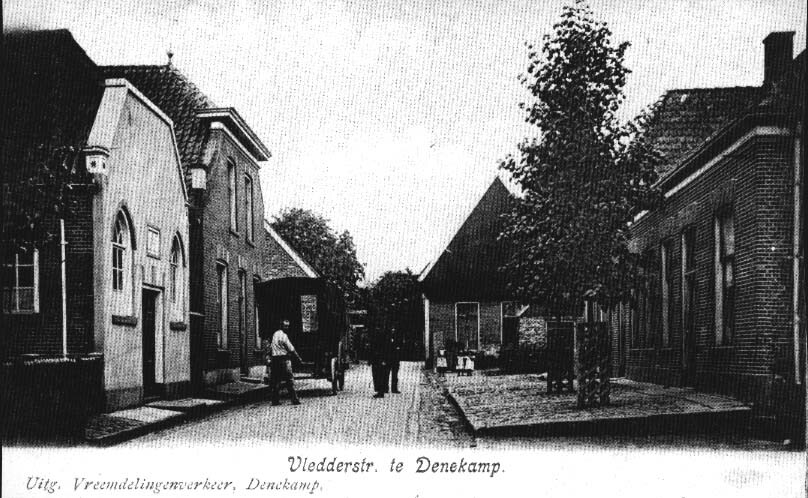
The building was modest, serving a community that never numbered much more than seventy people. A postcard of about 1920 shows it as a light-coloured, round-windowed building among the brick houses of the street. It was used for about three decades. During the Nazi German occupation the congregation was destroyed, and after the war the synagogue was demolished. Its stone with a Hebrew inscription was saved and set into the wall of the Catholic Mariakapel nearby. Since May 1988 a monument to the Jewish community has stood on the Vledderstraat, on the site of the synagogue.
Where it stood for 32 years
Historic: Vledderstraat, Denekamp (house number unknown). Today: site of the Jewish community monument at Vledderstraat 4, 7591 DJ Denekamp, Dinkelland, Overijssel (approximate).
Apri la mappa grande →La comunità ebraica
The first Jewish resident of Denekamp is mentioned in 1720, and by 1748 there were 21 Jews in Denekamp and its surroundings. The number grew slowly to 52 in 1809, 63 in 1869 and 72 in 1899, and stood at 54 in 1930. In the administrative division of Dutch Jewry of 1821, Denekamp and Ootmarsum together formed a single community with the status of a bijkerk, a minor congregation, whose official synagogue was in Ootmarsum. In 1906 Denekamp was attached to the community of Oldenzaal, but it went on functioning largely on its own, and in 1913 it became an independent community. Its members lived in the village centre, several of them on the Nordhornschestraat and the Vledderstraat, and some worked in the textile trade; Alex Salomons, for example, is recorded as a draper. The community never had a ritual bath or a religious school of its own. The early dead were buried in Ootmarsum; from the early nineteenth century Denekamp had its own cemetery on the Grave Es, used until 1890, and then a second one on the Knik near the Lattroperstraat, used until 1939.
Architettura e design
Nothing is known about the architect, the builder, the cost or the seating capacity of the synagogue, and no plan or interior view was found. The only image located is a postcard of the Vledderstraat published by the local tourist association (Vreemdelingenverkeer) about 1920, whose caption in the Jewish Cultural Quarter's collection says the synagogue is on the left. It shows a narrow, light-coloured, rendered or whitewashed street front set between brick houses. The front has two tall windows with round arches, a door with a plain surround and a small window above it, and appears to end in a shaped gable. A lamp on a bracket projects from the corner. The light finish and the arched windows set the building apart from the plain brick dwellings beside it, but its overall scale was that of an ordinary village house. A stone bearing a Hebrew inscription was fixed to the façade; this is the stone that was later moved to the Mariakapel. The style of the building cannot be named with confidence from this one small view.
La vita nella sinagoga
Very little is recorded about religious life in the Vledderstraat synagogue. Before 1913 the Jews of Denekamp had prayed in a private house in the town, with Ootmarsum as their official place of worship, so the new building gave them, for the first time, a synagogue of their own. With a community of around fifty to seventy people in the decades it was in use, it was a small village congregation; no source read describes how often services were held or what rite was followed. The community had no ritual bath and no Jewish school, and no rabbi, cantor or teacher of the congregation is named in the sources consulted. The officers of the community, the leaders who ran the synagogue between 1913 and the war, are also unknown. Some of its members came from just across the nearby German border: Alex Salomons, for example, was born in Lage in Lower Saxony in 1894 and later lived in Denekamp.
Distruzione
No source read describes what happened to the synagogue building during the Nazi German occupation of the Netherlands, whether it was damaged, looted or used for other purposes, nor whether the Nazi occupiers or Dutch Nazis (NSB members) were involved. Once its members had been deported it no longer had a congregation. The community encyclopedia of the Jewish Cultural Quarter states only that the synagogue was demolished after the war ('Na de oorlog is de synagoge afgebroken'), and the English version says it was razed after the war. The year of demolition is not given, and who demolished the building, and whether it was first sold by a postwar Jewish body or by the municipality, is not recorded in the sources consulted. Before or during the demolition the stone with the Hebrew inscription from the front of the building was saved, and it was later built into the wall of the Catholic Mariakapel near the former site.
Il destino della comunità
In 1930 Denekamp had 54 Jewish inhabitants. After the Nazi German invasion of May 1940 the Jews of Denekamp were subjected to the anti-Jewish measures of the Nazi occupation regime, and almost all of them were deported by way of Westerbork transit camp to the death camps in the East and murdered there; the victims found in this research died in 1942 and 1943. The Digital Jewish Monument records, among others, the draper Alex Salomons of the Brandlichterweg, who was murdered in Auschwitz on 31 March 1943, and whose wife Frida and son Carel died in 1942; and Hartog Elkus, his wife Hermine Elkus-Röttgen and their daughter Helene, who lived on the Nordhornschestraat and died in 1942. Senetta Salomons-ten Brink, born in 1853, also died in 1942. The exact number of Denekamp Jews who were murdered, and how many survived in hiding or returned, was not established in the sources consulted. No Jewish community was re-established in Denekamp after the war, and the remaining cemeteries are maintained by the local authorities.
Il luogo oggi
The synagogue's plot on the Vledderstraat no longer holds any trace of the building. In May 1988 a monument to the town's Jewish community, inscribed 'Omzien naar de toekomst' (Look back to the future), was placed on the site; it is listed at Vledderstraat 4. The Hebrew inscription stone from the synagogue's façade survives in the wall of the nearby Catholic Mariakapel. Stumbling stones lie in front of several former Jewish homes in the surrounding streets, and the town's former Jewish cemeteries are maintained by the local authorities. The Vledderstraat is today a quiet street in the centre of Denekamp, in the municipality of Dinkelland.
Hai qualcosa da condividere?
Fotografie, documenti, storie di famiglia o ricordi di questa sinagoga e della sua comunità aiutano a mantenerne viva la storia.
Share a memory or thought
No comments yet. Be the first to add one.