
История Derventa Synagogue
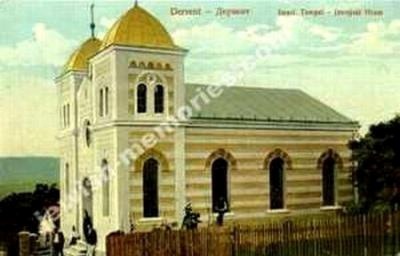
Derventa, a market town on the Ukrina river in the Bosnian Posavina, had a small but prosperous Jewish community that grew up under Ottoman and then Austro-Hungarian rule. For decades its members prayed in a house the community had bought, which also served as the rabbi's flat. As numbers grew, a building committee was formed and the town authorities granted a plot between the Serbian quarter (Srpska varoš) and the Harman district, with the Derventa–Sarajevo railway and the Ukrina behind it. The synagogue, paid for by donations from a handful of families, is dated to 1911 by most sources, although one local history records a consecration on 21 June 1909. It was built in a Moorish Revival style with a domed corner tower, striped walls and tall arched windows, and its interior was fitted with carved woodwork. A spring beside it, walled in stone, became known as the "Česma kod Templa", the fountain by the Temple. The synagogue was the centre of religious and communal life until 1941. After the Independent State of Croatia was proclaimed, the Ustaše persecuted and deported Derventa's Jews, and the building was heavily damaged. Its remnants collapsed in 1950. Today the site is residential, and the street where the synagogue stood bears the name Jevrejska, "Jewish Street".
Where it stood for nearly 35 years
Historic: plot between Srpska varoš and Harman, beside the Derventa–Sarajevo railway and the Ukrina river, Derventa. Today: Jevrejska ulica, Ukrina neighbourhood, Derventa (residential).
Открыть большую карту →Еврейская община
Jews came to Derventa mainly from Sarajevo and Travnik, joining families who had arrived from Austria and Poland. Most were merchants and craftsmen, and Jewish doctors and pharmacists provided much of the town's medical care. The community numbered 30 in 1879, 129 in 1885 and 136 in 1910, when 76 followed the Sephardi rite and 60 the Ashkenazi. After the First World War about 40 households with more than 300 people lived in the town. Leading families included the Pesah, Hajon, Kabiljo, Eskenazi, Grünberg and Sussman. The community opened a cemetery at Rabić in 1884, had a rabbi by 1897, formalised its organisation around 1914, and later belonged to the Federation of Jewish Communities in Belgrade. A Jewish national society was founded in 1922, and a choral society, "Lira", was active. In the late 1930s several Jewish doctors' families from Vienna and Graz settled in Derventa after fleeing Nazi rule in Austria.
Архитектура и дизайн
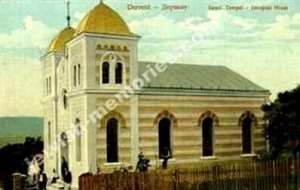
The synagogue was a free-standing building in the Moorish Revival style that was common for Bosnian synagogues of the Austro-Hungarian period. Local historians describe it as "semi-Moorish", with elements borrowed from Spanish synagogues, a reference to the Sephardi heritage of most of the congregation. Its front faced towards Jerusalem, and above the entrance on the north side there was a round opening containing a Star of David. A colour postcard shows a gabled hall with walls in horizontal bands of light and dark stone or render, three tall round-arched windows on the long side framed by striped arches, and a square tower at the corner crowned by a gilded onion dome; a second, smaller dome rose behind it. Inside, the hall was decorated with carved wooden ornament and furnished with the objects needed for worship. The building cost more than 12,000 crowns. The architect and seating capacity are not recorded in the available sources.
Жизнь в синагоге
Before the synagogue was built, services were held in a house bought by the community, which also held the rabbi's living quarters. Once completed, the Templ became the seat of the Jewish community. Besides prayer and religious instruction, members met there to discuss communal matters and to agree common positions when the town council took decisions affecting their social and economic standing. Rabbis kept the community's registers of births, marriages and deaths and taught religion to the children. The synagogue was led by Aron Hajon, and the rabbis who served the community included Haim Alkalaj and Jakov Papo, who was the last rabbi of Derventa. The last president of the community was Levi Pesah. A wedding invitation published in Židovska svijest in December 1920 announced a ceremony "in the Sephardi temple" in Derventa. The community celebrated the major festivals, among them Passover and Rosh Hashanah, openly until 1941.
Разрушение
In April 1941 Derventa became part of the Independent State of Croatia, ruled by the Ustaše. The district authorities ordered all Jews over 14 to wear a yellow armband, registered their property and placed commissioners in Jewish shops. On 1 August 1941 a first group of Serbs and Jews, among them Dr Jozef Grünberg, was sent to the Ustaše camp at Gospić, and a second group followed on 8 August. The synagogue was heavily damaged by the Ustaše in 1941. The remaining Jews were arrested in August 1942 on the orders of Ivan Tolj, head of the Ustaše police in Sarajevo, held in the Štapara transit camp opposite the railway station, and deported to Jasenovac and Đakovo. The ruined synagogue was never repaired, and its remnants collapsed in 1950.
Судьба общины
Almost the entire Jewish community of Derventa was murdered in the Holocaust. Men taken in the round-ups of August 1941 were shot at Gospić or killed at Jasenovac; Dr Jozef Grünberg, the town's best-known doctor and a long-serving councillor, died at Jasenovac. Families deported in 1942 were murdered at Jasenovac, Đakovo and, in some cases, Auschwitz and the Sajmište camp in Belgrade. The local historian Nedžmudin Alagić listed about 90 named victims, including the last rabbi, Jakov Papo, and many members of the Pesah family. Some Jews escaped with passes obtained with the help of the Croatian Peasant Party official Ivan Čović and the judge Matija Poljaković, travelling to Mostar and then to Dalmatia and Italy. Several young people joined the Partisans. After liberation on 19 April 1945, only two survivors, Levi Eskenazi and Jozef Pesah, returned to live in Derventa.
Место сегодня
Nothing of the synagogue survives. Its site, in the Ukrina neighbourhood between the old Serbian quarter and the river, is now occupied by private houses. The street where it stood is today called Jevrejska ("Jewish Street"), one of the few reminders of the community. The stone-walled spring known as the "Česma kod Templa", which stood beside the synagogue, still flows. The Jewish cemetery at Rabić was partly built over, damaged during the 1992–95 war and mined. No memorial to the synagogue is recorded.
Значимые имена
Jakov Papo
Unknown–1941/1942Last rabbi of DerventaJakov (Jakob) Papo was the last rabbi to serve the Derventa synagogue, named alongside Haim Alkalaj among the community's rabbis. He led worship and religious instruction in the Templ until the Ustaše persecution of 1941. Alagić lists him among the Jews of Derventa murdered in the Holocaust.
Биография или источник →Haim Alkalaj
UnknownRabbiHaim Alkalaj served as a rabbi of the Derventa community in the synagogue's lifetime, according to Violeta Kovačević's history of the town. He was one of two rabbis named for the congregation that worshipped in the Moorish Revival synagogue from its consecration until 1941.
Биография или источник →Aron Hajon
UnknownHead of the synagogueAron Hajon, of one of Derventa's best-known Sephardi merchant families, led the synagogue, according to Kovačević. He was responsible for running the Templ, the community's seat and meeting place, during the period when the congregation formalised its organisation around 1914.
Биография или источник →Levi Pesah
UnknownLast president of the Jewish communityLevi Pesah, a wholesale merchant and head of the large Pesah family, was the last president of the Jewish community of Derventa, whose seat was the synagogue. Alagić recalls him as an older man who still wore traditional Bosnian dress. Most of his descendants were murdered at Jasenovac, Đakovo and Auschwitz.
Биография или источник →Saul Stern
UnknownRabbi of Brod na Savi; consecrated the synagogueRabbi Saul Stern of Brod na Savi (Slavonski Brod) attended the consecration of the Derventa synagogue, which Kovačević dates to 21 June 1909. Derventa had a small congregation, and the rabbi of the larger neighbouring community across the Sava took part in dedicating its new building.
Биография или источник →Вам есть чем поделиться?
Фотографии, документы, семейные истории и воспоминания об этой синагоге и её общине помогают сохранить её историю.
- Jewish Heritage Sites of Bosnia-Herzegovina
- Jevreji u Derventi
- Zapisi o vremenu i ljudima – Derventa (chapter 'Jevreji u Derventi')
- Kratka kronologija jevrejske zajednice u Bosni i Hercegovini – iz Pinkasa Jevrejske opštine Sarajevo
- Kratka kronologija jevrejske zajednice u Bosni i Hercegovini (illustrated PDF edition)
- Židovi Dervente
- Izgubljeno u holokaustu: jevrejski komšiluk u Bosni i Hercegovini – Derventa (exhibition panel)
- Derventa – JewishGen Cemetery Discovery Project
- Jevrejska (way 167271571)
Share a memory or thought
No comments yet. Be the first to add one.