
История Didymoteicho Synagogue
Didymoteicho, on the Evros river near the Turkish border, was home to one of the oldest Jewish communities in Greece and the largest in Greek Thrace. In 1862 the community replaced an older, makeshift prayer house with a new synagogue on what is now Katsantoni Street, recorded by the architect Elias Messinas at number 13. It was built in the Sephardic manner as a square hall with a dome on the roof, and was radically renovated and extended westwards in 1924, when the town had just become part of Greece and the community had grown to about 1,000 people. A Jewish club, or community centre, stood beside it. Nazi German forces occupied Didymoteicho in April 1941. On 4 May 1943 the Jewish men were summoned to the synagogue, declared under arrest and ordered to bring their families; 731 Jews of the town were sent in cattle wagons to Thessaloniki and on to Auschwitz. After the war the building was not returned to Jewish use. It served the Christian Hearth (Christianiki Estia) organisation as a Sunday school, then stood abandoned, and was demolished in 1984. The sources consulted do not say who ordered the demolition. In 2002 the Municipality of Didymoteicho made the site the Square of Jewish Martyrs, where part of the synagogue's mosaic floor survives.
Where it stood for 122 years
Katsantoni 13 (historic address per Messinas), Didymoteicho 683 00, Evros, Greece; today Plateia Evraion Martyron (Square of Jewish Martyrs), Katsantoni Street
Открыть большую карту →Еврейская община
A Jewish community, probably Greek-speaking Romaniote, existed in Didymoteicho in the time of John VI Kantakouzenos, who was crowned there in the fourteenth century. Under Ottoman rule Ashkenazi refugees arrived from Hungary in 1376, France in 1394 and Bavaria in 1470, but they were absorbed by Sephardi newcomers, who called the town Demotica in Ladino. The community shrank in the seventeenth and eighteenth centuries and numbered about 500 by the mid-nineteenth century; a 1906 count gave 1,110 Jews in the district. Jews traded in grain and silk, the Givret family being prominent silk merchants, and ran shops and workshops. An Alliance Israélite Universelle school opened in 1897, with a new building in 1911. The community looked to the rabbis of nearby Edirne on matters of religious law. Youth groups, a B'nai B'rith lodge founded in 1922 and the Cercle Israélite club followed. After Greek rule came in 1920 the community grew to about 1,000 people.
Архитектура и дизайн
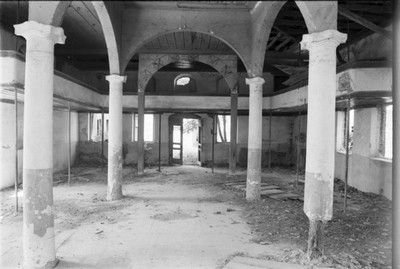
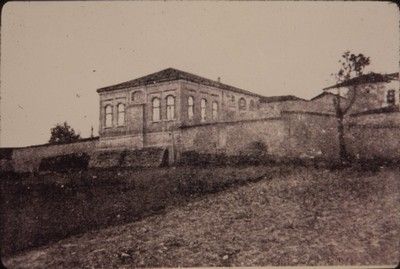
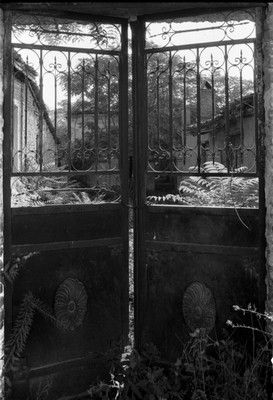
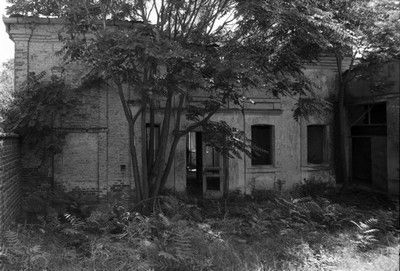
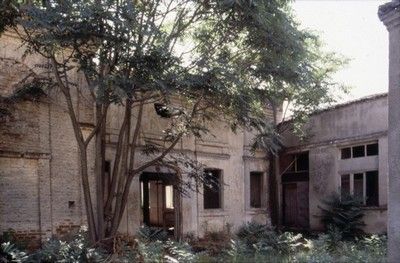
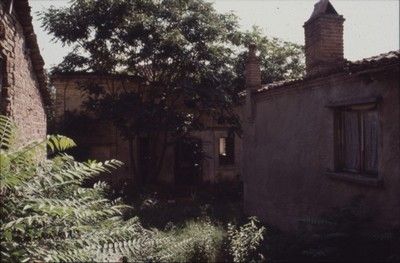
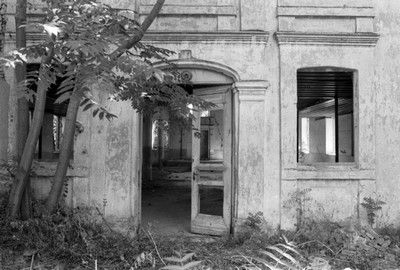
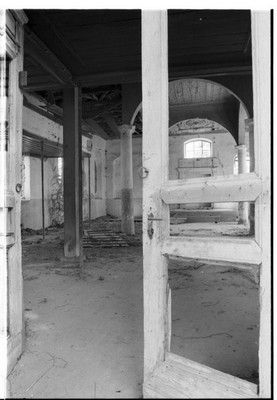
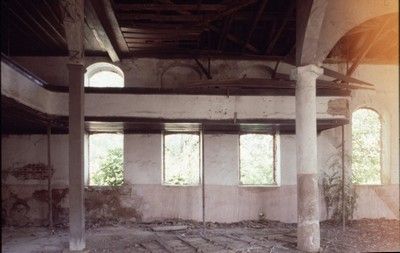
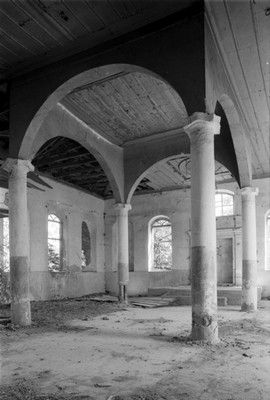
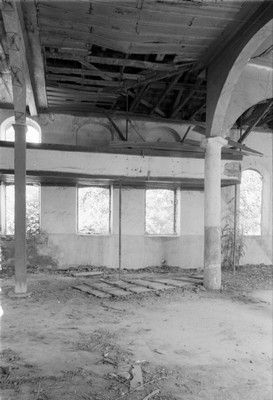
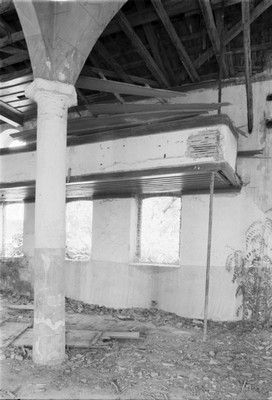
The Central Board of Jewish Communities of Greece describes the 1862 synagogue as built in the Sephardic style, square in plan with a dome on the roof. It stood in a walled courtyard entered through an iron street gate, with the Jewish club next to it. Photographs in the Jewish Museum of Greece, taken when the building stood empty, show a rendered masonry building with arched door and window openings. Inside, a near-square hall had four tall columns carrying round arches. These framed a raised central bay below a timber ceiling, an arrangement typical of Ottoman-era Sephardic synagogues. A women's gallery on timber brackets ran along the north wall and towards the entrance, with rows of arched windows below. The building was radically renovated and extended westwards in 1924. A 1960 photograph by the architect Shemtov Samuel shows the original wooden benches still in place, and his archive includes a site plan of the synagogue and the community centre. Elias Messinas surveyed what remained in 1994, and part of the mosaic floor survives on the site.
Жизнь в синагоге
The synagogue was the centre of a Ladino-speaking Sephardic community that followed the rabbis of Edirne in matters of law and kept close ties with the Jewish communities of Thrace and Bulgaria. Next door was the Jewish club, and the community's Alliance school, later a community school, trained generations of children. Its teachers included the Greek scholar Joseph Pessach, Samuel Nahon, Joseph Reitan and Elias Barzilai. Barzilai, who later became Chief Rabbi of Athens, worked briefly in Didymoteicho in 1934. The community's peak came in the early twentieth century, when Tsar Ferdinand of Bulgaria in 1913 and King Alexander of Greece in 1920 stayed at the mansion of Raphael Behar. Zionist ideas reached the town through Hebrew teachers from Bulgaria. In 1943 the synagogue was the place where the community was gathered for deportation.
Разрушение
Nazi German forces occupied Didymoteicho in April 1941. Over the next two years Jewish property was plundered and Jewish houses were requisitioned. On 4 May 1943 the Jewish men were gathered in the synagogue, declared under arrest and ordered to collect their families for transfer to Poland. The building itself survived the occupation. After the war it was not returned to the community and was used by the Christian Hearth (Christianiki Estia) organisation as a Sunday school, while the neighbouring club housed a soup kitchen. It then stood abandoned for some years, and photographs show the roof failing and the gallery decaying. The synagogue and the adjoining community centre were demolished in 1984. Elias Messinas, who documented abandoned Greek synagogues at that time, lists Didymoteicho with Xanthi and Alexandroupolis among those demolished just before or during his surveys. None of the sources consulted names who ordered or carried out the demolition, or why. The community, by then almost gone, was formally dissolved in 1987.
Судьба общины
Some families escaped across the border to relatives in Turkey before the deportations, and a very few reached Palestine; others were sent back by the Turkish authorities to the Greek islands and shared the fate of the Jews there. On 4 May 1943 Nazi German forces arrested 731 Jews of Didymoteicho, together with 180 from Nea Orestiada, and sent them in cattle wagons to Thessaloniki and then to Auschwitz, where nearly all were murdered. The Encyclopaedia Judaica puts the number deported at 970 of about 1,000 Jews living there in 1940. Another estimate gives 33 survivors out of 900. A few survivors came back in 1945 but most community property was not restored. There were 38 Jews in the town in 1948, 21 in 1967 and four in 1983. The last Jew of Didymoteicho died in 1985, and the community was officially dissolved in 1987.
Место сегодня
The site on Katsantoni Street is now the Square of Jewish Martyrs (Plateia Evraion Martyron), laid out by decision of the Municipal Council. Part of the synagogue's mosaic floor survives on the terrace where the building stood. In May 2002 the Municipality of Didymoteicho unveiled a Holocaust memorial beside it. Elsewhere in the town, the old and new Jewish cemeteries survive in poor condition. The Tarabulus family mansion has been restored as a guest house, and remembrance events are held there with the Central Board of Jewish Communities of Greece.
Значимые имена
Elias Barzilai
1891–1979Teacher and rabbi in Didymoteicho (1934); later Chief Rabbi of AthensBorn in Thessaloniki, Elias Barzilai taught at the Jewish community school of Didymoteicho and served the community briefly around 1934–35, when the synagogue was its religious centre. In 1936 he became Chief Rabbi of Athens. During the Nazi occupation his actions helped save thousands of Athenian Jews, while the Jews of Didymoteicho were deported in 1943.
Биография или источник →Вам есть чем поделиться?
Фотографии, документы, семейные истории и воспоминания об этой синагоге и её общине помогают сохранить её историю.
- The Jewish Community of Didymoteicho
- Preservation of Synagogues in Greece: Using Digital Tools to Represent Lost Heritage
- Διδυμότειχο
- Didymoteicho Old Jewish Cemetery (historical overview)
- Didymoteikhon
- Didymoteicho
- Photographs: The Synagogue of Didimoticho (records 1722–1729, 4197–4199, 4283)
- Πλατεία Εβραίων Μαρτύρων, Διδυμότειχο (way 269251744)
- Elias Barzilai
Share a memory or thought
No comments yet. Be the first to add one.