
La historia de Doesburg Synagogue
Doesburg is a small fortified Hanseatic town on the IJssel in the Achterhoek region of Gelderland. Jews are recorded there from the Middle Ages, and from 1639 Jews ran the town's pawnbank, around which a small community formed. For a long time services were held in a private house. In 1800 the community bought a building in the Torensteeg and made it a synagogue, but a storm brought it down in 1807; a replacement building was then bought with a subsidy from the central Jewish consistory, the Opperconsistorie.
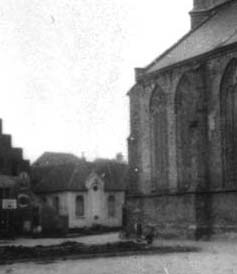
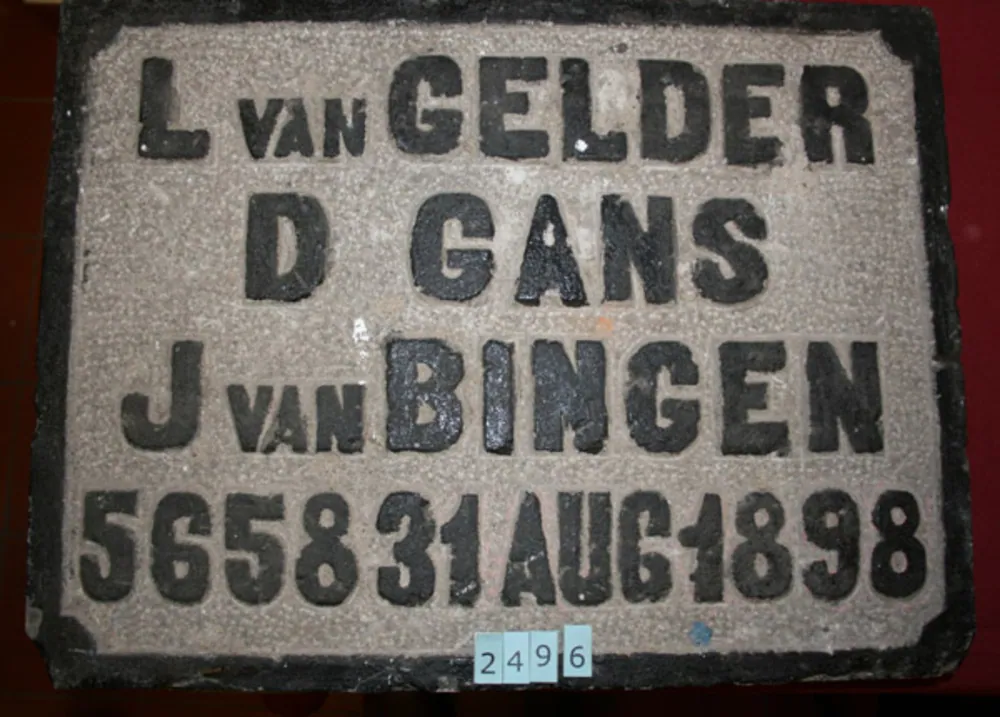
The synagogue described here was the community's third and last, and the only one it built for the purpose. It was put up in 1898 near the Martinikerk, the great Gothic church in the centre of town, and close to the Markt. A photograph of about 1930, captioned 'the Kerkplein in Doesburg with synagogue', shows a modest gabled building standing in the shadow of the church. Its foundation stone, dated 31 August 1898, is preserved in the town museum.
The congregation was already shrinking when the building opened, from 103 Jews in 1869 to 41 in 1930. During the occupation NSB members looted the synagogue, and shortly before the liberation in April 1945 it was largely destroyed when the church tower beside it was blown up. What remained was demolished after the war.
Where it stood for nearly 55 years
Historic: near the Martinikerk, on or beside the Kerkplein and the Markt, Doesburg (street and number unknown; the 2000 marker stands in the Torensteeg). Today: Torensteeg, 6981 BK Doesburg, Gelderland (approximate).
Abrir mapa ampliado →La comunidad judía
The Jewish presence in Doesburg is old: the community history of the Jewish Cultural Quarter mentions Jews in the Middle Ages and a 'Joedenstraat' in the fifteenth century. From 1639 Jews held the lease of the town pawnbank, and a small permanent community grew up around it. Many of its members were very poor, and in the early eighteenth century some joined the organised robber bands then active in the eastern Netherlands. After civil equality was granted in 1796, the town council resisted the settlement of Jews, and the provincial authorities had to intervene before a regular congregation could take shape. The community then grew through the nineteenth century, from 15 Jews in 1798 to 39 in 1809 and 108 in 1840, but many members still depended on poor relief. Its people earned their living mainly as butchers, traders, bankers and moneylenders. A religious school existed from the early nineteenth century. The community buried its dead successively on the Ooipoortwal, from 1723 on the Veerpoortwal, and from 1856 on the Molenveld outside the Meipoort; a burial society was founded in 1896. Numbers fell again from 78 in 1899 to 41 in 1930.
Arquitectura y diseño
Very little is recorded about the building itself. The community encyclopedia says only that a new synagogue was built in 1898 near the Martinikerk and the market square, and no architect, builder, seating capacity or interior plan is named. The one view found, a small photograph of about 1930 taken across the Kerkplein, shows a low, pale, rendered building with a pitched roof set back behind a low wall, its end gable facing the square and topped by a small raised centre with a round or oval feature. Tall round-headed windows appear along the side, and the buttressed wall of the Gothic church rises immediately to the right. The stone of the facade survives: a rectangular natural-stone plaque, painted with the names L. van Gelder, D. Gans and J. van Bingen and the date 5658, 31 August 1898. It records the founding of the building, though it does not say what roles these three men held. The museum catalogue links the stone to the Veerpoortstraat. The style of the building is unknown.
La vida dentro de la sinagoga
The sources consulted say almost nothing about worship in the 1898 building. By the time it opened, the Doesburg congregation numbered fewer than eighty people, and by 1930 only 41, so it was a small village-style synagogue serving a handful of families from the town and its surroundings. The burial society founded in 1896, two years before the synagogue was built, and the religious school that had existed since the early nineteenth century formed part of the same communal life. No rabbi, cantor, teacher or board member is named in the community history read for this entry; the only names connected with the building are the three on its foundation stone. Part of the furnishings and ritual objects escaped the wartime looting because they had been hidden; they were later recovered and are now shown in the Museum voor Stad en Ambt Doesborgh, De Roode Toren. These objects are the most direct surviving evidence of the life that went on inside.
Destrucción
During the occupation the synagogue was looted by members of the NSB, the Dutch National Socialist movement. Part of the interior had been hidden in time and survived. After the deportations of 1941 and 1942 the building stood without a congregation. In April 1945, as the Allied advance reached the IJssel, Nazi German forces prepared to withdraw across the river. According to a local war-heritage account they blew up the tower of the neighbouring Martinikerk at ten past twelve on Sunday 15 April 1945. The Jewish Cultural Quarter's community history states that the synagogue was partly destroyed (in its English version, largely destroyed) when the Nazis blew up the church tower beside it. A photograph of the ruin, dated about 1945, is held in the NIOD image collection and the Joods Historisch Museum collection but could not be downloaded. The ruin was not rebuilt. The Dutch community page gives the demolition year as 1953, while its English version and the NIOD catalogue give 1951. Who carried out the demolition is not recorded in the sources read.
El destino de la comunidad
Under the Nazi German occupation the Jews of Doesburg were caught in round-ups in the autumn of 1941 and in 1942, and most of the town's Jewish population was deported. Some went into hiding with help from the local resistance. According to the community history, none of the deportees returned. The address register of the Digital Jewish Monument lists, among others, Mauritz Sternfeld of Koepoortstraat 17, who died in 1941. With its synagogue a ruin and almost all its members murdered, the Doesburg congregation could not be revived: in 1947 it was formally dissolved and added to the Jewish congregation of Arnhem. The old cemeteries were later cleared, and the remains were reburied in Doetinchem. In 1985 a plaque commemorating the murdered Jews of Doesburg was unveiled in the town hall.
El lugar hoy
The synagogue no longer exists. The Dutch community page states that a monument was unveiled in 2000 in the Torensteeg, on the spot where the synagogue stood until 1953; the English version places it in the Torensteeg near the Martinikerk. The Torensteeg is the lane on the edge of the Kerkplein beside the rebuilt church tower, which fits the 1930 photograph and the account of the falling tower. However, the community's first synagogue of 1800 was also in the Torensteeg, and the foundation stone's catalogue entry mentions the Veerpoortstraat, so the exact plot of the 1898 building has not been confirmed. The foundation stone and the rescued ritual objects are kept in the town museum, De Roode Toren.
¿Tiene algo que aportar?
Fotografías, documentos, historias familiares o recuerdos de esta sinagoga y su comunidad ayudan a mantener viva su historia.
- Doesburg (Joodse gemeenten)
- Doesburg (Jewish communities)
- Foto van de ruïne van de synagoge te Doesburg, circa 1945 (NIOD image collection 161203)
- Foto van de ruïne van de synagoge te Doesburg, circa 1945 (JHM F002751)
- Gevelsteen Synagoge (inventory 2496)
- Grote of Martinikerk, Doesburg
- Joodse plaquette, Doesburg town hall
- Koepoortstraat 17, Doesburg
- Torensteeg, Doesburg (OpenStreetMap way 229862855)
Share a memory or thought
No comments yet. Be the first to add one.