
История Dordrecht Synagogue
Dordrecht lies on the rivers south-east of Rotterdam, in the province of Zuid-Holland. A first Jew swore the citizen's oath there in 1670, and by 1728 an organised congregation existed with its own regulations. In 1739 the community consecrated a synagogue in rooms of the former Mariaborn convent. More than a century later, by 1856, it had opened a Jewish community centre on the Varkenmarkt, close to the Grote Markt in the old city centre, which held the synagogue, the religious school and a room for other activities. This building served the congregation until the Second World War. Under the Nazi occupation its interior was looted, and in the Hunger Winter of 1944-1945 the remaining woodwork was burned for heating, though the Torah scrolls were saved. The small group of survivors could not keep the damaged building: it was sold in 1947 and pulled down in 1965. Services continued in other rooms until 1987, when the Dordrecht congregation merged with Rotterdam's.
Where it stood for 226 years
Historic: synagogue and Jewish community centre on the Varkenmarkt, Dordrecht (house number unknown); earlier synagogue in the former Mariaborn convent (location unknown). Today: Varkenmarkt / Grote Markt, 3311 Dordrecht; pin at the plaque marking the former synagogue site (approximate).
Открыть большую карту →Еврейская община
Jewish settlement in Dordrecht is documented from 1670, when the first Jew took the citizen's oath, and about 1700 three Jews were members of the merchants' guild. A document of late 1728 shows a constituted congregation with rules of its own, and around ten years later it bought a burial ground in the Wilgenbos outside the Sluyspoort. Poverty was the community's lasting problem. It caused repeated quarrels among members, some serious enough for the city magistrates to step in, and under French rule the position worsened so much that by 1810 most members depended on relief. The nineteenth century brought modest recovery. The Jewish population of Dordrecht and its surroundings was 310 in 1809, 327 in 1840, 384 in 1869 and 429 in 1899, falling to 322 by 1930. Besides the synagogue council there were a poor-relief board, two women's societies, men's societies and Torah study groups, and in the 1920s and 1930s a small Zionist movement and a coordinating commission for the societies.
Архитектура и дизайн
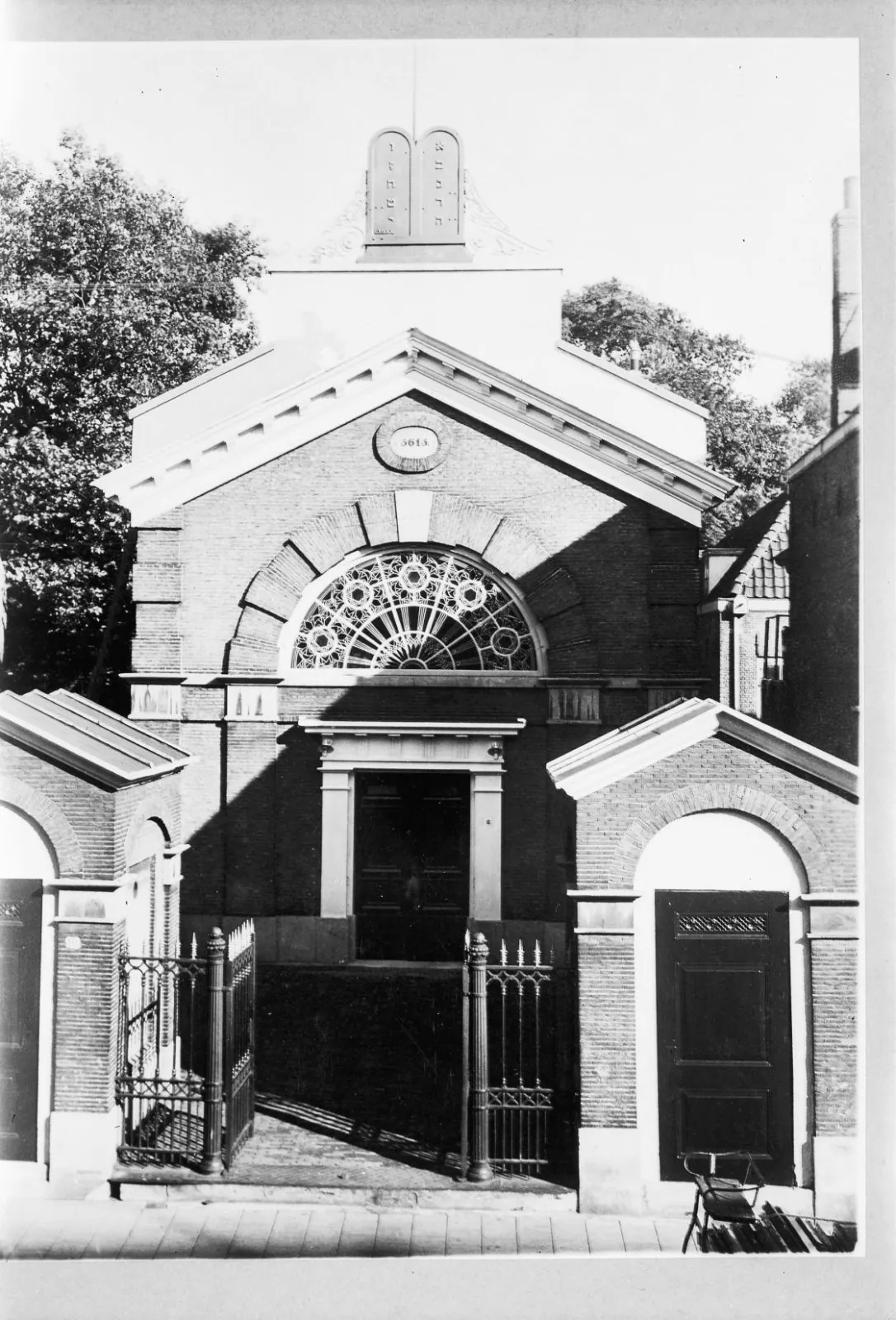
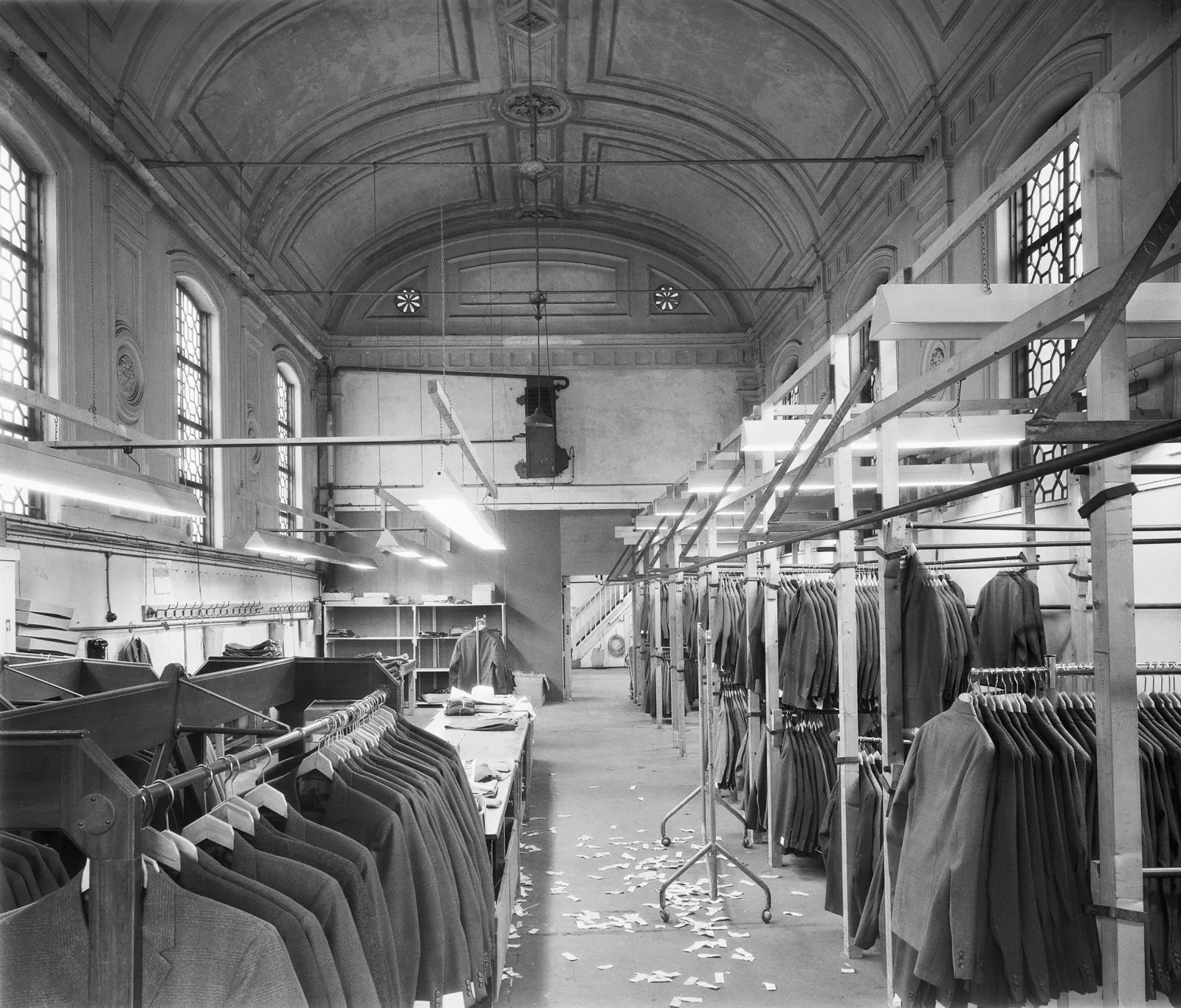
The first synagogue of 1739 was fitted into existing rooms of the former Mariaborn convent rather than built new; its location and form are unknown. The building on the Varkenmarkt is known from photographs in the Rijksdienst voor het Cultureel Erfgoed. Its street front was a brick gable in a sober Neoclassical manner: a broad pediment with a roundel in the tympanum, a large semicircular fanlight window with radiating glazing under a brick arch, and a central doorway with a plain stone surround. The Tablets of the Law stood on the roof ridge above. Lower wings on either side, each with a small pediment and an arched doorway, flanked a forecourt closed by iron railings. Inside, a photograph of 1960 shows a long hall under a coffered barrel vault, lit by tall round-arched windows between pilasters. A reproduced drawing filed with the same building shows a richly framed ark under a round arch with columns and lamps. Architect, builder and capacity are unknown.
Жизнь в синагоге
The building on the Varkenmarkt was the centre of organised Jewish life in Dordrecht for nearly ninety years. Besides the prayer hall it housed the religious school, where the children of the congregation received their Jewish education, and a room used for the meetings and activities of the community's many societies. These included the poor-relief board, which in a community long marked by poverty carried much of the burden of care, two women's societies, men's associations and groups devoted to Torah study. In the 1920s and 1930s a small Zionist movement met in Dordrecht, and a coordinating commission was set up to bring the various societies together. The names of the rabbis, cantors and wardens who served in the synagogue have not been found in the sources read for this entry, and nothing is recorded about the order of services or the congregation's religious customs.
Разрушение
During the Nazi occupation of the Netherlands the interior of the synagogue on the Varkenmarkt was looted and wrecked; the JCK encyclopedia attributes this to the Nazi German occupiers and names no individual or unit. After the deportations of 1942-1943 the building stood empty. In the Hunger Winter of 1944-1945, when fuel had run out in the occupied west, the wooden furnishings still inside were taken out and burned for heating; who burned them is not recorded. The Torah scrolls survived. After liberation the few survivors could not restore the building, and in 1947 it was sold. A government heritage photograph of April 1960 shows the hall in use as a warehouse for men's clothing. The building was demolished in 1965. Who bought it in 1947, who used it as a store and who carried out the demolition is not recorded in the sources consulted.
Судьба общины
After the Nazi German invasion of May 1940 the Jews of Dordrecht were subjected to the same anti-Jewish measures as elsewhere in the occupied Netherlands, which isolated them step by step from the rest of the population. Deportations from Dordrecht began in the second half of August 1942. Most of the city's Jews were taken away and murdered in the camps. According to a commemorative text in the city, of about 350 Jews living in Dordrecht, 285 did not survive the war. Among those recorded by the Digitaal Joods Monument at Varkenmarkt 7 rood, the street of the synagogue, were Hartog van Beugen, his wife Roosje van Beugen-Monasch and their son Elias, all killed in 1943. A few dozen Dordrecht Jews survived. They held services in various rooms until 1987, when the congregation merged with Rotterdam. Today a group called Bené Dór, with around fifty members from Dordrecht and the surrounding area, meets regularly.
Место сегодня
The synagogue building no longer exists. Its site lies in the old centre of Dordrecht at the Varkenmarkt, at its junction with the Grote Markt in the former Jewish quarter; the present use of the exact plot was not established in this research. A plaque on the Grote Markt marks the place where the synagogue stood. Of the community's other places, the Jewish cemetery on the Nieuwe Weg survives; the municipality took it over in 1999, restored its prayer house and reopened it in 2001. The map pin uses the coordinates given for the plaque.
Вам есть чем поделиться?
Фотографии, документы, семейные истории и воспоминания об этой синагоге и её общине помогают сохранить её историю.
- Dordrecht (Joodse gemeenten)
- Dordrecht (Jewish communities)
- Plaque Former Synagogue, Dordrecht
- Varkenmarkt 7 rood, Dordrecht
- Varkenmarkt and Grote Markt, Dordrecht (Nominatim)
- Voorzijde van de voormalige synagoge te Dordrecht
- Interieur van de in 1965 afgebroken synagoge te Dordrecht, in gebruik als opslagplaats voor herenkleding
- Interieur, tekening van gebedsdienst, reproductie
- Synagoge van de Nederlands-Israëlitische Gemeente te Dordrecht (1926)
Share a memory or thought
No comments yet. Be the first to add one.