
La storia di Drmoul Synagogue
Drmoul, called Dürrmaul in German sources, lies about 4 km south-west of Mariánské Lázně (Marienbad) in the Cheb district. Jewish families lived there from the end of the sixteenth century, and after the expulsion of the Jews from nearby Planá in 1686 more settled in Drmoul and in neighbouring Chodová Planá, building their houses around the large village green. A prayer house is recorded in 1724. The synagogue described here, the community's last, was built in 1800-1801 and consecrated in 1801; some sources give 1803 for its completion. It stood on plot no. 64 in the middle of the green, joined to the Jewish community house of 1861, which held the school and the teacher's flat. A small Catholic chapel of St Joseph was built beside it in 1924.
The community, which numbered 110 people in 1880, had shrunk to 36 by 1930, and its rabbis came from Chodová Planá. After Nazi Germany annexed the Sudetenland in October 1938, the synagogue was set on fire on 10 November 1938, the night of Kristallnacht, and the congregation came to an end. Sources disagree about what happened to the burned building afterwards: one says a fire station was built on its foundations in 1945-1946, another that it was repaired as flats and pulled down together with the community house in 1981. Only the floor of the main hall is said to survive.
Where it stood for 137 years
Historic: Dürrmaul no. 64 (plot no. 64), village green, beside the Jewish community house. Today: centre of the village green in Drmoul, next to the chapel of St Joseph on Sekerská street, 354 72 Drmoul, Cheb district (approximate).
Apri la mappa grande →La comunità ebraica
The beginnings of Jewish settlement in Drmoul are poorly documented because the community's old archive burned with the community house in 1872, but individual Jewish families are recorded at the end of the sixteenth century and the religious community probably dates from the seventeenth. The expulsion of the Jews from Planá in 1686 brought new families to Drmoul and Chodová Planá. In 1724 there were 17 families (78 people), at the end of the eighteenth century 20 to 29 families, and in 1837 still 29. In the early eighteenth century the families received or had confirmed privileges for trade, crafts and worship, paying an annual rent for their houses and prayer house and having to buy a fixed amount of brandy from the manor distillery. In the first half of the nineteenth century the village had about 25 Jewish houses, several of which survive in altered form. In 1880 there were 110 Jews, almost 13 percent of the population; in 1900, 77; and in 1930, 36. Members of the community helped develop the spa amenities of Marienbad and founded its Jewish community.
Architettura e design
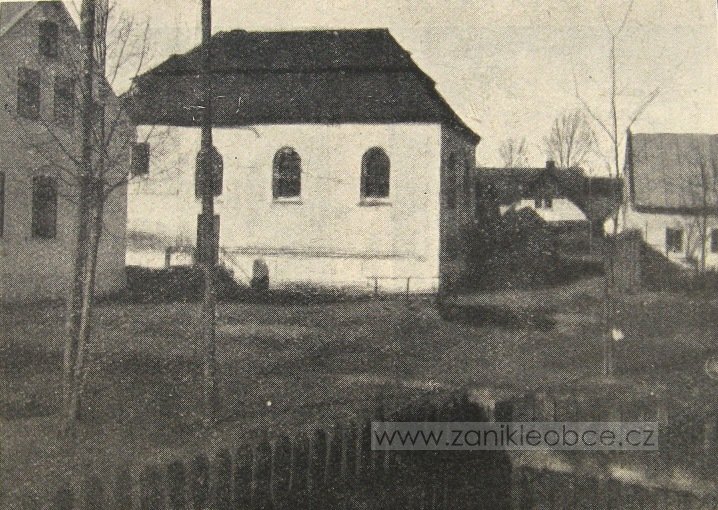
The synagogue was a free-standing masonry hall built in 1800-1801. Jiří Fiedler describes it as a plain building in the Classicist style; a 2012 thesis on the community calls it Baroque, and the Encyclopaedia Judaica entry quoted by JewishGen also speaks of a baroque synagogue. A historical photograph shows a rendered, rectangular building under a high hipped roof, with tall round-arched windows set in the long wall and a small annex or porch at one end. Inside, according to the thesis, there was a men's vestibule, a main hall of 9.2 by 7.9 metres and a women's gallery. The ceiling of the hall was domed and decorated, and the wooden Torah ark was richly carved. The building was joined to the Jewish community house of 1861 so that together they formed a square plan. The roof was re-covered with slate in 1901, the first repair recorded since construction. The entrance portal is said to have carried the German inscription 'In das Gotteshaus will ich gehen' ('I will go into the house of God'). The architect, builder and number of seats are unknown.
La vita nella sinagoga
The synagogue was the centre of a small rural congregation that kept its own cantors and teachers. The thesis by Kamila Sabová lists them from the community's records: Simon Friedenthal in 1882, Heinrich Löbl in 1883-1888, Joachim Katz from 1894, who served as cantor until 1907, and later Bernard Engl, Samuel Friedl, Adolf Neu, Hermann Gelb and, from 1915, Jakob Ziegler, who was still cantor in 1925. Most of them were also the community's teachers, working in the school in the adjoining community house. The first rabbi recorded in Drmoul, Abraham, is mentioned in 1784, and Lewi ben Šimon Hainsfurth served in 1787-1790; from the late nineteenth century there was no resident rabbi, and rabbis came from Chodová Planá, the last being Alfred Schapirnik in 1932-1934. Among the community's heads were Hermann Hofmann, Ignaz Fleischner, Markus Kohorn and Sigmund Doktor. Isaac Mayer Wise, later a founder of American Reform Judaism, spent part of his childhood in the village, and the writer Norbert Frýd drew on his grandfather's memories of it.
Distruzione
Drmoul lay in the Sudetenland, which was annexed by Nazi Germany in October 1938. On 10 November 1938, during the Kristallnacht pogrom, the Nazis set the synagogue on fire; the Encyclopaedia Judaica entry quoted by JewishGen says that 'the Nazis burned the synagogue in 1938', and Sabová's thesis states that it was burned and demolished by the Nazis on that day. No source names the individual men responsible. The later history of the shell is told in conflicting ways. The Jewish Community of Prague's monuments database says it was burned and demolished and that a fire station was built on its foundations in 1945-1946. Jiří Fiedler writes instead that services perhaps lasted until 1938, that the building was later used as housing, and that it was demolished together with the Jewish community house in 1981. Sabová's thesis repeats both versions, adding that after the war the building was repaired as flats and was completely destroyed in the 1980s. Who carried out the final clearance is not recorded. All sources agree that the community house next to it was pulled down in 1981.
Il destino della comunità
By 1930 only 36 Jews lived in Drmoul, and the community was already dissolving. According to Jüdische Gemeinden, the last Jewish families left immediately after the Kristallnacht of November 1938, in which the synagogue was burned; JewishGen likewise records that the Jews left in 1938. Where they went is not recorded in the sources consulted, and none of them follows the Drmoul families further or says how many were later deported and murdered in the Holocaust. The writer Norbert Frýd, whose grandfather came from Drmoul, was himself deported to Terezín, Auschwitz and Dachau, and his wife, child, father and brother were killed. In the early 1940s the Jewish cemetery outside the village was devastated under the Nazi occupation. The community was not re-established after the Second World War. The cemetery, with several hundred granite gravestones from the late seventeenth century onwards, has since been restored and is owned by the Federation of Jewish Communities in the Czech Republic.
Il luogo oggi
Nothing of the synagogue stands. The sources disagree on what is on its plot today: the Jewish Community of Prague's monuments database and part of Sabová's thesis say a fire station was built on its foundations soon after the war, while another chapter of the thesis describes the plot as a private garden, with only the floor of the main hall surviving. The site is in the middle of the village green, directly beside the small chapel of St Joseph built in 1924. Some of the former Jewish houses around the green still stand in altered form. The Jewish cemetery lies about 1.5 km west of the village on a wooded slope near Panský Vrch.
Nomi importanti
Alfred Schapirnik
UnknownRabbi serving Drmoul from Chodová Planá, 1932-1934Schapirnik is the last rabbi named in the records of the Drmoul community. Like his predecessors since the late nineteenth century he did not live in the village but travelled to Drmoul from Chodová Planá, where he was based, in 1932-1934. He thus led services in the synagogue during the final years before its destruction in 1938, when the congregation had shrunk to a few dozen people. Nothing further about his life or fate was found.
Biografia o fonte →Jakob Ziegler
UnknownCantor and teacher of the Drmoul congregation, 1915-1918 and 1925Ziegler is recorded as cantor of the Drmoul community in 1915-1918 and again in 1925, and as its teacher in 1915-1916. He is the last cantor named in the community's records studied by Kamila Sabová, so he led the singing in the synagogue in its final decades and taught the children in the school in the adjoining community house. His later life and fate are unknown.
Biografia o fonte →Joachim Katz
UnknownCantor of the Drmoul congregation, 1894-1907; teacher 1894-1897Katz served as cantor in the Drmoul synagogue from 1894 to 1907, the longest tenure among the cantors listed in the community's records, and was also the community's teacher in 1894-1897. His years of service fell in the period when the congregation was shrinking from about 110 members in 1880 to 77 in 1900 and had no resident rabbi. Nothing more about him was found.
Biografia o fonte →Hai qualcosa da condividere?
Fotografie, documenti, storie di famiglia o ricordi di questa sinagoga e della sua comunità aiutano a mantenerne viva la storia.
Share a memory or thought
No comments yet. Be the first to add one.