

La historia de Adelaide Road Synagogue, Dublin
The Adelaide Road Synagogue stood on the south side of Dublin, at 36-37 Adelaide Road, close to the streets around the South Circular Road where most of the city's Jews had settled by the 1890s. It was built by the Dublin Hebrew Congregation to replace its synagogue in a converted chapel at Mary's Abbey, north of the Liffey, which had become too far for many members to walk to on the Sabbath. Sources agree that it was the first purpose-built synagogue in Ireland.
The building cost more than £5,000, raised from donations by Jews in Britain, including the Rothschilds, and by Jews and non-Jews across Ireland, with about £3,000 borrowed on a mortgage. Chief Rabbi Hermann Adler consecrated it on 4 December 1892, the day after the last service at Mary's Abbey. A mikveh and baths were added in 1915 and school rooms in 1925.
For most of the twentieth century this was the city's senior congregation, known to the immigrant families of 'Little Jerusalem' as the English shul. Membership grew from 120 seat-holders in 1895 to 365 in 1944, then fell as families moved to the southern suburbs. In 1999 the members voted to close and join the Terenure congregation. The building was sold, the prayer hall and everything behind the street front were demolished, and only the façade remains, now the front of an office building.
Where it stood for 107 years
Historic: 36-37 Adelaide Road, Dublin (Comerford gives no. 37, NIAH no. 36). Today: 36 Adelaide Road, Dublin 2, D02; the retained façade fronts an office building. Exact (NIAH survey point).
Abrir mapa ampliado →La comunidad judía
From 1836 the Dublin Hebrew Congregation used a former Presbyterian chapel at Mary's Abbey. In the 1880s and 1890s Jewish families moved south of the river towards the South Circular Road and beyond, and the congregation decided to build closer to them. Martinus de Groot, president at Mary's Abbey, sat on the building committee. The congregation followed British synagogue customs, which is why the Eastern European families of the 'Little Jerusalem' district called it the English shul. According to Patrick Comerford it had 120 seat-holders or subscribing members in 1895 and 365 by 1944. From the 1960s numbers fell as families moved to Terenure, Rathfarnham and Churchtown, and by the 1990s a typical Saturday morning service drew 40 to 50 people.
Arquitectura y diseño
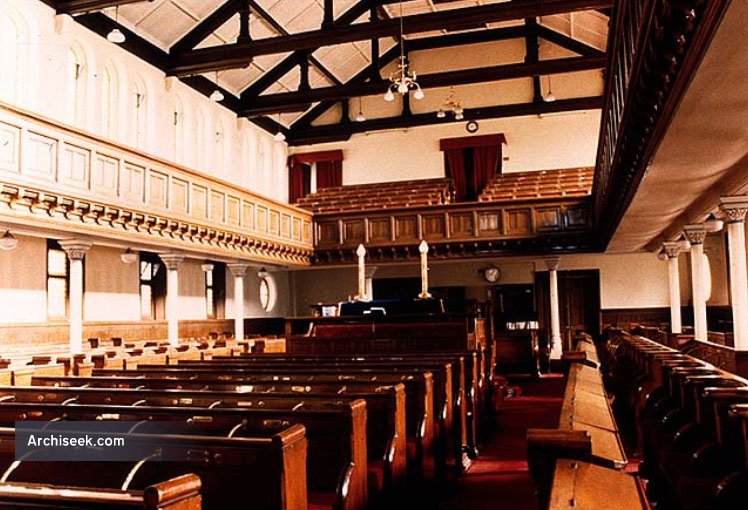
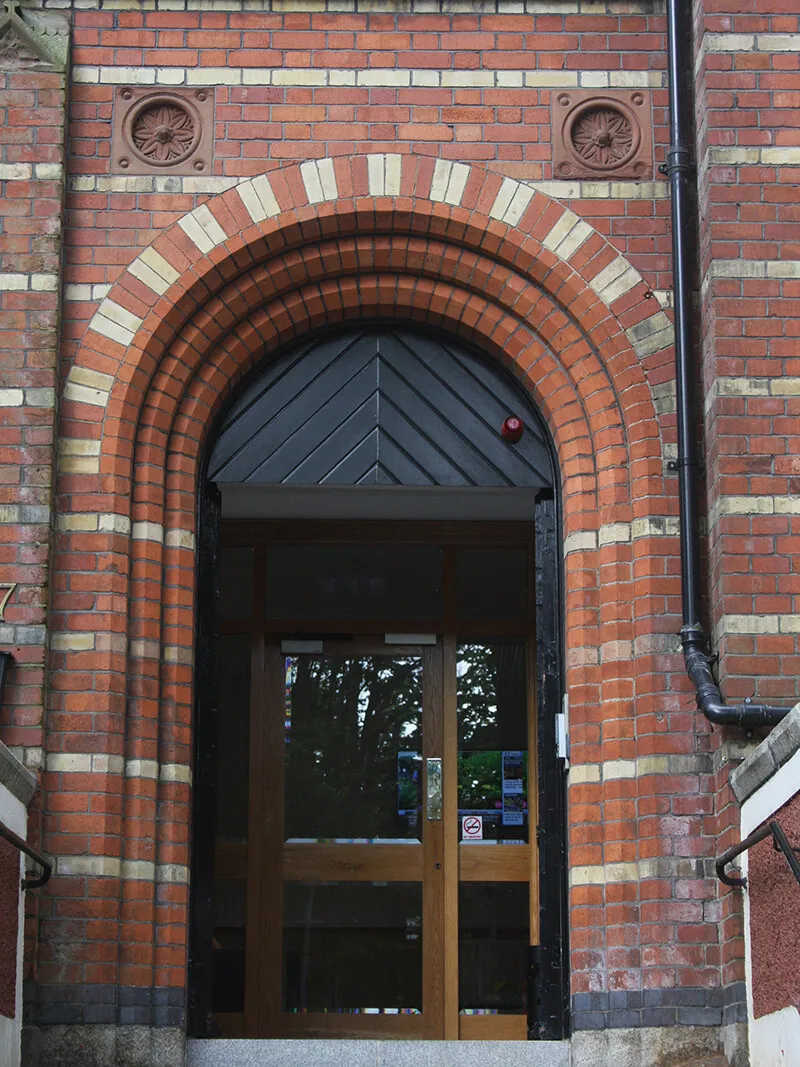
John Joseph O'Callaghan (c. 1838-1905), a Cork-born Dublin architect trained in the office of Deane and Woodward and otherwise known as a committed Gothic designer, gave the synagogue a loosely Byzantine or Eastern Romanesque dress. The surviving street front, as described by the National Inventory of Architectural Heritage, is a nine-bay, two-storey range over a raised basement, with a five-bay gable-fronted central breakfront under a slate roof. It is built of red brick in Flemish bond banded with polychrome brick and terracotta, with round-headed windows, and its symmetry is stressed by paired arched entrances reached by flights of steps. Behind it lay the prayer hall, which seated 300 people in the main body and 150 in the galleries. The one interior photograph found shows galleries on three sides carried on slender columns with ornate capitals, panelled gallery fronts, an open timber roof with exposed trusses, tall round-headed windows, rows of wooden pews and a central reading platform flanked by tall lamp standards.
La vida dentro de la sinagoga
The synagogue was consecrated on 4 December 1892 by Hermann Adler, newly installed Chief Rabbi of the British Empire, who declared that Ireland was the only country that could not be charged with persecuting the Jews. Services followed British usage under a succession of ministers and readers: Abraham Gudansky served as reader from 1901 and as minister until 1939, and Morris Roith was second reader for some forty-five years. Ephraim Mirvis, later Chief Rabbi of Ireland, was its minister from 1982. In 1915 a mikveh and baths were added, the work supervised by Caldeck and Dunlop to designs by Benjamin Septimus Jacobs of Hull, and in 1925 the building was extended with school rooms for Jewish children. Chaim Herzog, later President of Israel, celebrated his bar mitzvah here, and British Pathé filmed a wedding at the synagogue around 1930. James Joyce mentions the congregation's synagogue 'over in Adelaide road' in Ulysses. The centenary was celebrated in 1992.
Destrucción
The synagogue was never attacked or damaged. Its end came from decline: by the 1990s most members lived in the southern suburbs, and in January 1999 the congregation voted almost unanimously to close the building and merge with the Terenure Hebrew Congregation on Rathfarnham Road. The last services were held that year. The congregation sold the property shortly after closure, for some £6 million according to JCR-UK, and the proceeds were meant for the Terenure site. The new owners redeveloped the plot as offices. The National Inventory of Architectural Heritage records that the building was demolished at the rear in 1999 and a new structure was integrated to the south; Patrick Comerford writes that most of it was demolished apart from the façade. The prayer hall, galleries, interior fittings and the later mikveh and school wing were all lost. The sources consulted do not name the buyer, the developer or the demolition contractor.
El destino de la comunidad
The Adelaide Road congregation did not come to a violent end. After the 1999 vote its members moved to the synagogue of the Terenure Hebrew Congregation at Rathfarnham Road, built in 1953, where the two congregations worshipped together. On 15 December 2004 they held simultaneous general meetings and agreed a complete merger, and on 25 January 2005 the combined Dublin Hebrew Congregation held its first council meeting, carrying on the name of the community that had built Adelaide Road. The decline that closed the building followed the move of Dublin's Jewish families from the streets near Adelaide Road to the southern suburbs, which left the old synagogue far from where most members lived. A Torah scroll mantle from Adelaide Road is now kept in the Irish Jewish Museum in Portobello, in the former Walworth Road synagogue, one of the few movable objects from the building whose whereabouts are recorded in the sources consulted.
El lugar hoy
Only the street front of the synagogue stands. The nine-bay polychrome brick façade on Adelaide Road, with its central gable, round-headed windows and paired arched doorways reached by steps, was kept when the rest of the building was demolished in 1999. The prayer hall, galleries, mikveh and school wing behind it are gone, and the plot is now an office development: the National Inventory of Architectural Heritage, which recorded the façade in 2017 and rates it of national importance, lists it as the offices of the Communications Clinic at 36 Adelaide Road, with a modern block joined to its south side and taller office buildings rising behind. The doorways now serve as office entrances. No part of the interior survives in place.
Nombres destacados
John Joseph O'Callaghan
c. 1838-1905Architect of the synagogueCork-born and trained with Deane and Woodward, O'Callaghan worked on Trinity College Dublin and the Oxford Union before practising on his own in Dublin for more than thirty years. Although otherwise a committed Gothic architect, he designed the Adelaide Road Synagogue of 1892 in a loosely Byzantine or Romanesque style, with a banded polychrome brick front, the only part of the building that survives.
Biografía o fuente →Hermann Adler
1839-1911Chief Rabbi who consecrated the synagogueAdler, Chief Rabbi of the British Empire from 1891, preached the closing sermon at Mary's Abbey on 3 December 1892 and the next day led the procession that consecrated the Adelaide Road Synagogue. In his address he declared that Ireland was the only country in the world that could not be charged with persecuting the Jews, a line still quoted in histories of Irish Jewry.
Biografía o fuente →Martinus de Groot
UnknownMember of the building committee; congregation presidentDe Groot was president of the Mary's Abbey congregation when the move south was planned and sat on the committee that built the Adelaide Road Synagogue (Comerford). JCR-UK lists an 'M. de Groop, JP' as president of the Dublin Hebrew Congregation from 1896 to 1901, apparently the same man, so he led the congregation in its first years in the new building.
Biografía o fuente →Abraham Gudansky
UnknownReader from 1901, minister until 1939JCR-UK records the Rev. Abraham Gudansky as reader of the Dublin Hebrew Congregation from 1901 to about 1925 and then as its minister until 1939. For almost four decades he led the services at Adelaide Road, through the years when membership rose towards its peak of 365 seat-holders in 1944.
Biografía o fuente →Morris Roith
UnknownSecond reader, c. 1921-1966The Rev. Morris Roith served as second reader of the Dublin Hebrew Congregation from about 1921 until 1966, according to JCR-UK, assisting a series of ministers and chazanim at Adelaide Road for some forty-five years, longer than any other official named in the lists. Nothing more about him was found.
Biografía o fuente →Ephraim Mirvis
born 1956Minister of the congregation from 1982Mirvis was appointed rabbi of the Adelaide Road Synagogue in 1982; JCR-UK gives his ministry there as 1982 to 1984. He went on to be Chief Rabbi of Ireland from 1985 to 1992. He was among the last full-time ministers of the congregation before the pulpit was supplied by the chief rabbis.
Biografía o fuente →Chaim Herzog
1918-1997Bar mitzvah at the synagogueHerzog, son of Rabbi Yitzhak HaLevi Herzog, Chief Rabbi of Ireland, grew up in Portobello, Dublin, from 1919. The National Inventory of Architectural Heritage records that he had his bar mitzvah at the Adelaide Road Synagogue. He later became President of Israel, as NIAH notes.
Biografía o fuente →¿Tiene algo que aportar?
Fotografías, documentos, historias familiares o recuerdos de esta sinagoga y su comunidad ayudan a mantener viva su historia.
- Dublin Hebrew Congregation (incl. Adelaide Road Synagogue)
- The Synagogues of Dublin 10: Adelaide Road
- A Bloomsday odyssey in Dublin in search of ...
- Communications Clinic, 36 Adelaide Road, Dublin 2 (reg. no. 50110479)
- 1892 - Former Synagogue, Adelaide Road, Dublin
- Dublin Hebrew Congregation
- Ephraim Mirvis
- Hermann Adler
- Chaim Herzog
- Adelaide Road, Dublin (OpenStreetMap via Nominatim)
Share a memory or thought
No comments yet. Be the first to add one.