

La storia di Dunapataj Synagogue
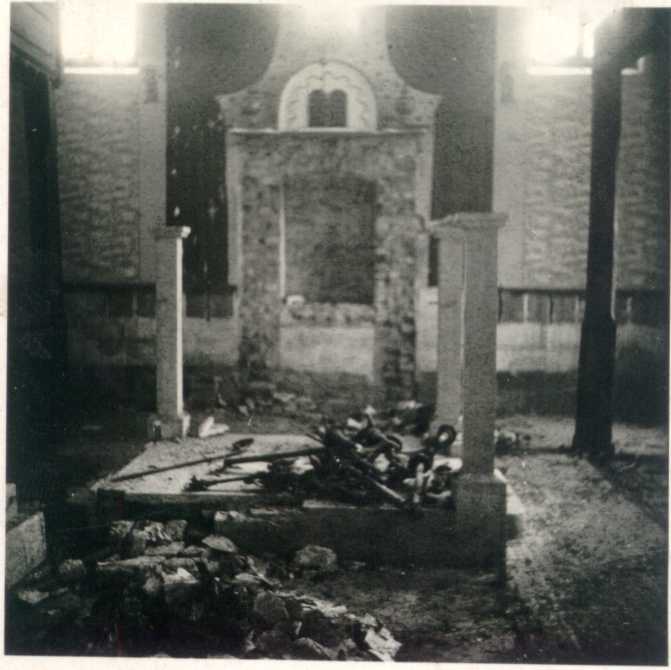
Dunapataj lies on the plain east of the Danube between Solt and Kalocsa; until 1950 it belonged to the Dunavecse district of Pest-Pilis-Solt-Kiskun county. Its Jewish community, founded mainly by merchants who had moved from Paks and Hőgyész, never numbered more than about 190 people, yet it kept a school, a burial society and, from 1879, a synagogue paid for by its own members. An older prayer house, dated to 1830 in Anikó Gazda's national survey, preceded it. No exterior view of the synagogue has been found; two photographs in the Hungarian Jewish Museum and Archives record a modest painted hall with round-arched windows, a round window above the ark and a railed reading platform among the pews. In May 1944, under Nazi German occupation, the Jews of the district were ordered into Kalocsa and deported from there. Only 21 Jews were counted in the congregation in 1949. The redundant synagogue was sold for its building materials and demolished at the end of the 1950s: the town's website gives 1958, another local account 1957. A press report of 1959 names the demolisher only as W. P., a swindler who took down seven rural synagogues in this way. Where exactly in the village the building stood is not recorded in the sources consulted.
Where it stood for nearly 80 years
Dunapataj, Bács-Kiskun county, Hungary (street and plot of the synagogue not identified; historic county: Pest-Pilis-Solt-Kiskun, Dunavecse district)
Apri la mappa grande →La comunità ebraica
The Magyar Zsidó Lexikon of 1929 says that the community's founding year is unknown, its archive holding only fragmentary records, but that it was established chiefly by merchants who came from Paks and Hőgyész: Áron Hers Frank, Salamon Krausz, Izsák Tauszig, Salamon Hauer and Farkas Breuer, a glazier who had been wounded at the battle of Königgrätz. Its elementary school is said to have existed by 1830 and to have taught in Hungarian from the start, while the burial society (Chevra Kadisha) dates only from 1886. Census figures record no Jews in 1840, 189 in 1880, 186 in 1910, 130 in 1920, 126 in 1930 and 118 in 1941, in a village of about 6,000. In the late 1920s the congregation, with members in Ordas and Harta, counted 156 people in 59 families, among them twenty merchants, twelve craftsmen, two doctors, a lawyer and a farmer. Forty-three men served in the First World War and five fell. The lexicon calls the community Orthodox; the registers of 1944 and 1949 list it as Congress (Neolog).
Architettura e design
No architect, plan or exterior photograph of the synagogue is known, so its form can be described only from two undated interior photographs in the Hungarian Jewish Museum and Archives. They show a single hall with plastered walls, patterned like masonry blocks in the lower zone and plain above, under a flat ceiling stencilled with small stars and edged by a painted frieze. The ark wall has two tall round-arched windows and, between them, a large circular window. Beneath it stood the Torah ark, a dark panelled cabinet in a masonry frame, crowned by a cornice with two urn finials, an arched panel shaped like the Tablets of the Law and a Star of David. A raised reading platform (bimah) with square posts and a pierced balustrade stood free in front of the ark, surrounded by wooden pews with reading desks; globe lamps hung from the ceiling. Capacity and dimensions are not recorded. Gazda's survey classes the building of 1879 as a synagogue and an older one of 1830 as a prayer house, and marks both as demolished.
La vita nella sinagoga
Little is recorded of worship in the building itself. According to the Magyar Zsidó Lexikon the community's first rabbi was Manó Basch. During and after the First World War Áron Roznai (also written Rózner or Rosner) served as rabbi or deputy rabbi; his wartime allowances appear in the registers of the National Israelite Office between 1916 and 1921. By April 1944 the congregation had no rabbi and employed two officials. In 1921 the Dunapataj Israelite Youth Amateur Society was formed under József Hahn for cultural and charitable work. In 1929 Lajos Freund was president, Jenő Hahn secretary and Mór Weisz head of the burial society, which had twenty members in 1944. The lexicon also records that 'the counter-revolution' claimed two victims from the community, the sixty-year-old merchant Vilmos Klein and the innkeeper Sándor Pollacsek, who were shot dead. The bimah standing free before the ark in the surviving photographs points to a traditional arrangement of the service.
Distruzione
The synagogue was not destroyed in the war. After the deportations of 1944 only a handful of Jews returned to Dunapataj, and by 1949 the congregation had 21 members. Undated photographs in the Hungarian Jewish Museum and Archives show the interior first neglected and then wrecked, the ark stripped and rubble heaped on the reading platform. In 1957 or 1958 a private demolition contractor pulled the building down. A Hungarian press report of 1959 identifies him only as W. P., a man with a criminal record who presented himself to Jewish community leaders as a tradesman, bought redundant synagogues for their materials and demolished seven of them, Dunapataj's among them. Village loudspeakers called buyers for the salvaged material to the council house, and he was later prosecuted for defrauding those buyers. The sources disagree on the year: the town's website gives 1958, while English Wikipedia, citing a Kalocsai Néplap article, gives 1957.
Il destino della comunità
In April 1944 the Dunapataj congregation numbered 102 people, 33 of them taxpayers, under its president Mór Schulhof, a merchant. After Nazi German forces occupied Hungary in March 1944, the sub-prefect of Pest-Pilis-Solt-Kiskun county ordered the Jews of every village in the Dunavecse district to move to Kalocsa; the transfer was to begin on 22 May 1944 and be completed within eight days. The Jews held at Kalocsa were deported in the summer of 1944 and most were murdered in Nazi camps. A letter of 1946 records that not one of the Jews deported through the Kalocsa ghetto from nearby Apostag came back. The number of victims from Dunapataj has not been established here. In 1949 the congregation, still classed as Congress (Neolog) and covering two outlying villages, had 21 members and nine taxpayers under its president Dezső Schulhof. A county newspaper wrote in 2008 that hardly any Jews remained in the village after the war.
Il luogo oggi
The synagogue's plot has not been identified: none of the sources consulted names its street, and the map pin therefore marks only the centre of Dunapataj. Nothing of the building is known to survive; when it was demolished its materials were sold off as salvage. The town's website mentions the synagogue only in passing, in its note on the Jewish cemetery, which still exists and whose keys were reported in 2008 to be kept at the mayor's office. The same note adds that Jewish families left a lasting architectural mark on the village in the shop buildings they put up. No memorial at the site of the synagogue is recorded in the sources consulted.
Nomi importanti
Manó Basch
UnknownFirst rabbi of the Dunapataj communityThe Magyar Zsidó Lexikon of 1929 names Manó Basch as the first rabbi of the Dunapataj Jewish community, which built its synagogue in 1879 from the donations of its members. His dates and the years of his service are not given there, so it is not established whether he officiated in the synagogue of 1879 or in the older prayer house that preceded it.
Biografia o fonte →Áron Roznai (Rózner, Rosner)
UnknownRabbi / deputy rabbi of Dunapataj, attested 1916–1921Áron Roznai, whose name also appears as Rózner and Rosner, served the Dunapataj congregation as rabbi or deputy rabbi during and after the First World War. The registers of the National Israelite Office record his war allowances in 1916 and 1917 and, in April 1921, the rejection of his request for a cost-of-living supplement. By April 1944 the congregation no longer had a rabbi.
Biografia o fonte →Lajos Freund
UnknownPresident of the community, c. 1929Lajos Freund is named in the Magyar Zsidó Lexikon of 1929 as president of the Dunapataj Jewish community, which then counted 156 members in 59 families in the village and in neighbouring Ordas and Harta. He headed a board that included Jenő Hahn as secretary and Mór and Dezső Schulhof among its members, and was responsible for the synagogue built in 1879.
Biografia o fonte →Mór Schulhof
UnknownBoard member (1929); president of the community in 1944Mór Schulhof, a Dunapataj merchant, sat on the board of the Jewish community in 1929 and was its president in April 1944, when the congregation of 102 people filed its return to the Central Council of Hungarian Jews shortly before the Jews of the district were ordered into Kalocsa and deported. He was the last president of the community while the synagogue served a full congregation.
Biografia o fonte →Dezső Schulhof
UnknownBoard member (1929); president of the post-war community, 1949Dezső Schulhof was a member of the community board in 1929 and is listed in 1949 as president of the surviving Dunapataj congregation, by then reduced to 21 members and nine taxpayers. He is the last recorded head of the community before the redundant synagogue was sold for its materials and demolished at the end of the 1950s.
Biografia o fonte →Hai qualcosa da condividere?
Fotografie, documenti, storie di famiglia o ricordi di questa sinagoga e della sua comunità aiutano a mantenerne viva la storia.
- Dunapataj (entry in Magyar Zsidó Lexikon, ed. Péter Újvári, Budapest 1929, p. 207)
- Zsinagógák és zsidó községek Magyarországon: térképek, rajzok, adatok (survey 1980–1987)
- Dunapataji zsinagóga belső tere (photograph, inv. F01.302)
- Dunapataji zsinagóga romos belső tere (photograph, inv. F01.303)
- Magyarországi zsidó hitközségek 1944. április: Dunapataj anyahitközség
- Magyarországi zsidó hitközségek 1944. április: Függelék, Izr. hitközségek 1949-ben
- A zsidó népesség száma településenként 1840–1941 (Budapest 1993): Pest-Pilis-Solt-Kiskun vm., Dunavecsei járás
- Pest vármegyében kijelölték a zsidók lakóhelyét (Keleti Ujság, 17 May 1944, p. 3)
- Aki eladott hét zsinagógát (in the column "Magyarország", Amerikai Magyar Szó, 26 November 1959, p. 10)
- Árad a falakból, az épületekből a nagyközség gazdag múltja (Dunapataj page, Petőfi Népe, 7 October 2008, p. 4)
- Nevezetességek (Zsidó temető)
- DUNAPATAJ: B-K
- List of synagogues in Hungary
- Az Országos Izraelita Iroda iktatónaplója 37276–40575 (1916–1918), entry 38272
- Az Országos Izraelita Iroda iktatónaplója 43886–46880 (1919–1922), entry 45554
- Az Országos Izraelita Iroda iktatónaplója 12001–14000 (1887–1889), entry 13394
- Hetényi Lajos levele a Pesti Izraelita Hitközség elnökségének az apostagi zsinagógáról, 21 September 1946 (in Toronyi Zsuzsanna, ed., Zsidó közösségek öröksége, Budapest 2010, p. 90)
- Kalocsa
- Dunapataj
- Dunapataj (relation 1130421)
- Dunapataj.jpg (synagogue photo catalogue)
Share a memory or thought
No comments yet. Be the first to add one.