
The story of Dunaszekcső Synagogue
Dunaszekcső is a village on the right bank of the Danube in Baranya county, north of Mohács, with Hungarian, Danube Swabian and Serbian inhabitants. Its Jewish community was small. The JewishGen Cemetery Discovery Project dates the Jewish cemetery to 1800, which suggests that Jews were settled in the village by then, and records the community as Neolog. Anikó Gazda's gazetteer counts 84 Jews in 1910 and 52 in 1941; the cemetery survey speaks of about 90 Jewish residents in the 1930s, mostly tradespeople, together with the owner of a brick works.
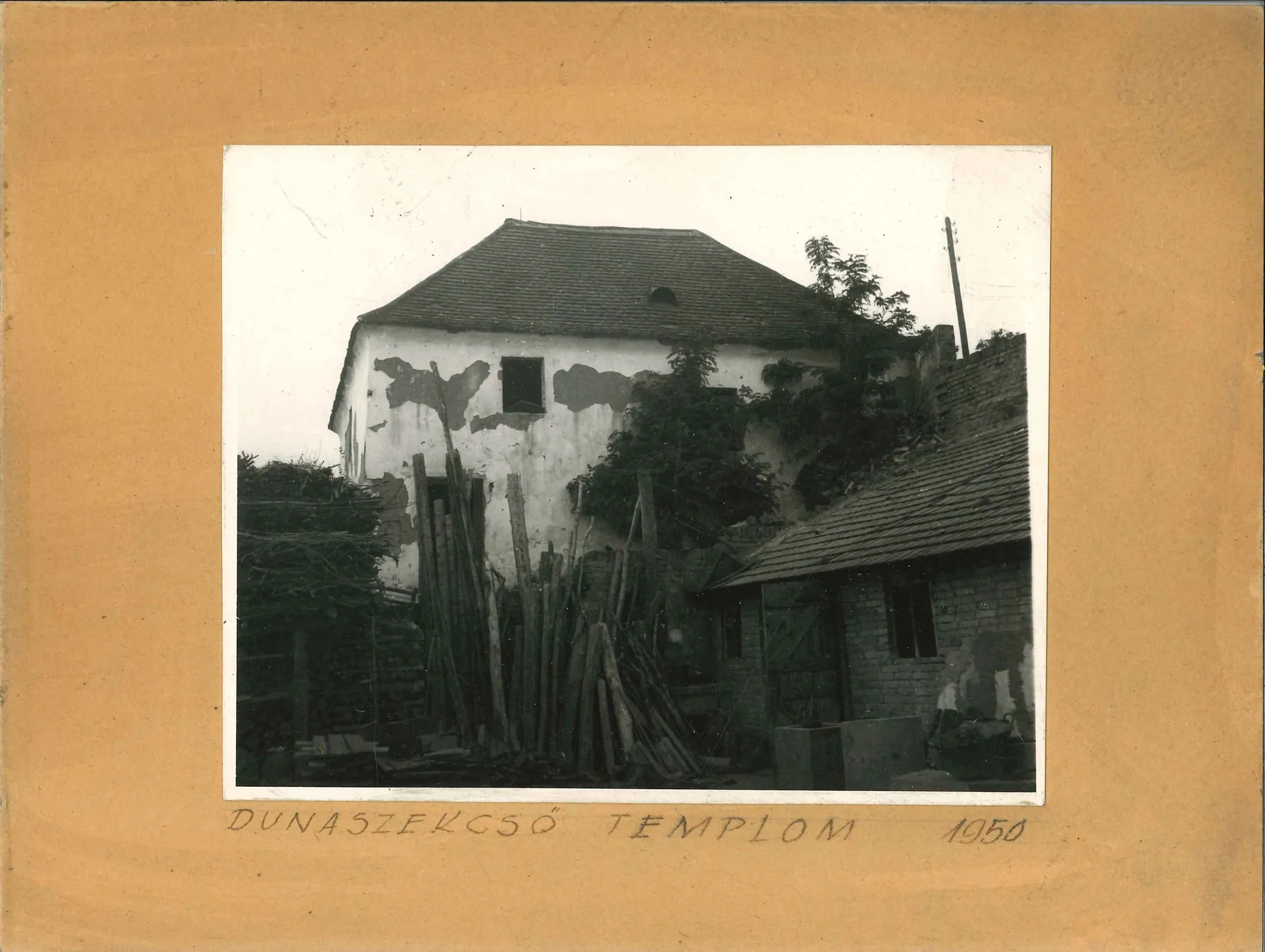
The synagogue is known from two kinds of evidence only. Gazda, who surveyed Hungary's synagogue sites between 1980 and 1987, classes the building as a synagogue and records it as demolished, but gives no building date. The Hungarian Jewish Museum and Archives holds a mounted photograph from its synagogue series, lettered 'Dunaszekcső templom 1950', which shows the building still standing but neglected five years after the war. No building date, architect, plan or interior view has been found, and the village has no entry in the 1929 Magyar Zsidó Lexikon that could be read in this research. The congregation ended in 1944, and the synagogue disappeared at some point between 1950 and Gazda's survey.
Where it stood
Historic: Dunaszekcső, Baranya county; street and house number unknown. Today: unknown; placeholder pin at the centre of 7712 Dunaszekcső, Baranya county (approximate).
Open larger map →The Jewish community
Nothing has been found about the founding of the Dunaszekcső community or its first members. The Jewish cemetery, which the JewishGen Cemetery Discovery Project dates to 1800, lies west of the village centre on an isolated wooded hillside and has a separate section for children and a pre-burial house with a tahara table and a hearse; its stones, of marble, limestone and sandstone, carry Hebrew and Hungarian inscriptions. The same survey describes the community as Neolog. Population figures are few. Gazda gives 84 Jews in 1910 and 52 in 1941, while the cemetery survey gives about 90 in the 1930s and 56 at the last census before the war, figures it does not reconcile. The Jews of Dunaszekcső were mostly tradespeople, and one of them owned the village brick works. The names of rabbis, cantors and community officers have not been found in the sources consulted, so it is unknown whether the congregation kept its own rabbi or was served from a larger neighbouring community such as Mohács.
Architecture and design
The only image found is the 1950 photograph in the Hungarian Jewish Museum and Archives. It shows a tall, free-standing, rendered building seen from a cluttered yard. It has a steep hipped roof of flat tiles with a small round-topped dormer opening in the slope. The render has fallen away in large patches from the upper wall, which has a single small rectangular window; a doorway at ground level is half hidden behind long timber poles stacked against the wall. Climbing plants and a young tree cover the right-hand part of the facade, and a low brick outbuilding with a tiled roof stands in front at the right, with a utility pole behind. Nothing in the picture shows tall arched windows, a gable front or Jewish symbols, so the view may be of a side or rear wall. The building looks like a plain village prayer house of vernacular construction rather than a designed monumental synagogue, but its date, architect, plan, seating capacity and interior are unknown.
Life inside the synagogue
No account of worship in the Dunaszekcső synagogue has been found. The JewishGen cemetery survey identifies the community as Neolog, which in Hungary meant the Congress branch formed after the national Jewish congress of 1868-69; Neolog congregations of this size usually held services in Hungarian-speaking surroundings and shared a rabbi with a larger town, but no source confirms how this congregation was organised. With some 50 to 90 members in the first half of the twentieth century, it would have been hard to gather a prayer quorum of ten men on ordinary weekdays, and the synagogue was probably most used on the Sabbath and the High Holidays. The community maintained its own cemetery with a burial house equipped for the ritual washing of the dead, which shows that a burial society existed. The names of its rabbis, cantors, teachers and officers, and whether the village ever had a Jewish school, are unknown.
Destruction
No source found records damage to the synagogue during the Second World War or names anyone who looted it in 1944. After the deportation of the congregation it stood empty. The photograph in the Hungarian Jewish Museum and Archives, lettered 'Dunaszekcső templom 1950', is mounted on an album page of the series in which the synagogues of provincial Hungary were recorded around 1949-50, and shows that the building survived the war: the roof was intact, but the render was falling off, the windows were empty, and timber poles and firewood were piled against its walls. Anikó Gazda recorded the building as demolished when she surveyed the sites between 1980 and 1987. It was therefore pulled down at some point between 1950 and the 1980s, under Communist rule. The date of the demolition, whether the building was first sold by the surviving Jews or the national Jewish office, and who demolished it are not recorded in any source consulted.
The community’s fate
Hungary was occupied by Nazi German forces on 19 March 1944, and that spring the Hungarian authorities, with the gendarmerie, concentrated the Jews of the provinces in ghettos. The sources consulted do not say where the Jews of Dunaszekcső were taken. The village lies in the Mohács district; according to a 2026 Telex article on the Pécs ghetto, the Jews of the Mohács ghetto and of several smaller nearby ghettos were moved to the Lakits barracks in Pécs at the end of June 1944, where about 4,000 people were gathered and deported to Auschwitz-Birkenau on 4 July 1944. Randolph Braham, however, writes that the Jews of Baranya living along the Drava were taken to Baja for entrainment, and Baja lies just across the Danube from Dunaszekcső, so the route is uncertain. In 1941 the village had 52 Jews. The number murdered is unknown. The JewishGen cemetery survey says that few returned after the war; the last burial in the cemetery was in 1945, and no organised community is recorded later.
The site today
The plot on which the synagogue stood has not been identified in any source consulted, so it is not possible to say what occupies it today. The 1950 photograph shows the building in a yard beside a brick outbuilding and close to other houses, but the album page gives no street name. No surviving fragment and no marker on the site are recorded. The map pin for this entry is a placeholder at the centre of Dunaszekcső and should not be read as the synagogue's location. The Jewish cemetery survives on a hillside west of the village; in 1991 it had no wall, gate or sign, many stones were toppled, and it is owned by the national Jewish community.
Do you have something to contribute?
Photographs, documents, family stories or memories of this synagogue and its community help keep its history alive.
- Zsinagógák és zsidó községek Magyarországon (Baranya county table)
- Dunaszekcső, zsinagóga (F16.026)
- Dunaszekcső Jewish cemetery (Cemetery Discovery Project)
- Ördögien megrendezett menet a halálba – így tűnt el Pécs zsidó közössége
- A népirtás politikája: a Holocaust Magyarországon, vol. 2
- Dunaszekcső
- Dunaszekcső (OpenStreetMap relation 575368)
Share a memory or thought
No comments yet. Be the first to add one.