
La historia de Dwingeloo Synagogue
Dwingeloo is a village in the south-west of Drenthe, in the present municipality of Westerveld. A few Jews lived there by about 1750, and in the French period, early in the nineteenth century, they formed an organised and officially recognised congregation of about ten families, half of them poor; the Jews of Beilen and Ruinen also belonged to it. In 1821 Dwingeloo became a subsidiary congregation (bijkerk) in the Ring of Hoogeveen.
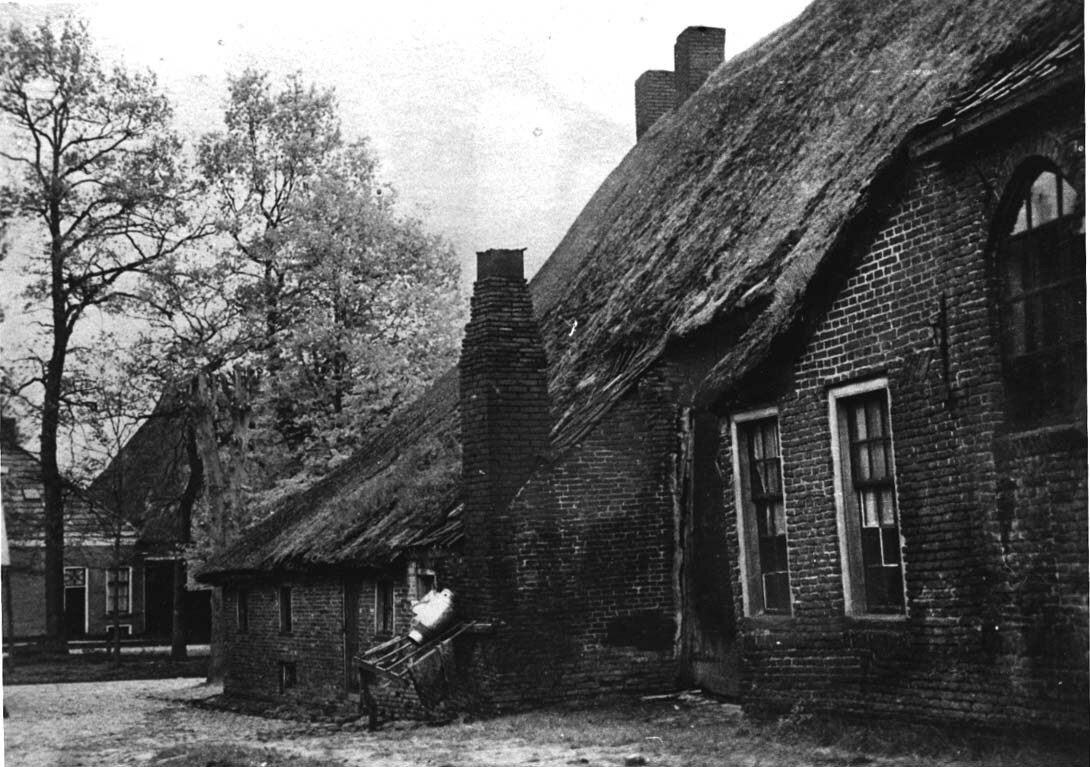
The congregation never had a purpose-built synagogue. Until 1835 services were held in a room of an inn; from 1835 the synagogue occupied a building that also housed a smithy. The Encyclopedie Drenthe gives a different early history, saying that Dwingeloo already had its own synagogue in 1811, located in a farmhouse. The prayer room was refurbished in 1846 and stayed in use until 1923, when a fire destroyed the building. The Encyclopedie Drenthe records that it burned together with a number of farmhouses and the Reformed Nicolaaskerk on the Brink. The community, by then very small, did not set up another synagogue. A photograph of about 1910 by E.J. Boneschanscher shows the building as a long, low thatched brick structure with a tall round-arched window in its end bay. Only the parochet, the curtain of the Torah ark, was saved from the fire.
Where it stood for nearly 90 years
Historic: Dwingeloo, Drenthe; street and house number unknown, probably near the Brink (inferred from the account of the 1923 fire). Today: placeholder pin on the Brink, 7991 Dwingeloo, municipality of Westerveld (approximate).
Abrir mapa ampliado →La comunidad judía
According to the Jewish Cultural Quarter's community encyclopedia, a few Jews were living in Dwingeloo around 1750, and by the French period at the start of the nineteenth century an officially recognised congregation existed. It then had about ten member families, half of them without means, and seven more families in Beilen and Ruinen belonged to it. The congregation counted 84 Jews in Dwingeloo and the surrounding area in 1809, 63 in 1840, 75 in 1869, 47 in 1899 and 21 in 1930. It reached its largest size around 1870 and shrank sharply from the beginning of the twentieth century until the Second World War. The Jews of Dwingeloo lived mostly close together and played no important part in the village's public life. From 1821 the congregation was a bijkerk, a subsidiary congregation without its own rabbi, in the Ring of Hoogeveen. From 1830 it had its own cemetery in the Dwingelerzand, also called the Dwingeler Duinen, which still exists.
Arquitectura y diseño
The synagogue was a prayer room in an existing building, not a purpose-built synagogue. The Jewish Cultural Quarter says it was housed from 1835 in a building that also sheltered a smithy, while the Encyclopedie Drenthe says the congregation had its own synagogue by 1811 in a farmhouse; whether these describe the same building is unknown. The only known photograph, captioned 'Synagoge in Dwingelo, ca. 1910', shows a long brick building under a steep, worn thatched roof, typical of rural Drenthe. At the right, a taller gabled end bay has two rectangular multi-pane windows and, higher up, a large round-arched window with glazing bars, the one feature that suggests a place of worship. A massive brick chimney stack rises in front of the lower wing, and a smaller chimney pair sits on the ridge. A milk churn rests on a rack by the wall and an unpaved lane runs past. The 1846 refurbishment is recorded but not described. Architect, builder, capacity and the interior arrangement are unknown.
La vida dentro de la sinagoga
Little is recorded about worship in the Dwingeloo synagogue. From 1821 it was a subsidiary congregation (bijkerk) in the Ring of Hoogeveen; the names of its rabbis, teachers, cantors or lay leaders were not found in the sources consulted. The only Jewish association in the village was the burial society, which cared for the dead and for the congregation's cemetery in the Dwingelerzand, in use from 1830. The prayer room was refurbished in 1846, when the congregation was still growing towards its peak of about 75 members around 1870. By 1930 only 21 Jews lived in Dwingeloo and its surroundings, and after the fire of 1923 no new synagogue was furnished. The ark curtain, the parochet, rescued from the burning building, is the only object from the synagogue known to survive. It was stolen during the Second World War, resurfaced in 2004 and was handed to the Jewish Historical Museum in Amsterdam.
Destrucción
The synagogue was destroyed by fire in 1923. The Jewish Cultural Quarter states simply that a fire destroyed the building in that year and that no new synagogue was set up afterwards. The Encyclopedie Drenthe adds that the synagogue burned down together with a number of farmhouses and the Reformed Nicolaaskerk on the Brink, which places the fire in the old village centre; the Reformed church is separately recorded as having been destroyed by fire in 1923, with only its walls left standing. No source consulted gives the exact date or the cause of the fire, and no source suggests it was set deliberately. Only the parochet was rescued. The remains of the synagogue were not rebuilt, and the small congregation, by then about twenty people, continued without a synagogue of its own.
El destino de la comunidad
By 1930 only 21 Jews lived in Dwingeloo and its surroundings. After the Nazi German invasion of the Netherlands in May 1940 they were subjected to the occupiers' anti-Jewish measures, and according to the Jewish Cultural Quarter almost all members of the Jewish community of Dwingeloo were deported during the occupation and murdered in the camps. The names of individual victims were not compiled for this entry, but the Joods Monument lists Jewish residents at addresses on the Brink, among them Mozes West and Jetje West-Zaligman at Brink 72 in February 1941. During the war the congregation's parochet, the one object that had survived the fire of 1923, was stolen; it reappeared in 2004 and was transferred to the Jewish Historical Museum in Amsterdam. The congregation did not revive after the war. In 1950 the Jewish community of Dwingeloo was officially dissolved and merged into that of Hoogeveen. Its cemetery in the Dwingelerzand survives and is maintained by the local council, though despite a request it has not been listed as a protected monument; its gravestones are recorded in the Stenen Archief.
El lugar hoy
The exact location of the synagogue has not been found in the sources consulted. The Encyclopedie Drenthe's account of the 1923 fire links it with farmhouses and the Reformed Nicolaaskerk on the Brink, the green at the heart of the old village, and the photograph of about 1910 shows it on an unpaved lane among trees and other thatched buildings, so it probably stood in or near the Brink area, but this is an inference. The Nicolaaskerk, rebuilt within its surviving walls, stands at Brink 29. No trace of the synagogue and no marker on its site is recorded. The Jewish cemetery in the Dwingelerzand is the community's only surviving site in the village.
¿Tiene algo que aportar?
Fotografías, documentos, historias familiares o recuerdos de esta sinagoga y su comunidad ayudan a mantener viva su historia.
Share a memory or thought
No comments yet. Be the first to add one.