
Die Geschichte von Egyek Synagogue
Egyek is a village in today's Hajdú-Bihar county; in 1944 it belonged to Hajdú county. Its Jewish community was small and late: according to the historical overview published by the ESJF European Jewish Cemeteries Initiative, the community bought a plot for a cemetery, founded a Chevra Kadisha burial society and opened a cheder in 1860. The census counted 124 Jews in 1880 and 142 in 1910, the highest figure on record. The synagogue was built in 1905, a date given both by the ESJF overview and by Anikó Gazda's gazetteer, which takes it from the Hungarian volume of Pinkas Hakehillot.
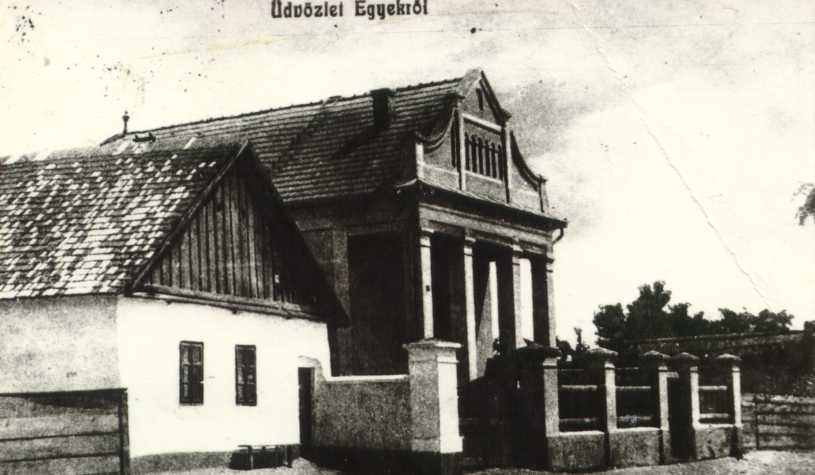
One picture of the building is known, a postcard captioned 'Üdvözlet Egyekről' in the Hungarian Jewish Museum and Archives. It shows a tall hall with a deep entrance porch and a shaped gable facing the street, behind a fence of masonry piers.
The congregation was Orthodox. By April 1944 it had 86 members and no rabbi; its president was Arnold Domán and its one employee was a caretaker, the timber merchant Dezső Horovitz. Later that year the Jews of Egyek were rounded up and deported. No source found says what happened to the empty synagogue. Gazda, who surveyed synagogue sites between 1980 and 1987, recorded it as demolished, and the ESJF overview says the same. When it was pulled down, and by whom, is unknown.
Where it stood for nearly 65 years
Historic: Egyek, Hajdú county; street and house number unknown. Today: unknown; placeholder pin at the centre of 4069 Egyek, Hajdú-Bihar county (approximate).
Größere Karte öffnen →Die jüdische Gemeinde
The ESJF overview says that most of Egyek's Jews lived from trade, that others were artisans, and that later some were farmers and private clerks. The community organised itself in 1860, when it bought land for a cemetery, set up a Chevra Kadisha and opened a cheder. There were 124 Jews among 3,639 inhabitants in 1880, 142 in 1910, 115 in 1920, 123 in 1930 and 107 among 7,473 inhabitants in 1941; Gazda's gazetteer gives the same figures for 1910 and 1941. The village had two Jewish cemeteries, an older one that already appears on the cadastral map of 1870 and a later one in the centre of the village. In the April 1944 survey of Hungarian Jewish communities Egyek appears as an Orthodox mother community of Hajdú county with 86 members, 20 of them taxpayers. Its president was Arnold Domán. It had no rabbi and no registrar rabbi, and its single employee was the caretaker Dezső Horovitz, a timber merchant. The Magyar Zsidó Lexikon of 1929 has no entry for Egyek.
Architektur und Gestaltung
The only view found is a postcard captioned 'Üdvözlet Egyekről', catalogued by the Hungarian Jewish Museum and Archives as the exterior of the Egyek synagogue. It shows the building from the street, at an angle. The synagogue is a tall rectangular hall under a steep tiled saddle roof with a chimney, standing with its narrow end to the street. That end is opened as a deep porch the full height of the wall, framed by slender pale piers with tall narrow openings between them and a strong projecting cornice above. Over the cornice rises a shaped gable: a rectangular centre panel pierced by a row of five narrow round-headed openings, flanked by concave curved shoulders that end in small piers, and crowned by a little triangular pediment. The walls look dark in the photograph, which may mean exposed brick, but the print is too coarse to be sure. A low whitewashed house with a boarded gable adjoins on the left, and a fence of capped masonry piers with a gate closes the yard. The architect, builder, seating capacity and interior are unknown.
Leben in der Synagoge
Very little is recorded about worship in the building. The congregation followed the Orthodox rite, and the April 1944 survey shows how it worked on the eve of its destruction. There was no rabbi; the accounts for the last closed year show 1,600 pengő spent on ritual staff out of total expenditure of 3,032 pengő, with 790 pengő going to charity, 400 pengő in national dues to OMZSA and 192 pengő to the upkeep of the community's property. Income of 3,070 pengő came from the religious tax (900 pengő), the gabella levy (1,500 pengő) and donations for national causes (670 pengő). The community held 38 pengő in cash. Beside the synagogue it had maintained a cheder and a burial society since 1860. The ESJF overview records that during the White Terror after the First World War Jewish shops in Egyek were smashed and stones were thrown at the synagogue. In 1938 the authorities withdrew the trade licences of Jews, closing the pub and the tobacco shop, and one Jewish shopkeeper was forbidden to sell sugar, flour and soap; later Jewish-owned land was expropriated.
Zerstörung
No source found describes the end of the building. The synagogue was attacked once before the Holocaust, when stones were thrown at it during the White Terror, but nothing suggests lasting damage. The April 1944 survey shows that the congregation was still paying for the upkeep of its property in the spring of 1944, so the synagogue was presumably standing when its members were rounded up for deportation later that year, under the Nazi German occupation of Hungary. What happened afterwards is not documented in anything read for this entry: whether the building was looted or damaged in 1944, whether returning survivors or the national Jewish office sold it, and whether a private buyer or a local council pulled it down are all unknown. Anikó Gazda, who inspected Hungarian synagogue sites between 1980 and 1987, classed the Egyek building as a synagogue and marked it as demolished. The ESJF survey of the village's cemeteries likewise states that the synagogue built in 1905 has since been demolished. The demolition therefore took place at some time between 1944 and 1987, and nobody is named as responsible.
Das Schicksal der Gemeinde
The census of 1941 counted 107 Jews in Egyek, and the community reported 86 members to the Central Council of Hungarian Jews in April 1944, after the Nazi German occupation of Hungary. Randolph Braham lists Egyek among the places in Hajdú county where Jews were rounded up in 1944 and notes that their names are printed in Gavriel Bar-Shaked's 'Nevek', a Yad Vashem volume on the Jews driven out of Hajdú county, published in 1991. Braham's account of the county describes the concentration of Jews at the Serly brickworks in Debrecen, from where 13,084 people were deported in the last days of June 1944, some trains going to Auschwitz and two to Strasshof in Austria. His main text does not name Egyek among the places brought to the brickworks, so the route taken by the Egyek families is not confirmed here. English Wikipedia states that most of the community was murdered in the Holocaust. The number of survivors is unknown, and no organised community is recorded after the war. The newest gravestone in the surviving cemetery dates from 1940.
Der Ort heute
The plot on which the synagogue stood has not been identified in any source read for this entry, so what occupies it today is unknown. The postcard shows the building on a village street beside a low house, but names no street. The map pin is a placeholder at the centre of Egyek and should not be read as the synagogue's location. The later of the village's two Jewish cemeteries survives at the corner of Tópart and Hunyadi János streets; it is fenced, its gravestones have been restored, and a Holocaust memorial was placed there in 2014. The older cemetery at 3 Árpád Street has been demolished and built over.
Bedeutende Namen
Arnold Domán
UnknownPresident of the Egyek Orthodox congregation, in office in April 1944Domán is named as president (elnök) of the Egyek mother community in the data sheet the congregation returned to the Central Council of Hungarian Jews in April 1944. He led a rabbi-less Orthodox community of 86 people and 20 taxpayers in the last weeks before its members were rounded up, and was responsible for the synagogue and a yearly budget of about 3,000 pengő. Nothing about his life or his fate was found.
Biografie oder Quelle →Dezső Horovitz
UnknownCaretaker (gondnok) of the Egyek congregation, in office in April 1944Horovitz, a timber merchant, is recorded in the April 1944 survey as the caretaker of the Egyek community and its only employee. With no rabbi in the village, he was the person who looked after the synagogue and the congregation's affairs in its final months. Nothing more about his life or what happened to him in 1944 was found.
Biografie oder Quelle →Haben Sie etwas beizutragen?
Fotos, Dokumente, Familiengeschichten oder Erinnerungen an diese Synagoge und ihre Gemeinde halten ihre Geschichte lebendig.
- Zsinagógák és zsidó községek Magyarországon (Hajdú-Bihar county table, PDF p. 28)
- Egyeki zsinagóga kívülről (postcard, inventory no. F71.123)
- Egyek Jewish Cemetery 1 (survey record with historical overview)
- Egyek Jewish Cemetery 2 (survey record)
- Magyarországi zsidó hitközségek 1944. április: a Magyar Zsidók Központi Tanácsának összeírása a német hatóságok rendelkezése nyomán, part A (entry 153, Egyek anyahitközség, p. 189)
- A népirtás politikája: a Holocaust Magyarországon, vol. 2 (Zone IV: Debrecen and Hajdú county)
- A népirtás politikája, vol. 2, p. 711 (endnote 58 to the Zone IV chapter)
- Pinkas Hakehillot Hungary (table of contents of the English translation project)
- Egyek
- List of synagogues in Hungary
- Egyek (OpenStreetMap relation 1607464)
Share a memory or thought
No comments yet. Be the first to add one.