
La historia de Eibergen Synagogue
Eibergen is a small town in the Achterhoek, the eastern part of the province of Gelderland, close to the German border. Jews settled there with some regularity from 1643, and by the late eighteenth century the community had a house synagogue and its own cemetery on a high bank of the Berkel, known locally as the Jodenbelt. In 1847 the congregation asked the municipality for a plot of land on the Hagen, beside the garden of A. Simmelink and bordering the Kerkenkamp. The request was granted in December 1847 and the new synagogue rose on the Kleine Hagen, at the end of the Klungelsteeg, in the middle of the village. It was inaugurated in August 1848 in the presence of more than seventy members.
The building served the congregation, which included the Jews of nearby Neede, until the German occupation. Requests to enlarge it were refused in 1875 and 1898; it was renovated in 1900, and a classroom and a ritual bath were added later. During the war its interior was wrecked and lost. The community was formally dissolved in 1947 and merged with that of Borculo. The building was sold, according to the Joods Cultureel Kwartier to the municipality, stood empty through the 1950s and was demolished in 1961.
Where it stood for 113 years
Historic: Kleine Hagen, at the end of the Klungelsteeg, Eibergen (house number unknown). Today: Kleine Hagen, 7151 BR Eibergen, municipality of Berkelland, Gelderland (approximate).
Abrir mapa ampliado →La comunidad judía
Jews are recorded in Eibergen from 1643, when they began to settle there with some regularity. In 1786 seven Jewish families paid the Jodentribuut, an annual tax levied on them by the town. The burial ground on the Rekkense Binnenweg, the Jodenbelt, was in use before 1756; in 1845 the Israelite community was recorded as owner of the high bank of the Berkel on which it lies. The congregation counted 33 people in 1797 and only 16 in 1809, but it grew through the nineteenth century: 52 in 1840, 84 in 1869 and 100 in 1899, its peak. In 1813 the small community of Neede was officially joined to Eibergen. Most families lived from trade. The best known was Kieuwe (Jules) Zion, born in Poland in 1838, who rented a textile shop in 1868 known as the Reddingsboot; it grew after 1880 into a department store, opened in 1928 and sold only in 1973. By 1930 the community had fallen to 42 people.
Arquitectura y diseño
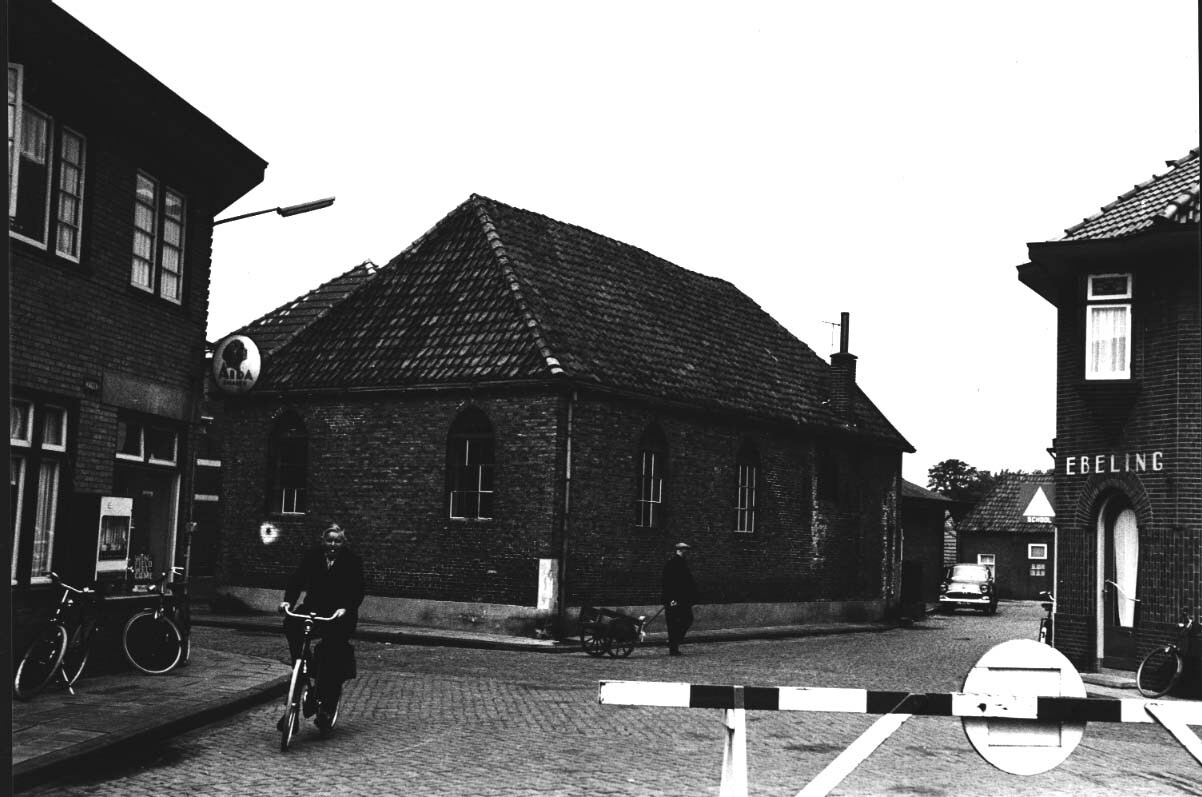
The synagogue was a free-standing, single-storey brick hall under a steep hipped roof of tiles, standing on a corner of the Kleine Hagen in the village centre. The building records summarised by the Akevoth archive note that its masonry walls were one and a half bricks thick. The only photograph found, taken around 1960, shows the long side wall with four tall round-headed windows, a narrower end front with a further round-headed window, a chimney on the ridge at the rear, and a lower annexe behind, probably the later classroom or ritual bath. The walls rest on a pale plinth and the building is set slightly back from the cobbled street behind a narrow pavement. There is no sign of a decorated facade, a gable inscription or a dome; it was a modest village synagogue. The congregation's requests to enlarge it in 1875 and 1898 were refused, and the renovation of 1900 kept the original shell. The architect, builder, seating capacity and interior layout are unknown, and no interior view was found.
La vida dentro de la sinagoga
The Akevoth summary of the community's history states that between 1813 and 1943 Eibergen employed twenty-four cantors and several Jewish teachers in succession. Religious lessons were given for most of that time, with short interruptions: none were held in 1864 and 1865, and after the departure of David Zion, a teacher from Poland who served for twenty-six years, no replacement was found until 1884. A classroom built onto the synagogue later housed the religious school, and a mikve was added for the women of the community. The congregation supported several associations. Ateres Bachoeriem, founded in 1884, helped the poor, the sick and the dying. The women's society Bigdei Koudesj looked after the interior of the synagogue. A study society also existed. The community was governed by a church board (kerkbestuur), whose chairman in 1914 is mentioned in connection with the cemetery, but no officer of the congregation is named in the sources read, and Eibergen never had a rabbi of its own.
Destrucción
The synagogue survived the war as a building, but not its contents. According to the Akevoth archive, it was desecrated by the Nazi German occupiers during the war, and afterwards very little could be saved; the Joods Cultureel Kwartier records that its interior was lost in the war. Neither source says when this happened, whether Dutch Nazis (NSB members) took part, or where the furnishings went. After liberation too few Jews remained to use it. The community was dissolved in 1947 and merged with Borculo, and the building was sold in 1952. The Joods Cultureel Kwartier states that it was sold to the municipality of Eibergen and then, in 1961, pulled down. A photograph of about 1960 shows it still intact, with its roof and windows complete, on the Kleine Hagen. No source read says why the municipality wanted the plot or names the firm that carried out the demolition; the building was municipal property when it was pulled down.
El destino de la comunidad
In 1930 Eibergen had 42 Jewish inhabitants. The Nazi German occupation of the Netherlands began in May 1940, and the occupiers' anti-Jewish measures reached this village congregation as they did every other. According to the Joods Cultureel Kwartier about half of the Jews of Eibergen were deported and murdered, while the other half survived by going into hiding. The Akevoth archive gives the figures as sixteen Jews of Eibergen deported and murdered and seventeen who went into hiding. The names of the victims, the dates of their deportation and the camps where they died were not established in the sources read. After the war most of the survivors moved to Borculo, and in 1947 the Eibergen congregation was formally dissolved and joined to the Borculo community. The Jewish cemetery on the Rekkense Binnenweg survives and is maintained by the municipality.
El lugar hoy
The synagogue stood on the Kleine Hagen, in the middle of Eibergen, at the end of the Klungelsteeg. No source read describes what was built on the plot after 1961 or gives a house number, so the exact footprint cannot be shown; the map pin marks the Kleine Hagen and should be read as approximate. No part of the building is known to survive. A monument to the deported Jews of Eibergen was unveiled in 1990. The Jewish cemetery, the Jodenbelt on the Rekkense Binnenweg, remains as the community's main physical trace and is cared for by the municipality of Berkelland, into which Eibergen has since been merged.
Nombres destacados
David Zion
UnknownTeacher (and probably cantor) of the Eibergen congregation for 26 years, before 1884The Akevoth history of the community names David Zion, a teacher who came from Poland, as the congregation's longest-serving teacher: he stayed for twenty-six years. After he left, Eibergen could not find a successor until 1884, so his service fell in the decades around the building of the synagogue in 1848, though his exact dates are not given. He is the only one of the community's twenty-four cantors and several teachers of 1813-1943 named in the sources read.
Biografía o fuente →¿Tiene algo que aportar?
Fotografías, documentos, historias familiares o recuerdos de esta sinagoga y su comunidad ayudan a mantener viva su historia.
Share a memory or thought
No comments yet. Be the first to add one.