

La historia de Eisenstadt Community Synagogue
Eisenstadt's Jewish quarter of Unterberg, at the foot of the Esterházy palace, was the seat of the largest of the Seven Communities (Sheva Kehillot) of present-day Burgenland. A fire on 10 July 1795 destroyed the old synagogue, a low building without a women's gallery, along with the community's other institutions. The growing congregation, which reached 908 people in 1836, decided to build a larger house of prayer 'in the modern style'. On 6 August 1832 Prince Paul Esterházy, son of Prince Nikolaus II, laid the foundation stone in a ceremony in the ghetto; the plans came from the princely court architect Charles Moreau, and the building was finished in 1834. Funds came from the sale of seats to members and from donations.
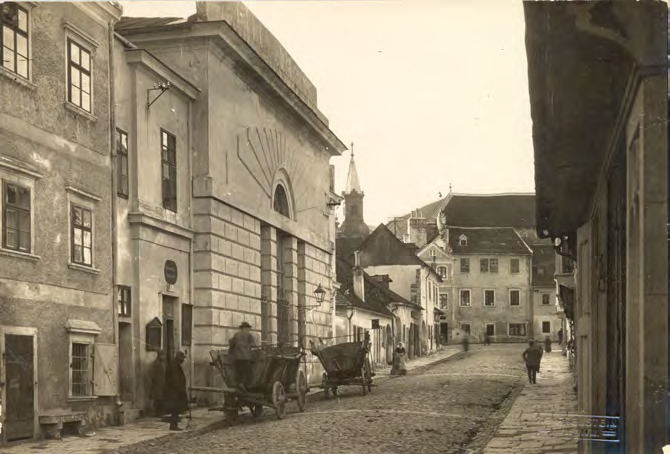
The synagogue stood at Unterbergstraße 17, built into the closed row of houses of the lower lane and joined to the community house. For a century it was the centre of religious and civic life in a community that kept its own municipal autonomy until 1938. It was not burned in November 1938, but its furnishings were destroyed. It survived the Nazi period as a store and was restituted to the Vienna Jewish community, which sold it in 1951 to the Austrian Trade Union Federation; the federation pulled it down that year.
Where it stood for 117 years
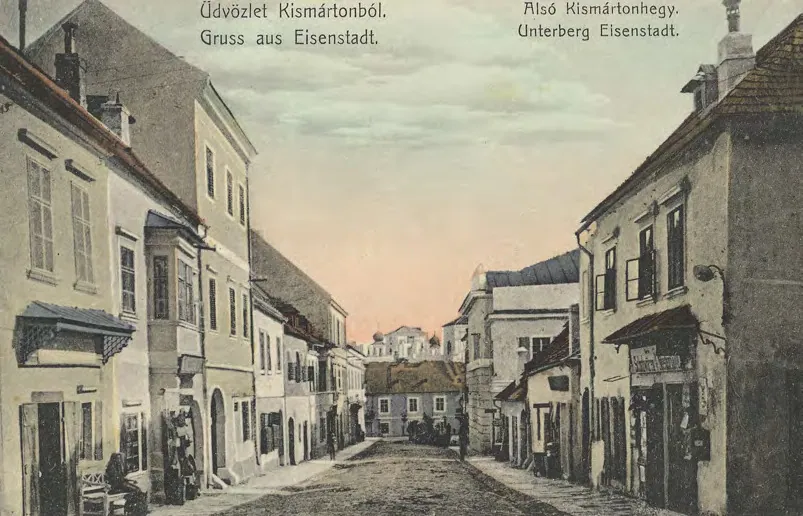
Historic: Unterberggasse (lower lane) of the Jewish quarter Unterberg-Eisenstadt, given as Unterbergstraße 17. Today: office building of an insurance company, Unterbergstraße 17, 7000 Eisenstadt. Pin approximate (street midpoint).
Abrir mapa ampliado →La comunidad judía
Jews settled in Unterberg under the protection of the Esterházy princes, who were the lords of Eisenstadt from the seventeenth century; the new quarter was founded in 1671 and received far-reaching rights of self-government in a charter of 1690. Under Rabbi Samson Wertheimer it became the head of the Seven Communities, and the eighteenth-century rabbi Meir ben Isaak (Mram Asch) made it a famous centre of learning. After 1848 the ghetto became a municipality of its own, entered in the land register as 'Eisenstadt Berg - Israelitengemeinde', and from 1871 it was the autonomous Großgemeinde Unterberg-Eisenstadt, the only Jewish community in Burgenland that remained a political municipality until 1938. In 1836, two years after the synagogue opened, 908 Jews lived in 191 households in 32 houses. The wine wholesale firm Leopold Wolf's Söhne, founded in 1790, was among the largest employers of the district, and the Wolf family led the community until 1938. In 1938 the community numbered 446 people.
Arquitectura y diseño
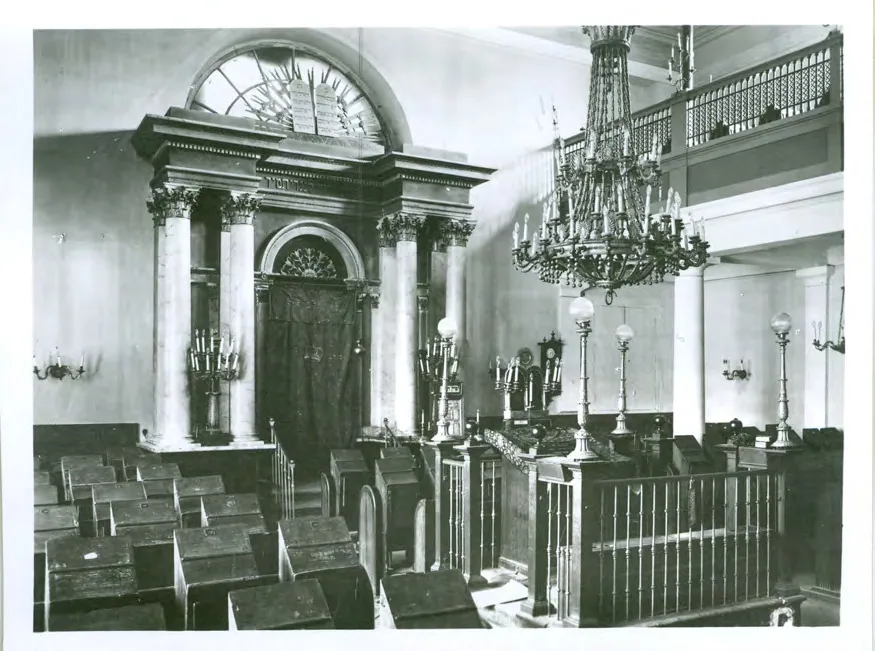
The synagogue was not free-standing. It joined the community house, which held the community offices, the yeshiva, the mikveh and the rabbi's flat, on its south and east sides, and its north front stood in line with the houses of the lower lane. The Neoclassical facade carried no inscription or emblem; only a weather vane on the ridge, bearing the year of construction, marked the building. A taller central section with a stepped attic was flanked by two lower wings containing the women's entrances. The ground floor of the centre had three tall rectangular window openings framed in rusticated blocks; above a continuous cornice was a large semicircular window ringed with radiating stones. The men entered from a narrow yard on the west through a vestibule. Inside, a women's gallery on Doric columns ran round three sides. The Torah ark, set against the south wall rather than the east according to the cadastral plans, had pairs of smooth marble columns with Corinthian capitals, a Hebrew inscription from Psalm 16:8 and the tablets of the Law above. The bimah, railed in wood, stood in the centre of the hall. No building plans survive.
La vida dentro de la sinagoga
The synagogue was known locally simply as 'die Schul'. Until the end of the nineteenth century the beadle walked from house to house five minutes before each service and knocked three times on a wooden board fixed to every door to call members to prayer, a custom that ended only in 1938. Every seat in the synagogue carried equal rights in community affairs, so it was also the community's assembly hall. Rabbi Isak Moses Perles insisted while it was being built that Christian craftsmen should not work on the Sabbath and Jewish festivals, and obtained the support of Rabbi Moses Sofer of Pressburg. From 1851 Rabbi Israel Hildesheimer shaped the congregation with his neo-Orthodox teaching and founded a yeshiva. A description of about 1908 mentions the vestibule with blessings for tallit and tefillin on parchment boards, a cupboard for worn holy writings, a wooden barrier behind which Christian pilgrims crowded to look in, and a silver ball over the door holding spare tzitzit. A large chandelier, a pendulum clock beside the ark and an underground treasury held the community's fifteen ark curtains and other ritual silver.
Destrucción
During the November Pogrom of 9-10 November 1938 a crowd armed with hooks forced its way into the synagogue and smashed the entire interior, including the great chandelier and the underground treasury, with its ark curtains, a Torah crown and books. A prospective buyer wrote in June 1940 that the temple had been damaged by Nazi SA men on 9 or 10 November 1938. Eyewitnesses reported that the building was not set on fire, probably for fear that the fire would spread to the neighbouring houses. Some valuables had been seized earlier by the Gestapo and passed to the Vienna Jewish community, where they disappeared in the pogrom. On 2 January 1939 the Niederdonau provincial authorities assigned the building to the Burgenland regional museum; the local Nazi party wanted it pulled down with the whole Jewish street. From May to August 1939 it housed a silkworm farm and later served as a Wehrmacht store. After 1945 it was restituted to the Israelitische Kultusgemeinde Wien, which sold the plot in 1951 to the Austrian Trade Union Federation (ÖGB); the federation demolished the building that year to build its new offices.
El destino de la comunidad
Immediately after the Anschluss in March 1938 the Nazi authorities in Burgenland, under Gauleiter Tobias Portschy, the Jewish affairs official Koch and the Eisenstadt Gestapo chief Bovensiepen, began driving the province's Jews out. From 26 March 1938 Jews were expelled; those living outside the ghetto were first forced into it, then expelled from Burgenland altogether, most to Vienna. By October 1938 no Jewish community existed in Burgenland any more, and in December the Nazi Grenzlandzeitung reported that the Jews had left. According to a list of the Vienna Jewish community, 446 Jews lived in Eisenstadt in 1938 and 441 were expelled; three were allowed to stay and two died before the expulsion. Only one is known by name, the 72-year-old former wine merchant Samuel Ungar, who died destitute in 1941 in the house at number 14 in the upper lane. Burgenland Jews were among those deported from Vienna from 1939 and in the large transports from autumn 1941. About 250 of Eisenstadt's Jews survived; only two or three families returned after 1945, and the community was never re-established.
El lugar hoy
The Austrian Trade Union Federation built new offices on the site, opened on 24 May 1952. Today an insurance company's office building stands where the synagogue stood, on Unterbergstraße in the former Jewish quarter, whose L-shaped row of nineteenth-century facades largely survives. Nothing of the synagogue itself is recorded as surviving except its foundation stone, which is kept in the Burgenland regional museum (Landesmuseum). A plaque on the facade of the present building records that the synagogue of the destroyed community of Unterberg-Eisenstadt stood here. A few doors away, the private synagogue in the Wertheimer house survives and is part of the Austrian Jewish Museum.
Nombres destacados
Charles Moreau
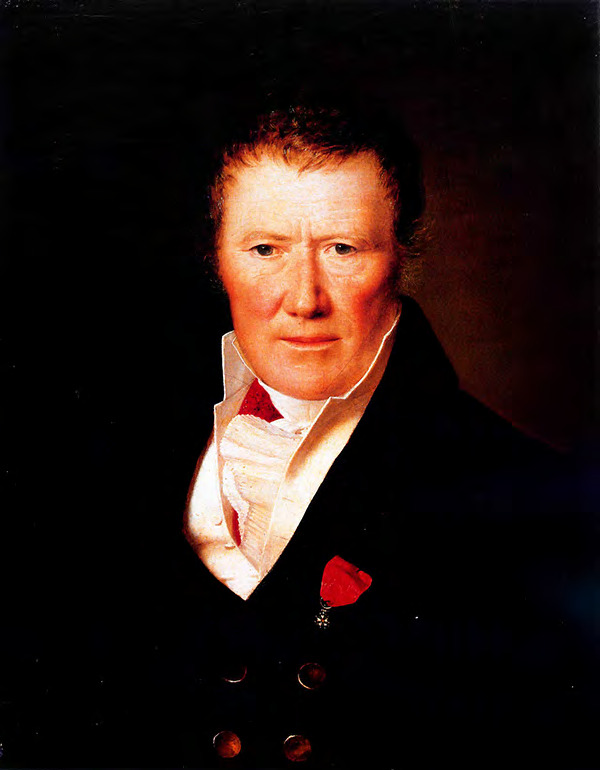
born 1760Architect of the synagogue, court architect of the Esterházy princesCharles-Jean-Alexandre Moreau, born at Rimaucourt in France in 1760, won the Grand Prix d'Architecture in 1785 and entered the service of Prince Nikolaus II Esterházy in 1803, remodelling the Eisenstadt palace and its park. He also worked on several Vienna buildings, including the Palais Palffy and the National Bank. In 1832 he was commissioned to design Unterberg-Eisenstadt's new community synagogue, completed in 1834 to his plans.
Biografía o fuente →Isak Moses Perles
born 1784Rabbi of Eisenstadt 1821-1840Born in Uherský Brod in Moravia, Perles was rabbi at Holics before coming to Eisenstadt in 1821. He was rabbi when the synagogue was built in 1832-1834 and forbade Christian craftsmen to work on it on the Sabbath and Jewish holidays, a ruling criticised in the community but backed by Rabbi Moses Sofer of Pressburg. He left his post in 1840 after a conflict with Leopold Wolf over a ban on card-playing.
Biografía o fuente →Israel (Azriel) Hildesheimer
born 1820Rabbi of Eisenstadt 1851-1869Born in Halberstadt in 1820 and educated in Altona and Berlin, Hildesheimer was called to Eisenstadt in 1851 and preached in this synagogue for eighteen years. He shaped the congregation with his neo-Orthodox programme, combining traditional learning with secular studies, and founded a yeshiva that became widely known. Caught between Hungarian Orthodox and Neolog factions, he left in 1869 for Berlin, where he founded a rabbinical seminary.
Biografía o fuente →Alexander (Sándor) Wolf
1871 or 1887-1946Wine merchant, collector and leading member of the communityA partner in the family wine firm Leopold Wolf's Söhne, whose family house stood beside the synagogue, Wolf was a scholar of art history and archaeology and built up a collection of about 6,000 objects, much of it Judaica, shown in his private museum at the edge of the ghetto. He was made honorary conservator for Burgenland in 1925. After his property was seized in 1938 he fled to Palestine and died in Haifa in 1946.
Biografía o fuente →¿Tiene algo que aportar?
Fotografías, documentos, historias familiares o recuerdos de esta sinagoga y su comunidad ayudan a mantener viva su historia.
Share a memory or thought
No comments yet. Be the first to add one.