
The story of Erdőbénye Synagogue
Erdőbénye is a wine village in the Tokaj-Hegyalja region of Borsod-Abaúj-Zemplén county. Jews settled there as leaseholders from the early eighteenth century, and by 1880 the Orthodox community numbered 332 people, about a sixth of the village. Its synagogue stood on what is now Hunyadi János Street, formerly Iskola (School) Street. According to the Zemplén Jewish heritage website, which draws on Viktor Cseh's 2021 survey of provincial communities, it was built around 1840 in Neoclassical style, burned in 1903 and was rebuilt with donations from the Jewish communities of the surrounding settlements.
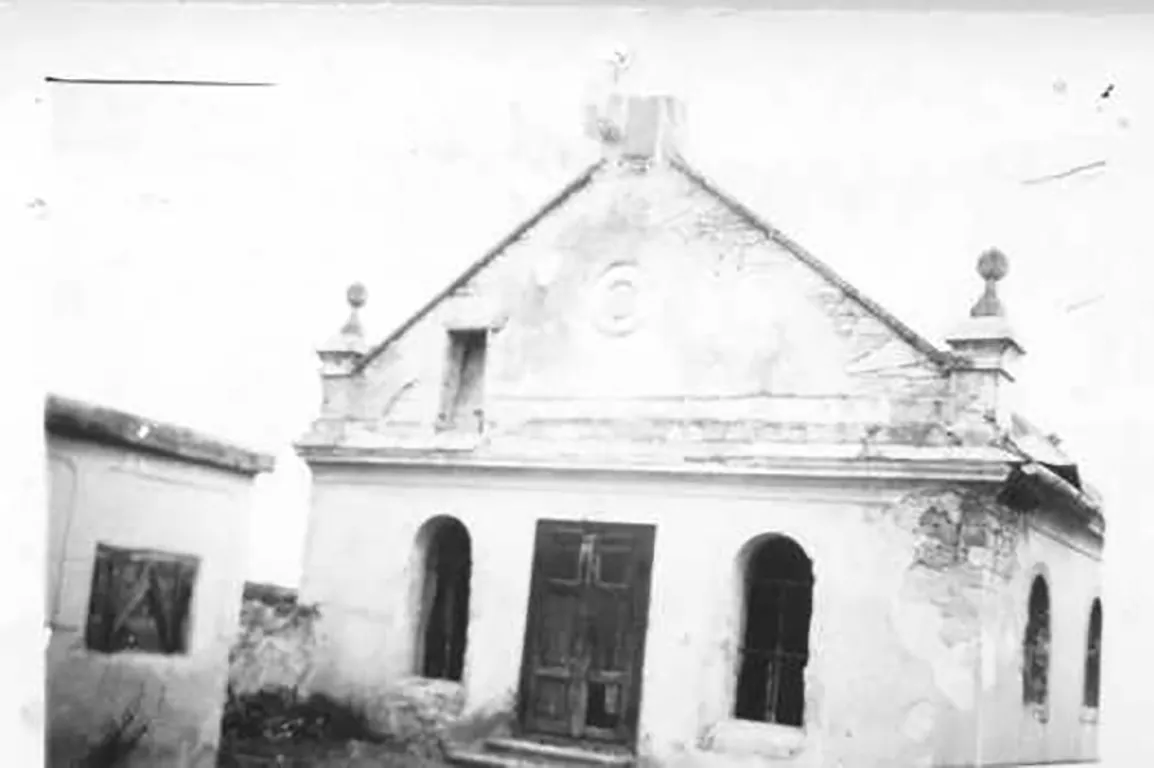
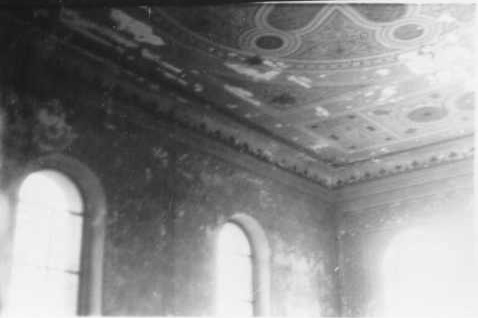
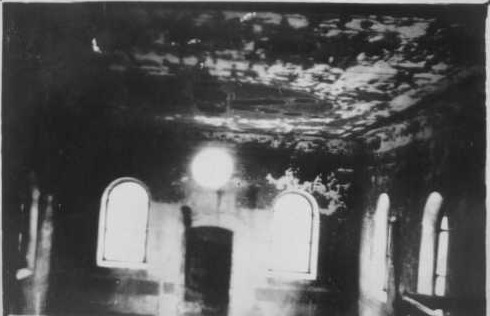
The only views found are small photographs that the Erdőbénye community gave to the Hungarian Jewish Museum in 1960. They show a gabled, rendered hall with ball finials at its corners and a painted ceiling, already derelict, with plaster falling from the walls and ceiling. The congregation had been destroyed in 1944, when the village's 120 Jews were taken through the ghettos of Tokaj and Sátoraljaújhely to Auschwitz.
Anikó Gazda, who surveyed Hungarian synagogue sites between 1980 and 1987, recorded the Hunyadi Street synagogue as demolished, and the heritage website dates the demolition to the second half of the 1980s. No source found says who pulled it down. The community's former school and house of study at Hunyadi Street 32 still stands, converted into a dwelling.
Where it stood
Historic: Iskola utca (later Hunyadi utca), Erdőbénye, Zemplén county; house number unknown. Today: Hunyadi János utca, 3932 Erdőbénye, Borsod-Abaúj-Zemplén county; pin placed at Hunyadi utca 32, the surviving former Jewish school on the same street (approximate).
Open larger map →The Jewish community
Jews came to Erdőbénye as leaseholders in the early eighteenth century, and their numbers grew after Galicia came under Habsburg rule in 1772 and after Joseph II's regulation on the Jews of 1783. Only six Jewish heads of family were recorded in 1840, but by 1880 the Orthodox community had 332 members, 16 percent of the village. It then shrank: Gazda's gazetteer gives 267 Jews in 1910, the heritage website 214 in 1920 (9 percent), JewishGen 153 in 1930, and the 1941 census counted 131 (4.2 percent), eight of whom gave Yiddish as their mother tongue. The community was closely tied to the Hasidic court of nearby Olaszliszka and for a time formed part of its congregation. Members included the quarry owner Sámuel Beck, who paid for the village's Kossuth statue, his son-in-law and successor Jónás Spitzer, the stonemason Márkusz Ábrahám Kőgel, who carved most of the stones in the Jewish cemetery, and Dávid Jichák Teitelbaum, a wine merchant from the Teitelbaum rabbinical family. When a spa opened at the village's mineral springs in the late nineteenth century, the community ran a kosher kitchen for its Jewish visitors.
Architecture and design
The Zemplén heritage website describes the synagogue as Neoclassical, built around 1840 and rebuilt after the fire of 1903; how much of the first building survived the fire is unknown. A photograph given to the Hungarian Jewish Museum in 1960 shows the entrance front: a rendered hall under a pitched roof, its gable treated as a triangular pediment above a moulded cornice. A round medallion sits at the centre of the pediment, with a small rectangular opening to one side. The corners of the front end in short piers carrying ball finials on pedestals, and the remains of another ornament stand at the apex. Below, a panelled double door reached by steps is flanked by two round-arched windows, and more round-arched windows run along the side wall. Two interior photographs show a rectangular hall with a flat ceiling painted with roundels and scalloped bands above a decorated cornice, and an end wall with a dark central feature between two arched windows and a round window above it. The architect, the builder, the seating capacity and the arrangement of the women's section are unknown.
Life inside the synagogue
The congregation was Orthodox and stood in the orbit of Liska (Olaszliszka) Hasidism. Its best-known rabbi, Chaim (Hájim) Friedlander, was the son-in-law of Tzvi Hirsh Friedmann, the 'wonder rabbi' of Olaszliszka; he was rabbi of Erdőbénye before he succeeded his father-in-law at Liska in 1874, and was remembered as a scholar and a preacher with a fine voice. On the same street as the synagogue the community kept a school and house of study. The Hungarian Jewish Museum records that this building, though older, was dedicated as a Jewish school in 1884 according to the Hebrew inscription 'Beit Midrash' on its surviving front; in 2025 its owner gave the museum a metal wall candle-holder marked with a six-pointed star, found when the building was turned into a flat, together with three prayer books. A ritual bath on Serház Street was fed by spring water, as religious law requires, and is still known locally as the Fuchs house after its former attendant. The community buried its dead in its own cemetery on what is now Petőfi Street. The names of the congregation's later rabbis, cantors, teachers and presidents were not found.
Destruction
No source found records damage to the synagogue in 1944 or during the fighting that followed. After the deportations it was left without a congregation; the Jewish Photo Archive notes that it was abandoned after the Second World War because so few members survived. Photographs that the Erdőbénye community gave to the Hungarian Jewish Museum in 1960 show it derelict, with plaster fallen from the façade and large patches of the painted ceiling gone. Anikó Gazda, who inspected synagogue sites across Hungary between 1980 and 1987, marked the Hunyadi Street synagogue as demolished, while the Zemplén Jewish heritage website says it was taken down in the second half of the 1980s. Read together, the two statements point to a demolition in the mid-1980s, in the last years of Communist rule, but that is an inference and no document of the demolition was found. None of the sources says who ordered or carried out the work, whether the building had been sold beforehand, or what became of its fittings.
The community’s fate
In the spring of 1944, during the Nazi German occupation of Hungary, 120 Jews were living in Erdőbénye. They were taken first to the ghetto at Tokaj and then to the ghetto and collection camp at Sátoraljaújhely, the county seat. Randolph Braham lists Erdőbénye among the Zemplén communities concentrated there, about 15,000 people in all, in an operation directed by the deputy county prefect, Miklós Bornemisza. He records four transports from Sátoraljaújhely: 3,500 people on 16 May, 3,500 on 22 May, 4,000 on 25 May and the remainder on 3 June 1944. The Erdőbénye Jews were deported to Auschwitz. The names of 108 of them are on the martyrs' memorial in the Jewish cemetery of Miskolc, and according to the Zemplén heritage website barely a dozen of the deportees survived the war. A few returned to the village: the last Orthodox burial in the Jewish cemetery took place in 1950, and a community body still existed in 1960, when it gave photographs of the synagogue to the Jewish Museum in Budapest. No Jews live in Erdőbénye today.
The site today
The synagogue no longer stands. Its plot was on Hunyadi János Street, formerly Iskola Street; no source consulted gives its house number or says what occupies the plot today, and no marker on the site is recorded. The nearest surviving trace is the former Jewish school and house of study at Hunyadi Street 32, now a private dwelling, and the map pin is placed there. Elsewhere in the village the former ritual bath on Serház Street survives as a private house, its pool filled in after the Second World War, and the Jewish cemetery, an enclosed section of the municipal cemetery at Petőfi Street 13, is kept in good order. Three Jewish residents are named in the village's memorial park of notable inhabitants, created in 2008.
Notable names
Chaim (Hájim) Friedlander
1835 or 1840-1904Rabbi of Erdőbénye before 1874; afterwards Lisker Rebbe at OlaszliszkaFriedlander was rabbi of Erdőbénye before 1874. He was the son-in-law of Tzvi Hirsh Friedmann, the Hasidic 'wonder rabbi' of nearby Olaszliszka, a tie that bound the two congregations, and when Friedmann died in 1874 he succeeded him as Lisker Rebbe. He wrote the homiletic work Tal Chaim and was known as a scholar and a preacher with a fine voice. Sources give his birth as 1835 or as 1840 at Kisvárda; he died in 1904.
Biography or source →Sámuel Beck
UnknownQuarry owner; leading member of the Erdőbénye Jewish communityBeck owned the stone quarry at Erdőbénye and was a prominent member of the Jewish community in the years when the synagogue was in use. He paid for the erection of the village's Kossuth statue. His son-in-law Jónás Spitzer, also of the community, carried on the business after him. Both men are named in the Memorial Park of Famous Erdőbénye Residents, created by villagers in 2008. His dates and any office he held in the congregation were not found.
Biography or source →Dávid Jichák Teitelbaum
c. 1850-1917Wine merchant and Torah scholar; member of the congregationA descendant of the Teitelbaum rabbinical family of Sátoraljaújhely, he lived in Erdőbénye and linked its congregation with that town's community. The inscription on his gravestone in the Erdőbénye Jewish cemetery says that he traded in wine alongside his study of the holy books and supported his family modestly from that income. The heritage website gives his birth as about 1850 and his death as 1917.
Biography or source →Márkusz Ábrahám Kőgel
UnknownStonemason; member of the Erdőbénye Jewish communityKőgel was a stonemason and a member of the Erdőbénye Jewish community. According to the Zemplén Jewish heritage website he carved most of the gravestones in the village's Jewish cemetery, so his work is the main physical record left by the congregation that worshipped in the synagogue. He is one of three Jewish residents named in the village's memorial park of notable inhabitants, created in 2008. His dates are unknown.
Biography or source →Do you have something to contribute?
Photographs, documents, family stories or memories of this synagogue and its community help keep its history alive.
- Erdőbénye (Jewish monuments of Zemplén), Hungarian page
- Erdőbénye (Jewish monuments in Zemplén), English page
- Zsinagógák és zsidó községek Magyarországon (Borsod-Abaúj-Zemplén county table, PDF p. 22)
- Erdőbényei zsinagóga (photograph F70.117)
- Erdőbényei zsinagóga belső képe (photographs F70.118.1-2)
- Erdőbényei izraelita imaház tornáca (photograph F70.119)
- Erdőbényei zsidó iskola megmaradt tárgyai (objects 2025.156.a-b)
- Erdőbénye, zsinagóga (photo 7544)
- Erdobenye.jpg (synagogue picture in the Flódni catalogue)
- A népirtás politikája: a Holocaust Magyarországon, vol. 1, p. 569 (Sátoraljaújhely)
- Erdőbénye (Cemetery Discovery Project record)
- Liska (Hasidic dynasty)
- Erdőbénye
- List of synagogues in Hungary
- Hunyadi utca 32, 3932 Erdőbénye (point address geocode)
- Hunyadi János utca, Erdőbénye (OpenStreetMap way 102987477)
Share a memory or thought
No comments yet. Be the first to add one.