
История Eshtemoa Synagogue
Eshtemoa, a biblical town of Judah, lies under the modern village of as-Samu' in the south Hebron Hills, south of Hebron in Judea and Samaria. In the fourth century CE Eusebius called it a large Jewish village. Its synagogue stood at the highest point of the village. L. A. Mayer and A. Reifenberg found a tall standing wall there in November 1934 and dug in 1935 and 1936, until the Arab revolt stopped the work. Ze'ev Yeivin excavated it systematically in 1969 and 1970, after houses that had been built against and inside the walls were removed.
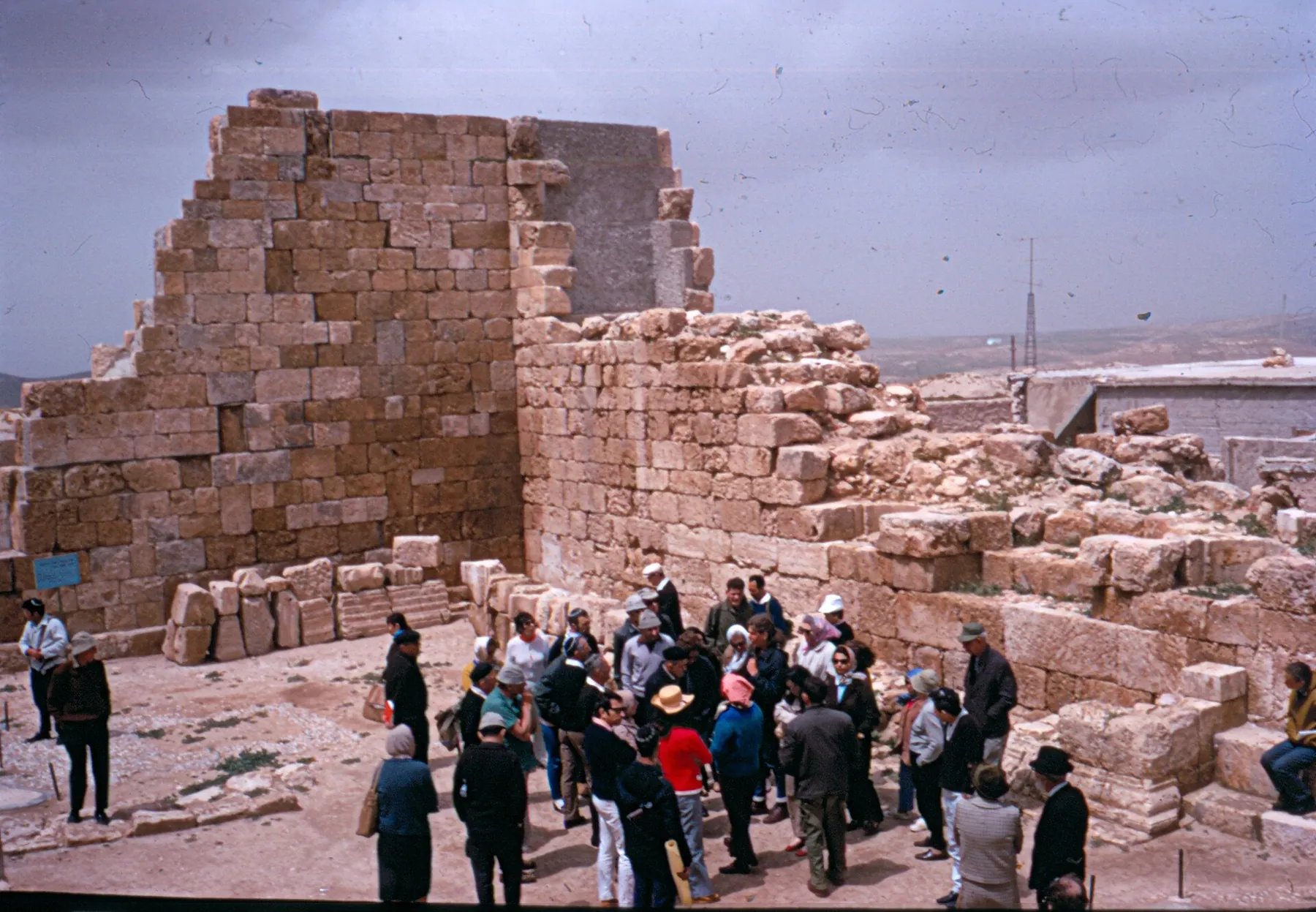
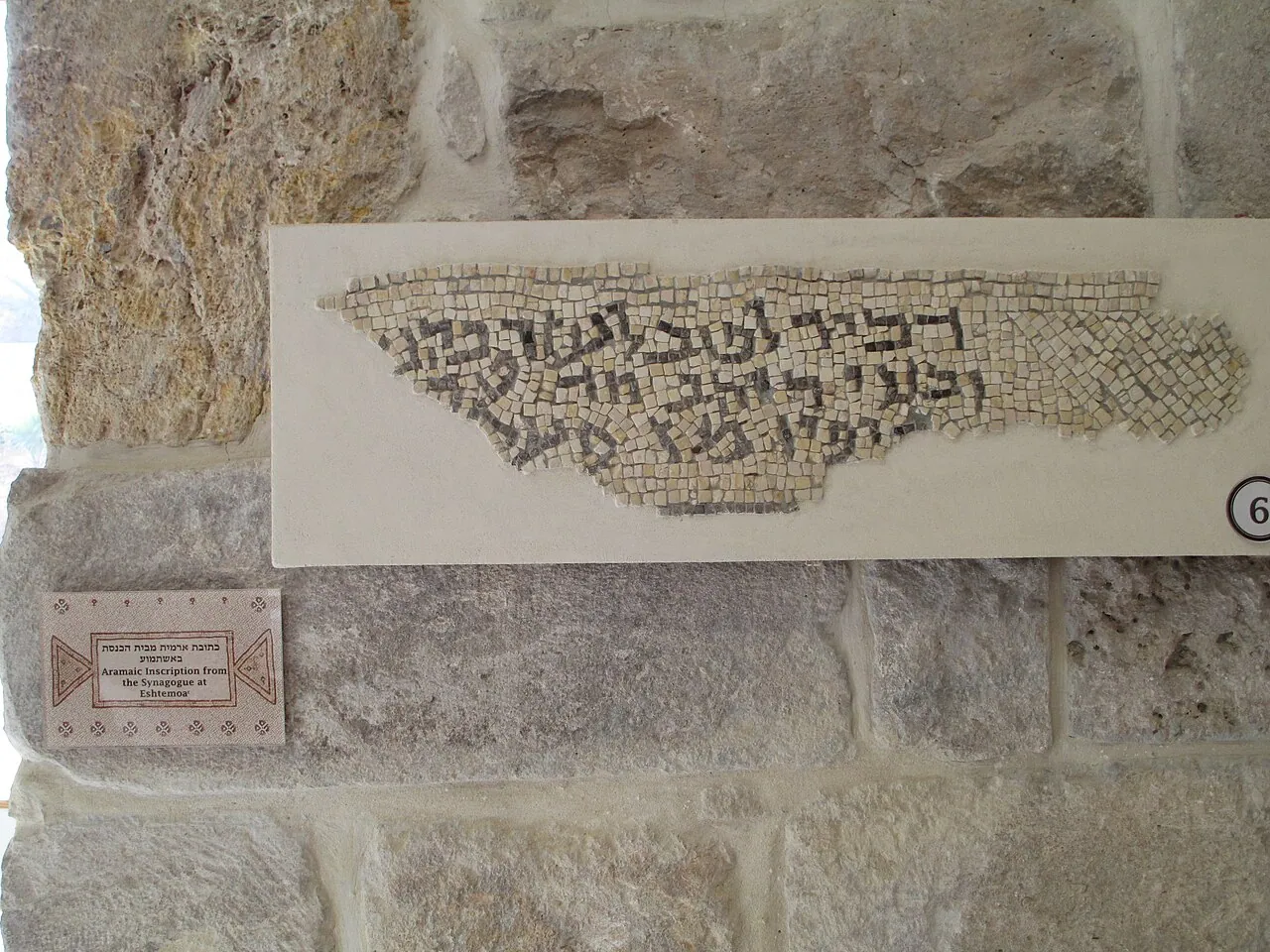
The building is a broadhouse: a single wide hall, entered from the east through a porch, with the Torah niche in the long north wall facing Jerusalem. This plan differs from the Galilean synagogues and is shared by other synagogues of the south Hebron Hills, such as Susiya. The date is disputed. Yeivin, writing on the 1969 excavation, placed its founding in the late second or early third century CE on the evidence of pottery under the mosaic floors; other scholars date it to the fourth or fifth century. An Aramaic mosaic inscription names Eleazar the priest and his sons as donors. At an unknown date the hall stopped serving as a synagogue, was partly demolished and was turned into a mosque. Its western wall still rises about 8.5 metres.
Where it stood
Historic: highest point of ancient Eshtemoa. Today: ruin in the centre of as-Samu', beside the as-Samu'–Yatta road, south Hebron Hills, Judea and Samaria (approximate).
Открыть большую карту →Еврейская община
Little is known about the Jews who built and used the synagogue beyond what the building itself records. Eusebius of Caesarea, in the fourth century CE, described Eshtemoa as a large village of Jews in the district of Eleutheropolis (Beth Guvrin). The town also appears in a story in the Jerusalem Talmud about a sage visiting a man called Hasa of Eshtemoa. The dedicatory mosaic in the porch shows that the community included priestly families with money to give: Eleazar the priest and his sons paid one trimisis, a third of a gold dinar, towards the building. Eshtemoa belonged to a cluster of Jewish villages of the late Roman and Byzantine south Hebron Hills, together with Susiya and Ma'on, whose synagogues share features with this one. The size of the congregation, its leaders and its religious officials are unknown, and no source consulted says when or why the Jewish population left Eshtemoa.
Архитектура и дизайн
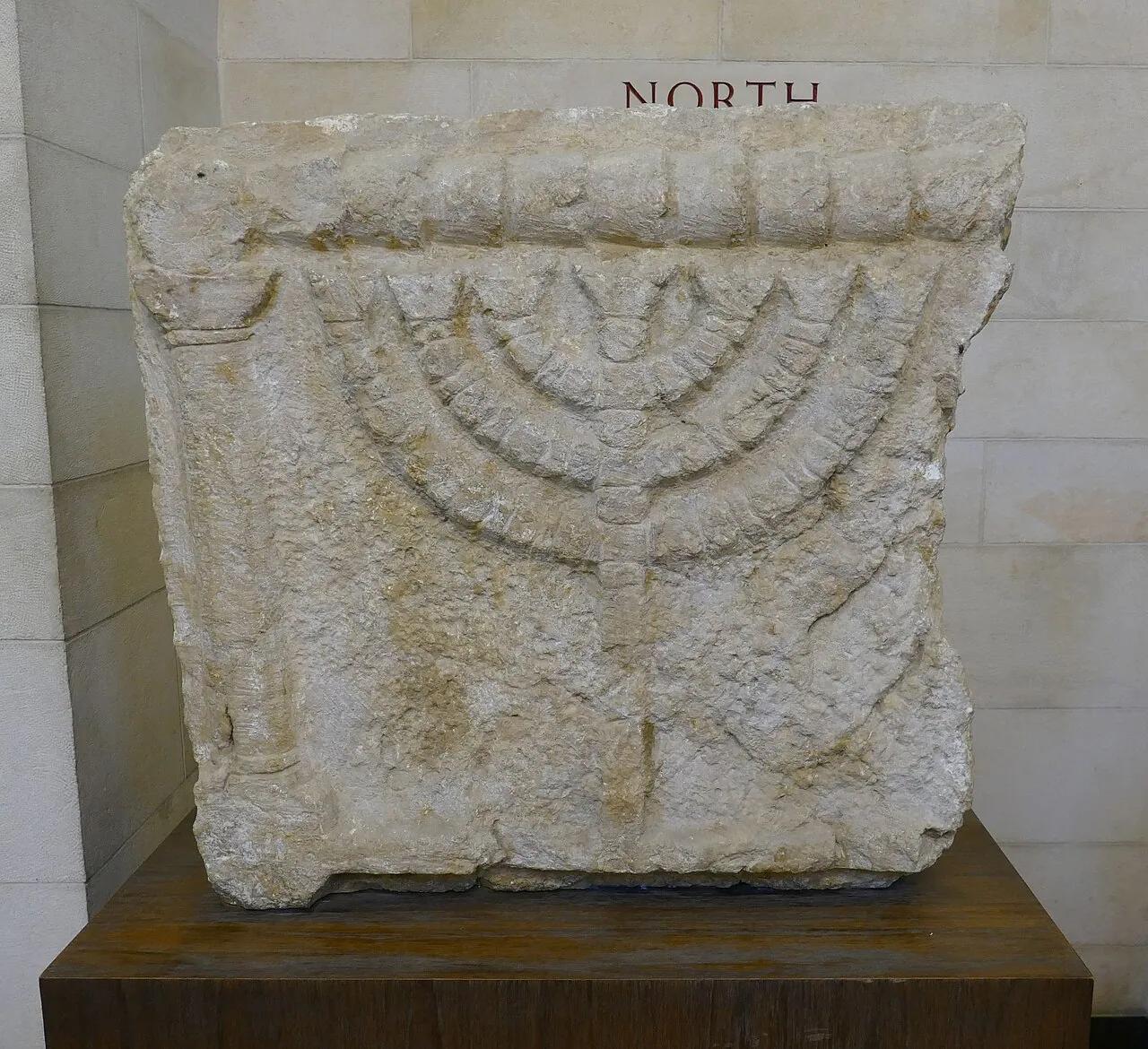
The synagogue is a rectangle oriented roughly east to west, about 27.5 by 17 metres outside including the porch; the hall inside measures about 21 by 10.8 metres. It is a broadhouse with no interior columns. Three doorways in the east wall, the central one wider, open from a porch reached by three broad steps; the porch roof rested on columns between two large pillars. The north wall, about 3.2 metres thick, holds three raised niches about 2 metres above the floor: a wide central one, about 2.1 metres across, probably for the Torah ark, and two narrow ones that probably held seven-branched lampstands. A bema about 6.25 metres long projected in front of them, and two tiers of benches ran along the north and south walls. The floors were mosaics with geometric designs, and the porch had a vine scroll with medallions. Carved lintels with menorahs, rosettes, cornices, Corinthian and Ionic capitals and a shell-headed niche were found, many reused in village houses. The architect is unknown.
Жизнь в синагоге
The building's furnishings show how worship was arranged. The congregation faced north, towards Jerusalem, where the central niche in the long wall is thought to have held the Torah ark, flanked by two smaller niches that probably held stone menorahs; fragments of marble or stone menorahs, one with lions, were found in the excavations. The bema in front of the niches was reached by steps and carried a carved inscription that has been read only in part; Yeivin's reading mentions a name, possibly Lulia, and the word bema, and ends 'amen, amen'. Worshippers sat on two tiers of stone benches along the side walls. In the porch, a three-line Aramaic mosaic inscription at the foot of the southern column remembered Eleazar the priest and his sons for their gift of one trimisis. At least four door lintels were carved with seven-branched menorahs. Nothing is recorded about the rabbis, prayer customs or daily life of the congregation.
Разрушение
No source consulted records a violent destruction. Yeivin's report says only that the building went out of use and was partly demolished, after which the remains were altered; it gives no cause such as earthquake or fire. In the Islamic period the hall became a mosque: a semicircular mihrab was cut into the southern wall through the mosaic floor, and partition walls divided the hall into rooms. The date of this conversion is disputed. Mayer and Reifenberg proposed the Umayyad period (7th–8th century), Robert Schick suggests the tenth century, and local tradition links it to Saladin in the twelfth. Later, village houses were built against and inside the walls, and many carved stones from the synagogue were reused in buildings across as-Samu'. In modern times the site has been vandalised: swastikas were sprayed on it in May 2014, and on 26 September 2024 a fire was set in the ruins, which the Mount Hebron Regional Council head called terrorism; police said they were checking the incident.
Судьба общины
What became of the Jews of Eshtemoa is not recorded in the sources consulted. Eusebius still knew it as a large Jewish village in the fourth century, and the synagogue's mosaics were repaired with larger white stones at a later stage, which shows the building stayed in use for some time. By the time the hall was converted into a mosque, at a date between the seventh and twelfth centuries, Jewish worship there had ended. Whether the community dwindled through gradual migration, conversion or the wider decline of Jewish settlement in the southern Judean hills in the late Byzantine and early Islamic periods cannot be said from the evidence read for this entry. No Jewish community lived at Eshtemoa in later centuries; the Arab village of as-Samu' grew over the ancient town.
Место сегодня
The synagogue survives as a roofless ruin in the centre of as-Samu'. Its western wall is the best preserved: about 8.35 metres high when measured in the 1930s and about 8.5 metres in Yeivin's report, and it is visible from the village's main street. The north wall stands about 2 to 4 metres, the east facade 2 to 3 metres with its three doorways, and the south wall about 1 metre or less. The walls are original ancient masonry, reinforced in 1969, when later houses were cleared and the site was prepared for visitors. Patches of mosaic, the niches and bench remnants remain. Two menorah lintels are in the Rockefeller Museum in Jerusalem. The site lies in an area under Palestinian Authority civil control.
Значимые имена
Eleazar the priest
Unknown (Roman or Byzantine period)Donor, named in the porch mosaic inscriptionEleazar the priest (kohen) is known only from the three-line Aramaic mosaic inscription at the foot of the southern porch column of the synagogue. It remembers him and his sons for giving one trimisis, a third of a gold dinar, from their own property towards the building. He is the only member of the congregation named in a legible inscription. As he is known only from the inscription, no portrait exists.
Биография или источник →Вам есть чем поделиться?
Фотографии, документы, семейные истории и воспоминания об этой синагоге и её общине помогают сохранить её историю.
- The Synagogue at Eshtemoa' in Light of the 1969 Excavations ('Atiqot 48)
- Eshtemoa synagogue
- Eshtemoa (Encyclopaedia Judaica)
- אשתמוע (Eshtemoa)
- Fire targets synagogue in southern West Bank; settler activists call it terrorist hate crime
- ערבים ריססו צלב קרס על בית הכנסת העתיק באשתמוע
- As-Samu'-Yatta road (OpenStreetMap way 37155857)
- File:The old Synagogue Eshtemoa.jpg
- File:Eshtemoa-7044.jpg
- File:Mosaic from Eshtemoa Synagogue.JPG
- File:Rockefeller-Museum-Jerusalem-1903-Eshtemoa-synagogue-lintel-3-4-century.jpg
Share a memory or thought
No comments yet. Be the first to add one.