
Historia Fadd Synagogue
Fadd is a large village in Tolna county, in the district of the town of Tolna. Its Jewish community was always small. Anikó Gazda's gazetteer of Hungarian synagogues and Jewish communities records 96 Jews there in 1828, 112 in 1851, 123 in 1910 and 58 in 1941. A burial society existed by 1846: its Hebrew memorial book, dated to that year, is kept in the Hungarian Jewish Museum and Archives in Budapest.
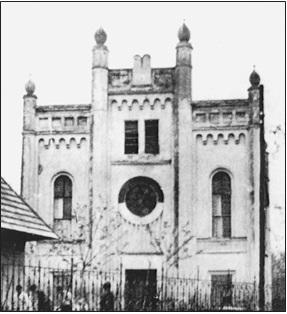
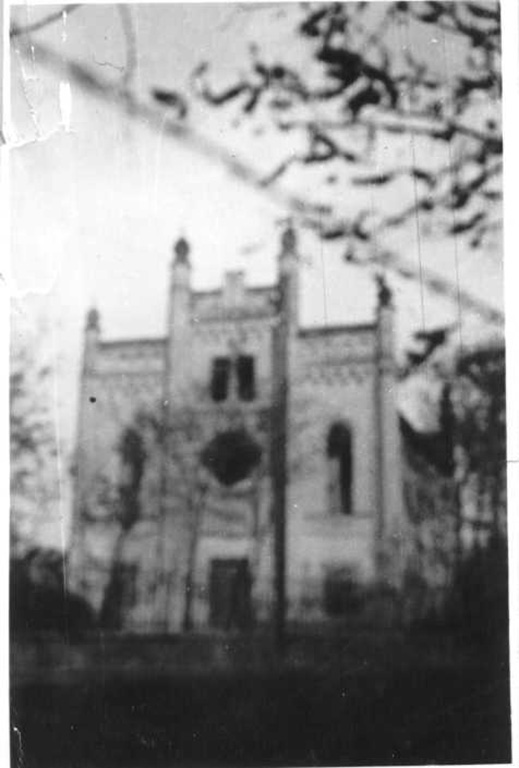
No record of the synagogue's construction was found. Two photographs survive. They show a two-storey rendered front in a simplified Moorish manner, divided by four slender turret-like pilasters with bulbous finials, and a large round window over the door. The author of the Tolna county local-history blog Régmúlt judged from the picture that it was built around the turn of the nineteenth and twentieth centuries; English Wikipedia's list of Hungarian synagogues says 'end of the 19th century (?)'.
No source read for this entry describes what happened to the Jews of Fadd in 1944. Gazda, who surveyed synagogue sites between 1980 and 1987, recorded the Fadd synagogue as demolished, with no date and no name. The Régmúlt blog says that after 1945 the synagogues of Tolna county places where too few Jews remained were sold with the permission of the national Jewish council, usually cheaply and for their building materials, but it gives no detail for Fadd. When the building came down and who demolished it are unknown.
Where it stood for nearly 90 years
Historic: Fadd, Tolna county; street and house number unknown. Today: possibly at the beginning of Béri Balogh Ádám liget, 7133 Fadd (tentative identification by a local historian from the Third Military Survey map); pin at the midpoint of that street (approximate).
Otwórz większą mapę →Społeczność żydowska
Gazda's table gives the only population figures found: 96 Jews in 1828, 112 in 1851, 123 in 1910 and 58 in 1941. The community therefore grew slowly through the nineteenth century, stood at a little over a hundred people when the synagogue was probably built, and had halved by the eve of the Holocaust. The earliest sign of organised communal life is the memorial book of the Fadd Chevra Kadisha, the burial society, whose title page is dated to the Hebrew year 5606, which the museum catalogue gives as 1846. Beyond that almost nothing is recorded. The Magyar Zsidó Lexikon of 1929 has no entry for Fadd, and the table of contents of Pinkas Hakehillot Hungary on JewishGen lists none either. The village's own history page does not mention Jews at all. The names of rabbis, teachers and community officers, the religious affiliation of the congregation and the rabbinate it belonged to are all unknown. The memorial book was given to the Jewish Museum in 1955 by the Jewish community of Szekszárd.
Architektura i projekt
Everything known about the building comes from two photographs of its entrance front. It was a rendered masonry building of two storeys, taller than the low village house beside it. The front was divided into three bays by four slender pilasters that rose above the roofline like small turrets, each ending in a bulbous, onion-shaped finial. The middle bay was the tallest and was closed by a stepped parapet with a raised block at its centre; the lower side bays had level parapets. A frieze of small round arches ran beneath all three parapets. In the middle bay a doorway at ground level was followed by a large round window in a heavy moulded frame and, above that, a pair of rectangular windows. Each side bay had one tall round-arched window at the upper level and a smaller opening below. An iron railing separated the forecourt from the street. The Régmúlt blog describes the design as a simplified version of the Moorish style typical of synagogues. The architect, builder, plan, capacity and interior are unknown, and no interior view was found.
Życie w synagodze
Very little can be said about how the synagogue was used. No source read names a rabbi, cantor or teacher of Fadd, and it is unknown whether the congregation followed the Orthodox, Neolog or Status Quo rite or kept a school. The one surviving object connected with its religious life is the manuscript memorial book of the burial society, now in the Hungarian Jewish Museum and Archives. Its Hebrew title page reads, in translation, 'Book for the remembrance of souls for all generations, made by the Chevra Kadisha of Fadd in the year 5606'. A book of this kind held the names of the community's dead. The tall arched windows at the upper level of the side bays suggest that the hall had a gallery, which in a synagogue of this period would have been for women, but that is an inference from the photographs and not a documented fact. The sharper of the two photographs shows several people standing at the railing in front of the building, the only glimpse found of the congregation's own time.
Zniszczenie
No source found records damage to the synagogue during the Second World War, and none describes its condition in or after 1944. Anikó Gazda, who surveyed Hungarian synagogue sites between 1980 and 1987, recorded the Fadd synagogue as demolished; she gives no date and names nobody. English Wikipedia's list of synagogues in Hungary says it was destroyed 'after 1945', without a source. The Régmúlt blog explains in general terms that after 1945 Jewish religious life in Tolna county resumed only in Bonyhád, Paks, Szekszárd and Dombóvár, that elsewhere too few believers remained to keep up the synagogues, and that the national Jewish council then allowed them to be sold, usually at low prices to buyers who wanted the building materials. It does not say that this is what happened in Fadd. An undated photograph in the Hungarian Jewish Museum and Archives shows the building still standing with its parapets and finials complete. Whether it was sold, when it was pulled down, and who pulled it down are unknown.
Los społeczności
Gazda records 58 Jews in Fadd in 1941. No source read for this entry says where they were held or how many were deported after Nazi Germany occupied Hungary on 19 March 1944. What is documented is the fate of the two nearest larger communities. In Tolna, the seat of the district to which Fadd belongs today, the local Hungarian authorities held about 400 Jews from the town and the surrounding area in three small ghettos, moved them to Paks on 29 June 1944, and from there they were deported to Auschwitz-Birkenau at the beginning of July. The Encyclopaedia Judaica says that the ghetto at Paks held 1,000 Jews, who were deported to Auschwitz on 4 to 6 July. It is likely, but not confirmed by anything read here, that the Jews of Fadd shared this route. How many survived or returned is unknown. No organised community is recorded in Fadd after the war, and by 1955 the burial society's memorial book was in the hands of the Jewish community of Szekszárd, which gave it to the Jewish Museum in Budapest.
Miejsce dzisiaj
The exact plot has not been established. The author of the Régmúlt blog, reading the map of the Third Military Survey, suggests that the synagogue may have stood at the beginning of what is now Béri Balogh Ádám liget, a street in Fadd, and presents this as a tentative reading. OpenStreetMap shows Béri Balogh Ádám liget as a residential street; what occupies the synagogue's plot today is unknown. No surviving fragment of the building and no marker on the site is recorded in the sources read. The map pin for this entry is placed at the midpoint of that street and is approximate. Confirming the plot will need a cadastral map or the village's own records.
Czy masz coś do przekazania?
Zdjęcia, dokumenty, historie rodzinne lub wspomnienia o tej synagodze i jej społeczności pomagają zachować jej historię.
- Zsinagógák és zsidó községek Magyarországon (Tolna county table)
- Faddi zsinagóga kívülről (photograph, inventory no. F70.137)
- A zsidó emlékek Tolna megyében. Bevezetés
- List of synagogues in Hungary (Tolna county, row 'Fadd Synagogue')
- Memorial to the Jewish Martyrs of the Holocaust (Tolna)
- Paks (Encyclopaedia Judaica)
- Magyar Zsidó Lexikon (1929), headwords 'Faciam Hungariam...' and 'Fái'
- Pinkas Hakehillot Hungary: table of contents
- Helytörténet (history of Fadd)
- Béri Balogh Ádám liget, Fadd (OpenStreetMap way 149931093)
Share a memory or thought
No comments yet. Be the first to add one.