
The story of Františkovy Lázně Synagogue
Františkovy Lázně, known in German as Franzensbad, is a spa town near Cheb (Eger) in the far west of Bohemia, founded as a spa in 1793. Jews could not settle there at first, but pedlars from nearby villages such as Steingrub (Lomnička) came for the season, and a kosher kitchen served Jewish visitors from about 1830. After the emancipation laws of 1848 and 1867 a few families settled for good, a religious association was founded in 1863 and an independent congregation in 1875.
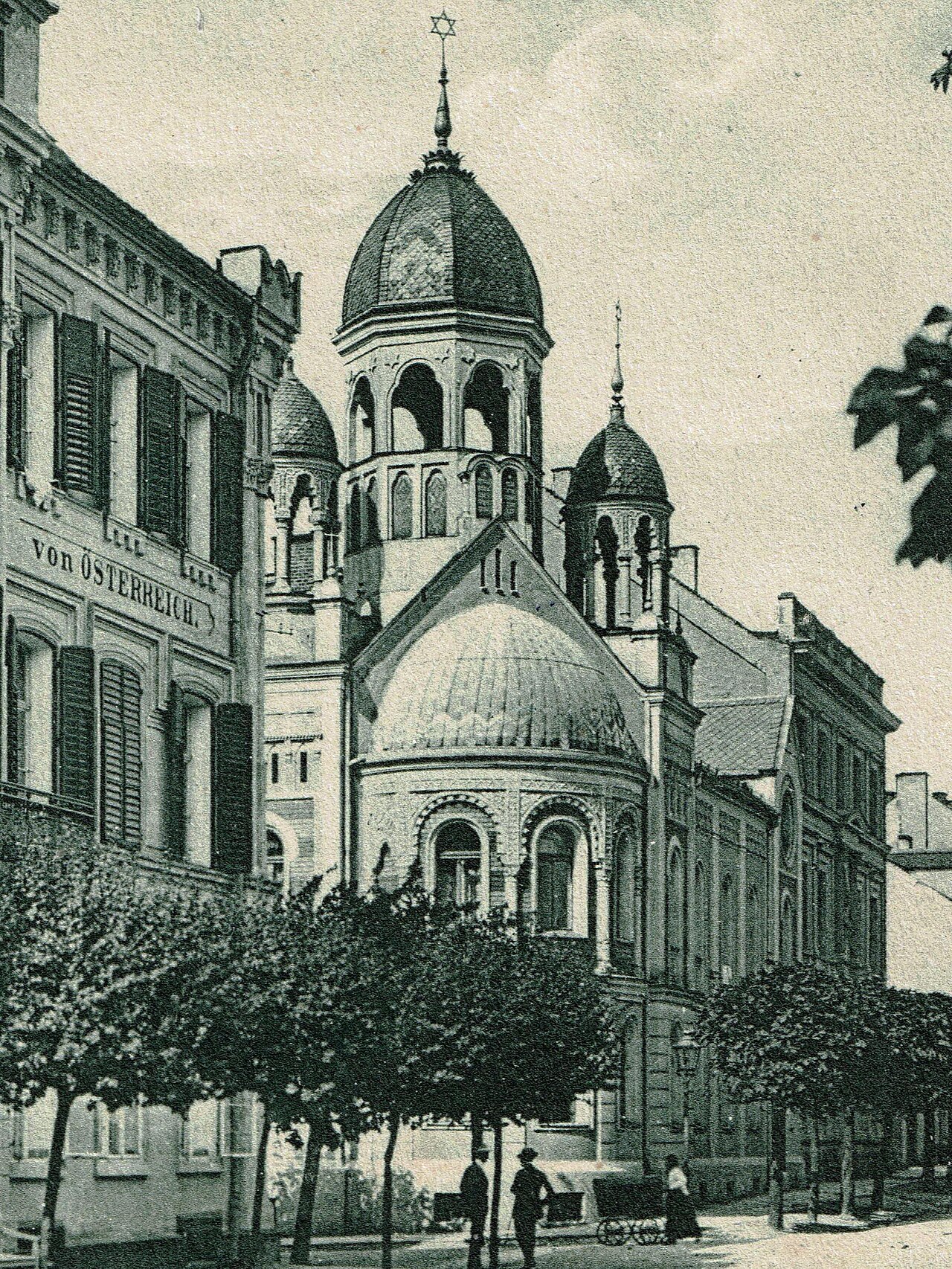
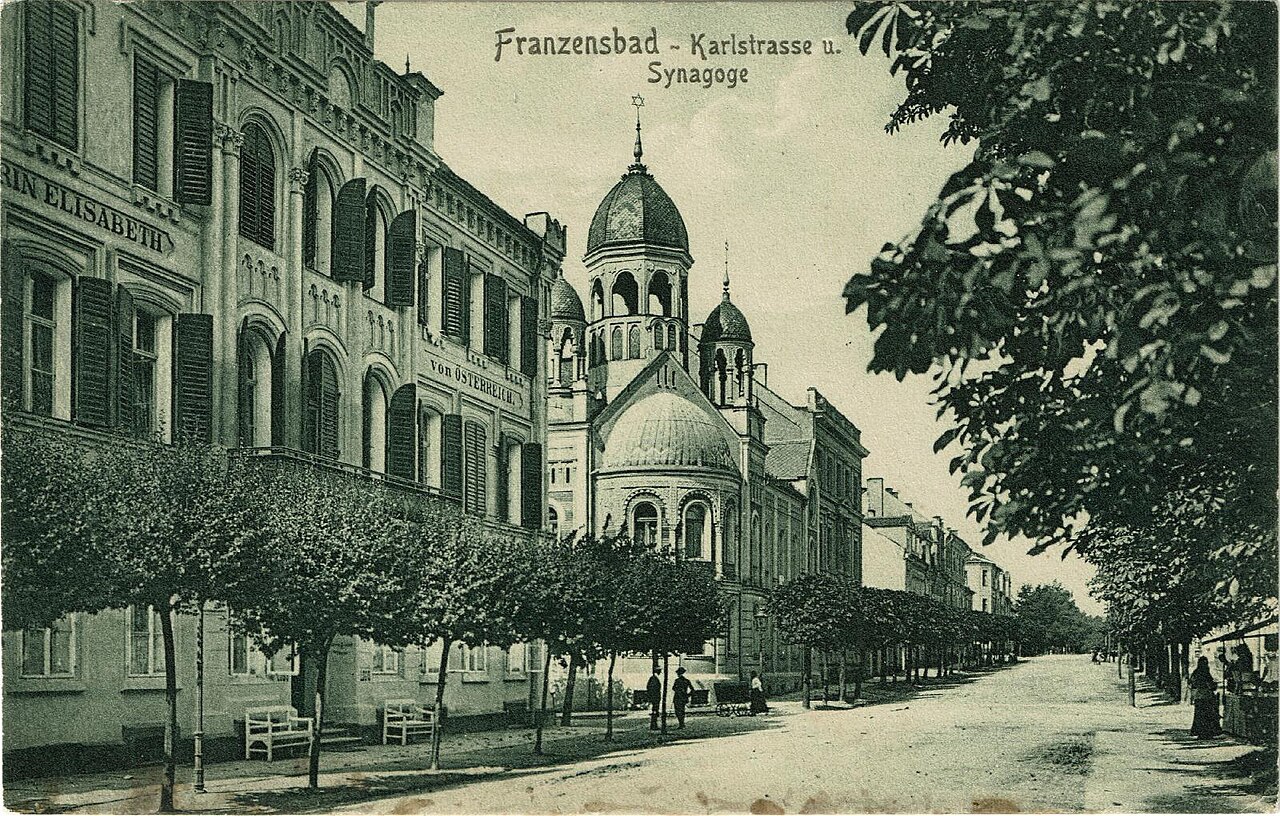
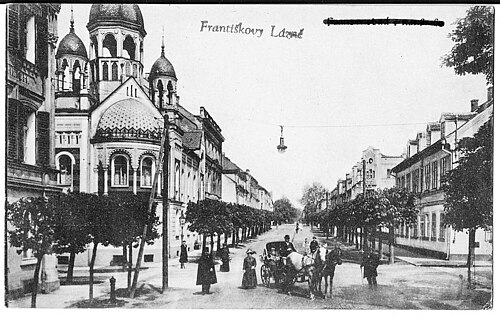
The synagogue was built between 1873 and 1875 on the town's main street, at the corner of what were then Karlstraße and Hönnlstraße, with money given by Jewish spa guests, by the town and by the emperor. With two towers and domes it was one of the most conspicuous buildings of the spa quarter, and it was consecrated in August 1877. A hospital for Jewish spa guests was later opened next door. After the annexation of the Sudetenland the synagogue and the hospital were wrecked and set alight during the November pogrom of 1938, and the ruin had been removed by 1944. Nothing of it remains at the corner of today's Americká and Francouzská streets.
Where it stood for nearly 70 years
Historic: corner of Karlstraße and Hönnlstraße, Franzensbad (on the former main street). Today: corner of Americká and Francouzská, 351 01 Františkovy Lázně, Karlovy Vary region (approximate).
Open larger map →The Jewish community
Jewish life in Franzensbad began as a seasonal presence. Jewish pedlars from the surrounding villages, among them Steingrub (Lomnička), stayed in the spa during the season from soon after its foundation but were not allowed to live there permanently. A kosher kitchen opened about 1830 and later also housed services. Permanent residence became possible after the laws of 1848 and 1867; the Adler family, who ran a hotel from 1865, and the physician Dr. Leopold Fellner were among the first to settle. A religious association was formed in 1863, a temporary prayer house opened in 1872, and the congregation became independent in 1875. In the 1870s it acquired a cemetery near Oberlohma. Physicians, many of whom ran spa houses, were its largest occupational group. Numbers stayed small: about 50 around 1870, 67 in 1880, 34 in 1900, 94 or 95 around 1911 to 1921 and 63 or 64 in 1930, with 15 more in the nearby village of Schlada. The few Jews still living in Steingrub were attached to the Franzensbad congregation.
Architecture and design
The synagogue was built between 1873 and 1875; the US Commission survey of 1992 names the architect as Wiedermann, and the Commons category for the Franzensbad builder Karl Wiedermann lists the synagogue among his works, while the Jüdische Gemeinden page names no architect. The sources describe it in different words, as oriental (German Wikipedia, after Alicke), Moorish (the 1992 survey) and Neo-Byzantine (Jüdische Gemeinden), but agree that it had two towers crowned with domes. It stood on the town's main street at the corner of Karlstraße and Hönnlstraße, north-west of the spa centre. Construction was paid for by donations from Jewish spa guests, a contribution from the town and a gift of 200 gulden from Emperor Franz Joseph. In 1898 a neighbouring building was opened as the Kaiser Franz Josef Jubilee Hospital for sick Jewish spa guests. The seating capacity, the interior arrangement and the building materials are unknown, and no plans or interior views were found.
Life inside the synagogue
The synagogue was consecrated on 12 August 1877 by Rabbi Dr. Plaut of Karlsbad, two years after the building was finished. For its first decades the small resident congregation had no rabbi of its own; the hotelier Philipp Adler acted as the official representative of the religious association. In 1889 Isaak Löwus came as cantor and ritual slaughterer, and in 1896 he became the community's first rabbi, serving until his death in 1904. Dr. David Spitzer, born in Vienna in 1874, was appointed rabbi in 1908 and led the congregation until 1938. Because Franzensbad was a spa, the synagogue was busiest in the summer season, when Jewish guests from across Central Europe came for the cure; their donations had helped build it, and from 1898 sick Jewish guests could be cared for in the hospital next door. No account of the order of services, the cantors after Löwus or the synagogue's ritual furnishings was found in the sources read.
Destruction
Most Jewish families had left Franzensbad before the Sudetenland was annexed by Nazi Germany in October 1938, and a local newspaper reported their departure that year. During the November pogrom of 1938 the synagogue and the adjoining Jewish hospital were wrecked and set on fire by a member of the town's fire brigade; the volunteer fire brigade only protected the neighbouring buildings. German Wikipedia, following Alicke's lexicon, states that the synagogue was destroyed by the Nazis in 1938, and the 1992 US Commission survey records that it was burned by the Nazis in 1938. The Jewish cemetery near Oberlohma was destroyed shortly afterwards, and Jewish property in the town was 'aryanised' in 1938 and 1939. The burned-out shell stood for several more years: according to Jüdische Gemeinden the ruin was removed by 1944, and the 1992 survey gives 1944 as the year of demolition. Who ordered or carried out the clearing of the ruin is not recorded in the sources consulted.
The community’s fate
By the outbreak of the Second World War only a few Jews remained in Franzensbad, most families having left in 1938 before or soon after the Nazi annexation. Those who stayed were deported soon afterwards by way of the Theresienstadt ghetto to the extermination sites 'in the East'. Their names, the number of Franzensbad Jews murdered, and the fates of Rabbi David Spitzer and of the families who had fled into the interior of Czechoslovakia are unknown from the sources read. After 1945 a short-lived Jewish congregation was organised with its seat in Aš, covering this corner of western Bohemia, but it came to an end as its members emigrated, many of them to Israel. The 1992 US Commission survey counted fewer than ten Jews in a town of about 5,000 people. The Jewish cemetery has no visible gravestones left.
The site today
The synagogue stood at the corner of today's Americká and Francouzská streets, north-west of the centre of Františkovy Lázně. No part of the building survives above ground, and no source consulted describes any later building on the plot. The Czech photographer Štěpán Bartoš included the site in his series 'Invisible synagogues', which photographs the empty places where demolished synagogues of Bohemia and Moravia once stood. A plaque recalling the synagogue was placed in 2003 on a building opposite the former site.
Notable names
David Spitzer
born 1874Rabbi of Franzensbad, 1908-1938Born in Vienna in 1874, Dr. David Spitzer was appointed rabbi of Franzensbad in 1908 and led the congregation for thirty years, until the annexation of the Sudetenland and the destruction of the synagogue in 1938. He was its rabbi through the First World War and the interwar years, when the resident community numbered about 60 to 100 people and the synagogue also served Jewish spa guests in season. His fate after 1938 was not found.
Biography or source →Isaak Löwus
died 1904Cantor and shochet from 1889; first rabbi of Franzensbad, 1896-1904Isaak Löwus came to Franzensbad in 1889 as cantor and ritual slaughterer for the congregation, which until then had no rabbi of its own. In 1896 he became the community's first rabbi and served in the synagogue until his death in 1904. His successor, David Spitzer, was appointed four years later. Nothing more about his origins or family was found in the sources read.
Biography or source →Philipp Adler
UnknownHotelier; official representative of the Franzensbad religious associationPhilipp Adler belonged to the Adler family, hoteliers in Franzensbad from 1865 and among the first Jews allowed to settle permanently in the spa. He served as the official representative of the Jewish religious association, which was founded in 1863 and built the synagogue in the 1870s with donations from spa guests, the town and the emperor. His dates and later life were not found.
Biography or source →Karl Wiedermann
UnknownArchitect (attributed)The 1992 US Commission survey names Wiedermann as the architect of the Franzensbad synagogue, built between 1873 and 1875, and the Wikimedia Commons category for Karl Wiedermann, a builder active in Franzensbad, lists the synagogue among his works together with the Hotel Imperial in the town. The Jüdische Gemeinden page names no architect, so the attribution should be checked in Alicke or Fiedler.
Biography or source →Do you have something to contribute?
Photographs, documents, family stories or memories of this synagogue and its community help keep its history alive.
- Synagoge (Franzensbad)
- Franzensbad (Böhmen)
- Františkovy Lázně (Cemetery Discovery Project, incl. US Commission survey CZCE0000332)
- Eger (Böhmen)
- Invisible synagogues: Czech photographer captures blank spaces where Jewish houses of worship once stood
- Category:Synagogue in Františkovy Lázně (Franzensbad)
- Category:Karl Wiedermann
- Americká (OpenStreetMap way 41951411)
Share a memory or thought
No comments yet. Be the first to add one.